

Phase 1: Empathy & Storytelling Opening
안녕하세요! 매일한글 (Daily Hangul) 에디터입니다.
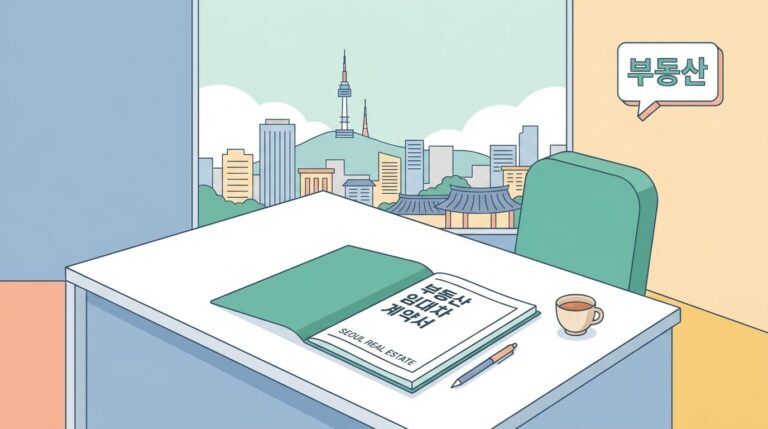
Imagine this classic K-Drama scene: You’ve just landed in Seoul, the neon signs of Hongdae are glowing in the cool evening drizzle, and you’re standing in a cozy, sunlit one-room (원룸) that looks straight out of Because This Is My First Life (이번 생은 처음이라). The realtor hands you a cup of instant mix coffee and places a thick, five-page document right in front of you. At the top, bold black letters read: 부동산 임대차 계약서 (Real Estate Lease Agreement). Suddenly, terms like 등기부등본 (certified copy of real estate register), 보증금 (deposit), and 특약사항 (special terms) start floating across your vision like abstract art. Your heart pounds—not from the romantic Seoul breeze, but from the fear of signing something you don’t fully understand.
Securing your own space in Korea is an incredible milestone, but navigating real estate contracts can feel overwhelming even for locals. If you are an intermediate learner (around B2 level), knowing basic conversational Korean isn’t enough when thousands of dollars in Jeonse or Wolse deposits are on the line. In this comprehensive guide, curated from ten years of navigating real estate in Korea alongside hundreds of international residents, we will break down the essential contract terminology, unwritten agency etiquette, and safety check strategies. By the end of this guide, you will sit across from any certified realtor (공인중개사) with total confidence and poise.
Phase 2: Deep Dive into 3 Core Expressions
1. 특약사항에 이 내용 추가해 주세요 (Teugyaksahang-e i naeyong chugahae juseyo)
- Pronunciation: [teuk-yak-sa-hang-e i nae-yong chu-ga-hae ju-se-yo] (Sounds like took-yahk-sah-hang-eh ee neh-yong choo-gah-heh joo-seh-yo)
- Literal vs. Real Meaning: Literally translates to “Please add this content to the special agreement section.” In reality, it means: “I want to make sure this specific agreement is legally documented so nobody can back out or charge me later.”
- K-Culture Moment: Seen frequently in slice-of-life dramas when a meticulous tenant insists that wallpaper replacement or boiler repair before move-in must be documented in writing before paying the down payment.
- Editor’s Insight: In Korean tenancy agreements, standard clauses are pre-printed, but the 특약사항 (Special Conditions) at the bottom is where the real negotiation lives. Anything not written in this box is considered verbal promise only, which holds very little weight in disputes.
- Situation Spectrum: Casual 🚫 | Semi-formal ⚠️ | Formal ✅ (Essential for official business)
- 🤔 Think About It: In many Western leases, tenant-landlord agreements are customized across the whole body of the contract. How does having a dedicated “Special Conditions” box reflect Korea’s balance between rigid standardized law and flexible personal negotiation?
2. 등기부등본상에 근저당권이 설정되어 있나요? (Deung-gibudeungbonsang-e geunjeodanggwon-i seoljeongdoe-eo innayo?)
- Pronunciation: [deung-gi-bu-deung-bon-sang-e geun-jeo-dang-gwon-i seol-jeong-doe-eo in-na-yo] (Think dung-gee-boo-dung-bon-sahng-eh goon-juh-dahng-gwon-ee sul-jung-dweh-uh een-nah-yo)
- Literal vs. Real Meaning: Literally, “Is a collateral mortgage set on the registry certificate?” Nuance: “Does the landlord owe serious debt on this property that could risk my deposit if the building goes to auction?”
- K-Culture Moment: In modern crime and mystery dramas involving housing fraud (전세사기), this exact phrase is used by lawyers and sharp tenants uncovering hidden debt burdens on an apartment.
- Editor’s Insight: 근저당권 (Collateral security/mortgage) indicates whether the bank has claims over the property. Asking this directly shows the realtor you know your legal rights and will not be taken advantage of.
- Situation Spectrum: Casual 🚫 | Semi-formal ⚠️ | Formal ✅ (Polite and precise legal inquiry)
- 🤔 Think About It: Why is financial transparency around property debt discussed so openly and early in Korean lease negotiations compared to private lease checks in your home country?
3. 전입신고랑 확정일자는 언제 받는 게 좋나요? (Jeon-ip-sin-go-rang hwakjeong-iljaneun eonje banneun ge jonnayo?)
- Pronunciation: [jeon-ip-shin-go-rang hwak-jeong-il-ja-neun eon-je ban-neun ge jon-na-yo] (Sounds like jun-eep-sheen-go-rahng hwahk-jung-eel-jah-noon un-jeh bahn-noon geh joh-nah-yo)
- Literal vs. Real Meaning: “When is it best to file the moving-in report and receive the fixed date stamp?” Nuance: “What is the exact timeline to secure legal priority protection (대항력) over my deposit against all other creditors?”
- K-Culture Moment: The moment an independent protagonist gets the keys to their studio apartment, rushes to the local Community Service Center (주민센터), and proudly holds up their stamped contract with a victory selfie.
- Editor’s Insight: These two administrative procedures are what activate your legal defense (대항력 and 우선변제권) under Korean Tenancy Protection Law. Doing this on the exact day you move in is crucial.
- Situation Spectrum: Casual ⚠️ | Semi-formal ✅ | Formal ✅
- 🤔 Think About It: How does tying civic residency registration (전입신고) directly to private deposit legal protection reflect Korea’s integrated administrative system?
Phase 3: Textbook Korean vs. Real Native Korean
Scenario 1: Requesting repairs before signing the lease
- 📖 교과서 한국어 (Textbook Korean): 집주인에게 보일러 수리를 요청해 주십시오. (Jipjuin-ege boilleo surireul yocheonghae jusipsio. – “Please request the landlord to repair the boiler.”)
- 🗣️ 진짜 한국어 (Real Native Korean): 입주 전까지 보일러 점검 및 수리해 주시는 조건으로 특약 넣어 주세요. (Ipju jeonkkaji boilleo jeomgeom mit surihae jusineun jogeoneuro teugyak neoeo juseyo. – “Please put a clause in the special terms stating the boiler will be inspected and repaired prior to move-in.”)
- 💡 왜 다를까? (Cultural Insight): Textbook phrasing relies on stiff imperative endings. Real-world negotiation uses conditional phrasing (~하는 조건으로) with specific lease jargon (특약 넣어 주세요) to ensure enforceable agreements without sounding aggressive.
Scenario 2: Asking if the registered owner is present
- 📖 교과서 한국어 (Textbook Korean): 소유자가 직접 여기에 왔습니까? (Soyujaga jikjeop yeogie watseumnikka? – “Did the property owner come here in person?”)
- 🗣️ 진짜 한국어 (Real Native Korean): 오늘 계약은 집주인분 본인이 직접 오신 건가요, 아니면 대리인 계약인가요? (Oneul gyeyageun jipjuinbun bonin-i jikjeop osin geon-gayo, animyeon daeri-in gyeyag-in-gayo? – “Is the owner here in person for today’s contract, or is it being signed via a proxy?”)
- 💡 왜 다를까? (Cultural Insight): Natural Korean uses polite honorific titles (집주인분) and clarifies agency (대리인 계약) softly through an A-or-B choice rather than a direct, interrogative inquiry.
Phase 4: K-Culture Deep Dive & Non-Verbal Manners
4-1. Nunchi (눈치) & Body Language at the Real Estate Office (부동산 공인중개사사무소)
- The Two-Hand Document Hold: When handed the 등기부등본 or contract draft, receive it with both hands, lightly placing both palms flat on the table edge while reading. Scanning with a pen hovering over lines shows serious diligence.
- The Thoughtful Pause (뜸 들이기): Never sign immediately after the agent finishes reading a paragraph. Take 5 to 10 seconds to read line by line. In Korean negotiation culture, pausing slightly communicates meticulous respect for the legal binding of the contract.
- Verifying Identity without Offense: When verifying the owner’s ID card (신분증) against the registry document, nod gently and say: “잠시 대조 확인만 하겠습니다” (I will just quickly cross-verify this). This prevents any awkwardness while maintaining strict vigilance.
4-2. Cultural Code: The Evolution of Housing Contracts in K-Drama
In classic K-Dramas of the early 2000s, moving into a rooftop room (옥탑방) often relied on warm, verbal promises between a quirky landlord and a struggling lead. However, contemporary K-Dramas (such as Work Later, Drink Now or My Liberation Notes) accurately reflect real-world modern Korean housing culture: hyper-cautious verification, escrow deposits, digital registry checks via government apps, and rigorous tenant rights awareness. Embracing this cultural shift means realizing that clear, meticulous boundary-setting in contract meetings is perceived as mature professionalism, not distrust.
Phase 5: Real-World Roleplay Scenario
Setting: Inside 행운공인중개사사무소 (Lucky Real Estate Agency) near Mapo Station. Clean glass desks, real estate maps covering the walls, and hot roasted barley tea on the desk.
Characters:
* Realtor (김 소장 – Agency Director Kim): Friendly, experienced, fast-paced.
* Tenant (Alex – B2 Korean Learner): Well-prepared, polite, yet thorough.
- Turn 1 (Kim): 앤디 씨, 마포 오피스텔 조건 마음에 드셨죠? 여기 임대차 계약서 초안 뽑아뒀습니다.
(Aendi ssi, Mapo opiseutel jogeon maeume deusyeotjyo? Yeogi imdaecha gyeyakseo cho-an ppobadwoesseumnida.)
“Andy, you liked the conditions of the Mapo officetel, right? I printed out the draft lease agreement here.”
🎭 Gesturing invitingly toward the paper with both hands while sliding a cup of tea over. -
Turn 2 (Alex): 네, 소장님. 계약서 작성 전에 등기부등본 오늘 날짜로 다시 확인해 볼 수 있을까요?
(Ne, sojangnim. Gyeyakseo jakseong jeone deung-gibudeungbon oneul naljjaro dasi hwaginhae bol su isseulkkayo?)
“Yes, Director. Before writing the contract, could we verify the registry certificate issued under today’s date?”
🎭 Leaning forward slightly with a polite smile, maintaining steady eye contact. -
Turn 3 (Kim): 아, 당연하죠! 방금 10분 전에 열람한 따끈따끈한 등본입니다. 여기 갑구, 을구 보세요.
(A, dangyeonhajyo! Banggeum sippun jeone yeollamhan ttakeunttakeunhan deungbonimnida. Yeogi gapgu, eulgu boseyo.)
“Ah, of course! This is fresh, viewed just 10 minutes ago. Look here at Section Gap and Section Eul.”
🎭 Pointing with a pen cap along the printed lines. -
Turn 4 (Alex): 을구에 근저당 설정이 안 되어 있어서 안심이네요. 그런데 특약사항 몇 가지만 넣어도 될까요?
(Eulgue geunjeodang seoljeong-i an doe-eo isseoseo ansim-ineyo. Geureonde teugyaksahang myeot gajiman neoeodo doelkkayo?)
“I’m relieved to see no collateral mortgage recorded in Section Eul. However, may I add a few special terms?”
🎭 Pointing gently to the blank notes section below. -
Turn 5 (Kim): 그럼요. 어떤 조건 생각하고 계세요? 집주인분께 바로 말씀드릴게요.
(Geureomyo. Eotteon jogeon saenggakhago gyeseyo? Jipjuinbun-kke baro malsseumdeurilgeyo.)
“Certainly. What conditions are you thinking of? I will convey them to the landlord right away.” -
Turn 6 (Alex): 잔금 지급 당일까지 현재 권리관계를 유지한다는 내용이랑, 옵션인 에어컨 수리 건을 명시하고 싶어요.
(Jangeum jigeup dang-ilkkaji hyeonjae gwon-gwan-gyereul yujihandaneun naeyong-irang, opsyeon-in eeokeon suri geoneul myeongsihago sipeoyo.)
“I want to state that the current legal title status must be maintained until the day of the remaining balance payment, and specify the repair of the included AC unit.”
🎭 Speaking calmly and clearly with structured points. -
Turn 7 (Kim): 역시 앤디 씨 꼼꼼하시네요! 그 문구는 제가 표준 특약으로 깔끔하게 적어 드리겠습니다.
(Yeoksi Aendi ssi kkomkkomhasineyo! Geu mungu-neun jega pyojun teugyageuro kkalkkeumhage jeogeo deurigesseumnida.)
“You are very thorough, Andy! I will neatly draft that clause using the standard special conditions wording.”
🎭 Nodding approvingly with a broad smile while typing on the computer. -
Turn 8 (Alex): 감사합니다. 특약 반영된 최종 계약서 확인하고 서명하겠습니다.
(Gamsahamnida. Teugyak banyeongdoen choejong gyeyakseo hwaginhago seomyeonghagesseumnida.)
“Thank you. I will sign after reviewing the final contract reflecting these special terms.”
🎭 Sitting upright and placing hands gently together in preparation for final review.
🔀 Interactive Choice Point
The landlord calls in saying they cannot come in person and sent their sibling with an ID card, asking you to sign right now.
- Option A: “괜찮습니다, 가족분이시니까 그냥 바로 계약서 작성하고 송금할게요!” (It’s fine, since you are family, I will write the contract and transfer money right now!)
- ❌ Feedback [Bad/High Risk]: In Korea, signing with a proxy without an official Power of Attorney (위임장) and an authorized Seal Certificate (인감증명서) leaves you legally unprotected if disputes occur.
- Option B: “대리 계약이시면 집주인 인감증명서 첨부된 위임장 확인하고, 계약금은 집주인 명의 계좌로 직접 송금하겠습니다.” (If this is a proxy contract, I will verify the power of attorney with the owner’s seal certificate, and wire the down payment directly to the owner’s name account.)
- 🌟 Feedback [Best Action]: Perfect! You ensure legal proof of agency and eliminate fraud risks by transferring funds strictly to the registered property owner’s bank account.
- Option C: “안 돼요. 무조건 집주인이 올 때까지 오늘 계약 취소하고 집에 가겠습니다.” (No way. I am canceling the contract today and going home until the owner comes unconditionally.)
- ⚠️ Feedback [Risk of Lost Deal]: While safe, abrupt walkouts without proposing standard proxy verification (위임장 확인) can needlessly burn bridges with the agency and forfeit a great home.
Phase 6: 10-Second Emotion Shadowing Drill
Practice reading these lines with natural flow, paying attention to the breath breaks marked by /.
[🧐 차분하고 신중하게 - Calm and cautious]- 등기부등본 / 갑구와 을구에 / 이상 없는지 / 꼼꼼하게 확인해 볼게요.
- (Deung-gibudeungbon / gapguwa eulgue / isang eomneunji / kkomkkomhage hwaginhae bolgeyo.)
- “Let me carefully verify / whether there are any abnormalities / in Section Gap and Section Eul of the registry.”
[💡 단호하고 당당하게 - Confident and firm]- 잔금 지급 시점까지 / 근저당 추가 설정을 하지 않는다는 / 특약을 꼭 넣어 주세요.
- (Jangeum jigeup sijeomkkaji / geunjeodang chuga seoljeong-eul haji anneundaneun / teugyageul kkok neoeo juseyo.)
- “Please make sure to include a special clause / stating that no additional mortgages will be placed / until the final balance payment.”
[😊 정중하고 상냥하게 - Polite and cordial]- 오늘 계약 끝나면 / 관할 주민센터 가서 / 바로 전입신고 접수하겠습니다.
- (Oneul gyeyak kkeutnamyeon / gwanhal juminsenteo gaseo / baro jeon-ipsin-go jeopsuhagesseumnida.)
- “Once we finish the contract today / I will head to the competent community center / and file the move-in report right away.”
Phase 7: K-Culture Mini Dictionary
- 등기부등본 (Deung-gi-bu-deung-bon) — Certified Real Estate Register Transcript
- Usage: The single most important official record in Korean real estate. It reveals who truly owns the property (갑구) and whether any bank debt, liens, or mortgages exist (을구).
- 확정일자 (Hwak-jeong-il-ja) — Fixed Date Stamp
- Usage: An official date stamp certified by the Community Center or Court Registry on your lease document. It legally establishes your priority claim over the deposit in case the building goes into public auction.
- 중개수수료 / 복비 (Jung-gae-su-su-ryo / Bok-bi) — Brokerage Commission Fee
- Usage: The statutory fee paid to the real estate agent upon contract completion. Calculated based on government statutory rate ceilings (법정 요율).
- 원상복구 의무 (Won-sang-bok-gu Ui-mu) — Duty of Restoration to Original State
- Usage: The tenant’s contractual obligation to restore the space to its original condition upon moving out, excluding natural wear and tear (자연 마모).
Phase 8: Survival Kit for Travelers & Expats
Top 3 On-the-Spot Survival Expressions
- “계약금 영수증 지금 바로 발급해 주실 수 있나요?” (Gyeyakgeum yeongsujeung jigeum baro balgeup-hae jusil su innayo?)
- Pro Tip: Always ask for an official stamped receipt immediately after wiring the initial 5-10% down payment (계약금).
- “관리비에 어떤 항목이 포함되어 있나요?” (Gwanribie eotteon hangmogi pohamdoe-eo innayo?)
- Pro Tip: Maintenance fees (관리비) vary wildly. Clarify if internet, water, or building cleaning are included.
- “이사 당일에 장기수선충당금 정산 부탁드립니다.” (Isa dang-ire jang-gisuseon-chungdanggeum jeongsan butakdeurimnida.)
- Pro Tip: If you live in an apartment/officetel, tenants pay this long-term repair reserve in the monthly bill, but the landlord owes this money back to you when you move out!
Editor’s Practical Tech Note
- Checking Real Estate Legitimacy Online: You can independently pull up a live property registry at any time using the 대한민국 법원 인터넷등기소 웹사이트 (Supreme Court Internet Registry Office) for under 1,000 KRW.
- Finding Your Neighborhood Office: Search your neighborhood branch using the 네이버 지도 앱 다운로드 (Naver Map Official App) to find your local 주민센터 (Community Service Center) for immediate moving-in filing (전입신고).
Phase 9: A Step Deeper (한 발 더 깊이)
In Korean society, a housing contract is not merely a dry commercial transaction; it is historically rooted in mutual community trust, known as 품앗이 (communal reciprocity) and 인정 (human affection). However, as metropolitan housing markets modernized rapidly, this cultural expectation of good faith evolved into rigorous institutional safeguards. The delicate linguistic balance in Korean lease negotiation—using maximum honorific humility (~해 주시면 감사하겠습니다) while insisting on uncompromising legal protection (특약 조항 명시)—reveals the duality of contemporary Korean society: deeply polite and harmonious in form, yet exceptionally precise and law-abiding in substance.
💬 Your Turn: How does the tenancy signing process in your country balance formal written clauses with verbal neighborly trust? Share your stories and questions in the comments below!
Phase 10: FAQ & Common Mistakes
Q: Can a foreign national receive “확정일자” (Fixed Date) and deposit protection in Korea?
A: Yes! Foreign residents who complete Alien Registration (외국인등록) and file a Change of Residence report (체류지 변경신고 / 전입신고) along with getting the 확정일자 stamp on their lease agreement enjoy equal legal protection under the Korean Housing Lease Protection Act (주택임대차보호법).
Q: Is it safe to transfer money into the realtor’s personal bank account?
A: Never transfer deposit funds or balance payments into an agent’s personal account. Payments must always be wired directly to the legal property owner’s bank account as identified on the 등기부등본.
Q: What should I do if the landlord promises verbal repairs during the room tour?
A: Always ask the realtor to insert it into the 특약사항 (Special Terms) box on the contract. A verbal promise like “I’ll change the wallpaper later” is extremely difficult to enforce once the contract is signed.
🚨 COMMON MISTAKES WARNING BOARD
────────────────────────────────────────────────────────────────────────
1. Mistake: Wiring the down payment before checking the registry on the day of signing.
   → Correct Action: Request a freshly pulled 등기부등본 issued on the exact date of signing.
2. Mistake: Neglecting to take timestamped photos of pre-existing room damage.
   → Correct Action: Take detailed photos and videos on move-in day and send them to the landlord/agent.
3. Mistake: Delaying the 전입신고 (Move-in report) until days after moving.
   → Correct Action: Visit the 주민센터 or use the online portal on the exact day of move-in.
────────────────────────────────────────────────────────────────────────
Phase 11: Action Mission & Engagement
- 🥉 Bronze Mission (Solo Practice): Read the Phase 6 Shadowing Drills aloud three times until you can articulate “특약사항에 추가해 주세요” smoothly without pausing.
- 🥈 Silver Mission (Social Sharing): Share this post with a friend or expat group planning to move to Korea, and write down two special terms you would demand in your dream Seoul apartment.
- 🥇 Gold Mission (Real-World Application): When touring your next apartment or speaking with a realtor, ask: “등기부등본 을구에 대출(근저당) 잡혀 있는 거 있나요?”
🎮 K-Culture Media Mission: Watch Episode 1 of the drama Because This Is My First Life (이번 생은 처음이라) or Monthly Magazine Home (월간 집) and spot the scenes where characters discuss 보증금 (deposits) and tenancy contracts!
Phase 12: Interactive Quiz Challenge
Test your real estate Korean mastery! Click the dropdowns below to reveal the answers.
1. Situation Judgment Quiz
You are signing a lease. The owner says: “I will pay off the bank mortgage with your deposit money next week, trust me.” What is your best response?
* (A) “네, 알겠습니다. 구두 약속 믿고 바로 계약할게요.”
* (B) “그 내용을 특약사항에 ‘잔금일 당일 대출 전액 상환 및 말소 조건’으로 명시해 주세요.”
* (C) “그럼 계약금만 먼저 드리고 계약서는 나중에 쓸게요.”
👉 Click to see the answer & explanation
Correct Answer: (B)
Explanation: Never rely on verbal promises (구두 약속). The condition that the mortgage must be repaid and canceled on the day the remaining balance is paid (잔금일 당일 대출 상환 및 말소) must be explicitly added to the 특약사항.
2. Fill-in-the-Blank Quiz
계약서 작성이 끝나면 관할 주민센터에 가서 ( )를 받아야 보증금을 법적으로 안전하게 보호받을 수 있습니다.
* Word Bank: [ 복비 / 확정일자 / 인감도장 ]
👉 Click to see the answer & explanation
Correct Answer: 확정일자 (Hwak-jeong-il-ja)
Explanation: Receiving the Fixed Date Stamp (확정일자) along with the move-in report (전입신고) grants the tenant legal priority repayment rights (우선변제권) under Korean law.
3. True or False Culture Quiz
True or False: In Korea, maintenance fees (관리비) automatically include all electricity and gas utility charges without exception.
👉 Click to see the answer & explanation
Correct Answer: False (X)
Explanation: In most Korean officetels and studios, 관리비 covers general building maintenance, cleaning, and sometimes water/internet. Electricity (전기세) and city gas (도시가스) are usually billed separately based on individual usage. Always clarify beforehand!







