

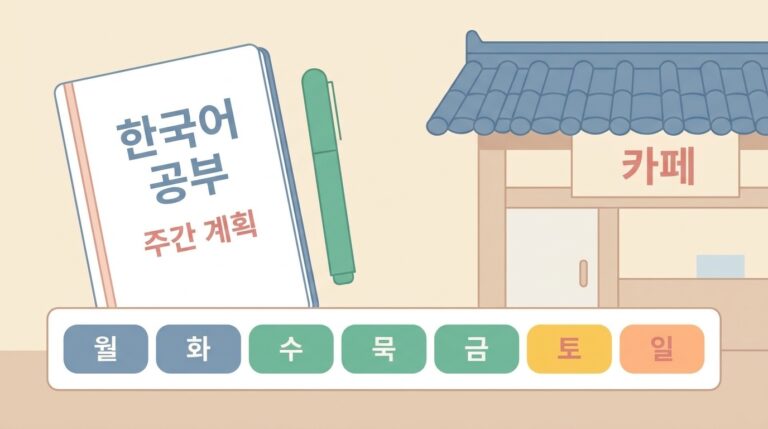
Weekdays vs Weekends in Korean: Master ‘Pyeong-il’ and ‘Jumal’ Without Confusion
Phase 1: Empathy & Storytelling
안녕하세요! I’m your Daily Hangul editor.
Imagine this: You are finally in Seoul, standing outside a trendy cafe in Seongsu-dong that you saved on Instagram months ago. The sign at the door says something about opening hours, but you only see confusing Korean characters. You try asking a friendly local waiting nearby, “Today open?” and they reply with a warm smile, “오늘은 평일이라서 일찍 닫아요 (Oneureun pyeong-il-iraseo iljjik dadayo).”
You freeze. Was that “weekday” or “weekend”? Are they closing early or opening late?
Distinguishing between weekdays and weekends in Korean—평일 (Pyeong-il) and 주말 (Jumal)—is one of the most common stumbling blocks for beginners. Whether you are trying to book a weekend pop-up store ticket, checking bus schedules, or making plans with a Korean friend, mixing up these two simple concepts can turn your dream travel itinerary upside down. Based on years of feedback from thousands of beginner learners just like you, this guide breaks down the core patterns so you will never second-guess your schedule in Korea again!
Phase 2: Top 3 Core Expressions Deep Dive
1. 평일 (Pyeong-il)
- Pronunciation: [Pyeong-il] (Sounds like “Py-ung” + “Eel”)
- Meaning: Literal: Flat/Ordinary day | Real Nuance: Weekday (Monday through Friday)
- K-Culture Moment: You will hear K-drama office workers in Business Proposal sighing on Monday morning: “평일 시작이다… (Pyeong-il sijagida… / The weekday grind begins…)”
- Editor’s Insight: ‘평’ (Pyeong) means flat or usual, and ‘일’ (Il) means day. Think of it as the normal, routine days of the week.
- Situation Spectrum: Casual: ✅ | Semi-formal: ✅ | Formal: ✅
- 🤔 Think About It: In English, we count days (week-days). In Korean, the root word represents “ordinariness.” How does your culture view the routine of the workweek?
2. 주말 (Jumal)
- Pronunciation: [Ju-mal] (Sounds like “Zoo” + “Mahl”)
- Meaning: Literal: Week-end | Real Nuance: Weekend (Saturday and Sunday)
- K-Culture Moment: Your favorite K-Pop idol ending their live broadcast on Friday night saying: “주말 잘 보내세요! (Jumal jal bonaeseyo! / Have a great weekend!)”
- Editor’s Insight: ‘주’ (Ju) means week, and ‘말’ (Mal) means end. It directly matches “weekend”!
- Situation Spectrum: Casual: ✅ | Semi-formal: ✅ | Formal: ✅
- 🤔 Think About It: Both Korean and English see Saturday and Sunday as the “end” of a weekly cycle. Isn’t it neat when two languages share the exact same logic?
3. 불금 (Bul-geum)
- Pronunciation: [Bul-geum] (Sounds like “Bool” + “Geum”)
- Meaning: Literal: Fire Friday | Real Nuance: TGIF / Friday Night Energy
- K-Culture Moment: Friends gathering around Korean BBQ in Hongdae clinking glasses of cider and yelling: “오늘은 불금이다! (Oneureun bulgeumida! / It’s Fire Friday!)”
- Editor’s Insight: A portmanteau of 불 (Bul – Fire) and 금요일 (Geum-yo-il – Friday). It’s the bridge between weekdays and the weekend!
- Situation Spectrum: Casual: ✅ | Semi-formal: ⚠️ | Formal: 🚫
- 🤔 Think About It: Why do Koreans call Friday “burning”? It represents burning up stress with friends after a long weekday grind.
Phase 3: Textbook Korean vs. Real Korean
Situation 1: Asking if a place is open on weekdays
- 📖 Textbook Korean: “월요일부터 금요일까지 영업합니까?” (Woryoilbuteo geumyyoilkkaji yeongeophabnikka? / Do you do business from Monday through Friday?)
- 🗣️ Real Korean: “평일에도 해요?” (Pyeong-ire-do haeyo? / Are you open on weekdays too?)
- 💡 Why is it different? Native speakers rarely list Monday through Friday out loud in daily life; they simply bundle them into 평일 (Pyeong-il) and use the versatile verb 하다 (hada – to do/open).
Situation 2: Asking someone about their weekend plans
- 📖 Textbook Korean: “주말에 무엇을 할 예정입니까?” (Jumare mueoseul hal yejeong-ibnikka? / What are you scheduled to do on the weekend?)
- 🗣️ Real Korean: “주말에 뭐 해요?” (Jumare mwo haeyo? / What are you doing this weekend?)
- 💡 Why is it different? Natural daily Korean cuts out stiff future tense formulas like “할 예정” in favor of simple present tense with future context.
Phase 4: K-Culture Deep Dive & Non-Verbal Manners
4-1. 눈치 (Nunchi) & Scheduling Etiquette
When asking Korean friends or colleagues about their 주말 (weekend) plans, avoid asking too aggressively on Monday morning. Friday afternoon is the prime golden window. When someone says “주말에 쉬어요 (I just rest on weekends),” matching their energy with a slight sympathetic nod and saying “푹 쉬세요 (Get plenty of rest)” shows high Nunchi (social awareness).
4-2. Cultural Code: The Rhythm of Seoul
Korean lifestyle is sharply divided between 평일 (weekdays) and 주말 (weekends):
* 평일 (Weekdays): Characterized by “Ppal-li Ppal-li” (quick, efficient) rush hours, affordable weekday lunch specials (Pyeong-il Teuk-seon), and quiet exhibition halls.
* 주말 (Weekends): Characterized by café hopping, outdoor Han River picnics, and pop-up store queues that can stretch around the block. Checking whether an event operates on 평일 or 주말 is the key to beating Seoul’s famous crowds!
Phase 5: Real-Life Roleplay Scenario
Setting: You are visiting a famous K-Beauty skincare clinic in Gangnam to book a facial appointment. The receptionist, Min-ji, greets you at the desk.
- 민지 (Min-ji): 안녕하세요! 예약 도와드릴까요? (Annyeonghaseyo! Yeyak dowadeurilkkayo? / Hello! May I help you with a reservation?)
- You: 네, 이번 주에 예약하고 싶어요. (Ne, ibeon jue yeyakhago sipeoyo. / Yes, I’d like to book this week.)
🎭 Hands clasped politely - 민지 (Min-ji): 평일에 오실 건가요, 주말에 오실 건가요? (Pyeong-ire osil geon-gayo, jumare osil geon-gayo? / Would you like to come on a weekday or on the weekend?)
- You: 평일이 더 한가해요? (Pyeong-iri deo hangahaeyo? / Are weekdays less busy?)
- 민지 (Min-ji): 네, 평일 낮 시간이 훨씬 여유로워요. (Ne, pyeong-il nat sigani hwolssin yeoyurowoyo. / Yes, weekday afternoons are much more relaxed.)
🎭 Smiling warmly and pointing at the tablet screen - You: 그럼 평일로 할게요! (Geureom pyeong-illo halgeyo! / Then I’ll go with a weekday!)
- 민지 (Min-ji): 목요일 오후 2시 어떠세요? (Mogyoil ohu dusi eotteoseyo? / How about Thursday at 2 PM?)
- You: 좋아요, 그때로 해주세요. (Joayo, geuttaero haejuseyo. / Sounds good, please set it for then.)
🔀 Interactive Choice Branch:
Min-ji asks: “주말은 예약이 꽉 찼는데, 평일 목요일 괜찮으세요?” (The weekend is fully booked, is weekday Thursday okay?)
- Option A: “네, 평일 목요일 좋아요!” (Ne, pyeong-il mogyoil joayo!)
- 👉 Feedback [Best]: Clear, polite, and natural! You confirmed both the weekday status and the specific day.
- Option B: “아니요, 주말만 돼요.” (Aniyo, jumalman dwaeyo.)
- 👉 Feedback [Risk]: Grammatically correct, but sounds a bit blunt to native ears. Adding “죄송하지만 (I am sorry, but…)” makes it much smoother.
- Option C: “불금 목요일 돼요?” (Bulgeum mogyoil dwaeyo?)
- 👉 Feedback [Bad]: “Bulgeum” is only for Friday! Using it for Thursday will confuse the receptionist.
Phase 6: 10-Second Emotion Shadowing Drill
Practice these lines with rhythm, pausing at /:
[😊 Relieved & Happy]- “드디어 / 주말이에요!” (Deudieo / jumarieyo! / Finally, it’s the weekend!)
[😩 A bit tired but cheerful]- “평일에는 / 너무 바빠요.” (Pyeong-ireneun / neomu bappayo. / On weekdays, I am so busy.)
[🎉 Hyped & Excited]- “오늘 불금인데 / 뭐 해요?” (Oneul bulgeuminde / mwo haeyo? / It’s TGIF today, what are you doing?)
Phase 7: K-Culture Mini Dictionary
- 평일 (Pyeong-il): Weekdays (Mon–Fri). Used in pricing tables: 평일 요금 (Weekday rate).
- 주말 (Jumal): Weekend (Sat–Sun). Used in business hours: 주말 휴무 (Closed on weekends).
- 공휴일 (Gong-hyu-il): Public / National Holiday. (e.g., Chuseok, Hangul Day).
- 연휴 (Yeon-hyu): Long holiday weekend (when holidays connect to normal weekends).
Phase 8: Traveler’s Survival Kit
Survival Expressions TOP 3
- 주말 요금이에요? (Jumal yogeum-ieyo?) – Is this the weekend rate?
- Pro Tip: Hotels and theme parks charge more on weekends. Use this to verify pricing.
- 평일 몇 시까지 해요? (Pyeong-il myeot sikkaji haeyo?) – Until what time are you open on weekdays?
- Pro Tip: Essential for museum and pop-up visits.
- 주말에는 예약 필수예요? (Jumareneun yeyak pilssuyeyo?) – Is a reservation required on weekends?
- Pro Tip: Popular restaurants in Hongdae or Seongsu often require weekend reservations.
Editor’s Travel Note
Always check local operating hours using a reliable mapping service rather than global apps that might be outdated in Korea. We strongly recommend completing the Naver Map app download before your trip to view accurate real-time weekday and weekend business hours.
Phase 9: A Step Deeper (Reflection)
In Korean society, the boundary between 평일 (weekday) and 주말 (weekend) represents not just calendar days, but a psychological reset. The collective devotion to “불금 (Burning Friday)” reveals how deeply Koreans value letting off steam together after rigorous workdays.
💬 Your Turn: Does your native culture celebrate Friday nights as enthusiastically as Korea’s “불금”? Share your favorite weekend routine in the comments below!
Phase 10: FAQ & Common Mistakes
Q: Can I use ‘불목’ (Fire Thursday) like ‘불금’?
A: Yes! Young Koreans sometimes say 불목 (Bul-mok) when taking Friday off or partying a day early.
Q: Does ‘주말’ include Friday evening?
A: Socially yes, but officially no. Friday day-time is strictly 평일 (Pyeong-il), while Friday evening kicks off the 불금 / 주말 mood.
Q: How do I say “every weekend”?
A: Add 마다 (mada): 주말마다 (Jumal-mada) means “every weekend.”
🚨 Common Mistakes Alert
- ❌ Mistake 1: Saying “주말일 (Jumal-il)”.
- ✔️ Correction: Just say 주말 (Jumal). Do not attach “일” at the end.
- ❌ Mistake 2: Pronouncing 평일 as “Pyeong-eel” with a hard gap.
- ✔️ Correction: Connect the sounds naturally as [Pyeong-il].
- ❌ Mistake 3: Assuming bank branches open on 주말.
- ✔️ Correction: Korean banks are strictly open on 평일 (Mon-Fri) only.
Phase 11: Action Missions
- 🥉 Bronze Mission (Solo Practice): Look at your calendar right now. Point to Wednesday and say “평일 (Pyeong-il)”, then point to Saturday and say “주말 (Jumal)” out loud 5 times.
- 🥈 Silver Mission (Social Challenge): Text a friend or study buddy: “주말 잘 보내세요! (Have a great weekend!)” this Friday.
- 🥇 Gold Mission (Real Life): Next time you enter a Korean cafe or restaurant, check their door sign and identify the words 평일 and 주말 on their schedule board.
🎮 K-Culture Mission: Watch any K-Drama episode and listen carefully for when a character says “주말에 만나요” (Let’s meet on the weekend).
Phase 12: Interactive Quiz Challenge
1. Situation Quiz: You want to ask your tutor if they have classes on Saturday and Sunday. Which word must you use?
* A) 평일 (Pyeong-il)
* B) 주말 (Jumal)
* C) 불금 (Bulgeum)
2. Fill in the Blank: “월요일은 [ ]이에요.” (Monday is a weekday.)
3. True or False: Banks in South Korea are normally open to the public on 주말.
👉 Click to view Answers & Explanations
- Answer: B) 주말 (Jumal) — Saturday and Sunday make up the weekend.
- Answer: 평일 (Pyeong-il) — Monday is part of the standard Monday–Friday workweek.
- Answer: False — Korean banks are open during 평일 (weekdays) from 9:00 AM to 4:00 PM and closed on 주말.






