

How to Politely Invite Elders to Eat in Korean: The Magic of ‘Jinji’
Phase 1: Empathy (Story-Driven Opening)
안녕하세요! (Annyeonghaseyo!) I am your friendly editor from Daily Hangul.
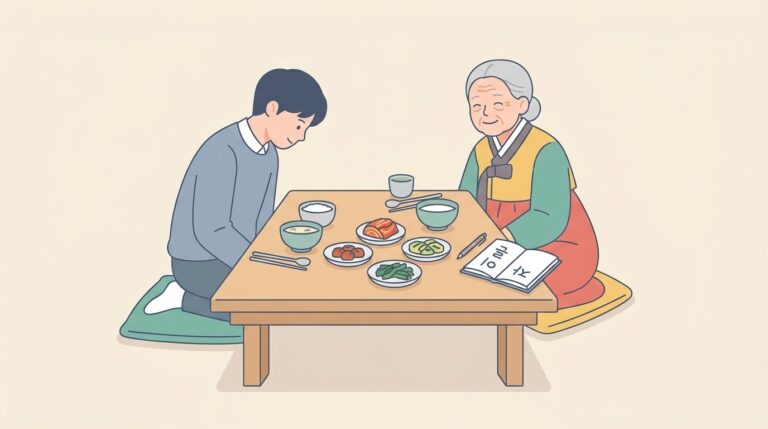
Picture this: You are invited to dinner at your Korean friend’s family home. The dining table is packed with steaming doenjang jjigae, crispy pajeon, and savory bulgogi. Everyone is waiting, and your friend’s grandmother sits at the head of the table. You want to be polite, smile warmly, and say: “Grandmother, please eat!” In standard polite Korean you learned from textbook apps, you might think of saying: “Halmeoni, bap meogeoyo!” or “Bap deuseyo!”
Suddenly, the room goes slightly quiet, and your friend gently nudges you. Why? In Korean culture, speaking to grandparents or senior elders requires a whole special set of honorific vocabulary, especially around mealtime! Saying bap (rice/meal) to an elder is okay in semi-casual settings, but the true golden word showing deep respect is 진지 (jinji), paired with 드시다 (deusida).
Don’t worry—you don’t have to be terrified of making dinner table blunders! With feedback gathered from hundreds of beginner learners just like you, this A2 guide will transform you into the most well-mannered guest any Korean family has ever met.
Phase 2: Top 3 Core Expressions Deep-Dive
1. 진지 잡수세요 / 진지 드세요 (Jinji japsuseyo / Jinji deuseyo)
- Pronunciation: Jin-ji deu-seh-yo (Sounds like: Gene-jee due-say-yo)
- Meaning: Literal: “Please partake of your honorable meal.” / Natural: “Grandmother / Grandfather, dinner is ready, please eat!”
- K-Culture Moment: Seen in warm family K-Dramas like Reply 1988 when the neighborhood kids call elders to the table before lifting a single spoon.
- Editor’s Insight: Jinji replaces bap (meal), and deuseyo replaces meogeoyo (eat). It creates the highest level of affectionate honorific respect for grandparents.
- Situation Spectrum: Casual 🚫 | Semi-formal ⚠️ | Formal & Elders ✅
- 🤔 Think About It: In English, we show respect through tone (“Would you care to join us for dinner, sir?”), but Korean changes the entire vocabulary noun and verb!
2. 식사하셨어요? (Siksahaseosseoyo?)
- Pronunciation: Sik-sa-ha-syeot-seo-yo (Sounds like: Seek-sah-hah-shyut-suh-yo)
- Meaning: Literal: “Did you have a meal?” / Natural: “Have you eaten yet? / How are you doing?”
- K-Culture Moment: Whenever junior colleagues meet senior managers in office dramas or when idols greet older staff backstage.
- Editor’s Insight: While Jinji is reserved for older elders (grandparents/seniors over 60), Siksa (식사) is the standard respectful word for bosses, teachers, and in-laws.
- Situation Spectrum: Casual 🚫 | Semi-formal ✅ | Formal ✅
- 🤔 Think About It: Asking if someone ate is the ultimate Korean way of showing you genuinely care about their well-being.
3. 맛있게 드세요 (Mas-itge deuseyo)
- Pronunciation: Mash-it-geh deu-seh-yo (Sounds like: Mah-sheet-geh due-say-yo)
- Meaning: Literal: “Please eat deliciously.” / Natural: “Enjoy your meal! / Bon appétit!”
- K-Culture Moment: Servers at traditional Korean restaurants setting down banchan with a bright, welcoming smile.
- Editor’s Insight: Say this right after an elder or host sits down and prepares their chopsticks. It spreads instant joy.
- Situation Spectrum: Casual ⚠️ | Semi-formal ✅ | Formal ✅
- 🤔 Think About It: It turns eating into a shared communal wish for happiness and great taste.
Phase 3: Textbook Korean vs. Real-World Korean
Situation 1: Calling grandparents to dinner
- 📖 Textbook Korean: 할머니, 밥 먹어요. (Halmeoni, bap meogeoyo. – “Grandma, eat rice.”)
- 🗣️ Real Korean: 할머니, 진지 드세요! (Halmeoni, jinji deuseyo! – “Grandmother, please have your meal!”)
- 💡 Why is it different? While grammatically polite (-yo ending), using plain bap (rice) and meokda (eat) directly to elders sounds blunt. Jinji elevates the meal itself as an act of honoring them.
Situation 2: Asking a boss or professor if they had lunch
- 📖 Textbook Korean: 밥 먹었어요? (Bap meogeosseoyo? – “Did you eat rice?”)
- 🗣️ Real Korean: 부장님, 식사하셨어요? (Bujangnim, siksa-hasyeosseoyo? – “Department Manager, have you had your meal?”)
- 💡 Why is it different? Siksa provides a polished, professional distance while showing warm social etiquette in workplace and everyday interactions.
Phase 4: K-Culture Deep-Dive & Non-Verbal Manners
4-1. 눈치 (Nunchi) & Table Body Language
- Wait for the first spoon: Never lift your chopsticks or spoon before the eldest person at the table takes their first bite.
- Two-Hand Rule: When passing a dish or pouring a drink for an elder, support your right forearm or wrist with your left hand.
- Slight Head Tilt: When saying “Jinji deuseyo”, bow your head slightly (about 15 degrees) with a soft smile.
4-2. Cultural Code: The Warmth of “Have You Eaten?”
Historically, Korea endured periods of poverty and famine, making a warm meal precious. Asking someone “Siksahaseosseoyo?” or telling an elder “Jinji deuseyo” is not just about calorie intake—it is an emotional check-in that says: “I care about your health, comfort, and peace today.”
Phase 5: Real-Life Roleplay Scenario
Setting: Minho’s home in Seoul. Minho’s grandmother (Halmeoni) has just placed a warm bowl of soup on the dining table.
- Minho (Friend): 할머니, 다 차렸어요? (Halmeoni, da charyeosseoyo?) [🎭 Helping place side dishes on the table] – “Grandma, is everything set?”
- Halmeoni (Grandmother): 그래, 어서들 와서 앉아라. (Geurae, eoseodeul waseo anj-ara.) [🎭 Sitting down gently at the head of the table] – “Yes dear, come sit down everyone.”
- You (Learner): 할머니, 진지 드세요! (Halmeoni, jinji deuseyo!) [🎭 Bowing head slightly with two hands placed politely on lap] – “Grandmother, please enjoy your meal!”
- Halmeoni: 아이고, 한국말을 참 예쁘게 하네! 어서 먹자. (Aigo, hangukmaleul cham yeppeuge hane! Eoseo meokja.) [🎭 Smiling with delighted eyes] – “Oh my, your Korean is so polite and lovely! Let’s eat.”
- You: 네, 맛있게 먹겠습니다! (Ne, mas-itge meokgetseumnida!) [🎭 Picking up spoon after Halmeoni takes her first bite] – “Thank you, I will eat well!”
- Halmeoni: 불고기 맛이 어떠니? (Bulgogi masi eotteoni?) [🎭 Offering you a piece of meat] – “How is the bulgogi?”
- You: 정말 맛있어요! 감사합니다. (Jeongmal mas-isseoyo! Gamsahamnida.) [🎭 Cheerful nod of appreciation] – “It’s really delicious! Thank you.”
- Minho: 우리 할머니 불고기 최고지? (Uri halmeoni bulgogi choegoji?) [🎭 Chuckling warmly] – “Isn’t my grandma’s bulgogi the best?”
🔀 Interactive Choice Point
Halmeoni offers to spoon extra soup into your bowl. What do you say?
* A. “할머니, 밥 더 줘!” (Halmeoni, bap deo jwo!)
* B. “감사합니다, 할머니! 정말 맛있어요.” (Gamsahamnida, halmeoni! Jeongmal mas-isseoyo.)
* C. “할머니도 밥 많이 먹어.” (Halmeoni-do bap mani meogeo.)
Feedback:
* Choice A: ❌ Bad. Bap deo jwo is casual slang used strictly between close kids or friends. It sounds disrespectful.
* Choice B: 🌟 Best! Polite, appreciative, and naturally shows warmth.
* Choice C: ⚠️ Risk. Telling an elder “Bap mani meogeo” uses informal speech (banmal). Never drop honorifics with grandparents!
Phase 6: 10-Second Emotion Shadowing Drill
Practice matching the exact rhythm and feeling:
[👵 With deep warmth and respect]
할머니, / 진지 / 드세요!
(Hal-meo-ni, / jin-ji / deu-seh-yo!)-
[✨ With bright gratitude before eating]
맛있게 / 잘 / 먹겠습니다!
(Ma-shit-geh / jal / meok-geht-seum-ni-da!) -
[💼 With professional politeness to a manager]
부장님, / 식사 / 맛있게 하셨어요?
(Bu-jang-nim, / sik-sa / ma-shit-geh ha-syeot-seo-yo?)
Phase 7: K-Culture Mini Dictionary
- 진지 (Jinji): Honorific noun for “meal/rice” specifically dedicated to elderly individuals and grandparents.
- 식사 (Siksa): Formal Sino-Korean noun for “meal”, ideal for workplace, seniors, and daily polite settings.
- 잘 먹겠습니다 (Jal meokgetseumnida): “I will eat well”—the indispensable Korean equivalent of Bon Appétit / Itadakimasu said before eating.
- 잘 먹었습니다 (Jal meogeotseumnida): “I have eaten well”—said right after finishing a meal to thank the cook or host.
Phase 8: Survival Kit for Travelers
Top 3 Food Survival Phrases
- 잘 먹겠습니다! (Jal meokgetseumnida!) – Say this aloud when your hot food arrives at any local restaurant.
- 메뉴판 주세요 (Menyupan juseyo) – “Please give me the menu.”
- 계산해 주세요 (Gyesanhae juseyo) – “Check please! / I would like to pay.”
Editor’s Travel Note
When traveling in South Korea, searching for highly rated local family restaurants is best done through Korean navigation tools rather than foreign apps. Be sure to check the Naver Map app on your phone to read authentic local reviews and check opening hours before visiting traditional dining spots!
Phase 9: A Step Deeper (Reflection)
In Western languages, respect is often expressed through indirect conditional clauses (“Would you mind…”). In Korean, honorifics mirror the social hierarchy and collectivist intimacy of the society. When you take the effort to say 진지 (Jinji) instead of 밥 (Bap), you are stepping directly into the Korean worldview—one where caring for elders is the highest virtue.
💬 Your Turn: Does your native language have special vocabulary words used exclusively when speaking to elders? Share your story in the comments below!
Phase 10: FAQ & Mistake Prevention
Q: Can I say “진지 드세요 (Jinji deuseyo)” to my company boss or father-in-law?
A: It is grammatically correct, but in modern Korea, Jinji is almost exclusively reserved for elderly grandparents (65-70+). For company bosses or fathers-in-law in their 40s to 50s, using “식사하세요 (Siksahaseyo)” or “맛있게 드세요 (Mas-itge deuseyo)” feels much more natural and contemporary.
Q: What is the difference between 드시다 (deusida) and 잡수시다 (japsusida)?
A: Both mean “to eat” in honorific form. 잡수시다 (Japsusida) is slightly older and more traditional, whereas 드시다 (Deusida) is the standard, universally loved modern honorific verb.
Q: What should I say right after an elder tells me to eat?
A: Bow your head politely and say: “네, 맛있게 먹겠습니다!” (Yes, I will eat well!).
🚨 Common Mistakes Alert
- Calling an elder’s meal Bap: Saying “Halmeoni bap meogeo” hurts ears! Always pair elders with Jinji and Deuseyo.
- Eating before elders: Never pick up your utensils first—wait until the oldest person takes their first spoon.
- Holding the bowl in the air: Unlike some Asian dining cultures, in Korea, rice bowls stay on the table while using spoons.
Phase 11: Action Missions
- 🥉 Bronze Mission: Stand in front of your mirror and practice saying: “할머니, 진지 드세요!” 5 times with a gentle head nod.
- 🥈 Silver Mission: Share this post on Instagram Story or Twitter and tag a friend who loves K-Dramas.
- 🥇 Gold Mission: Next time you visit a Korean restaurant, greet the kind elderly owner (Halmeoni / Emonim) with “맛있게 먹겠습니다!” with two hands.
- 🎮 K-Culture Mission: Watch an episode of a slice-of-life K-Drama (like Our Blues or Reply 1988) and spot how younger characters invite grandparents to eat.
Phase 12: Interactive Quiz Challenge
Question 1 (Situational): You are at your Korean friend’s house, and his 75-year-old grandfather enters the dining room. What is the most appropriate sentence to invite him to eat?
* A) 할아버지, 밥 먹어요! (Harabeoji, bap meogeoyo!)
* B) 할아버지, 진지 드세요! (Harabeoji, jinji deuseyo!)
* C) 할아버지, 밥 먹어! (Harabeoji, bap meogeo!)
🔍 Click to view the Answer & Explanation
Correct Answer: B) 할아버지, 진지 드세요!
Explanation: Grandparents belong to the elder generation where the special honorific noun 진지 (Jinji) and the honorific verb 드세요 (Deuseyo) should be used together.
Question 2 (Fill in the Blank): Fill in the missing honorific noun when speaking to grandparents:
“할머니, ______ 드세요!” (Grandmother, please have your meal!)
🔍 Click to view the Answer & Explanation
Correct Answer: 진지 (Jinji)
Explanation: 진지 is the dedicated honorific noun for rice/meal when addressing elders.
Question 3 (True / False): In Korean table manners, it is polite to pick up your spoon and start eating before the oldest person at the table.
🔍 Click to view the Answer & Explanation
Correct Answer: False
Explanation: You should always wait for the oldest person at the table to take their first bite before starting your meal.







