

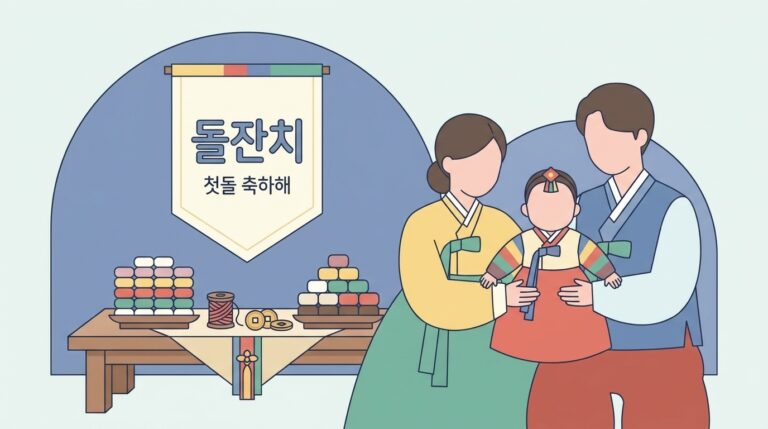
When the Birthday Baby Cries: Navigating a Korean Doljanchi with Confidence
Phase 1: Empathy & Storytelling
안녕하세요! 매일한글 에디터입니다. (Hello! This is your Daily Hangul Editor!)
Picture this: You are dressed smartly in a banquet hall in Seoul, sitting among Korean colleagues and friends to celebrate a baby’s first birthday—a sacred milestone known as 돌잔치 (Doljanchi). Traditional acoustic tunes play softly in the background, towers of colourful rice cakes stand tall, and the baby is dressed in an adorable, silk 한복 (Hanbok). The master of ceremonies grabs the microphone to start the legendary 돌잡이 (Doljabi) raffle ritual.
Suddenly, the spotlight glares, cameras flash, and the baby bursts into a full-lung, red-faced crying fit! The room suddenly quiets down. The parents look flustered, desperately waving squeaky toys. You feel a sudden wave of panic: Should I pretend not to see? Should I say something comforting? What if I say the wrong Korean phrase and make the parents feel even more embarrassed?
Don’t worry—you are not alone! Over our 10 years of coaching international learners, this exact high-pressure social scenario ranks among the top moments where learners freeze up. Today, we will transform that awkward silence into a warm, supportive cultural connection. By the end of this guide, you will know exactly what to say, how to manage your body language, and how to ease the mood like a true local.
Phase 2: Core Expressions Deep Dive
1. 아기가 낯을 가리나 봐요 (Agiga nacheul garina bwayo)
- Pronunciation: [Ah-gee-gah nah-cheul gah-ree-nah bwah-yo] (Sounds like “not-cheul” – similar to ‘nacho’ without the ‘o’)
- Meaning: Literal: “It seems the baby hides their face.” | Nuance: “The baby seems a bit shy around all these strangers / new faces.”
- K-Culture Moment: Commonly heard in variety shows like The Return of Superman (슈퍼맨이 돌아왔다) when a toddler meets guest uncles for the first time.
- Editor’s Insight: 낯을 가리다 (Nacheul garida) is the natural Korean expression for toddler stranger anxiety. Using this phrase reassures the parents that the crying is totally normal for a 1-year-old development stage, instantly relieving their guilt.
- Situation Spectrum: Casual (⚠️ 아기가 낯가리네) / Semi-formal (✅ 아기가 낯을 가리나 봐요) / Formal (✅ 아기가 낯을 가리는 것 같습니다)
- 🤔 Think About It: In English, we often say “Is the baby shy?”, but Korean focuses on “hiding the face (낯)”. How does focusing on the physical action reflect how Koreans observe child behaviour?
2. 옷이 불편해서 그럴 수도 있어요 (Osi bulpyeonhaeseo geureol sudo isseoyo)
- Pronunciation: [Oh-shee bool-pyeon-hae-seo geu-reol soo-doh eess-eo-yo]
- Meaning: Literal: “It could be like that because clothes are uncomfortable.” | Nuance: “It might just be that the traditional Hanbok is a bit scratchy or tight.”
- K-Culture Moment: In K-Dramas featuring family gatherings, an aunt usually steps in to adjust the baby’s traditional headpiece (돌띠 or 호건) while saying this line.
- Editor’s Insight: Traditional Hanbok fabrics (especially synthetic silk used for kids) can be stiff and hot under indoor lighting. Blaming the outfit is a polite face-saving tactic in Korean culture to deflect blame away from the parents or the baby’s temperament.
- Situation Spectrum: Casual (⚠️ 옷 불편해서 그래) / Semi-formal (✅ 옷이 불편해서 그럴 수도 있어요) / Formal (✅ 의상이 다소 불편하여 그럴 수 있습니다)
- 🤔 Think About It: Why is finding an external factor (like clothing) preferred over asking “Why is the baby crying?” in collectivistic social settings?
3. 울어도 너무 귀여워요! (Ureodo neomu gwiyeowoyo!)
- Pronunciation: [Oo-reo-doh neo-moo gwee-yeo-wo-yo!]
- Meaning: Literal: “Even crying, so cute!” | Nuance: “Even their crying face is absolutely adorable!”
- K-Culture Moment: Guests taking phone pictures during the birthday photo session and cheering for the flustered parents.
- Editor’s Insight: This is the ultimate mood-lifter. It validates that nobody in the room is annoyed by the noise and turns an embarrassing moment into an endearing memory.
- Situation Spectrum: Casual (✅ 울어도 귀여워) / Semi-formal (✅ 울어도 너무 귀여워요) / Formal (⚠️ 울어도 사랑스러우십니다)
- 🤔 Think About It: How does turning distress into cuteness reflect the communal affection Koreans have toward babies?
Phase 3: Textbook Korean vs. Real-Life Korean
Situation 1: Comforting the flustered mother
- 📖 교과서 한국어 (Textbook): 걱정하지 마십시오. 아기는 자주 웁니다. (Geokjeonghaji masipsio. Agineun jaju umnida. / Do not worry. Babies cry often.)
- 🗣️ 진짜 한국어 (Real Native): 아이고, 오늘 주인공이라 피곤한가 봐요! 천천히 하셔도 돼요. (Aigo, oneul juingong-ira pigonhan-ga bwayo! Cheoncheonhi hasyeodo dwaeyo. / Oh dear, they must be tired from being the star of the show today! Please take your time.)
- 💡 왜 다를까?: Textbook grammar sounds robotic and detached. Using affectionate words like 주인공 (main character/star) flatters the baby and encourages the parents to take a breath without feeling rushed.
Situation 2: Reacting when the baby refuses to pick a Doljabi item
- 📖 교과서 한국어 (Textbook): 아기가 물건을 선택하지 않습니다. (Agiga mulgeoneul seontaekhaji anseumnida. / The baby does not select an object.)
- 🗣️ 진짜 한국어 (Real Native): 다 갖고 싶어서 고민되나 봐요! (Da gatgo sipeoseo gomindoena bwayo! / They must want everything, so it’s hard to choose!)
- 💡 왜 다를까?: Instead of stating a dry fact, native speakers make a playful, auspicious joke that hints the baby is ambitious or blessed with great greed for success.
Phase 4: K-Culture Deep Dive & Non-Verbal Manners
4-1. 눈치 (Nunchi) & Polite Gestures
- Eye Contact & Smile: When the baby cries, avoid staring intensely with a worried or startled face. Give a warm, gentle smile, nod, and clap softly when the MC tries to soothe the child.
- Physical Boundary: Never rush forward to touch or pick up the crying baby unless the parents specifically ask for your help. The baby is already sensory-overloaded by 50+ guests.
- Body Angle: Lean back slightly in your chair to give the family physical breathing room on stage.
4-2. Cultural Insight: The Pressure of “Doljanchi”
In modern Korea, a Doljanchi is both a celebration of survival (historically marking that the infant survived the fragile first year) and a major social milestone for parents. Parents often spend months reserving venues, hiring photographers, and preparing gifts. When the baby melts down, parents experience immense social pressure. Your kind, calm reaction is the greatest gift of empathy you can provide.
Phase 5: Real-Life Roleplay Scenario
Setting: The banquet stage during Minjun’s 1st birthday party. Minjun starts weeping loudly as his mother, Sujin, tries to place the Doljabi tray in front of him.
- Sujin (Mom): 🎭 (Wiping sweat from her forehead, smiling apologetically) 아휴, 민준이가 갑자기 왜 이럴까요… 죄송해요, 여러분. (Ahyu, Minjun-iga gapjagi wae ireolkkayo… Joesonghaeyo, yeoreobun. / Oh dear, why is Minjun suddenly doing this… I’m so sorry, everyone.)
- You (Guest): 🎭 (Smiling warmly from your table, clapping lightly) 아이고, 수진 씨! 죄송하긴요. 아기가 오늘 주인공이라 긴장했나 봐요. (Aigo, Sujin ssi! Joesonghagin-yo. Agiga oneul juingong-ira ginjanghaenna bwayo. / Oh, Sujin! No need to apologize at all. He must be nervous because he’s the star of the show today.)
- Minho (Dad): 🎭 (Holding a rattle toy) 평소에는 잘 웃는데 오늘 사람이 많아서 낯을 가리네요. (Pyeongso-eneun jal unneunde oneul sarami manhaseo nacheul garineyo. / He usually smiles a lot, but he’s shy today with so many people around.)
- You (Guest): 🎭 (Nodding understandingly) 맞아요, 한복도 입어서 옷이 조금 불편할 수도 있어요. (Majayo, hanbokdo ibeoseo osi jogeum bulpyeonhal sudo isseoyo. / Exactly, wearing Hanbok might also feel a little unfamiliar and uncomfortable for him.)
- Sujin (Mom): 🎭 (Relieved sigh) 그래도 금방 그치겠죠? (Geuraedo geumbang geuchigetjyo? / He will stop crying soon, right?)
- You (Guest): 🎭 (Encouraging tone) 그럼요! 그리고 민준이는 울어도 너무 귀여워요. (Geureomyo! Geurigo Minjun-ineun ureodo neomu gwiyeowoyo. / Of course! And Minjun is so cute even when he cries.)
- MC (Host): 🎭 (Cheerfully into mic) 자, 우리 민준이에게 힘찬 응원의 박수 부탁드립니다! (Ja, uri Minjun-iege himchan eung-won-ui baksu butakdeurimnida! / Now, let’s give Minjun a big round of applause to cheer him up!)
- You (Guest): 🎭 (Clapping enthusiastically) 민준아, 화이팅! (Minjun-a, hwaiting! / Minjun, you can do it!)
🔀 Interactive Branching Point
What would you do if the baby continues crying for 5 more minutes?
* Option A: Shout “Don’t cry! (울지 마!)” loudly across the room to get the baby’s attention.
* ❌ Feedback (Bad): Shouting startles the baby more and puts harsh attention on the parents.
* Option B: Wave both hands, make a silly face, and run right onto the stage.
* ⚠️ Feedback (Risk): Unless you are the baby’s direct aunt or uncle, invading the stage disrupts the photographer and makes the atmosphere awkward.
* Option C: Calmly clap along with the MC’s rhythm, maintain a loving smile, and say: “천천히 해도 돼요! (Cheoncheonhi haedo dwaeyo! / Take your time!)”
* ✅ Feedback (Best): Pure Korean etiquette perfection! It creates a supportive, patient communal shield around the family.
Phase 6: 10-Second Emotional Shadowing Drill
[🥺 따뜻하고 안심시키듯이]아이고, / 죄송해하지 마세요! / 오늘 사람이 많아서 그래요. (Aigo, / joesong-he-haji maseyo! / Oneul sarami manhaseo geuraeyo.)[😊 다정하고 밝게]한복 입은 모습이 / 너무 예뻐요, / 울어도 귀여워요! (Hanbok ibeun moseubi / neomu yeppeoyo, / ureodo gwiyeowoyo!)[👏 활기차고 응원하며]천천히 해요! / 민준아 / 힘내라! (Cheoncheonhi haeyo! / Minjun-a / himnaera!)
Phase 7: K-Culture Mini Dictionary
- 돌잡이 (Doljabi): The highlight ritual of Doljanchi where the baby picks an item (thread for longevity, pencil for intellect, money for wealth, microphone for entertainment) predicting their future.
- 낯가림 (Natgarim): Stranger anxiety in infants. Used in daily conversation: “우리 아이가 낯가림이 심해요 (My child has severe stranger anxiety).”
- 돌반지 (Dolbanji): A 24K pure gold ring traditionally gifted by close relatives and friends wishing the baby health and prosperity.
- 금줄 (Geumjul): Traditional straw rope hung over doors after childbirth to ward off bad energy. While rarely hung today, its spirit of protecting pure infancy lives on in Doljanchi traditions.
Phase 8: Survival Kit for Travelers & Attendees
Top 3 Survival Phrases
- 축하드려요, 아기가 천사 같아요! (Chukha-deuryeoyo, agiga cheonsa gatayo!)
- Pro Tip: “Congratulations, the baby looks like an angel!” Perfect greeting when entering the venue.
- 사진 찍기 전에 잠깐 안아줘도 될까요? (Sajin jjikgi jeone jamkkan anajwodo doelkkayo?)
- Pro Tip: “May I hold the baby briefly before photos?” Only ask if you are close friends.
- 건강하게 자라렴! (Geon-ganghage jararyeom!)
- Pro Tip: “Grow up healthy!” Standard warm phrase to write inside the guestbook envelope.
Editor’s Travel Note
- Getting to the Venue: Banquets are often hosted in specialized buffet halls (뷔페) or hotel ballrooms. Save your location on the Naver Map app download for English navigation to find the correct banquet floor without getting lost.
- Cash Envelope Manners: Prepare crisp, clean KRW bills in a white envelope (축의금 봉투). Write your name vertically on the back left corner.
Phase 9: Think Deeper (한 발 더 깊이)
In Korea, there is a famous proverb: 아이 하나를 키우려면 온 마을이 필요하다 (It takes a whole village to raise a child). A Doljanchi is not just a private family party; it is a public covenant where the community pledges to watch over the new generation. When you comfort a crying baby with a warm gaze rather than annoyance, you become part of that Korean village.
💬 Your Turn: Have you ever experienced an awkward crying-baby moment in public? How would you handle it differently after reading this guide? Share your thoughts below!
Phase 10: FAQ & Common Mistakes
Q: What should I do if the baby starts crying right when we take the group photo?
A: Keep smiling! In modern Korea, a photo of a crying baby surrounded by smiling adults is considered a hilarious and treasured memory for the family album. Don’t stop smiling or look away.
Q: Is it rude to offer snacks or candy to soothe someone else’s baby?
A: Yes, always ask the parents first! Many Korean parents follow strict 12-month dietary rules (avoiding processed sugar, honey, or certain allergens).
Q: What is the appropriate gift amount (축의금) for a Doljanchi?
A: If you are an acquaintance or colleague, 50,000 to 100,000 KRW is standard. If you are very close, 100,000 to 200,000 KRW or a small gold ring (돌반지) is customary.
🚨 Common Mistakes Alert!
- ❌ Mistake 1: Saying “왜 울어요? (Why are you crying?)” loudly to the baby.
- 👉 Correct Action: Use reassuring phrases like “주인공이라 피곤한가 봐요 (They must be tired from being the star).”
- ❌ Mistake 2: Tapping your cutlery or glass to distract the baby.
- 👉 Correct Action: Clap gently with your hands or smile warmly.
- ❌ Mistake 3: Leaving your seat immediately when the baby gets fussy.
- 👉 Correct Action: Stay seated and follow the host’s lead; the fussiness usually subsides in a couple of minutes.
Phase 11: Action Mission & Engagement
- 🥉 Bronze Mission: Stand in front of a mirror and practice saying: “울어도 너무 귀여워요!” three times with a bright, welcoming smile.
- 🥈 Silver Mission: Watch a short clip of a Korean Doljabi on YouTube or Instagram Reels and comment in Korean: “아기가 너무 귀여워요!”
- 🥇 Gold Mission: Next time you see a flustered parent with a crying toddler on the subway or at a cafe in Korea, send them a gentle nod or whisper encouragingly to your friend: “낯을 가리나 봐요.”
🎮 K-Culture Mission: Find a Doljabi scene in a K-Drama (like Reply 1988 or Crash Landing on You) and spot which traditional item the baby reached for!
Phase 12: Interactive Quiz Challenge
Question 1 (Situational): The baby starts wailing right before grabbing an item during Doljabi. What is the most culturally polite reaction?
A) “아기가 시끄러워요.” (The baby is noisy.)
B) “옷이 불편해서 그럴 수도 있어요, 천천히 하세요!” (It might be the clothes, take your time!)
C) Stand up and leave the hall.
👉 Click to reveal Answer & Explanation
Correct Answer: B
Explanation: Blaming the stiff Hanbok clothing helps save face for both the parents and the child, bringing warm relief to the entire banquet hall.
Question 2 (Fill-in-the-Blank): Fill in the blank with the correct expression for infant stranger anxiety:
“아기가 오늘 사람이 많아서 [ ______ ]을/를 가리나 봐요.”
👉 Click to reveal Answer & Explanation
Correct Answer: 낯 (낯을 가리다 = to be shy around unfamiliar faces).
Question 3 (True/False): It is customary and recommended to rush to the stage and pick up a crying baby at a Doljanchi to help the parents.
👉 Click to reveal Answer & Explanation
Correct Answer: False (F)
Explanation: Unless you are an immediate family member, rushing to the stage intrudes on personal boundaries and disrupts the photo session. Warm clapping from your seat is the best etiquette!







