

Phase 1: 공감 (Story Immersion Opening)
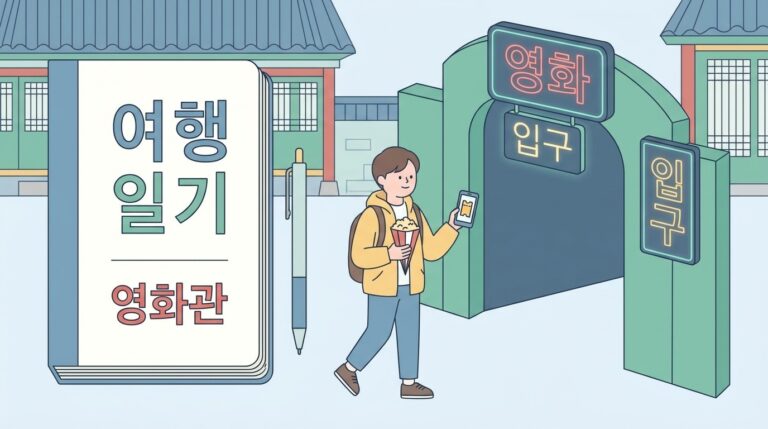
안녕하세요! 매일한글 에디터입니다. Have you ever stood in the bustling lobby of a multiplex cinema like CGV or Megabox in Seoul, holding a tub of sweet garlic popcorn, feeling your heart race as the clock ticks closer to showtime? You look up at the massive digital screens flashing floor numbers, theater hall numbers (관 – gwan), and colorful posters, but suddenly realize you don’t know which entrance gate leads to your specific screen. You hear the staff member calling out announcements with a headset, and panic strikes: “What if I walk into the wrong theater and sit in someone’s seat during the climax of a movie?!”
Take a deep breath! Entering a Korean movie theater (상영관 입장하기) is one of the most exciting everyday cultural adventures you can experience in Korea. With the rise of K-dramas and blockbuster Korean cinema, going to theaters here is a major social ritual. As a tutor who has helped hundreds of beginners navigate Korea’s ultra-modern lifestyle, I’ve designed this step-by-step survival guide to make your theater entrance 100% stress-free. By the end of this lesson, you’ll walk past ticket checks and slide into your seat like a true local.
Phase 2: 핵심 표현 3선 심층 분석 (Top 3 Core Expressions)
1. 몇 관이에요? (Myeot gwan-i-e-yo?)
- Pronunciation: [Myeot gwan-i-e-yo?] (Sounds like “Myut gwan-ee-eh-yo” – rhyme ‘gwan’ with ‘swan’)
- Meaning: Literal: “Which hall is it?” | Actual Nuance: “Which theater screen number should I head to?”
- K-Culture Moment: Seen in countless Korean date vlogs when couples check their printed ticket or smartphone screen outside the lobby.
- Editor’s Insight: Korean cinemas use the counter word 관 (gwan) for auditorium/hall numbers (e.g., 3관 = Hall 3, IMAX관 = IMAX Hall). If you’re lost, pointing at your mobile ticket and asking this simple question immediately gets you pointed in the right direction.
- Situation Spectrum: Casual ⚠️ | Semi-formal (Polite -yo) ✅ | Formal ⚠️
- 🤔 Think About It: In English, we often say “Which screen?” or “Theater 5.” Notice how Korean neatly attaches the counter unit 관 directly to numbers!
2. 어디로 들어가요? (Eodiro deureogayo?)
- Pronunciation: [Eo-di-ro deu-reo-ga-yo?] (Think: “Uh-dee-ro duh-ruh-gah-yo”)
- Meaning: Literal: “Where do I enter into?” | Actual Nuance: “Which way is the entrance?”
- K-Culture Moment: Used right after buying popcorn when you need to find whether your hall is upstairs on the 7th floor or straight ahead.
- Editor’s Insight: The particle -로/-으로 (ro/euro) indicates direction (“toward”). This phrase is your golden Swiss-Army-knife question everywhere in Korea—subway stations, malls, and concert venues!
- Situation Spectrum: Casual ⚠️ | Semi-formal ✅ | Formal ✅
- 🤔 Think About It: How does asking for direction of movement (-로) feel different from just asking “Where is it?” (어디예요?) in your native tongue?
3. 표 보여드릴게요. (Pyo boyeodeurilgeyo.)
- Pronunciation: [Pyo bo-yeo-deu-ril-ge-yo.] (Sounds like “Pyo bo-yuh-doo-ril-geh-yo”)
- Meaning: Literal: “I will show you the ticket.” | Actual Nuance: “Here is my ticket / Let me show you my mobile screen.”
- K-Culture Moment: That courteous moment at the gate when staff (미소지기/크루) greet you before you scan your QR barcode.
- Editor’s Insight: 드리다 (deurida) is the humble honorific form of ‘to give/show’ (주다). Using 보여드릴게요 shows great politeness and effortless Korean manners to service staff.
- Situation Spectrum: Casual 🚫 | Semi-formal ✅ | Formal ✅
- 🤔 Think About It: Korean culture places high value on polite service interactions using humble verbs. It instantly creates a warm, welcoming vibe!
Phase 3: 교과서 한국어 vs 진짜 한국어 (Textbook vs. Real-Life Korean)
Situation 1: Asking if admission has started
- 📖 교과서 한국어 (Textbook): 지금 상영관에 들어갈 수 있습니까? (Jigeum sang-yeong-gwane deureogal su itseumnikka? – “May I enter the screening hall now?”)
- 🗣️ 진짜 한국어 (Real-life): 지금 들어가도 돼요? (Jigeum deureogado dwaeyo? – “Can I go in now?”)
- 💡 왜 다를까? (Why the difference?): While the textbook phrase is grammatically immaculate, native speakers prefer the breezy, natural permission pattern -아/어도 돼요? in fast-moving theater lobbies.
Situation 2: Asking where your seat row is
- 📖 교과서 한국어 (Textbook): 저의 좌석 위치를 가르쳐 주십시오. (Jeoui jwaseok wichireul gareuchyeo jusipsio. – “Please teach me my seat position.”)
- 🗣️ 진짜 한국어 (Real-life): H열이 어디예요? (H-yeori eodiyeyo? – “Where is row H?”)
- 💡 왜 다를까? (Why the difference?): In Korea, theater seats are labeled with English alphabet letters for rows (열 – yeol) and numbers for seat numbers (번 – beon). Stating the row letter directly gets you an instant answer.
Phase 4: K-Culture 딥다이브 & 비언어적 매너 (Culture Deep Dive & Manners)
4-1. 눈치 (Nunchi) & Entrance Etiquette
- The 10-Minute Commercial Window: In Korean multiplexes (CGV, Lotte Cinema, Megabox), the scheduled movie time on your ticket is actually when 10 minutes of previews and advertisements begin. If your ticket says 14:00, the main feature actually starts at 14:10! You don’t need to panic if you are walking to the hall at 14:02.
- Smart Ticket Check: Most Korean theaters operate on “Smart Check-in” or autonomous entry. Staff might simply stand by the gate and say “Have a nice movie!” (즐거운 관람 되세요! – Jeulgeoun gwallam doeseyo!). You just hold up your phone screen slightly towards them with a quick nod.
- Silent Mode Etiquette: Turn your phone to silent mode (무음 모드) before passing the ticket gates. Using glowing screens during a movie in Korea is considered a major breach of etiquette (비매너).
4-2. Cinema Culture Code: The Snack Culture
Going to a movie in Korea isn’t just about watching a film; it’s a food experience! Try seasonal flavors like 반반 팝콘 (ban-ban pap-kon – half caramel, half sweet garlic) or grilled dried squid (버터구이 오징어). People comfortably bring their snacks inside before checking into the hall.
Phase 5: 실전 롤플레이 시나리오 (Real-Life Roleplay Scenario)
Setting: Outside the entrance gate of CGV Hongdae on the 8th floor. You hold a bag of popcorn and your mobile booking confirmation.
Characters: You (learning Korean) & Min-su (Theater Staff wearing a headset).
- Turn 1 (Staff): 안녕하세요! 예매 확인 도와드릴게요. (Annyeonghaseyo! Yemae hwag-in dowadeurilgeyo. – Hello! I will help check your reservation.)
🎭 Smiling and holding a barcode scanner - Turn 2 (You): 네, 여기 모바일 티켓 보여드릴게요. (Ne, yeogi mobail tiket boyeodeurilgeyo. – Yes, I’ll show you my mobile ticket here.)
🎭 Showing your smartphone screen - Turn 3 (Staff): 네, 5관이고요. 지금 바로 입장 가능하세요. (Ne, o-gwan-igoyo. Jigeum baro ipjang ganeunghaseyo. – Okay, it’s Hall 5. You can enter right now.)
🎭 Checking the screen and pointing inside - Turn 4 (You): 5관은 어디로 들어가요? (O-gwaneun eodiro deureogayo? – Where do I enter for Hall 5?)
🎭 Looking down the hallway - Turn 5 (Staff): 안쪽 복도 끝에서 오른쪽으로 가시면 돼요. (Anjjok bokdo kkeuteseo oreunjjogeuro gasimyeon dwaeyo. – Go to the end of the inner hallway and turn right.)
🎭 Pointing along the corridor - Turn 6 (You): 감사합니다! 혹시 화장실은 안에 있나요? (Gamsahamnida! Hoksi hwajangsil-eun ane innayo? – Thank you! By any chance, is the restroom inside?)
🎭 Inquiring politely - Turn 7 (Staff): 네, 5관 입구 바로 옆에 있습니다. (Ne, o-gwan ipgu baro yeope itseumnida. – Yes, it is right next to the entrance of Hall 5.)
🎭 Giving a clear nod - Turn 8 (You): 네, 알겠습니다. 수고하세요! (Ne, algetseumnida. Sugohaseyo! – Got it. Thank you for your work!)
🎭 Giving a light bow and walking in
🔀 Interactive Choice Point
You are entering Hall 5, but the lights are already dim and you can’t find your seat (Row G, Seat 12). What do you say to the usher standing inside?
- Choice A: “야! 내 자리 어디야?” (Ya! Nae jari eodiya?)
- Choice B: “저기요, G열 12번 자리 어디예요?” (Jeogiyo, G-yeol sib-i-beon jari eodiyeyo?)
- Choice C: “자리 없어요!” (Jari eopseoyo!)
Outcome Feedback:
* Choice A (Bad): 🚫 Extremely impolite! “야” is informal slang only used with very close friends or peers.
* Choice B (Best): ✅ Perfect! “저기요” grabs polite attention, and specifying row and seat number gets you guided immediately.
* Choice C (Risk): ⚠️ This means “There are no seats!” which causes confusion when you are just searching for your assigned spot.
Phase 6: 10초 감정 섀도잉 드릴 (10-Second Emotion Shadowing Drill)
Practice reading out loud with natural intonation, pauses (/), and matching emotions!
[😊 Politeness & Readiness]- Sentence: 모바일 티켓 / 보여드릴게요. (Mo-ba-il ti-ket / bo-yeo-deu-ril-ge-yo.)
- Tip: Keep the pitch steady on ‘티켓’ and gently lower it at the end of ‘드릴게요.’
[🤔 Curious & Inquiring]- Sentence: 실례지만, / 4관은 / 어디로 들어가요? (Sil-lye-ji-man, / sa-gwa-neun / eo-di-ro deu-reo-ga-yo?)
- Tip: Raise your intonation slightly at ‘들어가요?’ to make it sound friendly and inquisitive.
[🎬 Excited & Rushing]- Sentence: 영화 / 곧 시작하니까 / 빨리 들어가자! (Yeong-hwa / got si-jak-ha-ni-kka / ppal-li deu-reo-ga-ja!)
- Tip: Said to a friend! Put energy into ‘빨리’ (hurry) with a playful tone.
Phase 7: K-Culture 미니 사전 (Mini Dictionary)
- 상영관 (Sang-yeong-gwan) | Cinema screening auditorium / Hall
- Usage: The physical theater room where the film is projected. (e.g., 상영관 안에서는 조용히 해주세요 – Please be quiet inside the theater hall).
- 모바일 티켓 (Mo-ba-il Ti-ket) | Mobile e-ticket
- Usage: 95% of Koreans show their smartphone app barcode instead of paper tickets.
- 좌석 번호 (Jwa-seok Beon-ho) | Seat number
- Usage: Combination of Alphabet row and number, such as E-14 (E열 14번).
- 콤보 세트 (Kom-bo Se-teu) | Cinema snack combo
- Usage: Standard cinema combo meal containing popcorn and fountain sodas.
Phase 8: 여행자를 위한 생존 키트 (Traveler’s Survival Kit)
Survival Expressions TOP 3
- 화장실 어디예요? (Hwajangsil eodiyeyo? – Where is the restroom?)
- Pro Tip: Always go before walking into your screening hall; halls are massive and stairs can be steep in the dark!
- 몇 층이에요? (Myeot cheung-i-e-yo? – Which floor is it on?)
- Pro Tip: Multiplexes in Korea often span 3 to 4 department store floors. Always confirm your hall’s floor level.
- 물 하나 주세요. (Mul hana juseyo. – Please give me one bottle of water.)
- Pro Tip: Popcorn can be salty! Grab bottled water at the concession counter before queueing at the gate.
Editor’s Travel Note
- If you plan to watch films in Korea, download the official multiplex booking apps such as the CGV Cinema App on Google Play or the Megabox Korea App. You can easily check English subtitle availability for Korean films at major film festivals or flagship theaters (like CGV Yongsan I-Park Mall).
Phase 9: “한 발 더 깊이” (Cultural Reflection)
Korean cinema culture is a harmonious blend of ultra-fast technology and deep collective consideration (배려 – baeryeo). When entering a darkened hall, you will notice people bowing slightly when squeezing past seats and shielding their phone screens downwards so the glare doesn’t disturb others. This subtle social antenna shows that enjoying public entertainment in Korea is rooted in mutual respect for everyone’s cinematic experience.
💬 Your Turn: Have you ever watched a movie in another country? How does the entrance process compare to your hometown? Let me know in the comments below!
Phase 10: FAQ & 흔한 실수 (FAQ & Common Mistakes)
Q: Do I need to print out a physical paper ticket if I booked online?
A: No! In almost all modern Korean theaters (CGV, Megabox, Lotte Cinema), simply opening your mobile app booking screen or barcode image is completely sufficient.
Q: What if I arrive 5 minutes past the start time on my ticket?
A: You will not miss the movie! In Korea, advertisements and safety announcements run for the first 10 minutes past the scheduled start time.
Q: Can I bring outside food and drinks into Korean movie theaters?
A: Yes! Since 2008, Korean regulations allow outside food inside theaters, provided it does not have strong odors (like hot soup or raw fish) that bother other viewers.
🚨 흔한 실수 (Common Mistakes TOP 3)
- Mistake: Confusing 층 (cheung – floor) and 관 (gwan – theater hall number).
- Correct Action: If your ticket says “7층 3관”, go to the 7th floor first, then search for Hall 3.
- Mistake: Looking for seat rows from the bottom of the alphabet.
- Correct Action: Row A is closest to the screen (front row), while rows H, I, J are in the prime middle/upper section.
- Mistake: Speaking in high volume while entering during trailers.
- Correct Action: Lower your voice to a whisper (귓속말) as soon as you push past the heavy soundproof curtains.
Phase 11: 액션 미션 & 참여 유도 (Action Missions)
- 🥉 Bronze Mission (Self Practice): Say “어디로 들어가요?” three times out loud in front of a mirror with a natural smile.
- 🥈 Silver Mission (Social Share): Post your favorite Korean film on social media using the caption: “한국 영화관 가고 싶어요!” (I want to go to a Korean cinema!).
- 🥇 Gold Mission (Real Life): When visiting Korea, ask a theater crew member “지금 들어가도 돼요?” and enter your movie smoothly without speaking English!
- 🎮 K-Culture Mission: Watch a contemporary K-Drama date scene (like in Business Proposal or Crash Landing on You) and spot how characters show their tickets at the cinema.
Phase 12: 인터랙티브 퀴즈 챌린지 (Interactive Quiz Challenge)
1. Situation Quiz: You want to politely tell the theater staff member that you will show your ticket. Which sentence is best?
* A) 표 줘 (Pyo jwo)
* B) 표 보여드릴게요 (Pyo boyeodeurilgeyo)
* C) 표 없어요 (Pyo eopseoyo)
2. Fill-in-the-Blank: Complete the sentence to ask: “Where do I enter?”
* “어디____ 들어가요?” (Fill in the direction particle)
3. True or False: In Korea, if your ticket time is 15:00, the main movie starts at 15:00 sharp without any commercials.
* (True / False)
👉 Click here to reveal the Answers and Explanations!
- Answer: B (표 보여드릴게요) — This is the standard, highly polite way to offer your ticket for checking.
- Answer: 로 (어디로 들어가요?) — The particle ‘-로’ indicates direction.
- Answer: False — Korean theaters run approximately 10 minutes of previews and advertisements before the film begins!







