

Phase 1: Empathy (Story-Immersive Opening)
안녕하세요! 매일한글 (Daily Hangul) editor here, your friendly neighborhood cultural navigator!
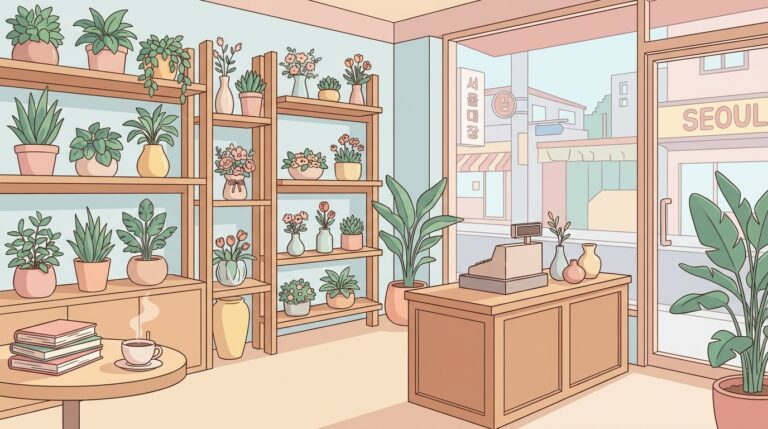
Picture this: You are walking down a quaint alleyway in Yeonnam-dong, Seoul. The afternoon sun hits a cozy flower shop with rows of charming terracotta pots sitting on a wooden bench outside. You step in, mesmerized by the earthy scent of fresh foliage. You want to buy a cute potted plant for your Airbnb windowsill or as a thoughtful housewarming gift (집들이 선물, jipdeuri seonmul) for a Korean friend. But suddenly, your mind freezes. How do you say “potted plant” without just asking for a cut flower? How do you ask if it needs lots of sunlight, or how often to water it without getting lost in complicated botanical vocabulary? You end up pointing awkwardly, nodding politely, and walking out hoping you won’t accidentally overwater your green friend to oblivion on day three.
Don’t worry, you are definitely not alone! Buying potted plants in Korea is a delightful cultural experience once you know just a few conversational keys. This A2-level guide was crafted directly from real experiences of learners just like you to give you total confidence when walking into any Korean florist (kkotjip).
Phase 2: Core Expressions Deep Dive
1. 키우기 쉬운 화분 있어요? (Ki-u-gi swi-un hwa-bun i-sseo-yo?)
- Pronunciation: [Kee-oo-gee she-oon hwa-boon ee-ssuh-yo?] (Sounds like: ‘Kee’ like key + ‘oo’ like moon + ‘gi’ like give + ‘she’ + ‘oon’ + ‘hwa’ + ‘boon’)
- Meaning: Literal: “Is there a potted plant easy to raise?” / Natural Nuance: “Do you have any low-maintenance plants for beginners?”
- K-Culture Moment: Frequently heard in cozy K-dramas when a character moves into a rooftop one-room (oktapbang) and wants to brighten up the space without fuss.
- Editor’s Insight: Notice the word 화분 (hwabun)—this refers specifically to a potted plant or flowerpot, whereas 꽃 (kkot) means cut flowers. Using hwabun immediately signals you want a living, rooted plant.
- Situation Spectrum: Casual: ✅ (친구 사이: 키우기 쉬운 거 있어?) | Semi-formal (Polite): ✅ (꽃집 점원: 키우기 쉬운 화분 있어요?) | Formal: ⚠️
- 🤔 Think About It: In Korean, you use the verb 키우다 (kiuda) (to raise/nurture) for plants, pets, and children alike. What does this reveal about how Koreans view their relationship with indoor plants?
2. 물은 얼마나 자주 줘요? (Mu-reun eol-ma-na ja-ju jwo-yo?)
- Pronunciation: [Moo-reun ul-ma-na jah-joo jwo-yo?] (Like ‘Moo’ as in a cow sound + ‘reun’ + ‘all’ + ‘mah’ + ‘nah’ + ‘jah’ + ‘joo’)
- Meaning: Literal: “As for water, how often do you give it?” / Natural Nuance: “How often should I water this?”
- K-Culture Moment: Seen in lifestyle vlogs where idols buy cute mini succulents (da-yook-i) for their dorm desks.
- Editor’s Insight: Koreans say ‘give water’ (물을 주다, mureul juda) rather than ‘water the plant’. It sounds very nurturing and friendly.
- Situation Spectrum: Casual: ✅ | Semi-formal: ✅ | Formal: ⚠️
- 🤔 Think About It: Why do you think Korean expresses plant care through gifting verbs like juda (to give)?
3. 선물용으로 포장해 주세요. (Seon-mul-yong-eu-ro po-jang-hae ju-se-yo.)
- Pronunciation: [Sun-mool-yong-eu-ro poh-jahng-hae joo-seh-yo]
- Meaning: Literal: “Please wrap it for gift-use.” / Natural Nuance: “Could you gift-wrap this for me?”
- K-Culture Moment: Classic scene when preparing for an office promotion or visiting a friend’s new apartment.
- Editor’s Insight: Adding -용 (-yong, for the use of) to nouns is an ultra-practical pattern: seonmulyong (for a gift), jibyone (for home use).
- Situation Spectrum: Casual: 🚫 | Semi-formal: ✅ | Formal: ✅
- 🤔 Think About It: Korean gift packaging is an art form. How does beautiful packaging reflect courtesy in social relations?
Phase 3: Textbook Korean vs. Real Korean
Situation 1: Asking if a plant survives indoors
- 📖 Textbook Korean: 이 식물은 실내에서 생존할 수 있습니까? (I singmureun silnaeeseo saengjonhal su itseumnikka? – Can this plant survive indoors?)
- 🗣️ Real Korean: 이거 방에서 키우기 괜찮아요? (Igeo bang-eseo kiugi gwaenchanayo? – Is it okay to keep this in a bedroom/room?)
- 💡 Why the difference? Textbook phrasing sounds like a biology paper! Native speakers simply ask if a plant is gwaenchanayo (alright/good) to grow in a bedroom.
Situation 2: Asking for a small decorative pot
- 📖 Textbook Korean: 작은 크기의 화초를 사고 싶습니다. (Jageun keugiui hwachoreul sago sipseumnida. – I desire to purchase a small-sized flowering plant.)
- 🗣️ Real Korean: 책상에 둘 만한 작은 거 있어요? (Chaeksang-e dul manhan jageun geo isseoyo? – Do you have something small to put on a desk?)
- 💡 Why the difference? Describing where you intend to put the plant (chaeksang-e dul manhan) gives the florist immediate context to recommend the perfect variety.
Phase 4: K-Culture Deep Dive & Non-Verbal Manners
4-1. Nunchi & Gestures at the Florist
- The Two-Handed Transfer: When the florist hands you the potted plant—even a tiny succulent—always receive it with both hands (du son) as a sign of appreciation and care.
- Point with Open Palm: Avoid pointing aggressively at fragile leaves with one index finger; instead, gesture toward the pot with an open hand angled upwards.
4-2. Cultural Code: “Pet Plants” (반려식물, Ballyeosikmul)
In modern Korea, single-person households (il-in gagu) are soaring. Many young Koreans embrace 반려식물 (ballyeosikmul, companion/pet plants) to soothe city loneliness and practice mindfulness (plant-tech / planterior). You’ll find aesthetic boutique plant shops everywhere from Seongsu-dong to Hongdae filled with young people picking their green “companions”!
Phase 5: Real-World Roleplay Scenario
Setting: ‘Green Oasis’ (그린 오아시스), a trendy botanical studio in Mangwon-dong run by Minji, a warm florist in a linen apron.
- Turn 1 (Minji): 안녕하세요! 천천히 구경하세요. (Annyeonghaseyo! Cheoncheonhi gugyeonghaseyo.) – 🎭 Smiling with a light bow. (Hello! Feel free to look around at your pace.)
- Turn 2 (You): 네, 안녕하세요! 저… 키우기 쉬운 화분 있어요? (Ne, annyeonghaseyo! Jeo… kiugi swiun hwabun isseoyo?) – 🎭 Looking around timidly with a warm smile. (Hi! Um… do you have any plants that are easy to raise?)
- Turn 3 (Minji): 그럼요! 이 스투키나 몬스테라 어떠세요? 물을 자주 안 줘도 돼요. (Geureomyo! I seutukina monseutera eotteoseyo? Mureul jaju an jwodo dwaeyo.) – 🎭 Pointing gently at a sleek pot. (Of course! How about this Stuckyi or Monstera? You don’t need to water them often.)
- Turn 4 (You): 몬스테라 예쁘네요! 물은 얼마나 자주 줘요? (Monseutera yeppeuneyo! Mureun eolmana jaju jwoyo?) – 🎭 Leaning closer to inspect the leaves. (The Monstera is pretty! How often should I give it water?)
- Turn 5 (Minji): 겉흙이 마르면 일주일에 한 번 정도 흠뻑 주세요. (Geotheulgi mareumyeon iljuire han beon jeongdo heumppeok juseyo.) – 🎭 Mimicking watering with hands. (When the topsoil dries out, give it a thorough soak about once a week.)
- Turn 6 (You): 네, 알겠습니다. 이거 선물용으로 포장해 주세요. (Ne, algessumnida. Igeo seonmulyong-euro pojanghae juseyo.) – 🎭 Nodding gratefully. (Got it. Please wrap this as a gift.)
- Turn 7 (Minji): 네! 예쁘게 리본 묶어 드릴게요. 잠시만 기다려 주세요. (Ne! Yeppeuge ribon mukkeo deurilgeyo. Jamsiman gidaryeo juseyo.) – 🎭 Taking the pot with two hands. (Sure! I’ll tie a pretty ribbon. Please wait just a moment.)
- Turn 8 (You): 감사합니다! (Gamsahamnida!) – 🎭 Bowing slightly. (Thank you!)
🔀 Interactive Choice Point
The florist is wrapping your plant and asks: “메시지 카드도 필요하세요?” (Do you need a message card too?)
* Option A: “네, 짧은 축하 카드 하나 써 주실 수 있어요?” (Best! Natural, polite request for a celebratory card.)
* Option B: “아니요, 괜찮아요. 그냥 주세요.” (Casual/Borderline blunt – understandable, but adding gamsahamnida softens it.)
* Option C: “몰라요!” (Risk! Means “I don’t know!” in an informal, abrupt tone.)
Phase 6: 10-Second Emotion Shadowing Drill
[😊 Curiously & Gently]저기요, / 책상에 둘 만한 / 작은 화분 있어요?
(Jeogiyo, / chaeksang-e dul manhan / jageun hwabun isseoyo?)[🤔 Attentively]물은 / 일주일에 / 몇 번 정도 줘요?
(Mureun / iljuire / myeot beon jeongdo jwoyo?)[✨ Cheerful Gratitude]선물할 건데, / 예쁘게 포장해 주세요!
(Seonmulhal geonde, / yeppeuge pojanghae juseyo!)
Phase 7: K-Culture Mini Dictionary
- 화분 (Hwabun) | Potted plant / Flowerpot | Used exclusively when referring to container-grown plants.
- 공기정화식물 (Gong-gi-jeong-hwa-sing-mul) | Air-purifying plant | Extremely popular purchase in Korea during fine dust (hwangsa/mise-meonji) seasons.
- 집들이 (Jipdeuri) | Housewarming party | A major Korean cultural gathering where potted plants (like Sansevieria) are standard gifts for good fortune.
- 다육이 (Dayuk-i) | Succulent | The beloved slang/diminutive term for mini succulents loved by office workers.
Phase 8: Traveler’s Survival Kit
Survival Phrases Top 3
- 햇빛 많이 필요해요? (Haetbit mani piryohaeyo?) – Does it need lots of sunlight? (Pro Tip: Perfect for studio dwellers with limited window light!)
- 영수증 버려주세요. (Yeongsujeung beoryeojuseyo.) – Please discard the receipt. (Pro Tip: Most shops ask if you need paper receipts.)
- 쇼핑백에 넣어 주세요. (Syopingbaek-e neoeo juseyo.) – Please put it in a shopping bag.
Editor’s Travel Note
When hunting for unique plants in Seoul, open your Naver Map app download and search “식물가게” (singmul gage) or “플랜트샵” (peullaenteu syap) for trendy independent spots rather than standard commercial flower stalls. Keep your T-money card or international credit card ready—almost every plant shop in Korea accepts card payments seamlessly!
Phase 9: A Step Deeper (Reflection)
In Korean culture, gifting a living plant is an intentional wish for growth, longevity, and thriving vitality (daebak). Unlike cut flowers that fade in days, a rooted plant symbolizes an ongoing, living connection between the giver and the receiver.
💬 Your Turn: What kind of plant do you keep on your desk at home, and what Korean phrase will you use on your next visit to a Seoul flower shop? Let us know in the comments below!
Phase 10: FAQ & Common Mistakes
Q: What is the difference between 꽃 (kkot) and 화분 (hwabun)?
A: 꽃 (kkot) means “flower” or a bouquet of cut flowers, whereas 화분 (hwabun) refers specifically to a potted plant with soil and roots.
Q: Can I take a potted plant from Korea back home on an airplane?
A: Most international customs strictly prohibit bringing uncertified soil and living plants across borders due to quarantine laws. If you are traveling, enjoy your plant during your stay or gift it to your Korean host before departing!
Q: How do I ask for a plant that purifies the air?
A: Just say: “공기 정화 잘 되는 식물 있어요?” (Gonggi jeonghwa jal doeneun singmul isseoyo? – Do you have plants that purify air well?)
🚨 Common Mistakes Warning Board
- Saying “꽃 주세요” when you want a pot: The florist will start wrapping cut roses! Always specify hwabun or sikmul.
- Confusing ‘물 주다’ with ‘물 마시다’: Don’t say singmuri mul masyeoyo (the plant drinks water); say mureul jwoyo (give water).
- Dropping polite honorifics at the counter: Always end your questions with ~isseoyo? or ~juseyo instead of root dictionary forms.
Phase 11: Action Missions
- 🥉 Bronze Mission: Practice saying “키우기 쉬운 화분 있어요?” 3 times in front of the mirror with a bright smile.
- 🥈 Silver Mission: Post a picture of your favorite houseplant on Instagram/Threads and caption it with: #반려식물 #키우기쉬워요.
- 🥇 Gold Mission: Walk into a local Korean-run flower boutique or market in Korea and purchase a mini succulent completely in Korean!
- 🎮 K-Culture Mission: Watch an episode of a Slice-of-Life K-drama (like Hospital Playlist or Summer Strike) and spot any plants sitting on desks or verandas!
Phase 12: Interactive Quiz Challenge
1. Situation Quiz: You want a plant that doesn’t need constant sunlight. What do you ask?
* A) 이거 물 마셔요?
* B) 그늘에서도 잘 자라요? (Does it grow well in the shade too?)
* C) 꽃다발 주세요.
2. Fill in the blank: “선물할 거라서, 예쁘게 (________)해 주세요.” (I’m gifting it, so please wrap it nicely.)
3. True or False: In Korean, the word ‘반려식물’ implies viewing your houseplants like companion pets.
🔍 Click to Reveal Quiz Answers & Explanations!
- Answer: B. Geuneureseo-do jal jarayo? accurately asks if the plant thrives in low light.
- Answer: 포장 (pojang) -> 포장해 주세요 (Please wrap it).
- Answer: True! ‘반려’ (ballyeo) means companion/life partner, highlighting emotional bonding with green plants.







