

Phase 1: Empathy (Story Opening)
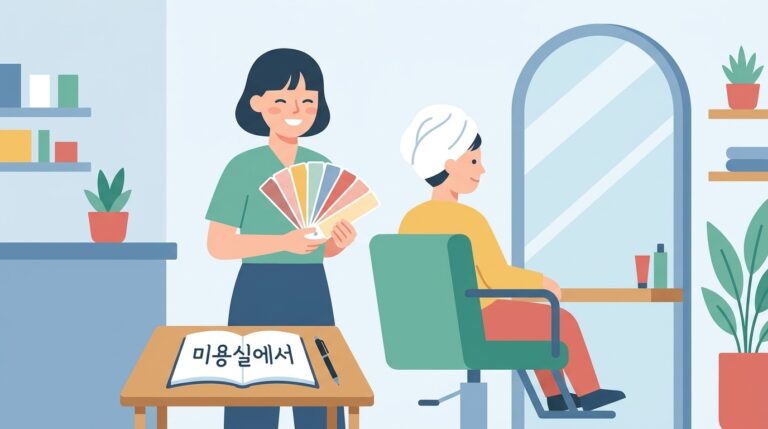
안녕하세요! 매일한글 에디터입니다. Have you ever walked into a trendy hair salon in Hongdae or Gangnam, hoping for that dreamy ash-brown or pastel K-pop idol hair, only to freeze when the stylist greeted you with a warm smile and asked what you wanted? You had your Pinterest board ready, but your Korean completely evaporated. You ended up pointing at random color swatches, nervous that you’d walk out looking like a walking neon highlighter.
You are definitely not alone! Hair salon visits can be intimidating, especially when you are trying to describe exactly what tone you want. But here is the good news: getting your dream hair color in Korea does not require complex grammar. With just a handful of simple A1-level phrases and the right visual tips, you can confidently sit in that salon chair and get the exact look you want. This guide is built directly from real student experiences and practical tips from local Seoul hair stylists to ensure your salon trip is stress-free and exciting!
Phase 2: 3 Core Expressions Deep-Dive
1. 염색 하고 싶어요 (Yeom-saek ha-go si-peo-yo)
- Pronunciation: [yeom-saek ha-go shi-peo-yo] (Sounds like: Yum-seck ha-go she-poh-yo)
- Meaning: Literal: “I want to do dyeing.” | Actual nuance: “I’d like to get my hair dyed, please.”
- K-Culture Moment: In K-dramas, when characters undergo a major life change or break-up, they dramatically enter a salon and state this line to mark their new beginning.
- Editor’s Insight: In Korean, noun + hago sipeoyo (I want to do…) is the ultimate magic formula for beginners. Simply saying 염색 (dyeing) with 하고 싶어요 clearly states your primary service.
- Situation Spectrum: Casual: ✅ | Semi-formal: ✅ | Formal: ✅
- 🤔 Think About It: In English, you say “I want to dye my hair,” but in Korean, omitting “my hair” (머리) is completely natural because the context already implies it. How does leaving out obvious words make conversations faster?
2. 이 색으로 해주세요 (I saeg-eu-ro hae-ju-se-yo)
- Pronunciation: [i sae-geu-ro hae-ju-se-yo] (Sounds like: Eee seg-oo-roh hae-joo-seh-yoh)
- Meaning: Literal: “Please do with this color.” | Actual nuance: “Please make it this color (showing a photo).”
- K-Culture Moment: Showing an Instagram photo of your favorite idol to your stylist and pointing at the phone screen while smiling politely.
- Editor’s Insight: The particle -으로 (euro) means “by means of / into this direction.” When paired with 해주세요 (please do it for me), it turns your reference photo into a clear, polite instruction.
- Situation Spectrum: Casual: ⚠️ | Semi-formal: ✅ | Formal: ✅
- 🤔 Think About It: Why do you think Korean stylists prefer visual references (photos) combined with polite request endings rather than lengthy descriptive adjectives?
3. 탈색해야 돼요? (Tal-saek-hae-ya dwae-yo?)
- Pronunciation: [tal-saek-hae-ya dwae-yo] (Sounds like: Tahl-seck-hae-ya dway-yoh)
- Meaning: Literal: “Must bleach do?” | Actual nuance: “Do I need to bleach it to get this color?”
- K-Culture Moment: A variety show clip where an idol explains how many rounds of bleach (탈색) they had to endure for their comeback stage.
- Editor’s Insight: 탈색 (Bleach) is a vital term in Korea because many aesthetic ash or pastel tones require lightening first. Asking this prevents surprise costs and unexpected hair damage.
- Situation Spectrum: Casual: ✅ | Semi-formal: ✅ | Formal: ✅
- 🤔 Think About It: In Korea, asking about feasibility upfront helps stylists give transparent price quotes and hair health assessments.
Phase 3: Textbook Korean vs Real Korean
Situation 1: Telling the stylist what color you want
- 📖 Textbook Korean: 저는 제 머리를 갈색으로 염색하기를 원합니다. (Jeoneun je meorireul galsaeg-euro yeomsaekhagireul wonhamnida. – I desire to dye my hair brown.)
- 🗣️ Real Korean: 브라운 톤으로 염색하고 싶어요. (Beuraun tone-euro yeomsaek-hago sipeoyo. – I’d like to dye it in a brown tone.)
- 💡 Why is it different? Textbook phrases sound like an official essay. In real life, Korean hair salons frequently use English loanwords like “톤 (tone)” or “컬러 (color)” with polite conversational endings.
Situation 2: Asking if a color is possible without damage
- 📖 Textbook Korean: 제 모발 손상이 심합니까? (Je mobal sonsang-i simhamnikka? – Is my hair damage severe?)
- 🗣️ Real Korean: 머리 많이 상해요? (Meori mani sang-haeyo? – Will it damage my hair a lot?)
- 💡 Why is it different? Native speakers use 상하다 (to get damaged/spoiled) for hair rather than technical medical terms like 모발 손상 in casual salon consultations.
Phase 4: K-Culture Deep Dive & Non-verbal Manners
4-1. 눈치 (Nunchi) & Gestures in a Korean Salon
When entering a Korean hair salon, you will usually be guided to a locker to store your coat and bag, and given a robe (가운). When discussing your hair color, holding your phone with two hands while showing the reference photo demonstrates respect. If the stylist touches your hair to check the texture, keep your head upright and relaxed. A gentle nod while saying “네 (Ne)” shows you understand their suggestions.
4-2. Cultural Code: The Idol Hair Trend & Personal Color
In Korea, hair coloring is deeply connected to the concept of Personal Color (퍼스널 컬러)—categorizing skin tones into Warm (웜톤) and Cool (쿨톤). Stylists love recommending subtle shade shifts (like Milk Brown for warm tones or Ash Gray for cool tones) to brighten your face. Trusting the stylist’s advice on tone matching is a huge part of the fun in Korean beauty culture!
Phase 5: Real Roleplay Scenario
Setting: A chic hair salon in Yeonnam-dong. Stylist Min-ji greets Alex, who is sitting in the styling chair holding a smartphone photo.
- 민지 (Min-ji): 안녕하세요! 오늘 어떤 머리 하고 싶으세요? (Hello! What kind of hair would you like today?)
🎭 Smiles warmly while tying the salon cape - 알렉스 (Alex): 안녕하세요! 저 염색 하고 싶어요. (Annyeonghaseyo! Jeo yeomsaek hago sipeoyo. – Hello! I want to dye my hair.)
🎭 Holds up smartphone - 민지 (Min-ji): 네! 봐둔 색상 있으세요? (Sure! Do you have a color in mind?)
🎭 Leans in to look at phone - 알렉스 (Alex): 이 색으로 해주세요. (I saeg-euro hae-juseyo. – Please do it in this color.)
🎭 Shows photo of soft ash-brown hair - 민지 (Min-ji): 아, 애쉬 브라운이네요! 고객님 모발이 어두워서 탈색 1번 하셔야 해요. (Ah, it is Ash Brown! Because your hair is dark, you need one round of bleach.)
🎭 Gently lifts a strand of hair - 알렉스 (Alex): 탈색하면 머리 많이 상해요? (Talsaek-hamyeon meori mani sang-haeyo? – If I bleach, will my hair get damaged a lot?)
🎭 Makes a slightly worried expression - 민지 (Min-ji): 영양 앰플 같이 넣으시면 괜찮아요! (If we add a nourishing ampoule treatment together, it will be fine!)
🎭 Reassures with a confident nod - 알렉스 (Alex): 좋아요. 그렇게 해주세요! (Joayo. Geureoke hae-juseyo! – Great. Please do it like that!)
🎭 Smiles in relief
🔀 Interactive Choice Point
What should you say if the stylist asks whether you want a scalp protector treatment?
- Option A: 두피 보호제도 같이 해주세요. (Dupi bohojedo gachi hae-juseyo. – Please add the scalp protector too.)
- Option B: 싫어요, 그냥 빨리 해주세요. (Sireoyo, geunyang ppalli hae-juseyo. – I hate it, just do it fast.)
- Option C: 몰라요, 마음대로 하세요. (Mollayo, maeumdaero haseyo. – Don’t know, do whatever.)
-
Feedback:
- Option A (Best): Polite, clear, and ensures your scalp stays comfortable during bleaching!
- Option B (Bad): Sounds rude and dismissive to the stylist’s professional care.
- Option C (Risk): May lead to unexpected extra charges or treatments you didn’t actually want.
Phase 6: 10-Second Emotion Shadowing Drill
Practice these natural intonation and pause points along with the emotion prompts:
[😊 Excitement & Clear Request]
저 / 염색 하고 싶어요! / 이 사진처럼요.
(Jeo / yeom-saek ha-go si-peo-yo! / i sa-jin-cheo-reom-yo.)-
[🤔 Curious & Slightly Concerned]
이 색 하려면 / 탈색해야 돼요?
(I saek ha-ryeo-myeon / tal-saek-hae-ya dwae-yo?) -
[🤝 Decisive & Friendly]
네! / 이 색으로 해주세요.
(Ne! / i sae-geu-ro hae-ju-se-yo.)
Phase 7: K-Culture Mini Dictionary
- 탈색 (Tal-saek) | Hair Bleaching | Essential when lifting black or dark brown hair to pastel/blonde levels.
- 톤다운 (Ton-da-un) | Tone Down (Dyeing Darker) | Used when you want to darken your bleached or faded hair back to a neat shade.
- 앰플 (Aem-peul) | Hair Ampoule / Treatment | Deep conditioning additive salons recommend during chemical treatments to protect hair.
- 뿌염 (Ppu-yeom) | Root Touch-up (Abbreviation of 뿌리 염색) | Super common daily slang used when touching up regrown hair roots.
Phase 8: Survival Kit for Travelers
Top 3 Survival Phrases
- 사진 보여드릴게요. (Sa-jin bo-yeo-deu-ril-ge-yo.) – Pro Tip: Say this while unlocking your phone to show your target hairstyle photo immediately.
- 얼마예요? (Eol-ma-ye-yo?) – Pro Tip: Ask this after discussing bleach/treatments to confirm the final estimate before starting.
- 안 뜨거워요 / 괜찮아요. (An tteu-geo-wo-yo / Gwaen-chan-a-yo.) – Pro Tip: Use this when the stylist checks if the blow dryer or rinse water is at a comfortable temperature.
Editor’s Travel Note
Most popular Seoul salons (especially in Hongdae, Sinsa, and Cheongdam) require advance reservations. Download the 네이버 지도 앱 다운로드 to search salons, view pricing menus, and book directly. Major foreign credit cards are widely accepted, and tipping is not practiced in Korea!
Phase 9: “한 발 더 깊이” (One Step Deeper)
In Korean salon culture, hairstylists view their work not just as a mechanical service, but as a collaborative aesthetic consultation (상담). Instead of just telling you “yes” or “no,” Korean stylists take pride in analyzing your undertone, face shape, and hair condition before mixing the dye. Being open to their suggestions while clearly expressing your preferences creates a warm, enjoyable bond between you and your designer.
💬 Your Turn: Have you ever dyed your hair a completely bold color? What shade would you try in Korea: warm brown, milk tea beige, or bold pastel? Share in the comments below!
Phase 10: FAQ & Common Mistakes
Q: Can I bring photos of non-Korean celebrities to a Korean salon?
A: Absolutely! Korean stylists are highly trained across diverse hair types and global trends. Just show the picture clearly.
Q: How do I say I want to do a root touch-up only?
A: You can say “뿌리 염색만 할게요 (Ppu-ri yeom-saek-man hal-ge-yo)” or use the friendly slang “뿌염 할게요 (Ppu-yeom hal-ge-yo).”
Q: Do I need to tip my hair designer in Korea?
A: No. Tipping culture does not exist in Korean hair salons. The price listed on the counter or booking app includes all tax and service fees.
🚨 Common Mistakes Alert
- Mistake: Saying 머리 빨갛게 칠해주세요 (Literally: “Paint my hair red”).
- Correct Action: Use 염색 (dyeing): 빨간색으로 염색해주세요.
- Mistake: Assuming bleach is included in the standard dye price.
- Correct Action: Always ask 탈색 포함이에요? (Is bleach included?) to confirm total costs.
- Mistake: Nodding silently without understanding recommendations.
- Correct Action: Simply ask 얼마예요? (How much is it?) or show your preferred reference photo again.
Phase 11: Action Missions
- 🥉 Bronze Mission (Self-Practice): Look into the mirror and say “저 염색 하고 싶어요! 이 색으로 해주세요!” 3 times smoothly.
- 🥈 Silver Mission (Social Sharing): Save a photo of your dream K-hair color and caption it on your Instagram or study notes with: #염색하고싶어요 #DailyHangul.
- 🥇 Gold Mission (Real Life Action): Walk into a salon or use a salon booking app to request a hair color consultation in Korean!
- 🎮 K-Culture Mission: Watch a YouTube salon vlog or K-drama scene set in a hair salon and spot the word 염색 or 탈색 in subtitles!
Phase 12: Interactive Quiz Challenge
1. Situation Judgment:
You found a cool idol photo and want to show it to the stylist. What do you say?
* A) 머리 칠해주세요.
* B) 이 색으로 해주세요.
* C) 염색 싫어요.
👉 Click to see the answer & explanation
Correct Answer: B
* Why: “이 색으로 해주세요 (Please do it in this color)” is the most natural and polite way to request a specific shade shown in a picture. Option A uses unnatural phrasing, and Option C means “I hate dyeing.”
2. Fill in the Blank:
If you want to ask whether bleaching is required, fill in the missing word:
“____해야 돼요?”
👉 Click to see the answer & explanation
Correct Answer: 탈색 (Tal-saek)
* Explanation: 탈색 means hair bleaching. 탈색해야 돼요? means “Do I need to bleach it?”
3. True or False:
In Korean hair salons, you should always leave a 10% to 15% cash tip at the front desk.
👉 Click to see the answer & explanation
Correct Answer: False
* Explanation: There is zero tipping culture in South Korea. You only pay the exact amount shown on the bill.







