

Phase 1: Empathy (Story-Driven Opening)
안녕하세요! 매일한글 에디터입니다. (Hello! This is your Daily Hangul editor.)
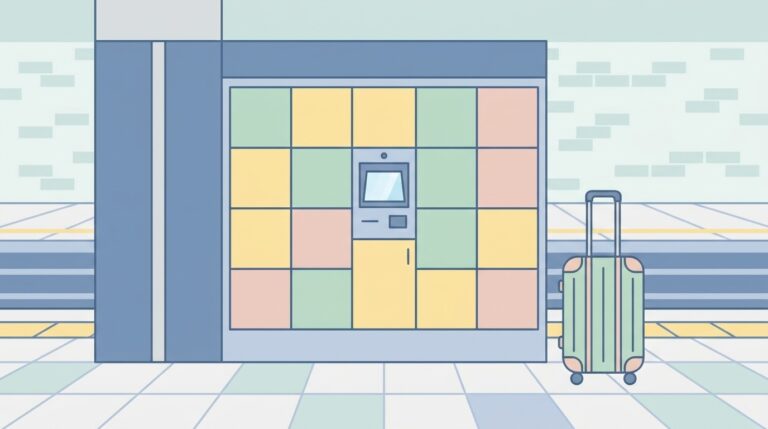
Picture this: You have just landed in Seoul and taken the AREX airport railroad to Hongdae or Gangnam. Your hotel check-in isn’t until 3:00 PM, but your favorite K-Pop popup store opens right now. You are dragging a 20kg suitcase through a bustling subway station filled with commuters rushing past. You finally spot the bright digital screen of the subway storage lockers (물품 보관함), but as you step in front of the kiosk, you freeze. Korean instructions pop up, someone is waiting right behind you, and you wonder: “Which button do I press? How do I pay? What if my locker won’t open later?”
Don’t worry—almost every traveler in Korea experiences this exact mini-panic! Navigating automated public facilities in Korea can feel overwhelming when you’re caught in the fast-paced flow of Seoul transit. This guide is built directly from real student experiences to give you the confidence, precise vocabulary, and cultural etiquette you need to store your bags smoothly and explore hands-free.
Phase 2: Top 3 Core Expressions Deep-Dive
1. 보관함에 짐 좀 맡길게요 (Hangul)
- Pronunciation: Bogan-hame jim jom mat-gil-ge-yo (Sounds like: boh-gahn-hah-meh jeem johm maht-geel-geh-yo)
- Meaning: Literal: “I will leave my luggage in the storage locker.” | Actual Nuance: A natural, polite way to inform a companion or staff that you’re about to store your luggage.
- K-Culture Moment: Often heard in travel vlogs and K-Dramas when characters arrive at a station before heading off on a spontaneous food tour.
- Editor’s Insight: The verb 맡기다 means ‘to entrust / deposit.’ Adding the softening particle 좀 (jom) makes your statement sound relaxed and polite rather than blunt.
- Situation Spectrum: Casual: ✅ (짐 좀 맡길게) | Semi-formal: ✅ (짐 좀 맡길게요) | Formal: ✅ (물품을 보관하겠습니다)
- 🤔 Think About It: Why does Korean use the verb “entrust” (맡기다) for lockers rather than simply “put” (넣다)? It reflects an emphasis on safe custody.
2. 보관함 빈자리 있어요? (Hangul)
- Pronunciation: Bogan-ham bin-jari iss-eo-yo? (Sounds like: boh-gahn-hahm bean-jah-ree ee-ssuh-yoh?)
- Meaning: Literal: “Is there an empty spot in the storage locker?” | Actual Nuance: “Are there any available lockers?”
- K-Culture Moment: Seen when someone is frantically looking around a crowded station during holiday rush or concert days.
- Editor’s Insight: 빈자리 (bin-jari) combines 빈 (empty) and 자리 (seat/spot). You can use this for lockers, subway seats, or restaurant tables.
- Situation Spectrum: Casual: ✅ (빈자리 있어?) | Semi-formal: ✅ (빈자리 있어요?) | Formal: ✅ (이용 가능한 보관함이 있습니까?)
- 🤔 Think About It: Notice how Korean frequently focuses on availability (있어요/없어요) rather than asking “Can I find a locker?”
3. 비밀번호를 잊어버렸어요 (Hangul)
- Pronunciation: Bimil-beonho-reul ijeo-beo-ryeoss-eo-yo (Sounds like: bee-meel-buhn-hoh-reul ee-juh-buh-ryuh-ssuh-yoh)
- Meaning: Literal: “I have forgotten the password.” | Actual Nuance: “I forgot my passcode (help!)”
- K-Culture Moment: The classic drama crisis moment when a character is locked out of their digital doorlock or station locker.
- Editor’s Insight: 잊어버리다 incorporates the auxiliary verb -버리다, expressing regret or an unintended completed action.
- Situation Spectrum: Casual: ✅ (비번 까먹었어) | Semi-formal: ✅ (비밀번호를 잊어버렸어요) | Formal: ✅ (비밀번호를 분실하였습니다)
- 🤔 Think About It: Korean adds emotional color to mistakes using grammar structures like -어/아 버리다 to signal “alas, it happened!”
Phase 3: Textbook Korean vs. Real Korean
Situation 1: Asking where the lockers are located
- 📖 Textbook Korean: 물품 보관소가 어디에 위치해 있습니까? (Mulpum bogwanso-ga eodi-e wichihae itsseumnikka?)
- 🗣️ Real Korean: 저기 혹시, 보관함 어디에 있어요? (Jeogi hoksi, bogan-ham eodi-e iss-eo-yo?)
- 💡 Why is it different? Real speakers prefer short words like 보관함 over formal words like 물품 보관소, softening the question with 저기 혹시 (excuse me, by any chance).
Situation 2: Asking if luggage fits in the locker
- 📖 Textbook Korean: 이 가방이 보관함 크기에 적합합니까? (I gabang-i bogan-ham keugi-e jeokhaphannikka?)
- 🗣️ Real Korean: 이 캐리어 여기에 들어갈까요? (I kaerieo yeogi-e deureo-galkkayo?)
- 💡 Why is it different? Koreans commonly borrow the word ‘캐리어’ (carrier / rolling suitcase) and use the everyday verb 들어가다 (to fit in / go inside).
Phase 4: K-Culture Deep-Dive & Non-Verbal Manners
4-1. 눈치 (Nunchi) & Station Locker Etiquette
Subway locker areas in major hub stations like Myeongdong, Hongdae, and Seoul Station have steady pedestrian traffic.
* Keep the Walkway Clear: Park your large suitcase directly beside you against the locker wall rather than leaving it in the center aisle.
* Screen Efficiency: If a queue forms behind you, quickly switch the language toggle to English or Japanese at the top right of the kiosk screen rather than hesitating.
* Confirmation Photo: Always snap a quick smartphone photo of your locker box number (함 번호) and digital receipt right after the door locks.
4-2. Cultural Insight: Korea’s Digital Locker Culture
Korea’s subway lockers (often branded as ‘T-Locker’ or ‘O-Locker’) have evolved into high-tech hubs. Many lockers operate without physical keys, relying entirely on a 6-digit passcode, mobile apps, or transit cards (T-money). This seamless digital infrastructure highlights Korea’s ‘Ppal-li Ppal-li’ (quick & convenient) lifestyle.
Phase 5: Real-World Roleplay Scenario
Setting: A modern subway station near Hongik University Station. Min-ji (a helpful local station attendant) notices Alex looking puzzled in front of the digital locker kiosk.
- Alex: 저기요, 보관함 사용법 좀 알려주실 수 있어요?
(Jeogiyo, bogan-ham sayongbeop jom allyeojusil su isseoyo?)
“Excuse me, could you teach me how to use this locker?”
🎭 Looking polite while holding up a suitcase handle - Min-ji: 네, 화면에서 ‘보관’ 버튼을 먼저 누르세요.
(Ne, hwamyeon-eseo ‘bogan’ beoteun-eul meonjeo nureuseyo.)
“Sure, first press the ‘Store’ (보관) button on the screen.”
🎭 Pointing gently toward the main touchscreen - Alex: 아, 여기서 빈 보관함 번호를 고르면 되나요?
(A, yeogiseo bin bogan-ham beonho-reul goreumyeon doenayo?)
“Ah, do I pick an empty locker number here?”
🎭 Nodding and tapping the blue highlighted box - Min-ji: 맞아요. 파란색 번호가 비어있는 보관함이에요.
(Majayo. Paransaek beonho-ga bieo-inneun bogan-ham-ieyo.)
“That’s right. The blue numbers are the empty ones.”
🎭 Smiling encouragingly - Alex: 비밀번호는 여섯 자리 설정하면 되죠?
(Bimil-beonho-neun yeoseot jari seoljeonghamyeon doejo?)
“I set a 6-digit passcode, right?”
🎭 Typing carefully on the numeric keypad - Min-ji: 네, 잊어버리지 않게 사진 찍어두세요! 결제는 카드로 하시면 돼요.
(Ne, ijeo-beoriji anke sajin jjigeo-duseyeo! Gyeolje-neun kadeu-ro hasimyeon dwaeyo.)
“Yes, take a photo so you don’t forget! You can pay by card.”
🎭 Gesturing toward the card reader below the screen - Alex: 결제 완료됐어요! 문이 열렸네요. 정말 감사합니다.
(Gyeolje wanryo-dwaesseoyo! Muni yeollyeon-neyo. Jeongmal gamsahamnida.)
“Payment complete! The door opened. Thank you so much.”
🎭 Placing luggage inside and lightly bowing - Min-ji: 좋은 여행 되세요!
(Joeun yeohaeng doeseyo!)
“Have a wonderful trip!”
🎭 Waving warmly
🔀 Interactive Branching Moment
After closing the locker door, what should you check before walking away?
* Option A: Walk away immediately because the screen showed ‘완료’ (Done).
* Option B: Pull the locker handle gently to confirm it is locked and verify your box number.
* Option C: Press ‘찾기’ (Retrieve) immediately to test if your passcode works.
- Feedback on A (Risk): Sometimes doors bounce back if luggage straps get caught in the latch.
- Feedback on B (Best): Perfect! Always physically check the latch and save your locker box number on your phone.
- Feedback on C (Bad): Pressing ‘찾기’ will finish your session, open the door, and charge you an extra fee to re-lock!
Phase 6: 10-Second Emotional Shadowing Drill
Practice matching natural pitch and emotional pauses:
[😊 Relieved and polite]
저기요, / 보관함 어디 있는지 / 여쭤봐도 될까요?
(Jeogiyo, / bogan-ham eodi inneunji / yeojwo-bwado doelkkayo?)
“Excuse me, / may I ask / where the lockers are located?”-
[🤔 Curious and cautious]
이 캐리어가 / 중형 보관함에 / 들어갈까요?
(I kaerieo-ga / junghyeong bogan-hame / deureo-galkkayo?)
“Will this suitcase / fit inside / the medium-sized locker?” -
[🥺 Slightly worried and urgent]
영수증을 잃어버렸는데, / 비밀번호로 / 열 수 있나요?
(Yeongsujeung-eul ireobeoryeonneunde, / bimil-beonhoro / yeol su innayo?)
“I lost my paper receipt, / can I open it / with just the passcode?”
Phase 7: K-Culture Mini Dictionary
- 보관 (Bogan) / 찾기 (Chatgi) | Storing / Retrieval
The two primary buttons on every locker kiosk screen in Korea. ‘보관’ initiates a new deposit, while ‘찾기’ retrieves your items. - 소형/중형/대형 (Sohyeong / Junghyeong / Daehyeong) | Small / Medium / Large Size
Refers to locker dimensions. Backpacks fit into 소형, standard carry-ons (20-inch) into 중형, and large check-in bags (28-inch+) require 대형. - 기본요금 (Gibon-yogeum) | Base Fee
The initial storage fee covering a standard period (typically the first 2 to 4 hours). - 추가요금 (Chuga-yogeum) | Additional Overtime Fee
The automated hourly charge billed when you retrieve items after the base time expires.
Phase 8: Traveler’s Survival Kit
Top 3 Survival Expressions
- “보관 누르면 되나요?” (Bogan nureumyeon doenayo?) — “Do I just press ‘Store’?” (Pro tip: Use when standing at the touchscreen to verify your action).
- “신용카드 결제 돼요?” (Sinyong-kadeu gyeolje dwaeyo?) — “Does it take credit cards?” (Pro tip: 95% of Seoul subway lockers only take credit/check cards or T-money).
- “짐이 안 나와요.” (Jimi an nawayo.) — “My bag won’t come out / The door won’t unlock.” (Pro tip: Call the station customer service number posted on the locker screen).
Editor’s Travel Note
Before wandering around huge transit stations like Seoul Station or Express Bus Terminal, install the T-Locker Subway Storage Official App or open your map to check locker availability in real time. Remember that payment is predominantly cashless, so keep your international travel debit card or topped-up transit card handy.
Phase 9: Stepping Deeper (Cultural Reflection)
In many global subways, automated lockers have disappeared due to security concerns, but in South Korea, they remain exceptionally safe, clean, and ubiquitous. This reflects high societal mutual trust and the cultural emphasis on civic convenience (Pyeon-ui). You will often notice people leaving umbrellas or parcels unattended momentarily without fear of theft.
💬 Your Turn: Have you ever used an automated locker in another country? How does the locker experience in your hometown compare to Korea’s digital system? Share your thoughts below!
Phase 10: FAQ & Common Mistakes
Q: Can I pay with foreign credit cards at subway lockers?
A: Yes, most modern digital kiosks accept Visa, Mastercard, and UnionPay. However, if your card doesn’t have an IC chip enabled or lacks contact payment, a local T-money transport card or Wowpass serves as a dependable backup.
Q: What happens if I return past subway operating hours?
A: Station shutters close after the last train (usually around midnight to 1:00 AM). If your bag is locked inside, you must wait until the station reopens at around 5:30 AM next morning, and overtime fees will apply.
Q: Can two people share one large locker?
A: Absolutely! As long as all bags fit comfortably within the door parameters without forcing the lock, you can store multiple items under one single fee and passcode.
🚨 Common Mistakes Alert
- Mistake: Forgetting to record the locker compartment number.
Correct Action: Take a photo of the locker door number and the kiosk confirmation screen before walking away. - Mistake: Closing the door before setting your 6-digit passcode on the screen.
Correct Action: Complete all touchscreen prompts first, pay the fee, and only close the locker door when instructed. - Mistake: Assuming cash notes are accepted.
Correct Action: Prepare a credit card, debit card, or T-money transport card beforehand.
Phase 11: Action Missions
- 🥉 Bronze Mission (Solo Practice): Read the Phase 6 Shadowing Drill out loud 3 times with the indicated emotions.
- 🥈 Silver Mission (Community Share): Write a comment below telling us what size locker (소형/중형/대형) you’d need for your next Korea trip using Korean!
- 🥇 Gold Mission (Real Life): When you arrive in Korea, find a subway locker, select the Korean language option, and complete the storage process independently!
- 🎮 K-Culture Mission: Next time you watch a travel show or drama set in Seoul, spot whether characters use automated lockers or station baggage centers.
Phase 12: Interactive Quiz Challenge
1. Situation Judgment: You placed your luggage inside the locker, closed it, and paid, but you want to grab your forgotten jacket right away. What happens if you press ‘찾기’ (Retrieve)?
2. Fill-in-the-blank:
“제 캐리어가 커서 [ ] 보관함을 써야 해요.” (My suitcase is big, so I need to use a Large locker.)
3. True or False: Subway lockers in Seoul only accept physical cash coins and 1,000 KRW paper bills.
👉 Click here to check the answers & explanations!
- Answer: Pressing ‘찾기’ finishes the rental transaction and unlocks the door. If you put your bag back in, you must pay the base fee again.
- Answer: 대형 (Daehyeong) — 소형 (Small), 중형 (Medium), 대형 (Large).
- Answer: False — Most modern subway lockers are completely cashless and require payment via credit card, mobile pay, or transit card.







