

Phase 1: Empathy & Story Opening
안녕하세요! 매일한글 에디터입니다. Have you ever stepped into a traditional Korean theater, excited to experience the raw, soulful storytelling of Pansori (판소리), only to freeze in your seat? In most Western classical concerts or operas, the golden rule is complete silence: do not cough, do not whisper, and definitely do not shout until the final bow.
So, imagine the sheer culture shock when you sit in a Hanok concert hall in Jeonju or Seoul, and the Korean grandmother next to you suddenly bellows “Eolssigu!” right in the middle of a singer’s high note! You might wonder: Is she being rude? Should I shush her? Or am I the one missing out on the party?
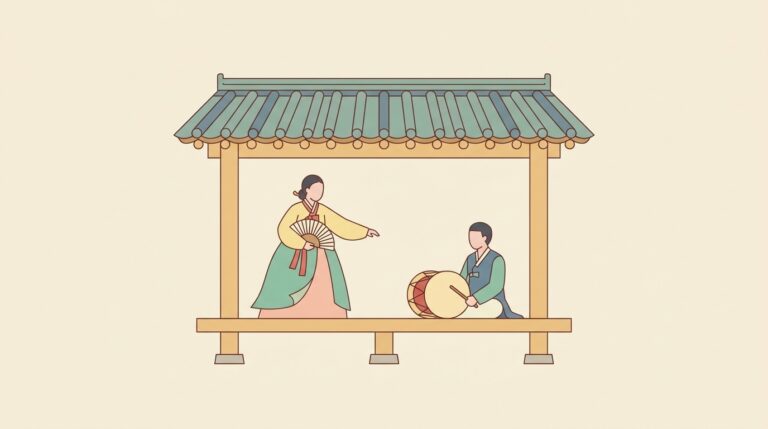
Here is the secret: Pansori is never a one-way performance. It is a three-way conversation between the singer (Sorikkun), the drummer (Gosu), and YOU—the audience. If you stay completely silent, the singer feels lonely and the energy drops! This guide is created based on real learner experiences to help you master Chuimsae (audience exclamations) and basic A2 Korean phrases so you can confidently cheer like a local.
Phase 2: 3 Core Expressions in Depth
1. 얼씨구! (Eolssigu!)
- Pronunciation: [Eol-ssi-gu] (Sounds like: “Uhl-see-goo” with a bouncy, joyful rhythm)
- Meaning: Literal: “Look here / Behold” | Real Nuance: “Oh yeah!”, “That’s the spirit!”, “Keep it up!”
- K-Culture Moment: In historical K-Dramas like Jeongnyeon: The Star is Born, whenever the lead singer pulls off a dramatic vocal run, the crowd shouts “얼씨구!” with a nod.
- Editor’s Insight: This is the ultimate Korean exclamation of spontaneous joy. You shout it when the rhythm picks up and the performance gets exciting.
- Situation Spectrum: Casual: ✅ | Semi-formal (Audience setting): ✅ | Formal Business: 🚫
- 🤔 Think About It: In English, cheering during a dramatic pause might feel disruptive. Why does Korean culture turn the audience into active co-creators of music?
2. 좋다! (Jota!)
- Pronunciation: [Jo-ta] (Sounds like: “Joe-tah” with a short, punchy ‘t’)
- Meaning: Literal: “It is good.” | Real Nuance: “Awesome!”, “Right on!”, “Bravo!”
- K-Culture Moment: When a K-pop idol or traditional singer hits a deeply resonant, gravelly note on a music show, the hosts pump their fists and shout “좋다!”.
- Editor’s Insight: While “좋아요” (joh-a-yo) is polite everyday Korean, during Pansori, dropping the formality to a crisp, hearty “좋다!” is standard theater etiquette.
- Situation Spectrum: Casual: ✅ | Audience Chuimsae: ✅ | Formal Office: 🚫
- 🤔 Think About It: Why is short, informal language preferred over polite honorifics when reacting to art in traditional Korea?
3. 잘한다! (Jarhanda!)
- Pronunciation: [Jal-han-da] (Sounds like: “Jahl-hahn-dah” with a strong, appreciative cadence)
- Meaning: Literal: “Doing well.” | Real Nuance: “You’re killing it!”, “Brilliant delivery!”
- K-Culture Moment: Hearing a Pansori master finish a 10-minute storytelling crescendo without losing breath prompts the entire hall to yell “잘한다!” in unison.
- Editor’s Insight: Use this right after an impressive vocal sprint or an emotional peak. It acts as instant fuel and encouragement for the performer.
- Situation Spectrum: Casual: ✅ | Audience Chuimsae: ✅ | Boss in Meeting: ⚠️ (Only if joking)
- 🤔 Think About It: How does directly praising someone’s skill out loud during a show strengthen the emotional bond (Jeong) between artist and listener?
Phase 3: Textbook Korean vs Real Korean
Situation 1: Expressing that the performance is deeply touching
- 📖 교과서 한국어 (Textbook): 이 공연은 정말 감동적입니다. (I gong-yeon-eun jeong-mal gam-dong-jeog-im-ni-da. – “This performance is very touching.”)
- 🗣️ 진짜 한국어 (Real-life): 와, 소름 돋았어요! (Wa, so-reum do-da-sseo-yo! – “Wow, I just got goosebumps!”)
- 💡 왜 다를까? (Why the difference?): While the textbook sentence is grammatically flawless, native speakers express deep admiration by referencing physical sensations like “goosebumps” (소름).
Situation 2: Praising the drummer’s rhythm
- 📖 교과서 한국어 (Textbook): 북 연주가 훌륭합니다. (Buk yeon-ju-ga hul-lyung-ham-ni-da. – “The drum playing is excellent.”)
- 🗣️ 진짜 한국어 (Real-life): 추임새가 딱 맞네요! (Chu-im-sae-ga ttak man-ne-yo! – “Your timing and cheers are spot on!”)
- 💡 왜 다를까? (Why the difference?): Koreans praise the rhythmic synergy (추임새 and 박자) rather than using formal adjectives like “훌륭하다”.
Phase 4: K-Culture Deep Dive & Non-verbal Manners
4-1. Nunchi & Performance Gestures
- Timing is Everything: Do not shout while the singer is in the middle of singing a lyrical phrase. Wait for the mini-pause at the end of a melodic line (Garak).
- Head Nod & Open Palms: A subtle head nod accompanied by a small upward open-hand gesture when shouting “좋다!” shows you are truly immersed in the rhythm.
- Reading the Drummer (Gosu): The drummer sits to the right of the singer. When the drummer yells a cheer, that is your green light to join in!
4-2. Cultural Code: Han (한) and Heung (흥)
Pansori is the ultimate sonic balance of two core Korean emotional states:
1. Han (한): Deep sorrow, historical grief, and perseverance.
2. Heung (흥): Uncontainable joy, groove, and communal ecstasy.
A typical Pansori story moves from deep suffering (Han) to ultimate celebration (Heung). Your cheers help the singer transition grief into communal joy!
Phase 5: Real-Life Roleplay Scenario
- Setting: The National Theater of Korea (국립극장), Seoul. You are sitting next to Min-woo, a friendly Korean Pansori fan.
- Characters:
- You (A2 Learner): Visiting your first live Pansori show.
- Min-woo (민우): Experienced traditional theater lover.
- Dialogue:
- 민우: 판소리 공연 처음 보세요? (Pan-so-ri gong-yeon cheo-eum bo-se-yo? / Is this your first time watching Pansori?)
🎭 Friendly smile - You: 네, 처음이에요. 조금 긴장돼요. (Ne, cheo-eum-i-e-yo. Jo-geum gin-jang-dwae-yo. / Yes, it’s my first time. I’m a bit nervous.)
🎭 Shy posture - 민우: 긴장하지 마세요! 조용히 안 계셔도 돼요. (Gin-jang-ha-ji ma-se-yo! Jo-yong-hi an gye-syeo-do dwae-yo. / Don’t be nervous! You don’t have to stay quiet.)
🎭 Waving hand lightly - You: 소리 질러도 돼요? (So-ri jil-leo-do dwae-yo? / Can I shout out loud?)
🎭 Surprised eyes - 민우: 그럼요! 소리꾼이 쉴 때 “얼씨구!” 해보세요. (Geu-reom-yo! So-ri-kkun-i swil ttae “Eol-ssi-gu!” hae-bo-se-yo. / Of course! Shout “Eolssigu!” when the singer pauses.)
🎭 Pointing towards stage - (The singer finishes a breathtaking vocal scale)
🎭 Drummer hits the Buk: DUNG! - You: 얼씨구! 좋다! (Eol-ssi-gu! Jo-ta! / Oh yeah! Bravo!)
🎭 Clapping with confidence - 민우: 와, 타이밍 대박! 정말 잘하시네요! (Wa, ta-i-ming dae-bak! Jeong-mal jal-ha-si-ne-yo! / Wow, incredible timing! You did so well!)
🎭 Thumbs up
🔀 Interactive Choice Point
The singer just completed a sad, tearful storytelling part about Chunhyang in prison. What do you do?
* Option A: Shout loudly: “얼씨구! 신난다!” (Eolssigu! This is so fun!)
* Option B: Say quietly with deep resonance: “그렇지…” (Geu-reot-ji… / “Indeed… that’s right…”)
* Option C: Stay silent, pull out your phone, and check Instagram.
Detailed Feedback:
* Option A (Bad): Shouting an upbeat party cheer during a tragic lament breaks the emotional atmosphere of Han.
* Option B (Best!): Perfect empathy! “그렇지…” or “아이고…” shows you are mourning along with the character.
* Option C (Risk): Using a glowing smartphone in a dark theater disrupts performers and fellow audience members.
Phase 6: 10-Second Emotion Shadowing Drill
Practice these lines out loud with the exact vocal pause (/) and feeling:
[😊 Joyful & Energetic]- 얼씨구! / 좋다! / 잘한다!
- (Eol-ssi-gu! / Jo-ta! / Jal-han-da!)
- “Oh yeah! / Awesome! / Brilliant!”
[🥺 Deeply Moved & Sympathetic]- 아이고… / 마음이 / 너무 아파요.
- (A-i-go… / Ma-eum-i / neo-mu a-pa-yo.)
- “Oh my goodness… / my heart / hurts so much.”
[🤩 Astonished & Excited]- 와, / 소름 / 돋았어요!
- (Wa, / so-reum / do-da-sseo-yo!)
- “Wow, / I just got / goosebumps!”
Phase 7: K-Culture Mini Dictionary
- 추임새 (Chu-im-sae) | Audience / Drummer Exclamations
- Usage: The supportive verbal cues and interjections that bring life into traditional Korean performing arts.
- 소리꾼 (So-ri-kkun) | Master Pansori Singer
- Usage: A storyteller who narrates an entire multi-hour epic tale through song (Sori), speech (Aniri), and gesture (Neoreumsae).
- 고수 (Go-su) | Traditional Drummer (Buk player)
- Usage: The rhythmic anchor of the stage. There is an old Korean saying: 일고수 이명창 (First is the drummer, second is the singer).
- 흥 (Heung) | Spontaneous Collective Joy
- Usage: Used widely in modern pop culture (e.g., “흥이 넘친다” – bursting with energy and groove).
Phase 8: Traveler Survival Kit
Top 3 Survival Phrases
- 한 표 주세요. (Han pyo ju-se-yo. / “One ticket, please.”)
- Pro Tip: Use this at small Hanok village ticket booths.
- 공연 언제 시작해요? (Gong-yeon eon-je si-jak-hae-yo? / “When does the show start?”)
- Pro Tip: Helpful when timing outdoor festival stages in Jeonju or Namwon.
- 사진 찍어도 돼요? (Sa-jin jji-geo-do dwae-yo? / “May I take photos?”)
- Pro Tip: Always ask before recording traditional stages.
Editor’s Travel Note
- Booking Tickets: For official stages like the National Gugak Center, navigate easily by using 네이버 지도 앱 다운로드 to check show schedules and subway routes.
- Where to Go: Visit the Jeonju Hanok Village on weekends for free open-air Pansori sessions where beginner cheers are warmly welcomed.
Phase 9: Go One Step Deeper
In Western classical music traditions, there is a clear boundary dividing the stage from the audience seats. But in traditional Korean arts, this fourth wall does not exist. A Pansori performance is considered incomplete without the audience’s active emotional labor. When you shout “얼씨구!”, you are not just a consumer of culture—you are an essential creator of the rhythm itself.
💬 Your Turn: Have you ever attended a concert where the crowd helped make the music? How does audience participation work in your home country? Drop your story in the comments below!
Phase 10: FAQ & Common Mistakes
Q: Can I shout “Eolssigu!” at a modern K-Pop concert?
A: Absolutely! K-Pop idols love traditional cheers. In fact, tracks like BTS’s IDOL and Stray Kids’ Thunderous directly integrate Chuimsae into their lyrics!
Q: What if my timing is off and I yell at the wrong moment?
A: Don’t panic! Traditional performers find foreign learners attempting Chuimsae endearing. If you make a mistake, simply smile and match the drummer’s next cue.
Q: Are there Pansori shows with English subtitles?
A: Yes! Major theaters like the National Theater of Korea offer real-time English, Japanese, and Chinese subtitles on small side screens.
🚨 Common Mistakes Alert
- Mistake: Remaining completely silent for 2 hours out of politeness.
- Correct Action: Join the drummer with a gentle “좋다!” after thrilling verses.
- Mistake: Clapping non-stop over the singer’s vocal lines.
- Correct Action: Pansori uses verbal cheers (Chuimsae), not continuous hand clapping. Save big applause for full song conclusions.
- Mistake: Shouting honorific words like “좋습니다!” during the show.
- Correct Action: Keep your cheers short and natural: “좋다!” or “얼씨구!”.
Phase 11: Action Mission & Engagement
- 🥉 Bronze Mission (Solo): Look into a mirror, raise your hand, and shout “얼씨구! 좋다!” 3 times with full energy.
- 🥈 Silver Mission (SNS): Watch a YouTube clip of Pansori (like Sugungga or Simcheongga) and type “얼씨구! 잘한다!” in the comments.
- 🥇 Gold Mission (Real Life): Visit a live traditional theater in Korea and deliver at least two on-beat Chuimsae during the performance!
🎮 K-Culture Mission: Listen to BTS’s song IDOL or Agust D’s Daechwita, spot the moment traditional Korean cheers appear, and shout along!
Phase 12: Interactive Quiz Challenge
Quiz 1: Situation Check
When the Pansori singer hits a thrilling high climax, what is the best natural cheer?
* A) 죄송합니다! (I am sorry!)
* B) 얼씨구! 좋다! (Oh yeah! Bravo!)
* C) 안녕히 계세요! (Goodbye!)
👉 Click to see the answer & explanation
Correct Answer: B) 얼씨구! 좋다!
Explanation: “얼씨구! 좋다!” is the standard pair of cheers used to celebrate exciting artistic peaks on stage.
Quiz 2: Fill in the Blank
Complete this common audience compliment:
“와, 노래 듣고 [ ] 돋았어요!” (Wow, listening to your singing gave me goosebumps!)
👉 Click to see the answer & explanation
Correct Answer: 소름 (so-reum)
Explanation: “소름 돋았어요” literally means “goosebumps popped up” and is used whenever you are deeply moved by a live performance.
Quiz 3: True or False
In Pansori etiquette, audience members must stay 100% quiet throughout the entire show just like in a Western classical symphony. (True / False)
👉 Click to see the answer & explanation
Correct Answer: False
Explanation: Pansori requires audience Chuimsae (cheers) to energize the singer and complete the performance harmony!







