

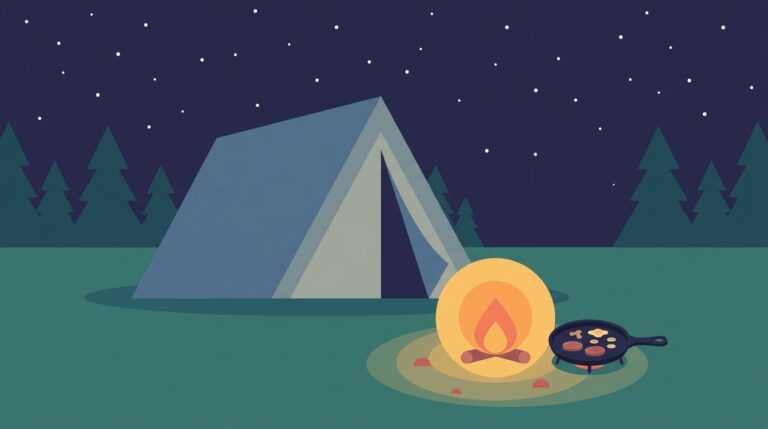
Master Korean Camping Vibes: The Art of Bulmeong and Campfire Cuisine
Phase 1: Empathy (Immersive Storytelling Opening)
안녕하세요! It’s your Daily Hangul editor and longtime cultural navigator. Imagine this: You’re sitting around a crackling campfire deep in the valleys of Gangwon-do with your Korean friends. The smell of thick pork belly sizzling on a cast-iron griddle fills the crisp evening air, and someone hands you a steaming cup of outdoor ramen. Everyone goes silent, eyes fixed hypnotically on the flickering flames. You want to describe this exact state of serene tranquility and praise the texture of the charcoal-grilled meat, but textbook phrases like “불이 아름답습니다” (The fire is beautiful) or “음식이 맛있습니다” (The food is delicious) feel utterly flat and clinical.
At the C1 level, mastering Korean isn’t just about grammatical accuracy—it’s about emotional resonance and shared sensory metaphors. Over the years, countless advanced learners have told me how frustrating it feels to understand 90% of a conversation yet lack the vivid, idiomatic vocabulary needed to match the ambient mood (bunwigi) of a Korean gathering. This guide is crafted directly from real field insights to help you transition from sounding like an analytical observer to feeling like an organic, soulful part of the camping circle.
Phase 2: Core Expressions Deep Dive
1. 불멍 때리다 (Bulmeong ttaerida)
- Pronunciation: [Bul-meong ttae-ri-da] (Think of ‘bull’ + ‘mung’ like a gong sound, and ‘ttae-ri-da’ like a sharp rhythmic tap)
- Meaning: Literal: “Hitting a fire trance” | Real Nuance: To zone out peacefully while gazing into a campfire, emptying your thoughts and destressing.
- K-Culture Moment: Seen constantly in Korean healing reality shows like Camping Club or House on Wheels, where cast members sit silently around a fire pit under the stars without uttering a word for minutes.
- Editor’s Insight: 멍때리다 means to zone out blankly. Compounding it with 불 (fire) creates a poetic modern buzzword. Koreans treat 불멍 almost as a form of active mindfulness.
- Situation Spectrum: Casual: ✅ | Semi-formal: ✅ | Formal: ⚠️ (Acceptable in casual business conversations about hobbies; avoid in formal written reports)
- 🤔 Think About It: Why do you think fast-paced, high-stress modern Korean society created specific words for zoning out at flames (불멍), water (물멍), and forests (숲멍)? What does this say about modern rest?
2. 겉바속촉으로 굽다 (Geot-ba-sok-chog-euro gupda)
- Pronunciation: [Geot-ba-sok-cho-geu-ro gup-da] (Crisp ‘geot-ba’, juicy soft ‘sok-chok’)
- Meaning: Literal: “To grill crispy on the outside, moist on the inside” | Real Nuance: Achieving the gold-standard texture for grilled meats, toasted marshmallows, or sweet potatoes baked in campfire coals.
- K-Culture Moment: Cooking enthusiasts on YouTube camping vlogs flipping a thick pork belly (samgyeopsal) slab, slicing it open to show the contrast between the crust and tender interior.
- Editor’s Insight: An abbreviation of 겉은 바삭하고 속은 촉촉하다. It’s not just a descriptive adjective; using it as an adverbial phrase (-으로 굽다/익히다) demonstrates high-level culinary fluency.
- Situation Spectrum: Casual: ✅ | Semi-formal: ✅ | Formal: 🚫
- 🤔 Think About It: How does sensory texture (siggam) take priority over simple flavor profiles in your mother tongue compared to Korean food descriptions?
3. 국물이 칼칼하고 얼큰하다 (Gungmuri kal-kal-hago eol-keun-hada)
- Pronunciation: [Gung-mu-ri kal-kal-ha-go eol-keun-ha-da] (Rough ‘k’ sound in ‘kal-kal’ echoing the throat-clearing spicy kick)
- Meaning: Literal: “The broth is scratchy-spicy and refreshing-spicy” | Real Nuance: The soup possesses a deep, invigorating, throat-warming spice that cuts through grease and chilly outdoor air.
- K-Culture Moment: Slurping ramyeon or kimchi jjigae cooked on a portable stove right after hours in the cold, followed by a theatrical “Khaa~” exhale.
- Editor’s Insight: English simplifies this to “spicy”, but 칼칼하다 denotes a clean chili-powder pepperiness in the throat, while 얼큰하다 refers to a deep, full-bodied warmth that relieves physical fatigue.
- Situation Spectrum: Casual: ✅ | Semi-formal: ✅ | Formal: ✅
- 🤔 Think About It: Why does Korean have over ten distinctive adjectives for spiciness (매콤하다, 얼큰하다, 칼칼하다, 맵싸하다) while most Western languages rely on mild vs. hot?
Phase 3: Textbook Korean vs. Real Korean
Situation 1: Expressing the need to relax without thinking
- 📖 교과서 한국어: “저는 지금 모닥불을 보면서 스트레스를 풀고 아무 생각도 하지 않고 있습니다.”
(I am currently releasing stress and not thinking about anything while looking at the bonfire.) - 🗣️ 진짜 한국어: “아, 장작 타는 소리 들으면서 불멍 때리니까 머릿속이 싹 비워지네요.”
(Ah, zoning out to the sound of burning firewood just completely clears my head.) - 💡 왜 다를까? Textbook Korean over-explains psychological states. Natural C1 Korean connects the ambient environmental sound (장작 타는 소리) with sensory idioms (머릿속이 싹 비워지다).
Situation 2: Suggesting how to cook campfire meat
- 📖 교과서 한국어: “고기의 겉을 바삭하게 만들고 안쪽의 육즙을 보존하여 구워주세요.”
(Please cook the meat such that the outside becomes crispy and the inner meat juice is preserved.) - 🗣️ 진짜 한국어: “센 불에 먼저 확 시어링해서 겉바속촉으로 육즙 제대로 가둬야 해요.”
(We need to sear it quickly over high heat first to lock in the juices and get that crispy-outside, tender-inside finish.) - 💡 왜 다를까? Advanced native speakers use dynamic verbs like 가두다 (to trap/lock in) combined with tactile compound buzzwords like 겉바속촉.
Phase 4: K-Culture Deep Dive & Non-Verbal Manners
4-1. 눈치 (Nunchi) & Campfire Etiquette
In Korean outdoor culture, the campfire pit (hmaro-dae) is a communal sanctuary.
* The Tongs Protocol: The person holding the tongs (jip-ge) is the conductor of the meal. Never grab your own piece directly off the central grill with raw chopsticks unless invited. Instead, observe their rhythm. When they place a cooked piece on your side plate or leaf wrap, accept it with two hands or a slight head bow.
* Fire Keeper Etiquette: Adding firewood (jangjak) requires subtle social awareness. Throwing a huge log without asking might produce sudden billowing smoke that stings everyone’s eyes (연기 테러). Always ask: “장작 하나 더 넣을까요?” (Shall I toss another log in?).
4-2. The Healing Trend: “Gamseong Camping” (감성 캠핑)
Korean camping has evolved far beyond rugged survivalism into Gamseong (aesthetic/emotional) culture. It revolves around soft ambient lighting (Edison lanterns), vintage cookware (cast iron griddles), acoustic playlists, and high-end outdoor gastronomy. Understanding this helps you realize why phrases like 힐링된다 (This is healing) and 분위기 깡패 (The atmosphere is unbeatable) are essential currency around the campfire.
Phase 5: Real-World Roleplay Scenario
Setting: A peaceful autumn evening campsite near the Bukhangang River.
Characters:
* Min-jun (민준): The seasoned camper and self-proclaimed BBQ master.
* You: An advanced Korean speaker unwinding after a busy week.
[Scene Start: The fire pit is glowing red, and pork neck steaks are sizzling on the griddle.]

민준: 🥩 (집게로 고기를 능숙하게 뒤집으며) 자, 지금 타이밍이야. 겉은 센 불로 바삭하게 익히고 있거든?
Min-jun: (Flipping the meat skillfully with tongs) Here we go, timing is key now. I'm crisping the outside over high heat.

You: 와, 진짜 겉바속촉의 정석이네요! 육즙 하나도 안 빠져나갔어요.
     [Wa, jinjja geot-ba-sok-chog-ui jeong-seog-i-ne-yo! Yuk-jeub ha-na-do an ppa-jyeo-na-gat-seo-yo.]
     (Wow, that’s the textbook definition of crispy outside, juicy inside! Not a drop of juice was lost.)

민준: 🥢 (흐뭇하게 웃으며 잘 익은 한 점을 건네준다) 얼른 소금만 살짝 찍어서 먹어봐.
Min-jun: (Smiling proudly, hands over a well-cooked slice) Hurry, dip it lightly in just salt and taste it.

You: 😋 (한 입 씹고 감탄하며) 음~! 씹자마자 육즙이 팡 터지는데요? 국물 요리도 슬슬 끓일까요?
     [Eum~! Ssip-ja-ma-ja yuk-jeub-i pang teo-ji-neun-de-yo? Gung-mul yo-ri-do seul-seul kkeulh-il-kka-yo?]
     (Mmm~! The juice literally bursts the moment I bite down! Shall we start simmering the soup too?)

민준: 🍲 (버너에 찌개 냄비를 올리며) 안 그래도 칼칼한 어묵탕 끓이려고 준비해 뒀지.
Min-jun: (Placing a stew pot on the portable stove) Already prepared a zesty fish cake soup for this exact moment.

You: 날씨 쌀쌀한데 국물 한 모금 마시면 속이 확 풀리겠어요.
     [Nal-ssi ssal-ssal-han-de gung-mul han mo-geum ma-si-myeon sok-i hwak pul-li-get-seo-yo.]
     (It's getting chilly out, so a sip of that broth will warm and soothe my stomach instantly.)

민준: 🔥 (의자에 깊숙이 기대앉으며) 맞아. 배 채웠으니까 이제 불멍이나 제대로 때리자.
Min-jun: (Leaning deep into his camping chair) Exactly. Now that we're full, let’s zone out to the fire properly.

You: 🌌 (모닥불을 가만히 바라보며) 타닥타닥 장작 타는 소리 듣고 있으니까 잡생각이 다 사라지네요.
     [Ta-dak-ta-dak jang-jak ta-neun so-ri deut-go iss-eu-ni-kka jap-saeng-gak-i da sa-ra-ji-ne-yo.]
     (Listening to the crackle of the wood just makes all random distractions fade away.)

[Scene End]
🔀 Interactive Decision Point
Min-jun throws another log on the fire, causing a burst of golden sparks, and sighs in comfort. How do you respond?
- Option A: “불멍 때리니까 그동안 쌓였던 스트레스가 눈 녹듯이 사라지는 것 같아요.”
- 👉 Feedback [Best]: Natural, evocative C1 phrasing connecting 불멍 with a poetic metaphor (눈 녹듯이 사라지다 – melt away like snow).
- Option B: “이 불의 화학 반응이 매우 인상적이고 온도가 아주 높습니다.”
- 👉 Feedback [Bad]: Overly clinical and robotic. Destroys the campfire sentimentality (gamseong).
- Option C: “야! 연기 나한테 오잖아! 빨리 불 꺼!”
- 👉 Feedback [Risk]: Abrupt, rude pan-mal imperative (야, 불 꺼). Even among close friends, snapping aggressively ruins the chill outdoor atmosphere.
Phase 6: 10-Second Emotion Shadowing Drill
Practice these lines with rhythm, taking note of breath pauses marked by /:
- [😌 Deep Serenity & Mindful Relief]
- “아무 생각 없이 / 타닥타닥 타는 장작 보면서 / 불멍 때리는 게 / 제일 큰 힐링이에요.”
- [A-mu saeng-gak eop-si / ta-dak-ta-dak ta-neun jang-jak bo-myeon-seo / bul-meong ttae-ri-neun ge / je-il keun hil-ling-i-e-yo.]
- [🤤 Genuine Culinary Delight]
- “와, / 고기가 겉바속촉으로 제대로 익어서 / 씹을 때마다 육즙이 / 입안 가득 퍼지네요!”
- [Wa, / go-gi-ga geot-ba-sok-chog-eu-ro je-dae-ro ik-eo-seo / ssib-eul ttae-ma-da yuk-jeub-i / ib-an ga-deuk peo-ji-ne-yo!]
- [🥶 Warm Gratitude in the Cold Night]
- “쌀쌀한 밤공기 마시다가 / 이 칼칼한 국물 한 숟가락 들어가니까 / 몸이 사르르 녹아요.”
- [Ssal-ssal-han bam-gong-gi ma-si-da-ga / i kal-kal-han gung-mul han sut-ga-rak deul-eo-ga-ni-kka / mom-i sa-reu-reu nok-a-yo.]
Phase 7: K-Culture Mini Dictionary
- 불멍 (Bul-meong): Fire Zen / Staring Blankly at Fire. The act of unwinding silently by watching campfire embers.
- 감성 캠핑 (Gam-seong Kaem-ping): Aesthetic Camping. Prioritizing vintage decor, mood lighting, and gourmet food presentation over spartan backpacking.
- 그리들 (Geu-ri-deul): Cast-Iron Camping Griddle. The round, flat Korean outdoor pan used for everything from searing meats to simmering spicy rice cakes.
- 마무리는 볶음밥 (Ma-mu-ri-neun Bok-keum-bap): The Mandatory Fried Rice Finale. The unwritten Korean culinary rule stating that whatever you grill on a griddle, you must finish the meal by frying rice in the remaining sauces.
Phase 8: Traveler’s Survival Kit
Top 3 Camping Expressions
- “장작 한 포대 더 살 수 있을까요?” (Can we buy one more sack of firewood?)
- Pro Tip: Useful at campground administrative booths (maeshim).
- “매너 타임이 몇 시부터인가요?” (What time does the quiet ‘manner time’ start?)
- Pro Tip: Most Korean campsites enforce strict silence (매너 타임) starting between 10:00 PM and 11:00 PM.
- “숯불에 고구마 호일 싸서 넣어둘게요.” (I’ll wrap sweet potatoes in foil and bury them in the charcoal embers.)
- Pro Tip: A classic staple of Korean campfire culture that will impress any native host.
Editor’s Travel Note
For reservations at scenic Korean campsites, foreign credit cards are often tricky on private pension sites. Check the Korea National Park Camping Reservation Service for state-run, eco-friendly forest sites that support English, and navigate remote trails using Naver Map Navigation App.
Phase 9: Go One Step Deeper (Reflective Essay)
In Korean culture, the hearth has shifted from an ancestral locus of survival to a psychological sanctuary of non-verbal solidarity. Koreans live in a hyper-connected, high-context society governed by constant social awareness (nunchi). 불멍 is one of the rare cultural moments where the expectation of dynamic conversation is officially suspended without social awkwardness. Sharing silence together around a flame is viewed not as distance, but as profound companionship (jeong).
💬 Your Turn: In your culture, is sitting in prolonged silence around a meal or fire seen as comforting or awkward? Share your perspective in the comments below!
Phase 10: FAQ & Common Mistakes
Q: Can I use “불멍 때리다” in front of my boss or professor?
A: You can use it when discussing personal weekend hobbies in casual conversation (e.g., “주말에 캠핑 가서 불멍 때리고 왔습니다”), but avoid it in formal presentations or business reports where “모닥불을 보며 휴식했습니다” is more appropriate.
Q: What is the difference between “얼큰하다” and “칼칼하다”?
A: 얼큰하다 refers to a deep, hearty, red-stew spiciness that warms the belly and restores vigor. 칼칼하다 highlights a sharp, clean peppery sensation at the back of the throat, often achieved with fresh Cheongyang chili or fine gochugaru.
Q: When is “마무리는 볶음밥” expected during outdoor cooking?
A: Whenever you use a wide flat pan (griddle or dolsot) for marinated meats, duck BBQ, or stir-fries. Leaving the leftover savory oils without mixing in cooked rice, shredded seaweed (gim), and sesame oil is considered almost tragic in Korean camping culture!
🚨 Common Mistakes Alert
- Mistake: Saying “불을 보고 멍해졌어요” (I became stupidly dazed looking at fire).
- Correct Action: Use the active compound: “불멍 때렸어요.”
- Mistake: Describing crunchy grilled meat as “바삭바삭해요” alone.
- Correct Action: Pair external crispness with internal juiciness using “겉바속촉이에요.”
- Mistake: Throwing trash or wet wood into a communal fire pit without checking.
- Correct Action: Respect the communal air quality; ask the designated fire master first.
Phase 11: Action Missions & Engagement
- 🥉 Bronze Mission (Self-Practice): Record your voice saying: “타닥타닥 장작 타는 소리 들으면서 불멍 때리니까 진짜 힐링되네요.” Focus on maintaining a relaxed, rhythmic tone.
- 🥈 Silver Mission (Social Connection): Post a photo of a cozy beverage, candle, or fire on Instagram using the hashtags
#불멍 #겉바속촉 #DailyHangul. - 🥇 Gold Mission (Real Application): Next time you eat BBQ or sit outdoors with Korean speakers, compliment the meat texture using “와, 육즙 제대로 가둬서 완전 겉바속촉인데요?”.
- 🎮 K-Culture Mission: Watch an episode of a Korean travel/camping variety show (like Three Meals a Day or Camping Club) and identify the moment the cast stops speaking to 불멍 때리다.
Phase 12: Interactive Quiz Challenge
Question 1: Situational Judgement
You are sitting around a campfire in Pyeongchang. Your friend asks how you feel after eating spicy stew and staring at the coals. Which response sounds most natural at an advanced C1 level?
A) “불이 너무 뜨겁고 음식이 빨간색이라 맵습니다.”
B) “칼칼한 국물 먹고 불멍 때리니까 한 주 스트레스가 싹 날아가네요.”
C) “저는 지금 정신을 완전히 잃어버려서 생각이 없습니다.”
🔍 Click to Reveal Answer & Explanation
Correct Answer: B
Explanation: Option B masterfully combines 칼칼하다 (peppery broth) with 불멍 때리다 (fire zoning) and the idiomatic expression 스트레스가 싹 날아가다 (stress flies completely away). Option A is elementary and flat; Option C implies clinical unconsciousness rather than pleasant relaxation!
Question 2: Fill-in-the-Blank
Complete the sentence to praise the grilling technique:
“고기를 센 불에 구워서 겉은 바삭하고 속은 부드러운 상태를 네 글자로 (____________)이라고 부릅니다.”
🔍 Click to Reveal Answer & Explanation
Correct Answer: 겉바속촉 (Geot-ba-sok-chok)
Explanation: Short for 겉은 바삭하고 속은 촉촉하다 (Crispy outside, juicy inside).
Question 3: Cultural True or False
Statement: In Korean campgrounds, making loud noise and playing high-volume music after 11:00 PM is welcomed as part of open festive socializing.
🔍 Click to Reveal Answer & Explanation
Correct Answer: False (F)
Explanation: Korean campgrounds strictly observe 매너 타임 (Manner Time) starting around 10:00~11:00 PM. Campers lower voices and switch off bright lanterns to allow neighbors to rest and enjoy quiet fire-gazing in peace.







