

Phase 1: Empathy (Story-Driven Opening)
안녕하세요! 매일한글 에디터입니다. (Hello! I’m your Daily Hangul editor!)
Picture this: You just landed at Incheon Airport at 8:00 AM after a 12-hour flight. Your heart is racing with excitement to explore the vibrant streets of Hongdae or Myeongdong, grab some sizzling tteokbokki, and sip on an iced Americano just like your favorite K-drama leads. But there’s a heavy, clunky problem rolling right beside you—your 28-inch suitcase. Official hotel check-in isn’t until 3:00 PM. Are you stuck dragging that giant luggage through crowded subway stations, cobblestone alleys, and tiny cosmetic shops? Absolutely not!
Many of our beginner students tell us they feel intimidated approaching the front desk before check-in time. You might freeze, wonder if luggage storage is even allowed, or worry about sounding impolite. Today, we’re going to master the single most magical, stress-relieving phrase every traveler in Korea needs: “짐 맡겨도 되나요?” (Can I leave my luggage here?). With this friendly survival guide built on real classroom feedback, you’ll walk up to any hotel desk with total confidence, drop off your bags in 30 seconds, and start your Seoul adventure hands-free!
Phase 2: Deep-Dive into Top 3 Key Expressions
1. 짐 맡겨도 되나요?
- Pronunciation: [Jim mat-gyeo-do doe-na-yo?] (Think: ‘Jim’ like the name Jim + ‘mat’ like floor mat + ‘gyeo’ like ‘pure’ without the p + ‘do doe-na-yo’)
- Meaning: Literal: “Is it okay even if I entrust luggage?” / Natural: “May I leave my luggage here?”
- K-Culture Moment: Seen in almost every travel romance drama (like Crash Landing on You or King the Land) when characters arrive at luxury hotels or boutique hanok stays before their room is ready.
- Editor’s Insight: The verb 맡기다 (mat-gi-da) means “to entrust / leave in someone’s care.” Adding “-도 되나요?” turns it into a polite request asking for permission without sounding demanding.
- Situation Spectrum: Casual: ⚠️ (짐 맡겨도 돼? – close friends only) | Semi-formal: ✅ (짐 맡겨도 돼요?) | Formal: ✅ (짐 맡겨도 되나요? / 짐 보관 되나요?)
- 🤔 Think About It: In English, we often ask “Can you hold my bags?” (focusing on the other person). Korean focuses on the act of entrusting (맡기다). How does asking permission reflect Korean politeness?
2. 체크인 전에 짐 보관할 수 있나요?
- Pronunciation: [Che-keu-in jeon-e jim bo-gwan-hal su in-na-yo?]
- Meaning: Literal: “Before check-in, is luggage storage possible?” / Natural: “Can I store my luggage before check-in?”
- K-Culture Moment: Perfect when speaking to busy concierge desks in upscale hotels in Gangnam or Incheon.
- Editor’s Insight: 체크인 (check-in) is a widely recognized Konglish term. 보관 (bo-gwan) is the Sino-Korean noun for ‘storage’ or ‘custody.’
- Situation Spectrum: Casual: 🚫 | Semi-formal: ✅ | Formal: ✅ (Highly recommended for clear communication)
- 🤔 Think About It: Koreans love efficiency! Using precise nouns like 보관 (storage) instantly signals your intent.
3. 몇 시까지 찾으러 오면 돼요?
- Pronunciation: [Myeot si-kka-ji cha-jeu-reo o-myeon dwae-yo?]
- Meaning: Literal: “By what time is coming to retrieve okay?” / Natural: “By what time should I come pick it up?”
- K-Culture Moment: When leaving your bags at a guesthouse near Busan beach before heading out for grilled clams and sunset views.
- Editor’s Insight: 찾다 (chat-da) usually means ‘to find’ or ‘to search,’ but when paired with luggage, money, or dry cleaning, it means ‘to pick up / retrieve.’
- Situation Spectrum: Casual: ⚠️ | Semi-formal: ✅ | Formal: ✅
- 🤔 Think About It: Notice how Korean creates smooth flow by combining actions: 찾으러 (in order to pick up) + 오면 (if I come) + 돼요 (is it okay?).
Phase 3: Textbook Korean vs. Real Native Korean
Situation 1: Asking to store bags
- 📖 Textbook Korean: 제 가방을 보관소에 보관해 주실 수 있습니까? (Je ga-bang-eul bo-gwan-so-e bo-gwan-hae ju-sil su it-seum-ni-kka? – Highly robotic and overly formal)
- 🗣️ Real Native Korean: 짐 좀 맡길 수 있을까요? (Jim jom mat-gil su iss-eul-kka-yo? – Natural, soft, and polite)
- 💡 Why is it different? Adding the soft cushion word 좀 (jom – a little/please) immediately softens the request, making you sound friendly rather than demanding.
Situation 2: Asking for your luggage back
- 📖 Textbook Korean: 맡겨진 수하물을 반환해 주십시오. (Mat-gyeo-jin su-ha-mul-eul ban-hwan-hae ju-sip-si-o. – Sounds like an airport customs notice)
- 🗣️ Real Native Korean: 저, 맡겨둔 짐 찾으러 왔어요! (Jeo, mat-gyeo-dun jim cha-jeu-reo wass-eo-yo! – Natural and conversational)
- 💡 Why is it different? Native speakers naturally open brief interactions with a gentle “저…” (Um / Excuse me) to get polite attention.
Phase 4: K-Culture Deep-Dive & Non-Verbal Etiquette
4-1. 눈치 (Nunchi) & Polite Gestures
When handing over your luggage or luggage tag at a hotel counter:
* The Two-Handed Handover: Always hand your passport, room key card, or luggage receipt ticket using both hands (or support your right forearm lightly with your left hand). Handing something with one limp hand can appear aloof or dismissive.
* The Micro-Bow: A polite 15-degree nod when saying “감사합니다” (Gam-sa-ham-ni-da) instantly builds warmth with hotel staff.
4-2. Cultural Insight: Korea’s Safe Travel Ecosystem (K-Travel)
Korea is famous for its incredible public safety. Leaving your luggage at a hotel front desk or guesthouse lobby is exceptionally safe and standard practice. Most accommodations will give you a small numbered plastic tag or claim paper called a 번호표 (beon-ho-pyo). You can confidently explore the city knowing your belongings are well cared for!
Phase 5: Real-Life Roleplay Scenario
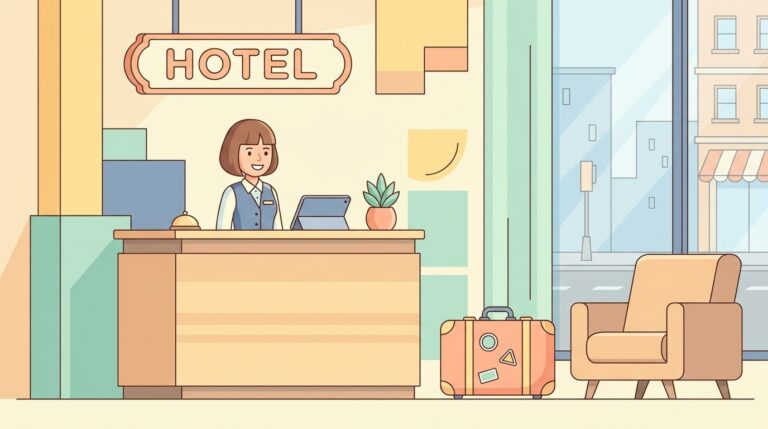
Setting: 10:30 AM at the sleek front desk of ‘Hotel Namsan View’ in Myeongdong.
Characters: You (The excited traveler) and Min-ho (The warm, sharp hotel concierge).
- Turn 1 (You): 안녕하세요! 저… 짐 좀 맡겨도 되나요?
(An-nyeong-ha-se-yo! Jeo… jim jom mat-gyeo-do doe-na-yo?)
🎭 Handing over your reservation booking screen with both hands and smiling.
(Hello! Um… could I leave my luggage here?) -
Turn 2 (Min-ho): 네, 환영합니다! 예약자분 성함이 어떻게 되시나요?
(Ne, hwan-yeong-ham-ni-da! Ye-yak-ja-bun seong-ham-i eo-tteo-ke doe-si-na-yo?)
🎭 Typing lightly on the keyboard with a bright smile.
(Yes, welcome! May I have the name on the reservation?) -
Turn 3 (You): 제 이름은 알렉스예요. 오늘 3시에 체크인해요.
(Je i-reum-eun Al-lek-seu-ye-yo. O-neul se-si-e che-keu-in-hae-yo.)
🎭 Nodding politely.
(My name is Alex. I am checking in today at 3 PM.) -
Turn 4 (Min-ho): 아, 알렉스 님 확인되셨습니다. 가방 몇 개이신가요?
(A, Al-lek-seu nim hwa-gin-doe-syeot-seum-ni-da. Ga-bang myeot gae-i-sin-ga-yo?)
🎭 Stepping forward to look at your bags.
(Ah, confirmed, Alex! How many bags do you have?) -
Turn 5 (You): 캐리어 하나랑 백팩 하나예요. 총 두 개요!
(Kae-ri-eo ha-na-rang baek-paek ha-na-ye-yo. Chong du gae-yo!)
🎭 Pointing gently to the suitcase and backpack.
(One suitcase and one backpack. Two in total!) -
Turn 6 (Min-ho): 네, 여기 보관 번호표 드릴게요. 잃어버리시면 안 돼요!
(Ne, yeo-gi bo-gwan beon-ho-pyo deu-ril-ge-yo. Il-eo-beo-ri-si-myeon an dwae-yo!)
🎭 Handing a plastic tag numbered ’14’ with both hands.
(Okay, here is your luggage claim tag. Please don’t lose it!) -
Turn 7 (You): 네, 감사합니다! 혹시 몇 시까지 찾으러 오면 돼요?
(Ne, gam-sa-ham-ni-da! Hok-si myeot si-kka-ji cha-jeu-reo o-myeon dwae-yo?)
🎭 Taking the tag with both hands.
(Thank you! By the way, by what time should I come pick it up?) -
Turn 8 (Min-ho): 프런트 데스크는 24시간 운영하니 편하실 때 언제든 오세요. 좋은 하루 보내세요!
(Peu-reon-teu de-seu-keu-neun i-sip-sa-si-gan un-yeong-ha-ni pyeon-ha-sil ttae eon-je-deun o-se-yo. Jo-eun ha-ru bo-nae-se-yo!)
🎭 Bowing gently.
(The front desk is open 24 hours, so feel free to come anytime. Have a wonderful day!)
🔀 Interactive Decision Branch
What would you say if you want to leave your bags after checking out at 11:00 AM?
- Option A: “야, 짐 맡겨.” (Ya, jim mat-gyeo.)
- Feedback (Bad): 🚫 Dangerously rude! This is aggressive banmal (informal speech). You might shock the receptionist!
- Option B: “체크아웃 했는데, 짐 잠깐 맡겨도 돼요?” (Che-keu-a-ut haen-neun-de, jim jam-kkan mat-gyeo-do dwae-yo?)
- Feedback (Best): 🌟 Perfect 100 points! Clear, polite, and completely natural Korean.
- Option C: “가방 바이바이!” (Ga-bang bai-bai!)
- Feedback (Risk): ⚠️ Cute and funny, but may cause confusion if the staff doesn’t understand context.
Phase 6: 10-Second Emotion Shadowing Drill
Practice saying these aloud with rhythm and feel!
[😊 Relieved & Friendly]
저 / 짐 좀 / 맡겨도 되나요?
(Jeo / jim jom / mat-gyeo-do doe-na-yo?)-
[🤔 Curious & Polite]
몇 시까지 / 찾으러 오면 돼요?
(Myeot si-kka-ji / cha-jeu-reo o-myeon dwae-yo?) -
[✨ Bright & Happy]
체크인 전에 / 짐 보관할게요!
(Che-keu-in jeon-e / jim bo-gwan-hal-ge-yo!)
Phase 7: K-Culture Mini Dictionary
- 캐리어 (Kae-ri-eo) | Suitcase / Rolling Luggage
Everyday Use: Koreans use the English word ‘Carrier’ rather than ‘Suitcase’ for wheeled travel luggage. - 보관 (Bo-gwan) | Storage / Safekeeping
Everyday Use: Appears on signs in train stations, subway lockers (물품보관함), and hotel counters. - 번호표 (Beon-ho-pyo) | Number Ticket / Claim Tag
Everyday Use: Given at luggage storage desks, busy restaurants waiting lines, and bank counters. - 체크아웃 (Che-keu-a-ut) | Check-out
Everyday Use: The universal standard word used in Korean accommodations.
Phase 8: Traveler’s Survival Kit
Top 3 Survival Phrases
- “짐 여기 둘게요!” (Jim yeo-gi dul-ge-yo! – I will put my bags right here!)
Pro Tip: Great when the staff points to a designated luggage area behind the desk. - “이거 깨지는 물건 있어요.” (I-geo kkae-ji-neun mul-geon iss-eo-yo. – There are fragile items inside.)
Pro Tip: Essential if you bought traditional ceramics or K-beauty glass serum bottles. - “제 짐 찾아갈게요.” (Je jim cha-ja-gal-ge-yo. – I am here to collect my luggage.)
Pro Tip: Say this while presenting your luggage claim tag.
💡 Editor’s Travel Note
If your Airbnb or small guesthouse doesn’t offer luggage storage, download the Naver Map navigation app guide to search for ‘물품보관함’ (Storage lockers) located inside almost every major Seoul Metro station. You can pay conveniently using your T-Money transit card or credit card!
Phase 9: A Step Deeper (Reflection)
In Korean language and society, requests are rarely framed as direct commands. Instead, they are framed around mutual harmony and polite permission using grammar forms like “-해도 돼요?” (Is it permissible even if I do this?). When you ask to leave your bags in Korean, you are acknowledging the staff’s caretaking effort rather than treating luggage storage as a mere transactional service.
💬 Your Turn: What is the standard etiquette for storing luggage at hotels in your home country? Have you ever had a funny or stressful experience traveling with heavy bags? Share your story in the comments below!
Phase 10: FAQ & Common Mistakes
Q: Is luggage storage before check-in usually free in Korean hotels?
A: Yes! Almost all hotels, hostels, and registered guesthouses in Korea provide complimentary luggage holding both before check-in and after check-out on the day of your stay.
Q: Can I leave my bags overnight if I travel to Jeju Island for two days?
A: Many hotels will allow this if you have another upcoming reservation with them upon return. Just ask: “모레 다시 오는데, 이틀 동안 보관 가능한가요?” (I return the day after tomorrow, can I store it for two days?).
Q: What if I lose my plastic luggage number tag (번호표)?
A: Don’t panic! Simply show your passport and hotel booking voucher so the front desk can verify your identity and match the name tag on the bag.
🚨 Common Mistakes Alert!
- ❌ Saying “내 가방 가져가!” (Nae ga-bang ga-jyeo-ga! – “Take my bag!”) -> ✅ Say: “짐 좀 맡겨주세요.” (Please take care of my luggage).
- ❌ Leaving valuables (passports, cash, expensive laptops) inside checked luggage -> ✅ Always keep critical valuables in a small carry-on bag.
- ❌ Forgetting to take a photo of your luggage claim tag -> ✅ Snap a quick photo with your phone just in case you lose the paper slip!
Phase 11: Action Missions
- 🥉 Bronze Mission: Stand in front of your mirror and repeat “짐 맡겨도 되나요?” 5 times until it rolls off your tongue smoothly.
- 🥈 Silver Mission: Save this phrase in your phone’s travel notes app and teach it to your travel partner.
- 🥇 Gold Mission: Use this exact phrase at your hotel or guesthouse reception during your next trip to Korea!
- 🎮 K-Culture Mission: Watch an episode of a travel variety show like Europe Outside Your Tent or a K-drama hotel scene, and listen for how characters say 체크인 or 짐!
Phase 12: Interactive Quiz Challenge
Quiz 1: Situation Judgement
You just arrived at a boutique hotel in Busan at 11:00 AM. Check-in is at 3:00 PM. What is the most natural sentence to say?
* (A) 체크인 지금 해줘! (Che-keu-in ji-geum hae-jwo!)
* (B) 짐 맡겨도 되나요? (Jim mat-gyeo-do doe-na-yo?)
* (C) 가방 가져가세요. (Ga-bang ga-jyeo-ga-se-yo.)
👉 Click to reveal Answer & Explanation
Correct Answer: (B)
Explanation: (B) is the polite, natural standard expression. (A) is an informal demand to check in immediately, and (C) sounds like you are ordering someone to take your bag away forever!
Quiz 2: Fill in the Blank
Complete the sentence for asking luggage pickup time:
“몇 시까지 _______ 오면 돼요?” (By what time should I come to pick it up?)
* (A) 찾으러 (cha-jeu-reo)
* (B) 버리러 (beo-ri-reo)
* (C) 만들러 (man-deul-leo)
👉 Click to reveal Answer & Explanation
Correct Answer: (A) 찾으러
Explanation: 찾으러 오다 means ‘to come pick up / retrieve.’ 버리러 means ‘to throw away,’ and 만들러 means ‘to make.’
Quiz 3: True or False (Culture)
In Korea, it is common and polite to hand over your luggage claim ticket or room key with both hands.
* (A) True
* (B) False
👉 Click to reveal Answer & Explanation
Correct Answer: (A) True
Explanation: Using two hands (or supporting your arm) expresses courtesy and respect in Korean etiquette.







