

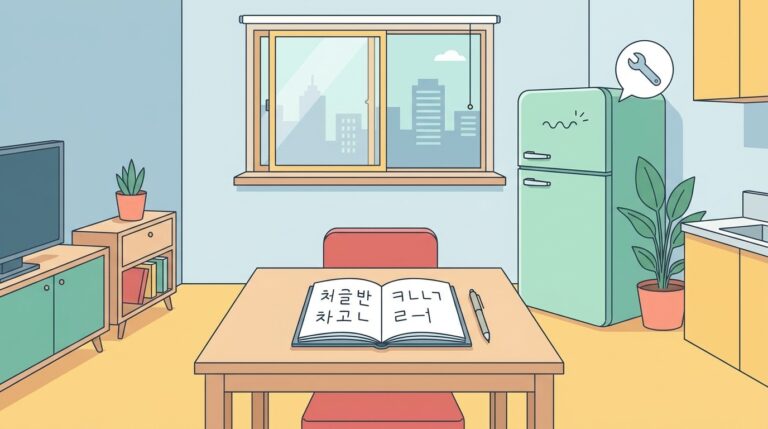
Phase 1: Empathy (Story-Immersive Opening)
안녕하세요! 매일한글 에디터입니다. (Hello! This is your Daily Hangul editor.)
Picture this: It is 2:00 AM in your cozy one-room (studio apartment) in Hongdae. You just turned off your favorite K-drama, wrapped yourself in your blanket, and closed your eyes. Suddenly… BRRRRRRR-CLACK-CLACK-WHIRRRRR. The small built-in refrigerator starts vibrating like an airplane engine preparing for takeoff. You toss and turn, put pillows over your ears, but the rattling noise just won’t stop.
The next morning, with tired eyes and a hot cup of iced americano, you look at your phone. You need to call the landlord (imdaein) or the electronics brand customer service center (A/S center). But panic sets in: “How do I describe a buzzing, rattling noise in Korean without sounding rude or completely lost?”
If you have ever felt paralyzed trying to explain a technical home appliance issue in Korean, you are definitely not alone! This guide is crafted from real feedback from international residents and students living in Korea. Mastering these expressions won’t just get your fridge fixed quickly—it will instantly level up your intermediate Korean conversational fluency and boost your confidence in handling real-world adulting in Korea.
Phase 2: 3 Core Expressions In-Depth
1. 냉장고에서 이상한 소리가 나요
- Pronunciation: [Naeng-jang-go-e-seo i-sang-han so-ri-ga na-yo] (Sounds like: naeng-jahng-go-eh-seo ee-sahng-hahn soh-ree-gah nah-yoh)
- Meaning: Literal: “A strange sound comes out from the refrigerator.” / Natural: “The fridge is making a weird noise.”
- K-Culture Moment: In slice-of-life dramas like Hospital Playlist or Because This Is My First Life, you often see characters calling customer service and nervously repeating this exact line when household gadgets act up.
- Editor’s Insight: Korean uses the verb 나다 (na-da, to emerge/come out) for sensory perceptions—sounds, smells, and tastes. Instead of saying “The fridge makes a sound” (냉장고가 소리를 만들어요 – unnatural!), you say the sound “comes out from” (~에서 소리가 나요).
- Situation Spectrum: Casual (⚠️ 친구에게: 소리 나) | Semi-formal (✅ 냉장고에서 이상한 소리가 나요) | Formal (✅ 냉장고에서 이상한 소음이 발생합니다)
- 🤔 Think About It: In English, machines “make” sounds (agent-action). Why do you think Korean conceptualizes sound as naturally “emerging” (나다) from the object?
2. 소음이 너무 심해서 잠을 못 자겠어요
- Pronunciation: [So-eum-i neo-mu sim-hae-seo ja-meul mot ja-get-seo-yo] (Sounds like: soh-eum-ee noh-moo sheem-hae-soh jah-meul moht jah-get-soh-yoh)
- Meaning: Literal: “Because the noise is too severe, I feel like I cannot sleep.” / Natural: “The noise is so bad that I can’t sleep.”
- K-Culture Moment: Essential when lodging a repair request or speaking to an apartment building manager (Gwanli-sosim). Expressing personal disruption emphasizes the urgency of the problem politely.
- Editor’s Insight: 소음 (so-eum) specifically means unwanted “noise” or racket, unlike generic 소리 (so-ri, sound). The ending ~겠어요 (-get-seo-yo) softens your statement by expressing a subjective state rather than demanding an aggressive solution.
- Situation Spectrum: Casual (⚠️ 소음 심해서 못 자겠어) | Semi-formal (✅ 소음이 너무 심해서 잠을 못 자겠어요) | Formal (✅ 소음이 심하여 일상생활에 지장이 있습니다)
- 🤔 Think About It: Notice how Korean uses emotional resonance (I can’t sleep) rather than strict legal language (You violated appliance quality) to request urgent care.
3. AS 기사님 방문 점검 예약하고 싶어요
- Pronunciation: [E-i-e-seu gi-sa-nim bang-mun jeom-geom ye-yak-ha-go sip-eo-yo] (Sounds like: eh-ee-eh-soo gee-sah-neem bahng-moon juhm-guhm yeh-yahk-hah-goh sheep-uh-yoh)
- Meaning: Literal: “I want to reserve an AS technician visit inspection.” / Natural: “I would like to schedule a home service visit with a technician.”
- K-Culture Moment: Booking a fast in-home repair visit is a hallmark of South Korea’s world-renowned ppalli-ppalli (fast-paced) after-sales service culture.
- Editor’s Insight: AS stands for After-Sales service (애프터서비스). Always append ~님 (-nim) to 기사 (gi-sa, technician/driver) as 기사님 (gi-sa-nim) to show genuine Korean workplace respect.
- Situation Spectrum: Casual (🚫 Don’t use in casual chat) | Semi-formal (✅ AS 기사님 방문 예약하고 싶어요) | Formal (✅ 출장 점검 예약을 신청하고자 합니다)
- 🤔 Think About It: How does attaching the honorific suffix -nim change the customer-service dynamic compared to calling someone “the technician” in your home country?
Phase 3: Textbook Korean vs. Real Korean
Situation 1: Explaining that the appliance is malfunctioning
- 📖 교과서 한국어 (Textbook): 냉장고가 고장 났습니다. 수리해 주십시오. (The refrigerator is broken. Please repair it.)
- 🗣️ 진짜 한국어 (Real-Life): 냉장고가 갑자기 웅웅거리면서 이상해요. 점검 좀 받을 수 있을까요? (The fridge is suddenly humming loudly and acting weird. Could I get it checked out?)
- 💡 왜 다를까? (Why the difference?): In real life, saying “it is completely broken” can sound overly definitive if it still turns on. Koreans mimic the sound (웅웅거리다 – humming/vibrating) and use gentle question forms (점검 좀 받을 수 있을까요?) for politeness.
Situation 2: Asking about repair fees
- 📖 교과서 한국어 (Textbook): 수리 비용이 얼마입니까? (How much is the repair cost?)
- 🗣️ 진짜 한국어 (Real-Life): 출장비랑 수리비가 대략 얼마 정도 나오나요? (About how much would the visit fee and repair cost come out to?)
- 💡 왜 다를까? (Why the difference?): In Korea, after-sales service consists of two separate charges: the technician travel fee (출장비, chul-jang-bi) and the parts/labor repair fee (수리비, su-ri-bi). Asking specifically about both shows savvy local knowledge!
Phase 4: K-Culture Deep Dive & Non-Verbal Manners
4-1. 눈치 (Nunchi) & Smart Non-Verbal Tips
- Record a 5-second Video Proof: Refrigerator noises are notorious for stopping right when the technician arrives! Before calling, take a short video capturing both the sound and the model sticker on the side of the fridge.
- Technician Hospitality (음료수 대접): When the Gisanim (technician) finishes inspecting your noisy fridge on a warm or freezing day, it is a warm Korean custom to offer a chilled canned coffee or a bottle of water (“기사님, 시원한 음료수 한잔 드세요”). This small gesture of Jeong (정) builds instant goodwill!
4-2. Cultural Code: The ‘One-Room’ & Sound Sensitivity
In dense urban areas across Seoul, many young professionals and international students live in studio apartments called One-Rooms (원룸). Because the kitchen area and the bed share the same single room, refrigerator motor hums feel ten times louder at night. Korean landlords and customer service reps completely understand this pain point, so stating that it disrupts your sleep (잠을 못 자요) is recognized as a valid, urgent request.
Phase 5: Real-Life Roleplay Scenario
- Setting: You are on the phone with the customer support representative (상담원) of an electronics brand service center.
- Characters: You (유저 – Intermediate Korean learner) & Customer Rep Kim (김 상담원).
대화 (Dialogue):
- 김 상담원: 반갑습니다, 고객님. 무엇을 도와드릴까요?
(Ban-gap-seum-ni-da, go-gaek-nim. Mu-eo-seul do-wa-deu-ril-kka-yo?)
“Welcome, valued customer. How may I assist you?”
🎭 Speaking in a bright, professional tone -
유저: 안녕하세요. 원룸 냉장고에서 웅웅거리는 소음이 너무 심해서 연락드렸어요.
(An-nyeong-ha-se-yo. Won-rum naeng-jang-go-e-seo ung-ung-geo-ri-neun so-eum-i neo-mu sim-hae-seo yeol-lak-deu-ryeo-sseo-yo.)
“Hello. I’m calling because my studio fridge is making a very severe humming noise.”
🎭 Polite but slightly distressed -
김 상담원: 아, 소음 때문에 밤에 많이 불편하셨겠어요. 모델명을 혹시 알고 계신가요?
(A, so-eum ttae-mu-ne bam-e man-i bul-pyeon-ha-syeot-get-eo-yo. Mo-del-myeong-eul hok-si al-go gye-sin-ga-yo?)
“Oh, you must have been so uncomfortable at night because of the noise. Do you happen to know the model name?” -
유저: 네, 문 옆 라벨에 적힌 모델명 사진 찍어뒀어요. 불러드릴까요?
(Ne, mun yeop ra-bel-e jeok-hin mo-del-myeong sa-jin jjik-eo-dwo-sseo-yo. Bul-leo-deu-ril-kka-yo?)
“Yes, I took a photo of the model name written on the door label. Shall I read it to you?” -
김 상담원: 네, 불러주시면 바로 조회해 드리겠습니다.
(Ne, bul-leo-ju-si-myeon ba-ro jo-hoe-hae deu-ri-get-seum-ni-da.)
“Yes, if you read it, I will look it up right away.” -
유저: R-B144GD예요. 혹시 이번 주에 기사님 방문 점검 예약이 가능할까요?
(R-B144GD-ye-yo. Hok-si i-beon ju-e gi-sa-nim bang-mun jeom-geom ye-yak-i ga-neung-hal-kka-yo?)
“It’s R-B144GD. By any chance, could I schedule an in-home inspection this week?” -
김 상담원: 네, 목요일 오후 2시에 방문 가능한데 괜찮으실까요?
(Ne, mok-yo-il o-hu du-si-e bang-mun ga-neung-han-de gwaen-chan-eu-sil-kka-yo?)
“Yes, our technician can visit this Thursday at 2:00 PM. Would that work for you?” -
유저: 네! 그때로 예약해 주세요. 출장비도 그때 결제하면 되나요?
(Ne! Geu-ttae-ro ye-yak-hae ju-se-yo. Chul-jang-bi-do geu-ttae gyeol-je-ha-myeon doe-na-yo?)
“Yes! Please book it for then. Can I pay the technician visit fee on the spot?”
🎭 Relieved and confirming clearly
🔀 Interactive Choice Point
The customer rep asks: “고객님, 기사님 방문 전에 냉장고 뒤쪽 먼지 청소나 수평 조절은 한번 해보셨을까요?” (Customer, before the technician visits, have you checked the level balance or cleaned the dust behind the fridge?)
- Option A: “아니요, 제가 잘 몰라서 그냥 기사님이 와서 봐주셨으면 좋겠어요.”
👉 Feedback [Best 👍]: Perfectly natural and polite! Acknowledging you aren’t an expert and requesting a professional check avoids miscommunication. - Option B: “왜 그런 걸 제가 해야 하죠? 그냥 빨리 고쳐주세요.”
👉 Feedback [Bad ❌]: Too confrontational. Korean customer service reps are trying to save you money on travel fees, so an aggressive response breaks rapport. - Option C: “네, 다 해봤는데도 계속 덜덜거려요.”
👉 Feedback [Risk ⚠️]: Good only if you actually tried it! If the technician arrives and fixes it in 2 seconds just by turning a leveling foot, you will still have to pay the basic visit fee (출장비).
Phase 6: 10-Second Emotion Shadowing Drill
Practice speaking these lines out loud with the exact emotional intonation indicated by the slashes / (micro-pauses):
[😫 Frustrated & Sleep-deprived]
“냉장고에서 / 웅웅거리는 소리가 계속 나서 / 밤에 잠을 못 자겠어요.”-
[🙏 Polite & Inquiring]
“혹시 / 기사님 방문 점검 / 언제쯤 가능할까요?” -
[💡 Curious & Practical]
“보증 기간이 남았는데 / 출장비가 따로 발생하나요?”
Phase 7: K-Culture Mini Dictionary
- A/S (애프터서비스) [Ae-peu-teo-seo-bi-seu]: After-Sales Service / Warranty Repair. Widely used across Korea for any electronics or appliance maintenance.
- 기사님 [Gi-sa-nim]: Technician / Engineer / Professional Driver. The universal, respectful honorific title used when speaking to or addressing service technicians.
- 출장비 [Chul-jang-bi]: On-site technician travel/dispatch fee. Standard in Korea (usually 15,000–25,000 KRW) when a specialist visits your residence.
- 소음 [So-eum]: Unpleasant noise / disturbance. Distinguishable from simple sound (소리); used when reporting environmental or appliance issues.
Phase 8: Traveler & Resident Survival Kit
Top 3 Survival Expressions
- 냉장고 문을 닫아도 소리가 안 멈춰요. (Even when I close the fridge door, the sound doesn’t stop.)
Pro Tip: Use this when the alarm sensor keeps beeping abnormally. - 수리비가 대략 얼마나 나올까요? (Roughly how much will the repair fee be?)
Pro Tip: Ask before the technician begins replacing components to avoid surprise costs. - 집주인분께 먼저 연락해 볼게요. (I will contact my landlord first.)
Pro Tip: In rented furnished studios, the landlord is often legally responsible for repairing built-in appliances.
Editor’s Travel & Life Note
- If you rent an Airbnb or studio apartment in Korea and an appliance breaks down, take a clear photo of the energy efficiency rating label on the side—it contains the customer service hotline (고객만족센터) and model code. To schedule service without a phone call, you can use the official brand web chat via the Samsung Electronics Service website or LG Electronics Customer Service portal.
Phase 9: “One Step Deeper” (Cultural Reflection)
In South Korea’s service landscape, the title 기사님 (Gisanim) carries an interesting blend of professional recognition and relational warmth. Unlike Western interactions where you might simply address someone by first name or impersonal title, adding -nim creates an immediate bubble of mutual respect. When you show consideration for a technician’s time and labor—such as offering a small canned drink or having the appliance cleared and accessible—you will often find technicians going out of their way to explain maintenance tips and reduce unnecessary repair costs.
💬 Your Turn: Have you ever experienced an appliance breakdown in an unfamiliar country? What was the hardest word to translate on the spot? Share your story in the comments below!
Phase 10: FAQ & Common Misconceptions
Q: Who pays for the refrigerator repair in a Korean rented studio (원룸)?
A: If the refrigerator was provided by the landlord as a built-in option (옵션) and broke down due to aging or normal wear and tear, the landlord (임대인) is typically responsible for the repair costs. However, always notify your landlord before booking an official technician!
Q: Can I book a technician on the weekend in Korea?
A: Most major electronics service centers (Samsung, LG, Winia) operate primarily on weekdays (9 AM – 6 PM) and Saturday mornings. Sunday visits are usually not available, so booking early in the week is recommended.
Q: What if I can’t speak Korean fluently on the phone?
A: You can use the real-time AI chat translation services on brand websites or request the Danuri Helpline (1577-1366) or Dasan Call Center (02-120) for three-way interpretation assistance.
🚨 Common Mistakes (경고판)
- ❌ Mistake 1: Saying “냉장고가 시끄러워요” to customer service.
✅ Correct Action: Say “냉장고 소음이 심해요” for a more natural, adult tone. - ❌ Mistake 2: Calling the technician “아저씨” (uncle/middle-aged man).
✅ Correct Action: Always use the respectful term “기사님”. - ❌ Mistake 3: Forgetting to write down the exact Model Name (모델명) before calling.
✅ Correct Action: Snap a photo of the barcode/label inside or on the side of the fridge first.
Phase 11: Action Missions
- 🥉 Bronze Mission (Solo Practice): Stand in front of your fridge and say: “냉장고에서 이상한 소리가 나요. 점검 예약하고 싶어요” 3 times smoothly in 10 seconds.
- 🥈 Silver Mission (Social Share): Leave a comment below mimicking your appliance’s noise using Korean onomatopoeia (e.g., 웅웅, 덜덜, 삐-삐-).
- 🥇 Gold Mission (Real-world Challenge): Check an appliance in your room, find the 모델명 (Model Name) on the label, and write a mock 1-sentence repair booking request.
- 🎮 K-Culture Mission: Watch an episode of a modern Korean drama (like My Liberation Notes) and spot how characters address delivery workers or service technicians using 기사님.
Phase 12: Interactive Quiz Challenge
1. [Situational] Your refrigerator is rattling loudly at night and keeping you awake. Which sentence is most natural to explain the urgency to the service center?
* A) 냉장고가 시끄러워서 화가 났습니다.
* B) 소음이 너무 심해서 밤에 잠을 못 자겠어요.
* C) 냉장고 소리를 작게 줄여주세요.
2. [Fill in the Blank] 수리 기사님이 집에 방문할 때 내는 기본 출장 비용을 ( )(이)라고 합니다.
3. [True / False] In Korea, it is considered rude to refer to a customer service repair specialist as “기사님”. (T / F)
🔍 Click here to reveal the Answers and Explanations!
- Answer: B (소음이 너무 심해서 밤에 잠을 못 자겠어요.)
Explanation: Stating the symptom and its direct impact on sleep politely conveys urgency without sounding unnecessarily aggressive. - Answer: 출장비 (Chul-jang-bi – Dispatch / Visit fee)
Explanation: 출장 (business trip / out-call) + 비 (fee/cost) = technician travel fee. - Answer: False (F)
Explanation: “기사님” is the most polite, standard, and respectful title you can use for repair technicians.







