

Phase 1: Empathy & Immersion Opening
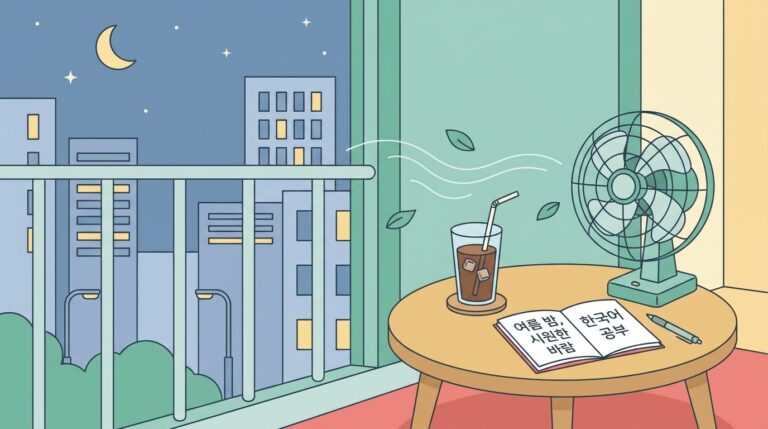
안녕하세요! I’m your Daily Hangul editor. Imagine this: It is 1:30 AM in mid-July in Seoul. You are lying in bed, but your sheet feels sticky, the air is thick with humidity, and even your trusty electric fan is just circulating warm breeze. You open Instagram, and half of your Korean friends are posting stories of iced Americanos at 24-hour convenience stores or sitting by the Han River eating fried chicken in shorts. Welcome to the infamous Korean phenomenon known as 열대야 (Yeoldaeya)—the tropical night.
Every summer, learners ask me: “How do I naturally complain about this heat without sounding like a robotic textbook?” In Korean culture, bonding over the shared misery of a sleepless, sweltering night is practically a summer ritual. Today, based on real feedback from intermediate learners like you, we will master the exact idioms, cultural nuances, and conversational survival lines Koreans use when the heat refuses to let them sleep.
Phase 2: Core Expressions Deep Dive
1. 열대야 때문에 잠을 설쳤어요 (Yeoldaeya ttaemune jameul seolchyeosseoyo)
- Pronunciation: [Yeol-dae-ya ttae-mu-ne ja-meul seol-chyeo-sseo-yo] (Sounds like: ‘Yuhl-deh-ya’ + ‘Tteh-moo-neh’ + ‘Jahm-eul’ + ‘Suhl-chyuh-ssuh-yo’)
- Meaning: Literal: “Because of the tropical night, I tossed and turned / slept poorly.” -> Real Nuance: “I barely got any shut-eye last night due to the suffocating heat.”
- K-Culture Moment: Commonly heard in workplace morning chats or K-dramas where exhausted characters walk into the office clutching a giant iced coffee.
- Editor’s Insight: ‘잠을 설치다’ specifically means sleeping intermittently without falling into deep rest. It captures the frustrating loop of waking up every hour.
- Situation Spectrum: Casual (✅) | Semi-formal (✅) | Formal (✅)
- 🤔 Think About It: In English, you might say “I had a rough night.” Why does Korean culture attribute sleeplessness specifically to weather conditions like ‘열대야’?
2. 더워서 숨이 턱턱 막혀요 (Deowoseo sumi teok-teok makhyeoyo)
- Pronunciation: [Deo-wo-seo su-mi teok-teok ma-khyeo-yo] (Sounds like: ‘Duh-wuh-suh’ + ‘Soo-mee’ + ‘Tuk-tuk’ + ‘Mah-kyuh-yo’)
- Meaning: Literal: “It’s so hot my breath is clogged ‘teok-teok’.” -> Real Nuance: “The humidity is so stifling it literally takes my breath away.”
- K-Culture Moment: Variety show cast members stepping out of an air-conditioned van into a humid outdoor filming set.
- Editor’s Insight: ‘턱턱’ is an onomatopoeia for a choking sensation. Using sound-symbolic words elevates your Korean from textbook level to vivid native fluency.
- Situation Spectrum: Casual (✅) | Semi-formal (✅) | Formal (⚠️ – slightly too sensory for boardrooms)
- 🤔 Think About It: How do visceral body sensations in Korean illustrate weather compared to abstract adjectives in your native language?
3. 밤새 에어컨을 틀고 잤어요 (Bamsae eeokeoneul teulgo jasseoyo)
- Pronunciation: [Bam-sae e-eo-keon-eul teul-go ja-sseo-yo] (Sounds like: ‘Bahm-seh’ + ‘Air-con-eul’ + ‘Teul-go’ + ‘Jah-ssuh-yo’)
- Meaning: Literal: “I slept keeping the air conditioner on all night.” -> Real Nuance: “It was so sweltering I had to run the A/C non-stop all night (even if I feared the electricity bill!).”
- K-Culture Moment: Friends debating electricity bills (‘전기세 폭탄’) in a group chat during peak August.
- Editor’s Insight: ‘틀다’ is used for turning on machines with switches or running water/fans. ‘틀고 자다’ expresses ongoing continuous state while asleep.
- Situation Spectrum: Casual (✅) | Semi-formal (✅) | Formal (✅)
- 🤔 Think About It: Why is running the air conditioner overnight such a loaded conversational topic in Korea (hint: electricity tariffs & health myths)?
Phase 3: Textbook Korean vs. Real Korean
Situation 1: Saying you couldn’t sleep because it was hot
- 📖 교과서 한국어: 어제 날씨가 너무 더워서 잠을 잘 수 없었습니다. (Yesterday the weather was so hot that I could not sleep.)
- 🗣️ 진짜 한국어: 어젯밤에 진짜 쪄 죽는 줄 알았어요. 뒤척거리느라 한숨도 못 잤어요! (Last night I thought I was being steamed to death. I couldn’t sleep a wink from tossing and turning!)
- 💡 왜 다를까?: Native speakers use expressive, tactile verbs like ‘찌다’ (to steam) and ‘뒤척거리다’ (to toss and turn) rather than flat declarative sentences.
Situation 2: Expressing fatigue the next morning
- 📖 교과서 한국어: 수면 부족으로 인해 오늘 매우 피곤합니다. (Due to lack of sleep, I am very tired today.)
- 🗣️ 진짜 한국어: 열대야 때문에 비몽사몽이에요. 카페인 수혈이 시급해요! (I’m in a total daze from the tropical night. I desperately need a caffeine transfusion!)
- 💡 왜 다를까?: B1+ speakers use colloquial idioms like ‘비몽사몽’ (half-awake, half-asleep) and trendy metaphors like ‘카페인 수혈’ (caffeine IV drip).
Phase 4: K-Culture Deep Dive & Non-Verbal Manners
4-1. Nunchi & Non-Verbal Gestures
When complaining about heat in Korean social settings, pairing your words with body language is essential. Fan your shirt collar gently with one hand while sighing a soft “휴~ (Hyu~)” before speaking. If you are in an office or shared space, do not dramatically blast the A/C down to 18°C without asking; check the room temperature and ask your colleagues, “에어컨 온도 조금만 낮춰도 될까요?” (May I lower the A/C temperature a bit?). This demonstrates high 눈치 (Nunchi) and social consideration.
4-2. Summer Culture Code: The Midnight ‘Chimaek’ & Hangang Escape
When nighttime temperatures stay above 25°C (77°F), indoor apartments turn into ovens. Koreans don’t just stay inside suffering—they embark on 야외 피서 (outdoor heat escapes). The banks of the Han River (한강공원) and neighborhood 24-hour convenience store plastic tables fill up with people enjoying icy draft beer and fried chicken (치맥), portable mini-fans in hand. Experiencing a tropical night isn’t just about losing sleep; it’s an invitation to Korea’s vibrant midnight outdoor culture.
Phase 5: Real-World Roleplay Scenario
Setting: 9:15 AM at a trendy marketing agency in Gangnam, Seoul. The office pantry is bustling as colleagues prepare iced coffees.
Characters:
* 민우 (Minwoo): A friendly, coffee-dependent Korean team lead.
* You: An intermediate Korean learner arriving at work looking visibly exhausted.
- Turn 1 (민우): 🎭 (Noticing your tired eyes while pouring espresso over ice) 오늘 얼굴이 왜 이렇게 핼쑥해요? 어디 아파요?
(Oneul eolguri wae ireoke haelssukaeyo? Eodi apayo? / Why do you look so drained today? Are you sick?) - Turn 2 (You): 🎭 (Sighing lightly and placing a hand on your neck) 아픈 건 아니고요, 어젯밤 열대야 때문에 잠을 설쳤어요.
(Apeun geon anigoyo, eojetbam yeoldaeya ttaemune jameul seolchyeosseoyo. / I’m not sick, but I barely slept because of the tropical night.) - Turn 3 (민우): 🎭 (Nodding emphatically in agreement) 맞아요, 어제 밤 기온이 27도였대요. 숨이 턱턱 막히더라고요.
(Majayo, eoje bam gioni 27doyeottaeyeo. Sumi teok-teok makhideoragoyo. / Tell me about it, they said last night’s temperature was 27°C. It was suffocating.) - Turn 4 (You): 🎭 (Grimacing humorously) 선풍기를 틀어도 뜨거운 바람만 나와서 결국 에어컨 켰어요.
(Seonpunggireul teureodo tteugeoun baramman nawaseo gyeolguk eeokeon kyeosseoyo. / Even with the fan on, only hot air came out, so I eventually turned on the A/C.) - Turn 5 (민우): 🎭 (Chuckling) 저도요! 근데 에어컨 계속 틀면 냉방병 걸릴까 봐 타이머 맞췄어요.
(Jeodoyo! Geunde eeokeon gyesok teulmyeon naengbangbyeong geollilkka bwa taimeo matchwosseoyo. / Me too! But I set a timer because I was worried about catching air-conditioning sickness.) - Turn 6 (You): 🎭 (Nodding with a wry smile) 타이머 꺼지자마자 바로 더워서 깼지 뭐예요.
(Taimeo kkeojijamaja baro deowoseo kkaetji mwoyeyo. / As soon as the timer turned off, I woke up right away from the heat.) - Turn 7 (민우): 🎭 (Handing you a tall glass filled with ice) 얼른 이거 마셔요. 오늘 아침은 아아가 생명수예요.
(Eolleun igeo masyeoyo. Oneul achimeun aaga saengmyeongsuyeyo. / Drink this quickly. Iced Americano is literally our elixir of life this morning.) - Turn 8 (You): 🎭 (Bowing with gratitude and taking a cold sip) 와, 살 것 같아요! 진짜 감사합니다.
(Wa, sal geot gatayo! Jinjja gamsahamnida. / Wow, I feel alive again! Thank you so much.)
🔀 Interactive Decision Branch
What should you reply if Minwoo asks: “오늘 퇴근하고 한강에서 치맥 한잔하면서 더위 식힐래요?” (Want to cool off with Chimaek at the Han River after work?)
- Option A: “좋아요! 시원한 강바람 맞으면서 힐링해요.” (Sounds great! Let’s heal while feeling the cool river breeze.)
- Feedback (Best): Perfect B1 expression! Enthusiastic, natural, and uses the cultural nuance of ‘더위를 식히다’ (cooling off).
- Option B: “아니요, 너무 피곤해서 집에서 잘 것입니다.” (No, because I am very tired I will sleep at home.)
- Feedback (Bad): Grammatically correct but overly robotic and flatly dismissive for coworker small talk.
- Option C: “에어컨 아래가 최고인데 왜 밖으로 나가요?” (Under the A/C is best, why go outside?)
- Feedback (Risk): A bit blunt and might sound like you are mocking their summer hangout suggestion.
Phase 6: 10-Second Emotion Shadowing Drill
Read aloud matching the rhythm and emotional cues marked by / pauses:
[😩 지치고 피곤하게 / Exhausted & drained]- 어젯밤에 / 열대야 때문에 / 한숨도 못 잤어요.
(Eojetbame / yeoldaeya ttaemune / hansumdo mot jasseoyo.)
- 어젯밤에 / 열대야 때문에 / 한숨도 못 잤어요.
[🥵 덥고 답답함을 토로하며 / Expressing suffocating heat]- 창문을 열어도 / 바람 한 점 안 불고 / 숨이 턱턱 막혀요.
(Changmuneul yeoreodo / baram han jeom an bulgeo / sumi teok-teok makhyeoyo.)
- 창문을 열어도 / 바람 한 점 안 불고 / 숨이 턱턱 막혀요.
[☕ 얼음 음료를 마시고 살아난 듯 / Relieved & revitalized]- 시원한 아아 한 잔 마시니까 / 이제야 살 것 같아요!
(Siwonhan a-a han jan masinikka / ijeya sal geot gatayo!)
- 시원한 아아 한 잔 마시니까 / 이제야 살 것 같아요!
Phase 7: K-Culture Mini Dictionary
- 열대야 (Yeoldaeya) | Tropical Night: Meteorological term for nights when the temperature stays at or above 25°C from 6 PM to 9 AM the next morning. Frequently used in daily small talk and weather forecasts.
- 아아 (A-A) | Iced Americano: Korea’s national beverage acronym (아이스 아메리카노). Essential morning fuel during sleepless summer heatwaves.
- 냉방병 (Naengbangbyeong) | Air-Conditioning Sickness: Physical fatigue, chills, or headache caused by prolonged exposure to cold indoor air during summer.
- 더위를 먹다 (Deowireul meokda) | To suffer from heat exhaustion: Literally “to eat the heat.” Used colloquially when someone feels dizzy, sluggish, or spaced out due to high temperatures.
Phase 8: Traveler’s Survival Kit
Survival Expressions TOP 3
- “에어컨 온도 조금만 낮춰 주실 수 있나요?”
- Pronunciation: [E-eo-keon on-do jo-geum-man nat-chwo ju-sil su in-na-yo?]
- Pro Tip: Use this polite phrasing at cafes, restaurants, or hotel receptions when your room feels stuffy.
- “얼음물 한 컵만 더 부탁드려요.”
- Pronunciation: [Eo-reum-mul han keop-man deo bu-tak-deu-ryeo-yo.]
- Pro Tip: In Korean diners (식당), cold water is standard, but asking for extra ice water during a heatwave is very natural.
- “손풍기 충전할 곳이 있을까요?”
- Pronunciation: [Son-pung-gi chung-jeon-hal go-si i-seul-kka-yo?]
- Pro Tip: ‘손풍기’ (handheld mini-fan) is an indispensable summer item. You can ask this at cafes when your mini-fan battery runs out.
Editor’s Travel Note
When navigating Korean tropical nights, download the 카카오맵 (KakaoMap) 대중교통 길찾기 앱 to locate 24-hour convenience stores or riverside park entrances safely. Also, keep your T-money card topped up, as night buses (올빼미 버스) run across Seoul between 11:30 PM and 4:00 AM for nocturnal heat explorers!
Phase 9: Stepping Deeper (Mini Essay)
In Western cultures, extreme weather complaints are often individual observations (“It’s so hot today”). In Korean society, however, weather dialogue is deeply relational and communal. Asking someone “어젯밤 열대야에 잘 잤어요?” (Did you sleep well through last night’s tropical night?) is not just about the thermometer—it is an inquiry into their well-being (안부). Summer in Korea is viewed as an ordeal endured together, giving rise to unique cultural rituals from sharing chicken soup on dog days (복날 삼계탕) to gathering outdoors to collectively beat the night heat.
💬 Your Turn: How does your hometown or home country deal with unbearable summer nights? Do people stay in or head outside like Koreans do? Let’s chat in the comments below!
Phase 10: FAQ & Common Mistakes
Q: What is the difference between ‘더워요’ and ‘열대야예요’?
A: ‘더워요’ is a general adjective meaning “it is hot” at any time of day. ‘열대야’ is a specific noun referring strictly to hot, humid nights over 25°C that hinder sleep. You use ‘열대야’ to emphasize nighttime sleeplessness.
Q: Can I say ‘잠이 안 와요’ instead of ‘잠을 설쳤어요’?
A: Yes, but with a slight difference! ‘잠이 안 와요’ means “I can’t fall asleep” (insomnia / restlessness), whereas ‘잠을 설쳤어요’ means you kept falling asleep and waking up repeatedly, getting poor quality rest.
Q: Is it okay to use ‘더워 죽겠어요’ with senior colleagues or bosses?
A: While common among peers and close colleagues, ‘죽겠다’ (dying of…) expressions can sound overly dramatic or casual in formal business meetings. Stick to “날씨가 많이 무덥네요” with higher-ups.
🚨 Common Mistakes Warning Board
- Mistake: Saying “열대야를 잤어요” ❌
- Correct Action: Use “열대야 때문에 잠을 설쳤어요” ✅ (‘열대야’ is the cause, not the activity of sleeping).
- Mistake: Using “에어컨을 열다” to mean turning on the A/C ❌
- Correct Action: Use “에어컨을 켜다 / 틀다” ✅ (‘열다’ means opening physical doors/windows).
- Mistake: Calling handheld fans “핸드 팬” ❌
- Correct Action: Call them 손풍기 (Sonpunggi) ✅ (Portmanteau of 손 [hand] + 선풍기 [electric fan]).
Phase 11: Action Missions
- 🥉 Bronze Mission (Self Practice): Record yourself shadowing the 3 emotion drills from Phase 6 on your phone’s voice recorder until you can say “숨이 턱턱 막혀요” with genuine breathless drama.
- 🥈 Silver Mission (Social Share): Snap a photo of your cold drink and post an Instagram Story with the caption: “열대야 극복 중! 🥤 #매일한글 #열대야”.
- 🥇 Gold Mission (Real Interaction): Next time you talk to a Korean friend or tutor during summer, open the conversation with: “어제 열대야였는데 잠 잘 잤어요?”.
- 🎮 K-Culture Mission: Watch a summer episode of a Korean variety show (like I Live Alone / 나 혼자 산다) and spot how many times the captions use ‘열대야’ or show characters using portable ‘손풍기’.
Phase 12: Interactive Quiz Challenge
Question 1: Situational Judgment
You arrive at your Korean language school in Seoul after a humid 28°C night without air conditioning. Your teacher asks: “어제 잘 잤어요?” What is the most natural B1-level answer?
* A) 네, 저는 날씨가 더워서 잘 수 없습니다.
* B) 열대야 때문에 잠을 설쳐서 너무 피곤해요.
* C) 에어컨을 닫아서 더웠습니다.
Question 2: Fill in the Blank
날씨가 너무 습하고 더워서 숨이 ( _____ ) 막혀요.
* A) 턱턱
* B) 펄펄
* C) 퐁퐁
Question 3: True / False Cultural Fact
In Korean, the term ‘냉방병’ refers to a medical allergy specifically caused by eating ice cream in the summer.
* True / False
🔍 Click here to reveal Quiz Answers & Explanations!
- Q1 Answer: B) “열대야 때문에 잠을 설쳐서 너무 피곤해요.” is the most natural and accurate phrase. (A is unnaturally stiff, and C uses the wrong verb ‘닫다’ instead of ‘끄다’ for turning off the A/C).
- Q2 Answer: A) 턱턱. The onomatopoeia ‘턱턱’ pairs naturally with ‘숨이 막히다’ to express suffocating breathlessness.
- Q3 Answer: False! ‘냉방병’ is air-conditioning sickness/fatigue resulting from excessive indoor air cooling relative to outdoor temperatures.







