

Phase 1: Empathy (Story-Immersive Opening)
안녕하세요! Welcome back to Daily Hangul! It’s your friendly local guide and Korean best friend here to make your Korea trip smoother than a warm mug of sikhye (sweet rice drink).
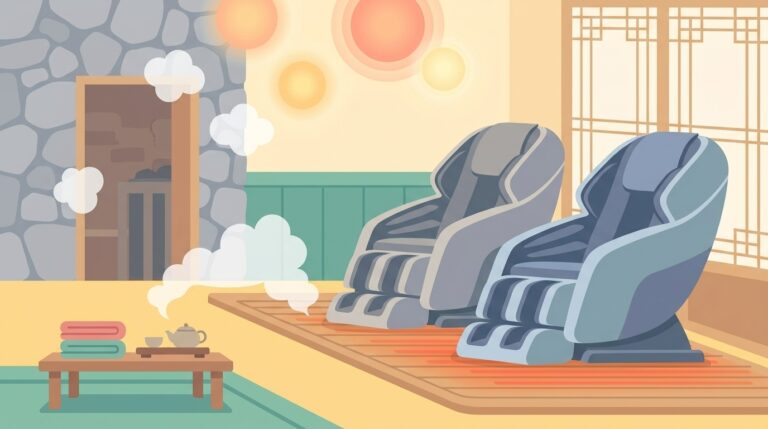
Picture this: You’ve just stepped into a massive Seoul jjimjilbang (Korean bathhouse). You’ve soaked in the herbal hot tubs, changed into the comfy oversized pajama set, and now your legs are aching from walking 20,000 steps around Myeongdong. In the corner of the grand rest hall, a row of luxurious, high-tech massage chairs (anma uija) glows like a sanctuary.
You excitedly walk over, sit down, and… nothing happens. There’s no coin slot. The screen flashes Korean text. A local grandma is politely waiting behind you, and you panic. Do you tap your locker key? Do you pay cash? How do you ask someone for help without feeling awkward?
Don’t worry at all! Today, we’re unlocking the exact, real-life A2-level Korean phrases and cultural know-how you need to conquer the jjimjilbang massage chair like a true local.
Phase 2: Top 3 Essential Expressions Deep Dive
1. 이거 어떻게 써요? (I-geo eot-teok-ke sseo-yo?)
- Pronunciation: [I-geo eot-teok-ke sseo-yo?] (Think: “Ee-guh ut-tuh-kay suh-yo?”)
- Meaning: “How do I use this?”
- K-Culture Moment: Whenever characters in variety shows like I Live Alone encounter new smart gadgets or vending machines, you’ll always hear them mutter this naturally.
- Editor’s Insight: 이거 (this) + 어떻게 (how) + 써요 (use). It is the universal survival phrase for any machine, kiosk, or app in Korea.
- Situation Spectrum: Casual (⚠️ 이거 어떻게 써?) / Semi-formal (✅ 이거 어떻게 써요?) / Formal (✅ 이것은 어떻게 사용하나요?)
- 🤔 Think About It: In English, you might say “Can you help me with this?”, focusing on the person helping. In Korean, focusing simply on “How does this work?” is often considered polite and direct without burdening the other person.
2. 키로 찍으면 돼요? (Ki-ro jji-geu-myeon dwae-yo?)
- Pronunciation: [Ki-ro jji-geu-myeon dwae-yo?] (Sound simile: “Key-roh jjee-geu-myun dway-yo?”)
- Meaning: “Can I just tap the key (wristband)?”
- K-Culture Moment: In Korean dramas, characters never carry wallets inside a sauna; they casually tap their rubber wristbands on vending machines and ice cream stands with a cheerful beep!
- Editor’s Insight: 찍다 (jjik-da) literally means to stamp or tag. Combined with -면 돼요? (“Is it okay if I…?”), it creates a super natural question for any contactless payment in Korea.
- Situation Spectrum: Casual (⚠️ 키로 찍어?) / Semi-formal (✅ 키로 찍으면 돼요?) / Formal (✅ 전자 키로 결제하면 됩니까?)
- 🤔 Think About It: Korean bathhouses are almost 100% cashless. Isn’t it fascinating how the electronic locker key acts as an all-in-one credit card and ID badge?
3. 자리 있어요? (Ja-ri it-sseo-yo?)
- Pronunciation: [Ja-ri it-sseo-yo?] (Think: “Jah-ree eet-suh-yo?”)
- Meaning: Literal: “Is there a seat?” / Real Nuance: “Is this seat taken?”
- K-Culture Moment: Seen constantly in cafes, busy food courts, and jjimjilbang relaxation zones when spotting an empty chair with someone nearby.
- Editor’s Insight: Koreans avoid long, complex questions when asking about seat availability. Just three short syllables—자리 있어요? with a rising tone—politely checks if someone is reserving it.
- Situation Spectrum: Casual (⚠️ 자리 있어?) / Semi-formal (✅ 자리 있어요?) / Formal (✅ 빈자리입니까?)
- 🤔 Think About It: Notice how Korean drops the subject (“Do you have a seat?”) and just asks about the state of the space itself. It keeps interpersonal interactions light and frictionless.
Phase 3: Textbook Korean vs. Real Korean
Situation 1: Asking how to pay at the massage chair
- 📖 Textbook Korean: 이 기계는 락커 키를 접촉하여 지불합니까? (Does one pay for this machine by contacting the locker key? – Stiff and robotic)
- 🗣️ Real Korean: 이거 키 찍으면 돼요? (Do I just tap the key for this?)
- 💡 Why is it different?: Spoken Korean favors action verbs like 찍다 (to tap/scan) over formal Sino-Korean nouns like 접촉 (contact) and 지불 (payment).
Situation 2: Asking if a massage chair is currently free
- 📖 Textbook Korean: 이 안마 의자를 사용 중인 사람이 있습니까? (Is there a person currently utilizing this massage chair?)
- 🗣️ Real Korean: 여기 자리 있어요? / 여기 사람 있어요? (Is this taken?)
- 💡 Why is it different?: Locals simply ask about the space (자리) or person presence (사람 있어요?) rather than making complete textbook queries.
Phase 4: K-Culture Deep Dive & Non-Verbal Manners
4-1. 눈치 (Nunchi) & Gestures
- The Locker Key Tap: Hold your rubber wristband key close to the sensor (usually on the right armrest) until you hear a chime. If you’re unsure, lightly point your wristband at the sensor while making gentle eye contact and saying, “여기 찍어요?” (Do I tap here?)
- Take off your shoes/slippers: Never put footwear onto the massage chair footrests. Place your slippers neatly in front of the chair before sitting.
- The Time Check Etiquette: Most chairs run in 10-to-15-minute cycles (usually 2,000–3,000 KRW). If someone is waiting nearby, avoid hogging the machine for more than two consecutive rounds.
4-2. Culture Code: The 24/7 Recharge Hub
In Korean culture, the jjimjilbang is not just a public bath—it is an egalitarian social sanctuary. From office workers recovering after overnight overtime to families spending Sunday afternoon eating hard-boiled smoked eggs (hunje gyeran), everyone shares the open floor. The massage chairs are the prime real estate of this relaxing haven!
Phase 5: Real-Life Roleplay Scenario
Setting: The peaceful, dimly-lit common hall (bul-gama) of a traditional Korean sauna. You approach a row of high-end massage chairs and see a friendly staff member (Imo-nim, auntie) wiping down nearby mats.
- Turn 1 (You): 저기요, 죄송한데 이거 어떻게 써요?
(Jeo-gi-yo, joe-song-han-de i-geo eot-teok-ke sseo-yo?)
“Excuse me, sorry, but how do I use this?”
🎭 Pointing gently to the chair display with a polite slight bow -
Turn 2 (Staff): 아, 그거 손목 키 찍으면 돼요!
(A, geu-geo son-mok ki jji-geu-myeon dwae-yo!)
“Ah, you can just tap your wristband key on it!”
🎭 Smiling and pointing at the RFID sensor on the armrest -
Turn 3 (You): 아, 키로 찍으면 돼요? 얼마예요?
(A, ki-ro jji-geu-myeon dwae-yo? Eol-ma-ye-yo?)
“Ah, tap with the key? How much is it?”
🎭 Raising the wristband towards the sensor -
Turn 4 (Staff): 십오 분에 이천 원이에요. 한 번 찍을 때마다 이천 원!
(Sib-o bun-e i-cheon won-i-e-yo. Han beon jji-geul ttae-ma-da i-cheon won!)
“It’s 2,000 won for 15 minutes. 2,000 won per tap!” -
Turn 5 (You): 네! 신발 벗고 타는 거죠?
(Ne! Sin-bal beot-go ta-neun geo-jyo?)
“Okay! I take off my slippers before getting on, right?”
🎭 Glancing down at your indoor slippers -
Turn 6 (Staff): 맞아요. 양말 신고 편하게 앉으세요.
(Ma-ja-yo. Yang-mal sin-go pyeon-ha-ge an-jeu-se-yo.)
“That’s right. Keep your socks on and sit down comfortably.” -
Turn 7 (You): 감사합니다! 시원하게 잘 받을게요.
(Gam-sa-ham-ni-da! Si-won-ha-ge jal ba-deul-ge-yo.)
“Thank you! I will enjoy the massage.”
🎭 Tapping the key with a satisfying 'BEEP' -
Turn 8 (Staff): 네, 푹 쉬어요!
(Ne, puk swi-eo-yo!)
“Sure, get plenty of rest!”
🔀 Interactive Choice Point
You finish your 15-minute massage, and you feel so relaxed that you want another round, but someone is standing nearby holding a bottle of banana milk, looking at your chair. What do you say?
- Option A: “자리 있어요?” (Is this seat taken?)
- Option B: “끝났는데 / 앉으실래요?” (I am done / Would you like to sit?)
- Option C: “저 또 할 거예요, 비키세요!” (I’m doing it again, move away!)
Feedback Breakdown:
* 🏆 Choice B (Best): Perfect consideration! Offering the seat (앉으실래요?) shows top-tier Korean manners.
* ⚠️ Choice A (Risk): Confusing because you are currently sitting on it! This phrase is for asking before you sit down.
* 🚫 Choice C (Bad): 비키세요 is impolite and harsh. Avoid using this unless there’s an emergency!
Phase 6: 10-Second Emotion Shadowing Drill
Practice these lines out loud with the marked intonations and emotion cues!
[🤔 Curious & Polite]저기요, / 이거 / 어떻게 써요? ↗
(Jeo-gi-yo, / i-geo / eot-teok-ke sseo-yo?)[💡 Realization & Confirmation]아! / 키로 찍으면 / 돼요? ↗
(A! / ki-ro jji-geu-myeon / dwae-yo?)[😌 Deeply Satisfied & Relaxed]와, / 진짜 / 시원하다… ↘
(Wa, / jin-jja / si-won-ha-da…)
Phase 7: K-Culture Mini Dictionary
- 안마 의자 (An-ma Ui-ja) | Massage chair.
- Usage: Found in saunas, expressway rest stops, and airport lounges across Korea.
- 락커 키 (Rak-keo Ki) | Electronic locker wristband.
- Usage: Used to lock lockers and make cashless payments inside the sauna.
- 식혜 (Sik-hye) | Sweet Korean rice drink.
- Usage: The quintessential refreshing drink consumed right after a hot bath or massage.
- 시원하다 (Si-won-ha-da) | “Cool / Refreshing / Relieving”.
- Usage: Koreans say this both when drinking cold drinks AND when experiencing a firm muscle massage or hot bath.
Phase 8: Survival Kit for Travelers
Top 3 Survival Phrases
- 여기 찍어요? (Yeo-gi jji-geo-yo?) – “Do I tap here?”
- Pro Tip: Point to the screen while asking; staff will nod immediately.
- 시간 얼마나 남았어요? (Si-gan eol-ma-na na-ma-sseo-yo?) – “How much time is left?”
- Pro Tip: Useful if someone is already using a chair you want to queue for.
- 계산은 나갈 때 해요? (Gye-san-eun na-gal ttae hae-yo?) – “Do I pay upon leaving?”
- Pro Tip: Reassures you that all wristband charges are settled at the exit front desk.
Editor’s Travel Note
- Cashless System: You settle your total bill (entry fee + massage chair + snacks) at the exit desk when returning your locker key.
- Essential Navigation Tool: Before heading to popular saunas like Spa Land in Busan or Dragon Hill style complexes, verify their opening hours on the official Naver Map app on App Store or Google Play Store.
Phase 9: “One Step Deeper” (Cultural Reflection)
In Korean society, public bathhouses reflect a unique culture of collective relaxation and high mutual trust. Everyone wears the same uniform, leaves their valuables in lockers, and walks around using a simple wristband for payment. The concept of 시원하다 (feeling refreshed/relieved from deep pressure) shows how Korean wellness embraces both heat and massage to release han (daily stress).
💬 Your Turn: Have you ever tried a high-tech massage chair or visited a Korean bathhouse? Which part of the experience are you most excited (or nervous) to try? Share your thoughts below!
Phase 10: FAQ & Common Mistakes
Q: Can I pay with cash or my physical credit card at the massage chair?
A: Almost never inside the bathhouse lounge area. All services and snack bars are synced to your electronic locker key band (락커 키). You pay for all charges at the exit reception.
Q: Do I need to keep my clothes and socks on?
A: Yes! In the co-ed relaxation area (jjimjil-zone), you must wear the designated jjimjilbang t-shirt and shorts provided upon entry. Socks are recommended for hygiene when using massage chairs.
Q: What should I do if the machine doesn’t start after tapping?
A: Check if the screen says “시작” (Start). Press the power button on the remote, or ask staff by saying: “저기요, 작동이 안 돼요” (Excuse me, it’s not working).
🚨 Common Mistakes Board
- ❌ Mistake 1: Wearing bathhouse slippers into the leg massage sleeves.
- 👉 Correct Action: Slip out of your slippers and leave them on the floor.
- ❌ Mistake 2: Tapping your credit card directly against the machine.
- 👉 Correct Action: Tap your numbered locker wristband (키).
- ❌ Mistake 3: Loud talking or taking phone calls on speaker while in the chair.
- 👉 Correct Action: Keep volume low; the massage area is a quiet rest zone.
Phase 11: Action Mission & Participation
- 🥉 Bronze Mission: Stand in front of a mirror and practice asking: “이거 키로 찍으면 돼요?” 3 times with natural intonation.
- 🥈 Silver Mission: Next time you see a Korean electronic payment terminal, identify the word 찍다 (tap) or 터치 (touch).
- 🥇 Gold Mission: Visit a Korean jjimjilbang during your trip, find the massage chair, and successfully use it using only Korean phrases!
- 🎮 K-Culture Mission: Watch an episode of a Korean travel or reality show (like Running Man) set in a bathhouse, and spot the sheep-towel hats (yang-meori) and snack bar orders.
Phase 12: Interactive Quiz Challenge
Q1. What is the most natural way to ask if you can pay with your sauna wristband?
* A) 이거 돈 내요?
* B) 이거 키로 찍으면 돼요?
* C) 이 의자는 얼마의 화폐가 필요합니까?
👉 View Answer & Explanation
Correct Answer: B) 이거 키로 찍으면 돼요?
Explanation: 키로 찍으면 돼요? is the exact conversational phrase used by native speakers across Korea.
Q2. Fill in the blank:
“저기요, 이거 어떻게 ________?” (Excuse me, how do I use this?)
* A) 먹어요 (eat)
* B) 써요 (use)
* C) 자요 (sleep)
👉 View Answer & Explanation
Correct Answer: B) 써요
Explanation: 써요 comes from 쓰다 (to use). 이거 어떻게 써요? means “How do I use this?”
Q3. [True / False] In a Korean sauna relaxation area, you should pay cash directly into the massage chair slot.
👉 View Answer & Explanation
Correct Answer: False
Explanation: Korean jjimjilbang use cashless locker wristbands for all in-house amenities.






