

Phase 1: Empathy & Story-Driven Opening
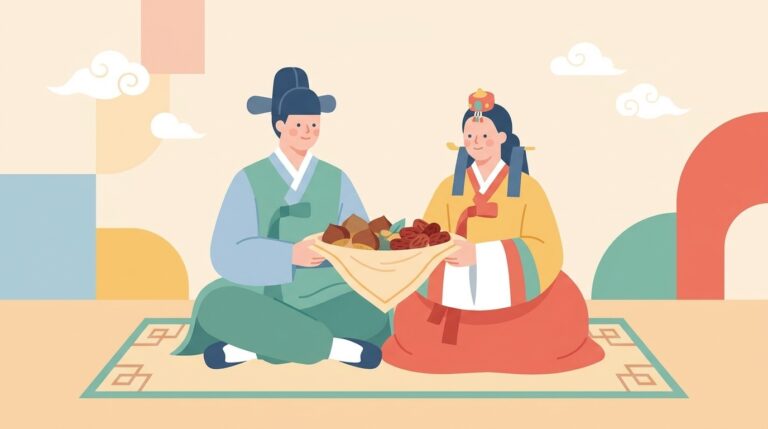
안녕하세요! This is your Daily Hangul editor and cultural navigator. Picture this: You are dressed in an exquisitely vibrant hwarot (ceremonial bridal robe) or samogwandae (groom’s official attire), kneeling inside a serene, wooden-paneled room surrounded by folding screens depicting peonies and cranes. The modern wedding party with the white dress and tuxedo has wrapped up, but now comes the real cultural heart of the day: 폐백 (Pyebaek).
Suddenly, the sumo-nim (ceremony master) whispers instructions in rapid, formal Korean, while in-laws prepare to toss handfuls of dried jujubes and chestnuts directly into your silk cloth. Panic sets in: How low do I bow? What do I say when receiving the envelope? Do I sip the cheongju liquor or down it in one shot?
If you have ever felt overwhelmed by the layered etiquette and hyper-polite honorifics of traditional Korean ceremonies, you are definitely not alone. Many intermediate learners hit a wall here because textbook Korean rarely prepares you for real-world ritual honorifics. This guide is crafted from real learner feedback and cultural fieldwork so you can glide through traditional wedding customs with total confidence and grace.
Phase 2: Key Expressions In-Depth Analysis
1. 예쁘게 잘 살겠습니다 (Yeppeuge jal salgetseumnida)
- Pronunciation: [Ye-ppeu-ge jal sal-get-seum-ni-da] (Sounds like: ‘Yeh-pboo-geh jal sal-get-soom-nee-dah’)
- Meaning: Literal: “We will live prettily and well.” | Nuance: “We promise to build a happy, harmonious, and admirable marriage.”
- K-Culture Moment: The classic line spoken by newlywed couples right after performing keunjeol (deep bows) to parents during traditional ceremonies.
- Editor’s Insight: In Korean, ‘예쁘다’ doesn’t just mean physical beauty; when applied to living (살다), it signifies living without conflict, being filial, and creating a heartwarming household.
- Situation Spectrum: Casual 🚫 | Semi-formal ⚠️ | Formal/Ceremonial ✅
- 🤔 Think About It: Why does Korean describe harmonious living as ‘living prettily’? How does your native language describe a successful marriage?
2. 덕담 한 말씀 부탁드립니다 (Deokdam han malsseum butakdeurimnida)
- Pronunciation: [Deok-dam han mal-sseum bu-tak-deu-rim-ni-da] (Sounds like: ‘Duk-dahm han mal-ssum boo-tahk-deu-reem-nee-dah’)
- Meaning: Literal: “Please give us one word of virtuous speech.” | Nuance: “We would be honored to hear your words of wisdom and blessings.”
- K-Culture Moment: Spoken by the groom or host inviting the elders to share wedding blessings and marital advice after receiving the ceremonial drink.
- Editor’s Insight: 덕담 (Deokdam) refers specifically to benevolent, auspicious blessings shared by elders during milestones like weddings or New Year’s Day. Note the honorific noun 말씀 (words).
- Situation Spectrum: Casual 🚫 | Semi-formal ⚠️ | Formal/Ceremonial ✅
- 🤔 Think About It: In many Western weddings, toasts are given by friends (Best Man/Maid of Honor). Why is the primary verbal blessing reserved for senior elders in traditional Korea?
3. 백년해로하겠습니다 (Baengnyeonhaerohagetseumnida)
- Pronunciation: [Baeng-nyeon-hae-ro-ha-get-seum-ni-da] (Sounds like: ‘Bang-nyun-heh-ro-hah-get-soom-nee-dah’)
- Meaning: Literal: “We will grow old together for a hundred years.” | Nuance: “We vow to love each other faithfully till old age.”
- K-Culture Moment: A sophisticated four-character idiom (사자성어) frequently printed on traditional wedding invitations or pledged directly to grandparents.
- Editor’s Insight: Using this Sino-Korean idiom demonstrates an intermediate-to-advanced grasp of elevated Korean culture, instantly delighting Korean in-laws.
- Situation Spectrum: Casual 🚫 | Semi-formal ⚠️ | Formal/Ceremonial ✅
- 🤔 Think About It: Compare ‘Till death do us part’ with ‘Growing white-haired together for 100 years.’ What emotional difference do you feel?
Phase 3: Textbook Korean vs. Real Korean
Situation 1: Expressing determination to parents after bowing
- 📖 교과서 한국어: 저희는 열심히 일하고 행복하게 지내겠습니다. (We will work hard and live happily.)
- 🗣️ 진짜 한국어: 서로 아끼고 배려하면서 예쁘게 잘 살겠습니다! (We will cherish and care for each other, and build a wonderful life together!)
- 💡 왜 다를까? Textbook Korean sounds like an employee performance review. Real-life Korean uses dynamic relational verbs like 아끼다 (to cherish) and 배려하다 (to be considerate).
Situation 2: Catching chestnuts and dates thrown by in-laws
- 📖 교과서 한국어: 대추와 밤을 많이 던져 주십시오. (Please throw many jujubes and chestnuts.)
- 🗣️ 진짜 한국어: 많이 던져주세요, 하나도 안 놓치고 다 받을게요! (Throw lots our way, we won’t drop a single one!)
- 💡 왜 다를까? While Pyebaek is formal, this exact ritual is joyful and playful. Showing lighthearted enthusiasm breaks the tension and brings smiles to the elders.
Phase 4: K-Culture Deep Dive & Non-Verbal Manners
4-1. 눈치 (Nunchi) & Non-Verbal Etiquette in Traditional Rites
- The Sumo-nim Rhythm: During Pyebaek, you will be assisted by a 수모 (Sumo-nim), a ceremonial attendant. Never rush your movements. Watch her subtle hand signals: when she adjusts your sleeve, that is your cue to begin your keunjeol (deep ceremonial bow).
- The Hanbok Gaze & Hand Position: When kneeling and bowing, keep your hands overlapping (for women: right hand over left; for men: left hand over right) at eye level. Avoid direct, intense eye contact with the elders while bowing; lower your gaze modestly by about 45 degrees.
- Catching the Jujubes and Chestnuts: The bride and groom hold a wide piece of embroidered silk (폐백보). When the parents toss the jujubes (대추, symbolizing sons) and chestnuts (밤, symbolizing daughters), lean slightly forward together to catch as many as possible. Dropping them is harmless, but catching many is considered great fortune!
4-2. Cultural Code Analysis
In classic K-Dramas like Queen of Tears or Crash Landing on You, family rites spotlight the union not just of two individuals, but of two lineages. Historically, Pyebaek was strictly performed by the bride for the groom’s family to formally enter his household. In contemporary Korea, however, it has evolved into a modernized, inclusive celebration where both maternal and paternal sides often take turns sitting at the table, reflecting Korea’s evolving gender and family values.
Phase 5: Real-Life Roleplay Scenario
Setting: The Pyebaek room at a Seoul wedding hall. The groom (Min-woo) and his foreign partner (Alex) are dressed in full royal court wedding attire, seated opposite Min-woo’s parents.
Characters:
* 수모님 (Sumo-nim): The sharp yet supportive ceremony director.
* 어머님 (Mother-in-law): Warm, holding a plate of dried jujubes.
* 아버님 (Father-in-law): Dignified, holding a wooden cup of cheongju.
* Alex & Min-woo: The newlyweds.
- 수모님: (소매를 정돈해주며) “신랑 신부, 양가 부모님께 큰절 올리겠습니다. 국궁배~”
(Groom and bride, let us offer a deep bow to the parents. Bow deeply~) - Alex & Min-woo: (🎭 천천히 깊게 절하며) “예쁘게 잘 살겠습니다, 아버님, 어머님.”
(We will cherish each other and live a beautiful life together, Father, Mother.) - 아버님: (술잔을 내려놓으며 따뜻하게 미소 짓는다) “오냐, 먼 길 오느라 고생 많았다. 서로 믿고 존중하며 살아라.”
(Indeed. You’ve worked hard on this long journey. Live trusting and respecting each other.) - 어머님: (🎭 덕담 봉투를 건네며) “우리 가족이 된 걸 환영한다. 자, 이제 대추랑 밤 받아보거라.”
(Welcome to our family. Now, get ready to catch the dates and chestnuts.) - 수모님: (천을 팽팽히 쥐어주며) “자, 신부님 천 활짝 펼치세요!”
(Bride, stretch the silk cloth wide!) - Alex: (🎭 활짝 웃으며 천을 꼭 쥐고) “어머님, 많이 던져주세요! 다 받을 준비 됐습니다!”
(Mother, throw lots! We’re totally ready to catch them all!) - 어머님 & 아버님: (대추와 밤을 한 움큼 던지며) “아들딸 쑥쑥 낳고 부자 되거라!”
(May you have healthy children and prosper abundantly!) - Alex & Min-woo: (천에 가득 담긴 대추를 보며) “감사합니다! 백년해로하겠습니다!”
(Thank you so much! We will grow old together in happiness!)
🔀 Interactive Choice Point
After catching 8 jujubes and 5 chestnuts, the father-in-law hands you a filled cup of traditional rice wine (cheongju). How do you respond?
- Option A: Drink the entire cup quickly with one hand while looking directly into his eyes to show confidence.
- Option B: Receive the cup with both hands, slightly turn your head away from the parents, and take a polite sip before placing it back down.
- Option C: Put the cup on the table without touching it and say, “저는 술을 못 마십니다” (I do not drink alcohol) in a casual tone.
[Feedback A - Risk]: Drinking with one hand and direct eye contact is considered disrespectful when drinking with Korean elders. Always use both hands and turn slightly to the side.
[Feedback B - Best]: Perfectly executed Korean drinking etiquette (주도)! Using two hands and turning your upper body shows deep respect for the elder.
[Feedback C - Bad]: Even if you do not drink alcohol, abruptly rejecting the ceremonial cup disrupts the ritual flow. In real ceremonies, simply raising the cup gently to your lips without actually drinking is the standard polite alternative.
Phase 6: 10-Second Emotion Shadowing Drill
Practice matching the cadence, pauses (/), and emotional tones:
[🙇♂️ 공손하고 진심 어린 목소리로]
“부모님의 은혜에 / 진심으로 감사드리며, / 예쁘게 / 잘 살겠습니다.”
(Bu-mo-nim-ui eun-hye-e / jin-sim-eu-ro gam-sa-deu-ri-myeo, / ye-ppeu-ge / jal sal-get-seum-ni-da.)-
[😄 밝고 활기차며 센스 있게]
“걱정하지 마세요! / 저희 둘이서 / 서로 아끼며 / 백년해로하겠습니다!”
(Geok-jeong-ha-ji ma-se-yo! / jeo-hui du-ri-seo / seo-ro a-kki-myeo / baeng-nyeon-hae-ro-ha-get-seum-ni-da!) -
[🙏 겸손하고 정중하게]
“귀한 덕담 / 가슴 깊이 새기고 / 늘 지혜롭게 / 행동하겠습니다.”
(Gwi-han deok-dam / ga-seum gip-i sae-gi-go / neul ji-hye-rop-ge / haeng-dong-ha-get-seum-ni-da.)
Phase 7: K-Culture Mini Dictionary
- 폐백 (Pyebaek): The traditional post-wedding bowing ritual where the couple pays respects to family elders and receives blessings.
- 덕담 (Deokdam): Formal words of well-wishes, wisdom, and blessings delivered by senior relatives to younger generations.
- 수모 (Sumo-nim): The professional master of ceremonies and hanbok coordinator who directs traditional wedding movements.
- 함 (Ham): A decorative wooden box sent by the groom’s family to the bride’s home before the wedding, filled with gifts, silk, and wedding paper (honseo).
Phase 8: Traveler’s Survival Kit for Korean Weddings
Top 3 Survival Expressions
- 결혼 축하드려요! (Gyeolhon chukadeuryeoyo!)
- Pro Tip: Use this when greeting the bride, groom, or their peers at the photo wall.
- 축의금 어디에 내면 되나요? (Chug-uigeum eodie naemyeon doenayo?)
- Pro Tip: Use this at the reception desk to locate the monetary gift table (축의대).
- 식권 챙겨주셔서 감사합니다. (Sikkweon chaenggyeojusyeoseo gamsahamnida.)
- Pro Tip: In Korea, you receive a meal voucher (식권) right after delivering your gift envelope.
Editor’s Travel Note
- If you need to navigate to wedding venues or hanbok rental boutiques in Seoul, make sure to download the Naver Map application for foreign visitors instead of standard global maps for precise building floor plans.
- When preparing wedding money envelopes (축의금), use clean, crisp 50,000 KRW bills and write your name vertically on the bottom-left side on the back of the envelope.
Phase 9: A Step Deeper (Reflection Essay)
In Western wedding traditions, the spotlight shines almost exclusively on the autonomy and romantic vows of the two individuals. In contrast, the Korean Pyebaek reminds us that a wedding is a communal bridge between two entire family networks. When couples catch the chestnuts and jujubes thrown by their parents, they are symbolically accepting the collective responsibility, ancestry, and blessing of generations before them.
💬 Your Turn: How does your home culture bridge the gap between romantic individualism and family tradition during weddings? Share your experiences in the comments below!
Phase 10: FAQ & Common Mistakes
Q: Can guests watch the Pyebaek ceremony, or is it strictly private?
A: While historically restricted to direct family, modern wedding halls feature glass windows or open doorways where close friends and guests can politely observe and take photos from just outside the mat area.
Q: Is Pyebaek mandatory in every modern Korean wedding?
A: No. Many contemporary couples choose to skip Pyebaek to save time and streamline expenses. However, if both families value tradition, it remains one of the most cherished and memorable parts of the day.
Q: What do the tossed dates and chestnuts actually mean?
A: 대추 (Jujubes) possess single seeds, symbolizing sons and steadfast loyalty. 밤 (Chestnuts) split inside the shell, traditionally symbolizing daughters and multi-talented wisdom.
🚨 Common Mistakes Alert Board
- Mistake 1: Bowing with wrong hand placement. (Men place left hand over right; women place right hand over left during auspicious occasions like weddings).
- Mistake 2: Stepping on the silk cushions. (Never step on the silk sitting mat (보료) with shoes or bare heels; move smoothly on your knees/toes).
- Mistake 3: Opening the gift envelope in front of the elders. (Always accept envelopes with two hands, bow your head slightly, and tuck it neatly on the tray without opening it immediately).
Phase 11: Action Missions
- 🥉 Bronze Mission (Solo Practice): Stand in front of a mirror and recite “예쁘게 잘 살겠습니다!” with a gentle bow three times with clear pronunciation.
- 🥈 Silver Mission (Social Share): Comment below with your favorite Korean wedding drama scene and identify whether the characters did Pyebaek!
- 🥇 Gold Mission (Real Application): Next time you attend a Korean wedding or meet older Korean acquaintances celebrating an anniversary, offer the formal phrase: “백년해로하시길 바랍니다!”
- 🎮 K-Culture Mission: Watch an episode of a Korean variety show featuring weddings (like Same Bed, Different Dreams) and spot the exact moment the sumo-nim guides the couple’s bow.
Phase 12: Interactive Quiz Challenge
1. Situation Judgment: What is the correct way to hold your hands when performing a deep ceremonial bow (큰절) as a groom?
* (A) Right hand on top of the left hand
* (B) Left hand on top of the right hand
* (C) Hands placed flat on the floor at shoulder width
2. Fill-in-the-Blank:
“저희 두 사람 서로 아끼며 평생 동안 ( )하겠습니다!”
* (A) 식권교환
* (B) 백년해로
* (C) 덕담봉투
3. True or False: During Pyebaek, dried chestnuts (밤) traditionally symbolize daughters.
* (A) True
* (B) False
🔍 Click here to reveal the answers and explanations!
- Answer: (B)
- Explanation: In traditional Korean protocol, men place their left hand over the right during auspicious events (길사), such as weddings and New Year’s bows.
- Answer: (B) 백년해로
- Explanation: 백년해로 (Baengnyeonhaero) means growing old together harmoniously for a hundred years.
- Answer: (A) True
- Explanation: In Pyebaek folklore, jujubes represent sons and chestnuts represent daughters.
- Explanation: In Pyebaek folklore, jujubes represent sons and chestnuts represent daughters.







