

Phase 1: Empathy (스토리 몰입형 오프닝)
안녕하세요! Editor here from Daily Hangul.
Imagine this: It’s a chilly weekend morning in Seoul, or perhaps the humid summer rainy season (장마) has arrived. You pull out your cozy duvet (이불), only to realize it desperately needs a deep wash. But there’s a big problem—your studio apartment’s miniature top-loader washing machine is way too small to fit a thick blanket!
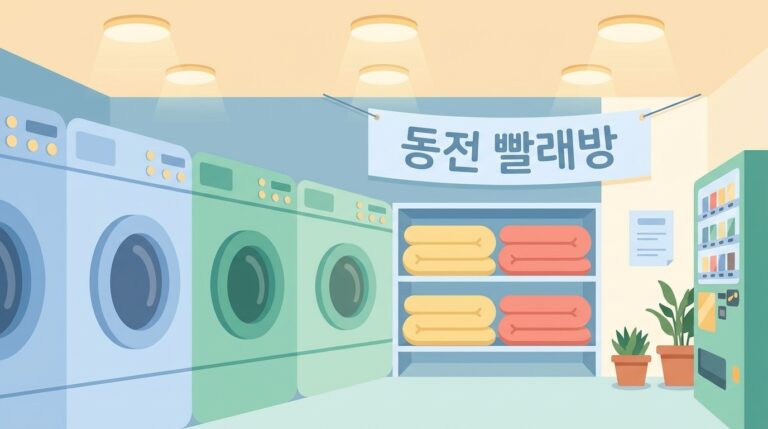
You bundle up your massive duvet, haul it down the alleyway, and step into a bright, sleek 24-hour self-service laundromat (코인 세탁소 / 셀프 빨래방). Heavy laundry machines hum in the background, neon lights glow, and touchscreen payment terminals beep in fast-paced Korean. Suddenly, panic sets in! Which machine size do I pick? Does detergent automatically come out, or do I buy it separately? How do I ask someone nearby for help without sounding clueless?
Don’t worry! In today’s guide, inspired by real feedback from our B1-level learners living in Korea, we’re diving into the exact phrases, cultural manners (눈치), and laundry hacks you need to breeze through your bedding laundry day with confidence.
Phase 2: Core Expressions (핵심 표현 3선 심층 분석)
1. 이불 빨래 돌리러 왔어요.
- Pronunciation: I-bul ppal-lae dol-li-reo wa-sso-yo (ee-bool pahl-lae dohl-lee-ruh wah-ssoh-yoh)
- Meaning: “I came to run a load of bedding laundry.”
- K-Culture Moment: You bump into a neighbor at the laundromat lounge holding a huge blanket bag, and you make friendly small talk.
- Editor’s Insight: Koreans rarely say “세탁하다” in conversation. Instead, we use ‘빨래를 돌리다’ (literally: to spin the laundry). Adding ‘-러 오다’ shows your purpose!
- Situation Spectrum: Casual: ✅ | Semi-formal: ✅ | Formal: ⚠️
- 🤔 Think About It: Why do you think Korean uses the dynamic motion verb ‘돌리다’ (to spin) for doing laundry?
2. 건조기 몇 분 돌려야 돼요?
- Pronunciation: Geon-jo-gi myeot bun dol-ryeo-ya dwae-yo? (guhn-joh-gee myut boon dohl-ryuh-yah dwae-yoh?)
- Meaning: “How many minutes should I run the dryer?”
- K-Culture Moment: Unsure if your thick winter duvet will dry completely in 30 minutes, you ask another laundromat regular.
- Editor’s Insight: ‘-야 되다’ expresses necessity (“should / must”). Combining it with ‘몇 분’ (how many minutes) creates a very natural natural-sounding question.
- Situation Spectrum: Casual: ✅ | Semi-formal: ✅ | Formal: ✅
- 🤔 Think About It: How does asking for advice at shared neighborhood spots foster community feeling in urban Korea?
3. 세제랑 섬유유연제는 자동으로 나와요?
- Pronunciation: Se-je-rang seom-yu-yu-yeon-je-neun ja-dong-eu-ro na-wa-yo?
- Meaning: “Do detergent and fabric softener come out automatically?”
- K-Culture Moment: Pointing at the washer dispenser panel before inserting your kiosk payment.
- Editor’s Insight: ‘자동으로 나오다’ is the set phrase for automated dispensing in modern self-service machines.
- Situation Spectrum: Casual: ✅ | Semi-formal: ✅ | Formal: ✅
- 🤔 Think About It: Notice how noun combinations with ‘랑’ (and) keep Korean casual conversations fluid and fast!
Phase 3: Textbook Korean vs. Real Korean
Situation 1: Explaining how to operate the giant washer
- 📖 Textbook: 이불을 세탁기에 넣으십시오. (Please place the bedding into the washing machine.)
- 🗣️ Real: 이불 세탁기에 넣고 3번 버튼 누르시면 돼요. (Just put the duvet in the washer and press button #3.)
- 💡 Why different? Spoken B1 Korean relies on smooth connectors like ‘-고’ (and then) and polite suggestions like ‘-시면 돼요’ (you can just do…) rather than rigid formal imperatives.
Situation 2: Checking if laundry is finished
- 📖 Textbook: 세탁 과정이 완료되었습니다. (The laundry process is completed.)
- 🗣️ Real: 빨래 다 돌아갔어요! (The laundry is all done spinning!)
- 💡 Why different? Locals naturally express completion using ‘다’ (all) + ‘돌아가다’ (spun through), keeping things punchy and colloquial.
Phase 4: K-Culture Deep Dive & Non-Verbal Manners
4-1. 눈치 (Nunchi) & Laundromat Etiquette
- Cart & Basket Etiquette: Laundromats provide heavy-duty mobile laundry carts (세탁 바구니 카트). Once a machine stops, if you aren’t there, someone might carefully transfer your clothes to a basket to free up the machine. To show good nunchi, set a timer on your phone and arrive 2 minutes before the cycle ends!
- Door Courtesy: Leave the washer door slightly open after taking your clean duvet out to let moisture evaporate.
4-2. Culture Code: Laundromats as Cozy Urban Havens
In K-Dramas and modern Seoul lifestyle, 24-hour laundromats (셀프 빨래방) are no longer dingy basements. They are aesthetic, well-lit sanctuaries equipped with capsule coffee machines, free Wi-Fi, massage chairs, and soothing music playlists. They serve as quiet retreats for single-person households (1인 가구) looking for a relaxing break on weekend afternoons.
Phase 5: Real-Life Roleplay Scenario
Setting: A stylish 24-hour laundromat in Hongdae on a rainy Saturday.
Characters: You (Learner) & Friendly Resident NPC (동네 주민)
- You: 안녕하세요! 혹시 이 대형 세탁기에 이불 두 장 다 들어가요?
(An-nyeong-ha-se-yo! Hok-si i dae-hyeong se-tak-gi-e i-bul du jang da deol-eo-ga-yo?)
“Hello! By any chance, can two duvets fit inside this large washer?”
(🎭 Action: Pointing politely at the giant 30kg washing machine with a slight tilt of the head) -
NPC: 아, 네! 30kg짜리라 두 장 다 충분히 들어가요.
(A, ne! Sam-sip-ki-lo-jja-ri-ra du jang da chung-bun-hi deol-eo-ga-yo.)
“Ah, yes! It’s a 30kg machine, so two will easily fit.” -
You: 아 다행이네요! 그런데 세제는 따로 넣어야 하나요?
(A da-haeng-i-ne-yo! Geu-reon-de se-je-neun tta-ro neo-eo-ya ha-na-yo?)
“Ah, what a relief! But do I need to put detergent in separately?”
(🎭 Action: Holding up a sachet of detergent with a curious facial expression) -
NPC: 아니요, 여기는 코스 선택하면 세제랑 유연제가 자동으로 나와요.
(A-ni-yo, yeo-gi-neun ko-seu seon-taek-ha-myeon se-je-rang yu-yeon-je-ga ja-dong-eu-ro na-wa-yo.)
“No, here if you select the cycle, detergent and softener come out automatically.” -
You: 와, 진짜 편하네요! 그럼 건조기는 몇 분 정도 돌리는 게 좋아요?
(Wa, jin-jja pyeon-ha-ne-yo! Geu-reom geon-jo-gi-neun myeot bun jeong-do dol-li-neun ge jo-a-yo?)
“Wow, that’s so convenient! Then how many minutes should I run the dryer?” -
NPC: 이불은 두껍니까 최소 40분은 돌려야 바짝 말라요.
(I-bul-eun du-kkeo-eu-ni-kka choe-so sa-sip-bun-eun dol-ryeo-ya bat-jjak mal-ra-yo.)
“Duvets are thick, so you should run it for at least 40 minutes to dry completely.” -
You: 그렇군요! 40분 설정하고 카드 결제하면 되죠?
(Geu-reot-goon-yo! Sa-sip-bun seol-jeong-ha-go ka-deu gyeol-je-ha-myeon dwae-jo?)
“I see! I just set it for 40 minutes and pay by card, right?” -
NPC: 네, 터치스크린에서 화면 보고 따라 하시면 쉬워요!
(Ne, teo-chi-seu-keu-rin-e-seo hwa-myeon bo-go tta-ra ha-si-myeon swi-wo-yo!)
“Yes, just follow the onscreen touchscreen prompts and it’s super easy!”
🔀 Interactive Branching Scenario
The dryer cycle finishes, but your heavy duvet is still slightly damp in the center! What do you say to the resident nearby?
- Option A: “이불이 아직 좀 눅눅한데 10분만 더 돌릴까요?”
- Option B: “세탁기 고장 났어요. 책임지세요!”
- Option C: “그냥 축축한 채로 가져갈게요.”
Feedback:
* Option A (BEST): Perfect! “눅눅하다” (damp) is accurate and natural for B1 level. Asking for a quick 10-minute extra run shows great laundry savvy.
* Option B (BAD / RISK): Too aggressive! Equipment isn’t broken; heavy blankets simply need extra dryer time.
* Option C (WEAK): Taking home damp blankets causes mildew (곰팡이) quickly in Korean apartments!
Phase 6: 10-Second Emotion Shadowing Drill
Practicing native pause rhythms (/) and emotional tone:
[😊 Relief & Friendliness]
이불이 너무 크죠? / 세탁기가 넓어서 / 다행이에요!
(I-bul-i neo-mu keu-jo? / Se-tak-gi-ga neol-beo-seo / da-haeng-i-e-yo!)-
[🤔 Curiosity & Polite Inquiry]
혹시 / 세제랑 섬유유연제 / 자동으로 나오는 건가요?
(Hok-si / se-je-rang seom-yu-yu-yeon-je / ja-dong-eu-ro na-o-neun geon-ga-yo?) -
[💡 Realization & Thanks]
아하! / 건조기는 40분 돌리면 되는군요! / 감사합니다!
(A-ha! / Geon-jo-gi-neun sa-sip-bun dol-li-myeon doe-neun-gun-yo! / Gam-sa-ham-ni-da!)
Phase 7: K-Culture Mini Dictionary
- 셀프 빨래방 (Seul-peu Ppal-lae-bang)
- Translation: Self-service laundromat.
- Usage: The most common modern term used on maps and signs, alongside ‘코인 세탁소’.
- 섬유유연제 (Seom-yu-yu-yeon-je)
- Translation: Fabric softener.
- Usage: Essential for making duvet blankets soft and fragrance-fresh.
- 바짝 말리다 (Bat-jjak mal-li-da)
- Translation: To dry completely crisp and bone-dry.
- Usage: Crucial phrase when drying heavy laundry items like winter bedding.
- 동전 교환기 (Dong-jeon gyo-hwan-gi)
- Translation: Coin changer machine.
- Usage: Used if you pay with cash/coins instead of touch Kiosk credit card readers.
Phase 8: Traveler’s Survival Kit
Survival Top 3 Expressions
- 대형 세탁기 어디 있어요? (Dae-hyeong se-tak-gi eo-di is-seo-yo?) – Where is the large washer?
- 카드 결제 돼요? (Ka-deu gyeol-je dwae-yo?) – Can I pay by card?
- 건조기 다 돌아갔어요. (Geon-jo-gi da dol-a-gat-seo-yo.) – The dryer cycle is finished.
Editor’s Travel Note
When hunting for laundromats in Korea, open your Naver Map App Download and search for “셀프 빨래방” or “코인 세탁소”. Most modern shops accept Korean T-Money transit cards or international Visa/Mastercard credit cards at the central touch kiosk terminal!
Phase 9: One Step Deeper (생각 질문)
In densely populated urban areas like Seoul, small studio living space (원룸 culture) makes owning large dryers impractical. Consequently, laundromats have evolved into communal third spaces where neighbors briefly cross paths, catch up, or relax over coffee while watching laundry tumble. Language reflects this warmth—phrases like ‘빨래를 돌리다’ bring a sense of domestic rhythm into busy modern lives.
💬 Your Turn: What does laundry day look like in your home country? Have you ever visited a 24-hour laundromat abroad? Tell us in the comments below!
Phase 10: FAQ & Common Mistakes
Q: Do I need to bring my own laundry detergent powder?
A: Most modern Korean self-service laundromats automatically inject liquid detergent and softener during the wash cycle! Check for signs saying “세제/유연제 자동 투입”.
Q: What if I don’t have Korean credit cards for the payment Kiosk?
A: You can use the coin exchanger (동전 교환기) to convert 1,000 KRW cash bills into 500 KRW coins and insert coins directly into the machine.
Q: Can I leave the laundromat while my duvet is washing?
A: Yes! Just set a smartphone timer so you return right as the cycle finishes to respect fellow users waiting for machines.
🚨 Common Mistakes TOP 3
- Mistake: Saying “이불을 요리해요” (cooking bedding!) instead of “이불을 빨아요”.
- Correct Action: Use 빨래하다 or 세탁하다 for washing clothes!
- Mistake: Putting tennis balls in Korean commercial dryers without checking rules.
- Correct Action: Dryer balls are usually supplied or prohibited; check laundromat guidelines.
- Mistake: Pouring liquid detergent into dry automatic machines.
- Correct Action: Look for signs reading “세제 자동 투입” to avoid over-foaming disaster!
Phase 11: Action Mission & Engagement
- 🥉 Bronze Mission: Practice saying “이불 빨래 돌리러 왔어요” out loud 3 times using natural pause rhythms.
- 🥈 Silver Mission: Write a 2-sentence story in Korean about your laundry day routine and share it in our community comments.
- 🥇 Gold Mission: Visit a local Korean laundromat or spot one in a K-drama, and identify whether it uses automated detergent dispensers (자동 투입)!
🎮 K-Culture Mission: Watch a slice-of-life Korean drama scene (like Reply 1988 or Work Later, Drink Now) and spot how characters talk about domestic chores like laundry!
Phase 12: Interactive Quiz Challenge
Quiz 1: Situation Judgment
You want to know if detergent is automatically supplied by the washer. What do you ask?
* A) 세제 사야 돼요?
* B) 세제 자동으로 나와요?
* C) 세제 어디 구워요?
🔍 Click to view Answer & Explanation
Correct Answer: B) 세제 자동으로 나와요?
Explanation: “자동으로 나오다” means “to come out automatically.” Option A asks if you must buy detergent, while C uses the verb for grilling food!
Quiz 2: Fill in the Blank
“이불이 두꺼워서 건조기를 40분 ( _____ ) 돼요.”
* A) 먹어야
* B) 돌려야
* C) 자야
🔍 Click to view Answer & Explanation
Correct Answer: B) 돌려야
Explanation: ‘-야 되다’ means “must/should do.” For running dryers and washers, we use 돌리다 (to spin/run).
Quiz 3: Culture True/False
Modern Korean coin laundromats (셀프 빨래방) generally require you to stay inside the building during the entire wash cycle.
🔍 Click to view Answer & Explanation
Correct Answer: False!
Explanation: You are free to grab a coffee, visit a nearby convenience store, or walk around as long as you return on time when your timer ends!







