

Phase 1: Welcome to Daily Hangul!
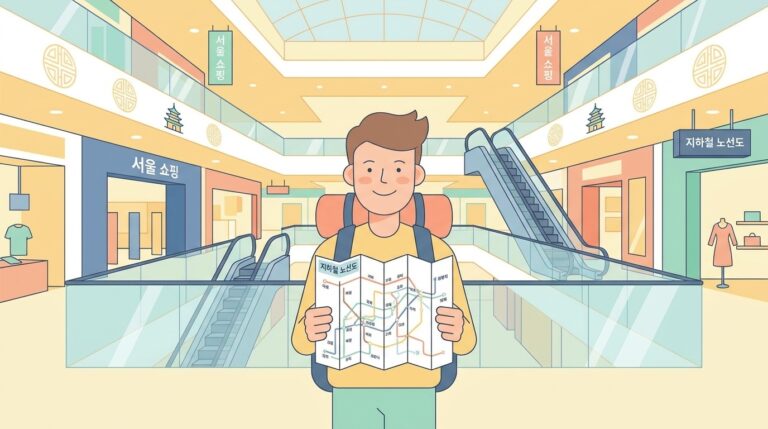
안녕하세요! Welcome to Daily Hangul! I’m your Korean culture navigator and editor. Imagine this: You’ve just arrived at a bustling subway station in Gangnam or a massive shopping complex like COEX Mall in Seoul. Your feet are aching after a long day of sightseeing, and you are desperately looking for the exit or another floor. You see a friendly station staff member, but panic sets in—how do you ask where to go, and what if they tell you to take the escalator? Don’t worry! Finding facilities like escalators, restrooms, and exits is one of the most practical skills you can learn as a beginner. Based on real learner feedback, mastering just a few simple directional phrases will turn your travel anxiety into confidence. Today, we’ll make sure you never get lost in Korea again!
Phase 2: Core Expressions Deep Dive
1. 에스컬레이터 타세요 (Eseukeolleito taseyo)
- Pronunciation: [Eh-seuh-keol-leh-ee-teo tah-seh-yo] (Sounds like “Escalator” + “Ta-say-yo” like saying “Touch-say-yo”)
- Meaning: Direct: “Please ride the escalator.” / Nuance: “Take the escalator.”
- K-Culture Moment: You hear this in crowded Seoul subway stations during rush hour when safety announcements play, or when staff guide tourists in department stores.
- Editor’s Insight: In Korean, we use the verb ‘타다’ (tada – to ride) for escalators, elevators, buses, and trains. Adding ‘-세요’ (seyo) makes it a polite request or direction.
- Situation Spectrum: Casual ⚠️ | Semi-formal ✅ | Formal ✅
- 🤔 Think About It: In English, you “take” an escalator, but in Korean, you “ride” (타다) it. Why do you think Korean treats an escalator like a vehicle?
2. 어디에 있어요? (Eodie isseoyo?)
- Pronunciation: [Eoh-dee-eh eess-eoh-yo?] (Sounds like “Oh-dii-eh ees-oh-yo?”)
- Meaning: Direct: “Where is it located?” / Nuance: “Where is [item/facility]?”
- K-Culture Moment: Asking a staff member in a K-beauty store or K-pop pop-up shop where the elevator or restroom is.
- Editor’s Insight: Just put any location or item before ‘어디에 있어요?’. For example: “화장실(restroom) 어디에 있어요?”
- Situation Spectrum: Casual ⚠️ | Semi-formal ✅ | Formal ✅
- 🤔 Think About It: Notice how Korean puts the location context right upfront. How does this compare to how you ask directions in your native language?
3. 저쪽에 있어요 (Jeojjoge isseoyo)
- Pronunciation: [Jeoh-jjoh-geh eess-eoh-yo]
- Meaning: Direct: “It is over that way.” / Nuance: “It’s over there.”
- K-Culture Moment: A friendly local pointing toward the back of a trendy Seongsu-dong cafe when you ask for the stairs.
- Editor’s Insight: ‘저쪽’ (jeojjok) refers to a direction slightly farther away from both you and the speaker, accompanied by a polite hand gesture.
- Situation Spectrum: Casual ⚠️ | Semi-formal ✅ | Formal ✅
- 🤔 Think About It: Korean has distinct words for “here” (이쪽), “there near you” (그쪽), and “over there far away” (저쪽). Isn’t spatial orientation fascinating?
Phase 3: Textbook Korean vs Real Native Korean
Situation 1: Asking where the escalator is
- 📖 Textbook Korean: 에스컬레이터가 어디에 있습니까? (Eseukeolleitoga eodie itsseumnikka?)
- 🗣️ Real Native Korean: 에스컬레이터 어디 있어요? (Eseukeolleito eodi isseoyo?)
- 💡 Why is it different?: In daily speech, native speakers drop the subject particle ‘가’ (ga) and use the friendly polite ending ‘-어요’ (-eoyo) instead of the super formal ‘-습니까’ (-seumnikka).
Situation 2: Guiding someone to ride the escalator
- 📖 Textbook Korean: 에스컬레이터를 타고 올라가십시오. (Eseukeolleiteoreul tago ollagasipsio.)
- 🗣️ Real Native Korean: 에스컬레이터 타세요. (Eseukeolleito taseyo.)
- 💡 Why is it different?: Short, sweet, and direct! When giving directions on the street, short verb forms with ‘-세요’ are preferred for fast clarity.
Phase 4: K-Culture Deep Dive & Non-verbal Manners
4-1. Nunchi (눈치) & Gestures
When asking for directions in Korea, non-verbal cues are key! Instead of pointing with a single index finger (which can be seen as slightly blunt), open your whole hand with your palm facing slightly upward while pointing toward ‘저쪽’ (over there). Also, in busy subway stations, keep an eye on escalator etiquette: stand on the right side if you are standing still, so people walking fast can pass on the left!
4-2. Culture Code: Korea’s Shopping & Subway Wonders
Korean underground shopping malls (like Express Bus Terminal Station or Yeouido) are massive multi-story mazes! You’ll notice signage in Korean, English, Chinese, and Japanese. Listening for the key word “타세요” (taseyo) will help you follow staff directions smoothly without looking up at maps every ten seconds.
Phase 5: Interactive Roleplay Scenario
Setting: You are inside a bustling department store in Hongdae looking for the exit.
Character: Friendly Information Desk Staff (민우 – Minwoo)
- You: 저기요, 출구 어디에 있어요? (Jeogiyo, chulgu eodie isseoyo?) / [🎭 Action: Pointing politely with an open hand] / Excuse me, where is the exit?
- Minwoo: 아, 출구는 2층에 있어요. (A, chulgunun icheong-e isseoyo.) / [🎭 Action: Smiling warmly] / Ah, the exit is on the 2nd floor.
- You: 2층이요? 어떻게 가요? (Icheong-iyo? Eotteokke gayo?) / [🎭 Action: Tilting head with curiosity] / 2nd floor? How do I go?
- Minwoo: 저쪽에 에스컬레이터 있어요. (Jeojjoge eseukeolleito isseoyo.) / [🎭 Action: Pointing toward the right] / There is an escalator over there.
- You: 에스컬레이터요? (Eseukeolleitoyo?) / [🎭 Action: Looking towards the direction] / The escalator?
- Minwoo: 네, 에스컬레이터 타세요! (Ne, eseukeolleito taseyo!) / [🎭 Action: Making a gentle wave gesture] / Yes, please take the escalator!
- You: 아! 감사합니다! (A! Gamsahamnida!) / [🎭 Action: Nodding head softly] / Ah! Thank you!
- Minwoo: 네, 즐거운 시간 되세요! (Ne, jeulgeoun sigan doeseyo!) / [🎭 Action: Bowing lightly] / Yes, have a great time!
🔀 Interactive Choice Point
What will you say after Minwoo tells you to take the escalator?
* Option A: “네, 에스컬레이터 타요!” (Ne, eseukeolleito tayo!)
* Option B: “아, 감사합니다!” (A, gamsahamnida!)
* Option C: “몰라요.” (Mollayo.)
Feedback:
* Option A (Good): Natural and polite enough! You are confirming you’ll ride it.
* Option B (BEST): Perfect! Expressing gratitude right after receiving helpful directions is super natural.
* Option C (RISK): Saying “I don’t know” abruptly might make the staff think you didn’t understand anything at all!
Phase 6: 10-Second Emotion Shadowing Drill
Practice saying these lines out loud with feeling! Watch the pause marks /.
- [😊 Friendly & Inquiring] 저기요, / 에스컬레이터 / 어디에 있어요?
(Jeogiyo, / eseukeolleito / eodie isseoyo?) - [💡 Realization & Happy] 아! / 저쪽에 / 있어요!
(A! / Jeojjoge / isseoyo!) - [✨ Confident & Polite] 감사해요, / 에스컬레이터 / 타 볼게요!
(Gamsahaeyo, / eseukeolleito / ta bolgeyo!)
Phase 7: K-Culture Mini Dictionary
- 에스컬레이터 (Eseukeolleito) | Escalator | Used universally across Korea in stations and malls.
- 엘리베이터 (Ellibeiteo) | Elevator / Lift | Essential facility word when traveling with heavy baggage.
- 출구 (Chulgu) | Exit | Way out of subway stations or big venues.
- 층 (Cheong) | Floor / Level | Used with Korean-Sino numbers (e.g., 1층 = 1st floor, 2층 = 2nd floor).
Phase 8: Traveler Survival Kit
Top 3 Survival Phrases
- 화장실 어디 있어요? (Hwajangsil eodi isseoyo?) – Where is the restroom?
- 에스컬레이터 타세요. (Eseukeolleito taseyo.) – Take the escalator.
- 저쪽으로 가세요. (Jeojjogeuro gaseyo.) – Go that way.
Editor’s Travel Note
When navigating Korean transportation and facilities, Google Maps often doesn’t give walking details well in Korea. We strongly recommend downloading the Naver Map Navigation App or KakaoMap Korea Route App for real-time indoor subway facility maps!
Phase 9: A Step Deeper (Korean Mindset)
In Korea, space and convenience are designed around community flow. Notice how people guide you using directional honorifics like ‘-세요’ (seyo). It shows warmth and care for strangers navigating shared spaces. Language reflects this consideration—directions are rarely orders, but friendly recommendations.
💬 Your Turn: Have you ever gotten lost in a foreign subway station? What expression saved your day? Share your story in the comments below!
Phase 10: FAQ & Common Mistakes
Q: Can I use “에스컬레이터 어디예요?” instead of “어디에 있어요?”?
A: Yes! “어디예요?” (Eodiyeyo?) is a shorter, very common casual-polite way to ask “Where is it?”.
Q: What if someone tells me “엘리베이터 타세요” instead?
A: ‘엘리베이터’ (Ellibeiteo) means elevator! So they are advising you to take the elevator instead of the escalator.
Q: Is “타세요” formal enough to use with elders or staff?
A: Yes, ‘-세요’ is the perfect level of polite honorific speech for everyday public interactions in Korea.
🚨 Top 3 Common Mistakes
- Mistake: Saying “에스컬레이터 가세요” (Go escalator).
- Correct Action: Use “에스컬레이터 타세요” (Ride the escalator).
- Mistake: Pointing directly at staff with one index finger.
- Correct Action: Open your palm flat when pointing toward directions.
- Mistake: Confusing ‘이쪽’ (this way) and ‘저쪽’ (that way over there).
- Correct Action: Remember ‘저’ refers to something distant from both speakers!
Phase 11: Action Mission & K-Culture Challenge
- Bronze Level: Say “에스컬레이터 타세요” out loud 3 times looking in the mirror.
- Silver Level: Comment below using the phrase: “[Facility] 어디에 있어요?”.
- Gold Level: Watch a vlog set in Seoul subway/mall and spot someone riding an escalator while saying “타세요!”.
🎮 K-Culture Mission: Watch a scene from your favorite modern K-drama set in a department store. Can you hear the characters using directions ending in ‘-세요’? Write down the place name you hear!
Phase 12: Interactive Quiz Challenge
Q1. How do you tell someone to “take the escalator” politely in Korean?
a) 에스컬레이터 먹어요
b) 에스컬레이터 타세요
c) 에스컬레이터 자요
🔍 Click to reveal Answer & Explanation
Answer: b) 에스컬레이터 타세요
Explanation: ‘타다’ (tada) means to ride, and combined with ‘-세요’ it forms the polite instruction “Please ride/take the escalator.”
Q2. Fill in the blank: “Restroom 어디에 있어요?” -> “화장실 ___ 있어요?”
🔍 Click to reveal Answer & Explanation
Answer: 어디에
Explanation: ‘어디에’ means “where at”. Full sentence: 화장실 어디에 있어요? (Where is the restroom?)
Q3. True or False: In Korean escalator etiquette, walking people usually pass on the left side.
🔍 Click to reveal Answer & Explanation
Answer: True
Explanation: Standing passengers stay on the right, leaving the left lane open for quick walkers in busy Korean public spaces.







