

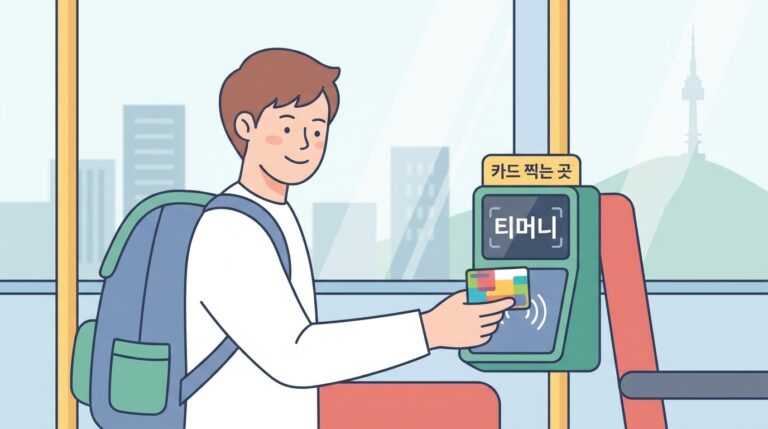
Master the Korean Bus Transfer: “환승입니다” Made Easy!
안녕하세요! 매일한글 에디터입니다. (Hello! I’m your lead editor at Daily Hangul!) Have you ever stood inside a packed Seoul bus, holding your transportation card near the reader, only to hear a crisp chime say “Hwanseung-imnida”? You panic for a second—did your card decline? Did you do something wrong? Take a deep breath! That cheerful voice actually gave you great news: “It’s a transfer!” You just saved money thanks to Korea’s seamless transit system.
Taking the bus in Korea can feel intimidating at first with fast-boarding crowds and quick bus doors. But once you understand how transfers work, you’ll feel like a local navigating Seoul, Busan, or Jeju with total confidence. In this lesson, we will break down the essential words, transit etiquette, and real-life scenarios so you never panic at the bus card reader again!
Phase 2: Core Expression Deep Dive
1. 환승입니다 (Hwanseung-imnida)
- Pronunciation: [Hwan-seung-im-ni-da] (Sounds like ‘Hwan’ + ‘sung’ + ‘im-nee-dah)
- Meaning: “It is a transfer.” (Literal) / “Transfer discount applied!” (Nuance)
- K-Culture Moment: You hear this automated chime every time you tap your card onto a second bus or subway within 30 minutes.
- Editor’s Insight: This isn’t an error sound! It confirms you are getting a free or discounted ride under the integrated transit fare system.
- Situation Spectrum: Casual 🚫 | Semi-formal ✅ | Formal ✅
- 🤔 Think About It: How does your city encourage public transit use compared to Korea’s automatic transfer system?
2. 교통카드 찍어 주세요 (Gyotong-kadeu jjigeo juseyo)
- Pronunciation: [Gyo-tong-ka-deu jji-geo ju-se-yo] (Jji-geo sounds like snapping a photo or pressing down hard)
- Meaning: “Please tap your transit card.”
- K-Culture Moment: Bus drivers or friendly passengers remind you to tap your card when entering or exiting.
- Editor’s Insight: The verb 찍다 (jjik-da) literally means to stamp or take a picture, but in daily life, it means ‘to tap a card’.
- Situation Spectrum: Casual ⚠️ | Semi-formal ✅ | Formal ✅
- 🤔 Think About It: Why is tapping out (exiting) just as important as tapping in in Korea?
3. 내릴게요! (Naeril-geyo!)
- Pronunciation: [Nae-ril-ge-yo]
- Meaning: “I am getting off!”
- K-Culture Moment: The bus is crowded, you are near the back door, and people are blocking the exit.
- Editor’s Insight: Short, direct, and polite. Saying this clearly helps people make way for you instantly.
- Situation Spectrum: Casual ⚠️ | Semi-formal ✅ | Formal ✅
- 🤔 Think About It: How do people in your country politely navigate crowded public buses?
Phase 3: Textbook Korean vs. Real Korean
Situation 1: Asking if you get a transfer discount
- 📖 Textbook Korean: 환승 할인이 적용되었습니까? (Hwanseung harin-i jeokyong-doe-eoss-seumnida-kka?)
- 🗣️ Real Korean: 환승 됐어요? (Hwanseung dwae-sseo-yo?)
- 💡 Why the difference? Real Koreans trim long passive verbs into short, past-tense conversational forms.
Situation 2: Asking where to tap the card
- 📖 Textbook Korean: 어디에 카드를 대야 합니까? (Eodie kadeu-reul daeya hamnida-kka?)
- 🗣️ Real Korean: 어디에 찍어요? (Eodie jjigeo-yo?)
- 💡 Why the difference? The casual verb 찍다 is universally preferred over the formal 대다 for card readers.
Phase 4: K-Culture Deep Dive & Etiquette
4-1. Nunchi & Gestures
In Korea, bus efficiency relies heavily on Nunchi (quick social situational awareness):
* Card in Hand: Always hold your T-money card or phone ready before reaching the door.
* Tap Off Always: Always tap your card when exiting (하차태그) to keep your transfer discount valid for the next ride within 30 minutes.
4-2. Culture Code: The 30-Minute Rule
Korea’s transfer discount system allows up to 4 free/discounted transfers within 30 minutes (1 hour at night). As long as you tap off properly, hearing “환승입니다” guarantees you won’t pay a full fare again!
Phase 5: Real Role-Play Scenario
Setting: You get onto Bus No. 7016 at Gwanghwamun after taking the subway.
Characters: You (A1 Learner) & Bus Reader Machine / Driver (Friendly Local)
- A: 저기요, 이거 버스 가요? (Jeogiyo, igeo beoseu gayo? / [🎭 Hesitantly pointing at the bus route] / Excuse me, does this bus go?)
- Driver: 어디 가요? (Eodi gayo? / [🎭 Glancing warmly] / Where are you going?)
- A: 홍대요! (Hongdae-yo! / [🎭 Smiling brightly] / Hongdae!)
- Driver: 네, 탄 다음 카드 찍으세요. (Ne, tan daeum kadeu jjigeuseyo. / [🎭 Nodding] / Yes, get on and tap your card.)
- A: [Taps T-money card on the machine]
- Machine Voice: 🔔 환승입니다! (Hwanseung-imnida! / [🎭 Chime sounds] / Transfer applied!)
- A: 아, 다행이다! 감사합니다! (A, dahaeng-ida! Kamsahamnida! / [🎭 Relieved smile] / Ah, what a relief! Thank you!)
- Driver: 조심히 앉으세요~ (Joshimhi anjeuseyo~ / [🎭 Checking mirror] / Please take a seat safely~)
🔀 Interactive Choice Point
What do you do when getting off at Hongdae?
* Option A: Walk off without tapping your card because you already paid.
* Option B: Hold your card near the red exit reader until it beeps before stepping down.
* Option C: Ask the driver loudly if you need to pay again in cash.
Feedback:
* Option A (BAD): 🚫 You will lose your transfer discount and pay a penalty fee on your next trip!
* Option B (BEST): ✅ Perfect! Tapping off registers your exit time and keeps your 30-minute transfer window active.
* Option C (RISK): ⚠️ The driver will tell you to tap your card, which might slow down passengers behind you.
Phase 6: 10-Second Emotion Shadowing Drill
[😊 Relieved & Happy]환승입니다! / 감사합니다! (Hwanseung-imnida! / Kamsahamnida!)[😮 Curious & Polite]어디에 / 찍어요? (Eodie / jjigeo-yo?)[🏃 Urgent & Clear]이번에 / 내릴게요! (Ibeone / naeril-geyo!)
Phase 7: K-Culture Mini Dictionary
- 교통카드 (Gyotong-kadeu): Transit Card (T-money, Cashbee). Used for buses, subways, and convenience stores.
- 환승 (Hwanseung): Transfer. Switching routes or transit types within a set timeframe.
- 하차태그 (Hacha-taegeu): Exit Tap. Tapping your transit card when getting off the vehicle.
- 버스 정류장 (Beoseu jeongryujang): Bus stop. The designated waiting shelter for public buses.
Phase 8: Traveler’s Survival Kit
Top 3 Survival Phrases
- 교통카드 충전해 주세요. (Gyotong-kadeu chungjeon-hae juseyo.) – Please recharge my transit card.
- 홍대 가요? (Hongdae gayo?) – Does this go to Hongdae?
- 다음 정류장에 내려요. (Daeum jeongryujang-e naeryeoyo.) – I get off at the next stop.
Editor’s Travel Note
Before stepping out in Seoul, make sure to Download Naver Map App to track real-time bus arrivals and transfer routes effortlessly!
Phase 9: One Step Deeper
Korea’s public transit system reflects a deep cultural priority on collective speed and shared convenience. By tapping quickly and exiting efficiently, everyone helps keep the city moving smoothly. Understanding terms like 환승 isn’t just about language—it’s your doorway into participating in the daily rhythm of modern Korean society.
💬 Your Turn: Have you ever used a public transit transfer system in another country? Share your experience in the comments below!
Phase 10: FAQ & Common Mistakes
Q: What does
Frequently Asked Questions (FAQ)
Q: What does "환승입니다 (Hwanseung-imnida)" mean in Korean and how do you pronounce it?
A: In Korean, "환승입니다 (Hwanseung-imnida)" is pronounced [Hwan-seung-im-ni-da] and means: "It is a transfer." (Literal) / "Transfer discount applied!" (Nuance)
Q: What does "교통카드 찍어 주세요 (Gyotong-kadeu jjigeo juseyo)" mean in Korean and how do you pronounce it?
A: In Korean, "교통카드 찍어 주세요 (Gyotong-kadeu jjigeo juseyo)" is pronounced [Gyo-tong-ka-deu jji-geo ju-se-yo] and means: "Please tap your transit card."
Q: What does "내릴게요! (Naeril-geyo!)" mean in Korean and how do you pronounce it?
A: In Korean, "내릴게요! (Naeril-geyo!)" is pronounced [Nae-ril-ge-yo] and means: "I am getting off!"







