

Phase 1: Empathy & Storytelling Opening
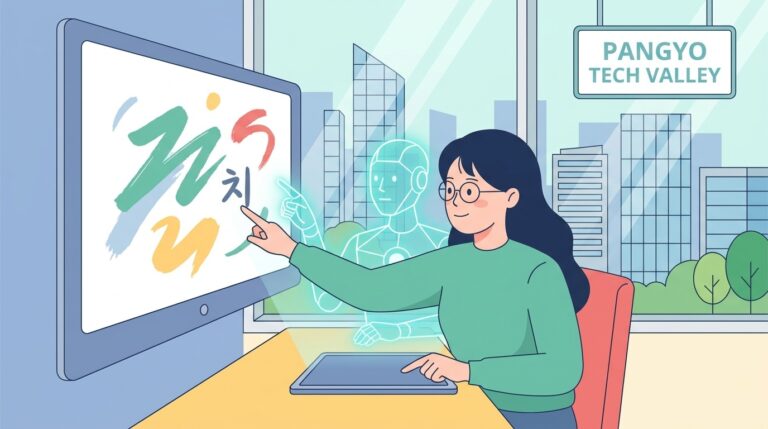
안녕하세요! I’m your Daily Hangul lead editor and local culture navigator! Imagine walking into a high-energy creative workshop in Pangyo Tech Valley—Korea’s Silicon Valley. A group of webtoon artists, legal experts, and AI developers are gathered around a digital screen, intensely debating over an award-winning digital painting. The catch? The prompt was written by a human artist, but the pixels were generated entirely by an AI model.
At the C2 (Proficient) level, your challenge in Korean isn’t just ordering coffee or making simple conversation. It’s stepping into complex, high-stakes intellectual debates with fluency, sophistication, and cultural precision. How do you articulate legal nuances like “copyright attribution,” “originality,” or “legal personhood” without sounding like you’re reading directly from a rigid textbook?
In Korea’s fast-moving tech and content industries—from K-Pop music AI composition to Webtoon generation—this debate is taking center stage right now. Based on real feedback from advanced learners working in Seoul’s tech and creative sectors, this guide will equip you with the exact C2-level framing, vocabulary, and cultural manners needed to hold your ground in high-level Korean professional discussions.
Phase 2: Core Expressions Deep Dive
1. 저작권이 귀속되다 (Jeojakgwoni gwisokdoeda)
- Pronunciation: [Jeo-jak-gwon-i gwi-sok-doe-da] (Sounds like “joh-jak-gwon” + “gwee-soke-dwae-da”)
- Meaning: Literal: Copyright is vested in / attached to. Nuance: The legal or formal ownership of copyright automatically belonging to a designated entity.
- K-Culture Moment: Seen frequently in K-Drama courtroom scenes or tech startup boardroom arguments when negotiating intellectual property rights.
- Editor’s Insight: The verb 귀속되다 (to belong to / vest in) is indispensable for formal debates on law, business, and philosophy. It moves your speech immediately into professional C2 territory.
- Situation Spectrum: Casual 🚫 | Semi-formal ⚠️ | Formal ✅
- 🤔 Think About It: In your home country’s legal system, can non-human entities hold rights, or must legal ownership always be vested in a natural human person?
2. 독창성을 인정받다 (Dokchangseong-eul injeongbatda)
- Pronunciation: [Dok-chang-seong-eul in-jeong-bat-da] (Pronounced smoothly with liaison as “in-jeong-bat-da”)
- Meaning: Literal: To receive recognition for originality. Nuance: To be officially or culturally credited with genuine creative uniqueness.
- K-Culture Moment: K-Pop audition show judges discussing whether an AI-assisted song track possesses genuine human artistry and emotional depth.
- Editor’s Insight: Instead of just saying “새롭다” (to be new), using 독창성 (originality) paired with 인정받다 (to be recognized) elevates your analytical precision.
- Situation Spectrum: Casual ⚠️ | Semi-formal ✅ | Formal ✅
- 🤔 Think About It: If an AI generates art based on 10,000 human prompts, where does “human contribution” end and machine generation begin?
3. 법적 주체성을 부여하다 (Beopjeok jucheseong-eul buyeohada)
- Pronunciation: [Beop-jjeok ju-che-seong-eul bu-yeo-ha-da] (Note the tensification on [법쩍])
- Meaning: Literal: To grant legal agency / personhood. Nuance: Extending legal rights, duties, or recognition to an entity (like AI) within a legal framework.
- K-Culture Moment: Discussed on academic talk shows or tech policy symposiums hosted in Seoul regarding AI regulation.
- Editor’s Insight: 주체성 refers to subjecthood/agency. Adding 법적 (legal) and 부여하다 (to grant/confer) forms a powerhouse C2 academic collocation.
- Situation Spectrum: Casual 🚫 | Semi-formal ⚠️ | Formal ✅
- 🤔 Think About It: How would society change if algorithms were granted legal personhood equivalent to corporations?
Phase 3: Textbook Korean vs. Real Native Korean
Situation 1: Expressing doubt about AI copyright eligibility
- 📖 Textbook Korean: AI가 만든 작품에 저작권을 부여해야 합니까?
- 🗣️ Real Native Korean: AI 창작물에까지 저작권을 인정해 주는 게 과연 맞을까요?
- 💡 Why it works: Native speakers use the nuance marker “~에까지” (even extending to) and the rhetorical inquiry “~는 게 과연 맞을까요?” to express diplomatic skepticism during sophisticated discussions.
Situation 2: Highlighting the main dilemma
- 📖 Textbook Korean: 제일 중요한 문제는 인간의 기여 정도입니다.
- 🗣️ Real Native Korean: 핵심은 어디까지를 인간의 창의적 기여로 볼냐가 관건이죠.
- 💡 Why it works: Using “~가 관건이다” (the key crux/point lies in…) instantly transforms basic statements into persuasive executive-level Korean.
Phase 4: K-Culture Deep Dive & Non-verbal Etiquette
4-1. Nunchi & Non-Verbal Gestures in Debates
In Korean professional debates, direct contradiction can destroy gi-bun (emotional harmony). When disagreeing on sensitive tech-legal topics:
* The Soft Opening Nod: Slightly nod your head 1-2 times before delivering a counterargument.
* Softening Phrase: Begin with “말씀하신 취지는 충분히 이해합니다만…” (I fully understand the intent of your point, however…).
* Hand Gesture: Keep palms open facing slightly upward when offering a counter-perspective, avoiding index-finger pointing.
4-2. Cultural Code: The Webtoon & IP Explosion
Korea is the global epicenter of Webtoons (Naver Webtoon, Kakao Page). Because Korean webtoon creators face brutal weekly deadlines, AI image generators have become both a savior and a massive point of legal friction regarding style theft and artist copyright. Understanding this context gives your language real-world cultural grounding.
Phase 5: Real-Life Roleplay Scenario
Setting: A panel discussion at Pangyo Webtoon Creators Hub.
Characters:
* 민호 (Min-ho): Senior AI Legal Tech Researcher
* 지수 (Ji-soo): Webtoon Artist & IP Rights Advocate
- 민호: 지수 작가님, 이번 AI 웹툰 공모전 수상작 논란에 대해 어떻게 생각하십니까?
(Ji-soo-ssi, what are your thoughts on the controversy surrounding the winning entry in the AI Webtoon Contest?) - 지수: 🎭 (고개를 갸웃거리며) 현행법상 저작권은 인간의 창작물에만 귀속되는 게 원칙 아닌가요?
(Under current law, isn’t it the principle that copyright is vested exclusively in human creations?) - 민호: 🎭 (손바닥을 펼치며) 맞는 말씀입니다. 하지만 프롬프트 구성에 들어간 인간의 노력을 인정해야 한다는 의견도 거셉니다.
(You are correct. However, arguments asserting that human effort in prompt engineering must be recognized are gaining strong ground.) - 지수: 프롬프트를 입력했다고 해서 독창성을 인정받기엔 무리가 있다고 봅니다.
(Simply entering a prompt seems insufficient to warrant recognition for originality.) - 민호: 그렇다면 AI를 독립된 법적 주체로 보지 않더라도, 기여도에 따라 분배하는 방식은 어떨까요?
(Then, even if we don’t view AI as an independent legal entity, what about distributing rights based on the degree of contribution?) - 지수: 🎭 (진지한 표정으로) 기여도 측정 기준이 모호하다면 또 다른 법적 분쟁을 야기할 수 있습니다.
(If the criteria for measuring contribution remain ambiguous, it could provoke yet another round of legal disputes.) - 민호: 결국 법적 제도화 이전에 사회적 합의 도출이 선행되어야겠군요.
(Ultimately, deriving a social consensus must precede formal legal institutionalization.) - 지수: 정확히 보셨습니다. 기술의 발전 속도를 제도가 따라가지 못하는 실정입니다.
(You hit the nail on the head. The current reality is that our legal framework cannot keep pace with tech advancement.)
🔀 Interactive Branching Point
If you were asked to step into this debate, how would you respond to Min-ho?
* Option A: AI가 그린 거니까 당연히 저작권은 없죠! (Too blunt/casual)
* Option B: AI 창작물이라도 인간의 독창적 기여도가 입증된다면 부분적 저작권을 인정하는 방안도 고려해 볼 만합니다. (Best Answer)
* Option C: 잘 모르겠는데 법원에서 알아서 하겠죠. (Dismissive/Risk)
- Feedback:
- Option A: Valid point, but the phrasing lacks C2 sophistication for a professional panel.
- Option B (Best): Perfect balance of complex structure (“~가 입증된다면”, “~하는 방안도 고려해 볼 만합니다”) and nuanced legal perspective.
- Option C: Disengages from the conversation and breaches professional etiquette.
Phase 6: 10-Second Emotion Shadowing Drill
Practice these lines with exaggerated natural pause (/) and emotional tone tags:
[🧐 진지하고 논리적으로]
AI 창작물에 / 저작권이 귀속될 수 있는지에 대해서는 / 보다 신중한 접근이 필요합니다.[💡 깨달음을 얻은 듯이]
결국 핵심은 / 기술 자체가 아니라 / 인간의 창의적 기여도를 / 어떻게 규정할인가에 있군요.[⚖️ 확고하고 전문적으로]
법적 주체성이 없는 AI에게 / 저작권을 부여하는 것은 / 현행 법체계의 근간을 흔들 수 있습니다.
Phase 7: K-Culture Mini Dictionary
- 창작자 (Changjakja) | Creator / Author | Used in intellectual property law to designate the human author behind a work.
- 기여도 (Giyeodo) | Degree of Contribution | Highly relevant in business contracts and AI-human co-creation share calculations.
- 판례 (Pallye) | Legal Precedent | Used when discussing existing court rulings regarding AI creations worldwide.
- 지식재산권 (Jisikjaesangwon) | Intellectual Property (IP) Rights | Frequently shortened to “IP” in tech and entertainment sectors in Korea.
Phase 8: Professional Survival Kit
TOP 3 Expressive Power Tools
- 사회적 합의가 시급합니다. (Social consensus is urgently needed.)
- 선례를 남길 수 있습니다. (This could set a legal precedent.)
- 갑론을박이 이어지고 있습니다. (Hot debates and pros/cons continue to flare up.)
Editor’s Travel & Tech Note
When navigating legal or policy discussions in Korea, referencing official government legalese adds immense authority. Check out legal definitions directly on the 국가법령정보센터 웹사이트 to stay updated on Korea’s evolving copyright laws.
Phase 9: One Step Deeper (Reflective Essay)
In Korean culture, innovation is adopted at lightning speed, but social order (질서) and collective consensus (사회적 합의) are prized above arbitrary individualism. The AI copyright debate in Korea reflects this exact duality: while companies rapidly commercialize AI webtoons and synthetic K-Pop vocals, society demands a harmonious standard that protects human creators while fostering futuristic industries.
💬 Your Turn: What is the legal stance on AI-generated copyright in your country? Leave a comment in Korean using today’s expression “~에 귀속되다”!
Phase 10: FAQ & Mistake Prevention
Q: Can I use “저작권” (copyright) for non-creative products?
A: No. 저작권 strictly applies to artistic, creative, literary, or intellectual works. For industrial inventions or software utility, use 특허권 (patent rights) or 소유권 (property rights).
Q: What is the difference between 저작권자 and 창작자?
A: 창작자 is the physical author/creator. 저작권자 is the copyright holder (which could be a publishing company or studio that bought the rights).
Q: How do I express “prompt engineering” in natural Korean debate?
A: You can say “프롬프트 작성” or adopt the loan word directly as “프롬프트 엔지니어링”.
🚨 Common Mistakes TOP 3
- Mistake: AI가 저작권을 가져요. (Too simplistic)
- Correct Action: AI에게 저작권이 귀속됩니다.
- Mistake: 인간의 아이디어를 인정해야 해요.
- Correct Action: 인간의 창의적 기여도를 인정할 필요가 있습니다.
- Mistake: 법이 진짜 느려요.
- Correct Action: 기술 발전에 비해 법제도 정비가 미흡한 실정입니다.
Phase 11: Action Mission & Engagement
- Bronze Mission: Write a one-sentence opinion on AI art using the word “독창성”.
- Silver Mission: Record yourself reciting the 3 Emotion Shadowing sentences in Phase 6 and check your rhythm.
- Gold Mission: Engage in a forum or write a short 3-paragraph essay arguing whether AI prompts count as human creative contribution.
🎮 K-Culture Mission: Watch a recent Korean tech news broadcast on YouTube (like KBS News or YTN Tech) and spot the word “지식재산권” or “판례” in action!
Phase 12: Interactive Quiz Challenge
Test your C2 mastery below! Click the toggles to check answers.
1. Fill in the blank
현행법상 AI 창작물은 인간의 직접적인 개입이 없다면 저작권이 ( ) 어렵습니다.
🔍 Check Answer & Explanation
Answer: 귀속되기 (or 인정받기)
Translation: Under current law, it is difficult for AI creations to have copyright vested in them without direct human intervention.
2. True or False
In Korean legal debates, starting a counterargument with “틀린 말씀입니다” is considered professional and polite.
🔍 Check Answer & Explanation
Answer: False!
Explanation: Saying “You are wrong” directly damages debate harmony. Use softening phrases like “말씀하신 취지는 이해하지만…” instead.







