

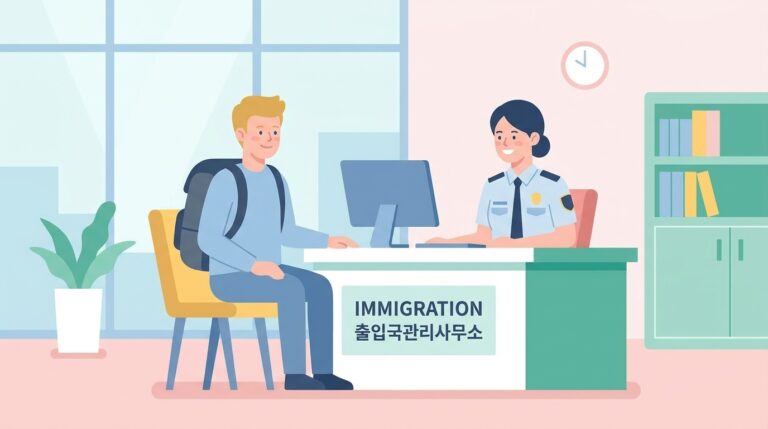
Navigating the Korean Immigration Office Without Fear: Essential Phrases & Survival Guide
Phase 1: Empathy & Storytelling
안녕하세요! (Annyeonghaseyo!) I’m your Daily Hangul editor and your Korean best friend! Have you ever felt your heart pounding just standing in front of a government building in a foreign country? Picture this: You walk into the bustling Korean Immigration Office (출입국·외국인관서) in Seoul. The room is filled with glowing digital screens displaying waiting numbers, officers typing briskly, and foreign residents clutching blue folders full of documents. You hold your passport in one sweaty hand and wonder, “What if I say the wrong thing and get sent home?”
Don’t worry! Every foreign resident in Korea—including thousands of our Daily Hangul learners—has stood right where you are. Navigating public offices in Korea can feel intimidating, but with just a few simple, natural phrases, you can transform a stressful ordeal into a smooth, successful experience. Today, we are going to master the exact words you need for your Immigration Office visit. By the end of this guide, you will feel confident, prepared, and ready to handle your visa extension or ARC pickup like a local!
Phase 2: Top 3 Essential Expressions
1. 예약하고 왔어요. (Yeyak-hago wasseoyo.)
- Pronunciation: [Ye-yak-ha-go wass-eo-yo] (Sounds like “Yay-yahk hah-go wah-sso-yo”)
- Meaning: “I came with a reservation.” (Literal: “Reservation made and came.”)
- K-Culture Moment: In K-dramas, when characters visit fine-dining restaurants or exclusive clinics, they confidently tell the receptionist, “예약하고 왔어요.” It immediately signals that you follow the proper system.
- Editor’s Insight: Most Korean immigration offices require advance online booking via HiKorea. Saying this right as you approach the counter shows the officer that you are organized and respectful of their schedule.
- Situation Spectrum: Casual 🚫 / Semi-formal ✅ / Formal ✅
- 🤔 Think About It: In Korea, system efficiency and advance scheduling are highly valued. How does appointment booking in your country compare to Korea’s digital reservation system?
2. 체류 기간을 연장하고 싶어요. (Chaeryu giganeul yeonjang-hago sipeoyo.)
- Pronunciation: [Chae-ryu gi-gan-eul yeon-jang-ha-go sip-eo-yo] (Sounds like “Chae-ryoo gee-gahn-eul yawn-jahng hah-go see-poh-yo”)
- Meaning: “I would like to extend my period of stay.”
- K-Culture Moment: You will hear “연장” (extension) often in Korean life—whether extending a gym membership, a library book, or stay duration in real-life drama plots!
- Editor’s Insight: While ‘비자 연장’ (visa extension) is common slang, using ‘체류 기간’ (period of stay) sounds polite and grammatically clear for A2 learners communicating with official officers.
- Situation Spectrum: Casual 🚫 / Semi-formal ✅ / Formal ✅
- 🤔 Think About It: Using polite verb endings like ~고 싶어요 (-go sipeoyo) soft-lands your request in Korean culture, making officers much more eager to assist you.
3. 이 서류가 맞나요? (I seoryuga mannayo?)
- Pronunciation: [I seo-ryu-ga man-na-yo?] (Sounds like “Eee seh-ryoo-gah mahn-nah-yo?”)
- Meaning: “Is this document correct?”
- K-Culture Moment: In office-setting K-dramas like Business Proposal, junior staff hand over folders asking if documents meet the boss’s approval.
- Editor’s Insight: Instead of asking an overwhelming question like “Did I do everything right?”, pointing to a specific form and asking “이 서류가 맞나요?” gives the officer a simple, direct question to answer with a quick yes or no.
- Situation Spectrum: Casual 🚫 / Semi-formal ✅ / Formal ✅
- 🤔 Think About It: Seeking confirmation politely shows humility (겸손) in Korean culture, which encourages helpfulness from administrative staff.
Phase 3: Textbook Korean vs. Real Korean
Situation 1: Waiting at the Counter
- 📖 Textbook Korean: “잠시만 기다려 주십시오.” (Jamsiman gidaryeo jusipsio.)
- 🗣️ Real Korean: “잠시만요~” (Jamsimanyo~)
- 💡 Why is it different? While official forms use super-formal phrasing, officers in fast-paced public offices often shorten phrases with a friendly, rhythmic tone to keep things moving efficiently.
Situation 2: Submitting Documents
- 📖 Textbook Korean: “서류를 제출하겠습니다.” (Seoryureul jechulhagesseumnida.)
- 🗣️ Real Korean: “여기 서류 가지고 왔어요.” (Yeogi seoryu gajigo wasseoyo.)
- 💡 Why is it different? Complete textbook formal sentences can sound stiff or overly rehearsed. Spoken Korean naturally favors softer conversational past-tense forms.
Phase 4: K-Culture Deep Dive & Non-Verbal Manners
4-1. Nunchi (눈치) & Office Gestures
When interacting at a Korean immigration counter, non-verbal etiquette is just as important as spoken words:
1. Two-Handed Delivery: Always hand over your passport, application form, or payment card using both hands (or holding your right wrist with your left hand). This simple gesture shows high respect.
2. Eye Contact & Slight Bow: When your number is called, make brief eye contact, give a gentle 15-degree bow, and say “안녕하세요!”
3. Patient Nunchi: Korean public offices work with incredible speed (Pali-pali culture). Avoid tapping your fingers or looking at your watch continuously while the officer types.
4-2. Culture Code: The “Pali-Pali” Administrative Efficiency
Korea is famous for its rapid administrative system. Everything from ticket printing to passport scans is digitized. Because officers handle hundreds of applicants daily, being prepared with your papers organized in order shows great courtesy and earns you instant goodwill!
Phase 5: Interactive Role-Play Scenario
Setting: Seoul Immigration Office Counter #4. You hear your number chiming on the LED display.
NPC Character: Officer Park (출입국 관리관) – Efficient, professional, but very helpful if you are polite!
- Turn 1 (Officer Park): 🎭 Looks up from the monitor and nods. “안녕하세요. 번호표 주세요.” (Hello. Please give me your ticket number.)
- Turn 2 (You): 🎭 Handing over the ticket with both hands. “안녕하세요! 여기 있습니다.” (Hello! Here it is.)
- Turn 3 (Officer Park): 🎭 Scans the ticket. “오늘 어떤 일로 오셨나요?” (What brings you here today?)
- Turn 4 (You): 🎭 Smiling politely. “예약하고 왔어요. 체류 기간을 연장하고 싶어요.” (I came with a reservation. I would like to extend my stay.)
- Turn 5 (Officer Park): 🎭 Types on keyboard. “네, 여권이랑 신청서 보여주세요.” (Yes, please show me your passport and application form.)
- Turn 6 (You): 🎭 Hands over the document folder. “여기 있어요. 이 서류가 맞나요?” (Here you go. Are these documents correct?)
- Turn 7 (Officer Park): 🎭 Checks documents quickly and smiles. “네, 잘 준비하셨네요. 잠시만 기다려 주세요.” (Yes, you prepared them well. Please wait a moment.)
- Turn 8 (You): 🎭 Nods respectfully. “네, 감사합니다!” (Yes, thank you!)
🔀 Interactive Branching Choice
What will you do if the officer asks for an extra document you forgot to print?
- Option A: Say “모르겠어요” (I don’t know) and panic.
- Option B: Say “죄송합니다. 모바일로 보여드려도 될까요?” (I am sorry. May I show you on my phone?)
- Option C: Argue in English that you were not told about this document.
Feedback Matrix:
* Option A (Bad): Leaves the officer unable to help you and stalls the counter line.
* Option B (BEST): Highly effective! Officers often accept digital PDFs or clear photos on your smartphone screen.
* Option C (Risk): Creates tension and language barriers. Staying calm and polite in basic Korean yields far better results.
Phase 6: 10-Second Emotional Shadowing Drill
Practice these lines out loud with the indicated pauses (/) and emotional tone!
[😊 Confident & Polite]안녕하세요! / 예약하고 왔어요. (Annyeonghaseyo! / Yeyak-hago wasseoyo.)[🥺 Gentle Request]체류 기간을 / 연장하고 싶어요. (Chaeryu giganeul / yeonjang-hago sipeoyo.)[🤔 Curious & Humble]제가 작성한 / 이 서류가 맞나요? (Jega jakseonghan / i seoryuga mannayo?)[🙏 Grateful]감사합니다! / 수고하세요! (Gamsahamnida! / Sugohaseyo!)
Phase 7: K-Culture Mini Dictionary
- 외국인등록증 (Oegugin Deongnokjeung) | Alien Registration Card (ARC) | The official ID card issued to foreign residents staying over 90 days in Korea.
- 하이코리아 (HiKorea) | HiKorea Government Portal | The official e-governance website used to book immigration office visits and check visa policies.
- 방문예약 (Bangmun Yeyak) | Visit Reservation | The compulsory appointment slot booked beforehand to visit an immigration desk.
- 번호표 (Beonhopyo) | Waiting Ticket | The paper slip printed upon arrival showing your designated queue number.
Phase 8: Traveler’s Survival Kit
TOP 3 Survival Phrases
- 도와주세요. (Dowajuseyo.) – Please help me. (Use when feeling lost.)
- 수수료는 어디서 내나요? (Susuryoneun eodiseo naenayo?) – Where do I pay the processing fee?
- 다 끝났나요? (Da kkeutnannayo?) – Is everything finished?
Editor’s Travel Note
Before heading out, make sure you download the Naver Map app download guide to navigate directly to your local immigration branch. Remember that processing fees at immigration offices usually require cash (ATM on-site) or revenue stamps (수입인지), so always keep 30,000 to 60,000 KRW cash in hand!
Phase 9: One Step Deeper (Reflective Insight)
Korean administrative culture operates on a foundation of clear structure, digital convenience, and mutual politeness. While administrative tasks in many countries are notorious for endless delays, Korea’s public service aims for maximum speed. When foreign residents speak even basic polite Korean phrases, it bridges cultural gaps instantly and reflects your appreciation for Korean social norms.
💬 Your Turn: Have you ever visited a government office in Korea or your home country? What was the hardest part? Share your experiences in the comments below!
Phase 10: FAQ & Common Mistakes
Q: Can I visit the Korean Immigration Office without an appointment?
A: In most major cities like Seoul, Incheon, and Busan, walk-ins are not accepted for visa extensions or ARC applications. You must book a ‘방문예약’ (Visit Reservation) on the HiKorea website beforehand.
Q: What should I say when leaving the counter?
A: Say “감사합니다, 수고하세요!” (Thank you, keep up the good work!). This is a very common and polite Korean greeting when leaving businesses or public desks.
Q: What if the officer speaks too fast?
A: You can politely ask: “천천히 말씀해 주세요” (Cheoncheonhi malsseumhae juseyo – Please speak slowly).
🚨 Common Mistakes TOP 3
- Mistake: Handing documents over with one hand.
- Correct Action: Always hand over passports and forms using both hands.
- Mistake: Arriving right at your appointment time.
- Correct Action: Arrive 15 minutes early to print your waiting slip at the kiosk.
- Mistake: Forgetting cash for processing stamps.
- Correct Action: Carry at least 50,000 KRW cash, as card processing is not always available for government fee stamps.
Phase 11: Action Mission & Engagement
- 🥉 Bronze Mission: Practice saying “예약하고 왔어요” three times in front of the mirror.
- 🥈 Silver Mission: Write down your survival phrases on a notepad or phone memo app.
- 🥇 Gold Mission: Use at least two Korean phrases during your next actual visit to a public office or bank!
🎮 K-Culture Mission: Watch an episode of a workplace K-drama (like Misaeng or Extraordinary Attorney Woo) and spot how workers hand over documents using two hands!
Phase 12: Interactive Quiz Challenge
Test your knowledge before you go!
1. What is the polite way to say “I came with a reservation”?
* A) 예약했어요
* B) 예약하고 왔어요
* C) 그냥 왔어요
👉 Click to reveal Answer & Explanation
Answer: B) 예약하고 왔어요
Explanation: ‘예약하고 왔어요’ is the standard, natural semi-formal phrase used when arriving for scheduled appointments in Korea.
2. True or False: It is polite to pass your passport to an officer using only your left hand.
* A) True
* B) False
👉 Click to reveal Answer & Explanation
Answer: B) False
Explanation: In Korea, handing items with one hand can seem dismissive. Always use two hands when handing items to elders or officials!







