

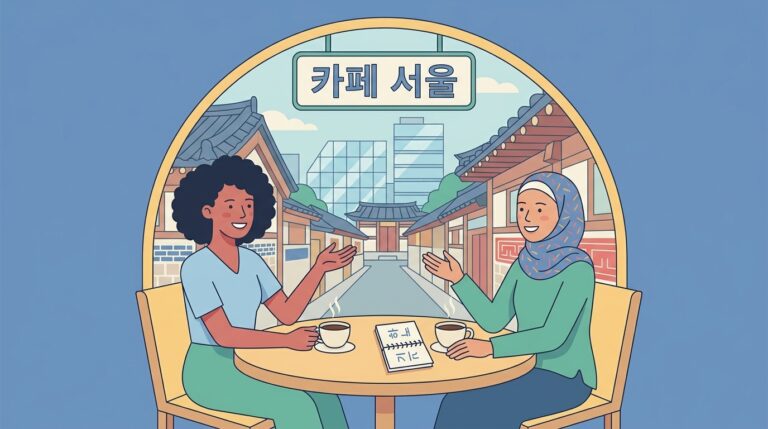
Phase 1: Empathy & Connection
안녕하세요! 매일한글 에디터입니다. Have you ever sat down with a new Korean friend at a cozy café in Hongdae, sipping a sweet iced Americano, only to feel your mind go completely blank when the conversation pauses? You want to break the ice and ask about their favorite pastimes, but traditional textbooks taught you rigid, formal sentences like “당신의 취미는 무엇입니까?” (What is your hobby?). Saying that out loud can make you sound like a job interviewer rather than a friendly peer! Asking about hobbies is one of the quickest ways to build warmth and find common ground in Korea. Based on feedback from hundreds of beginner learners at Daily Hangul, mastering smooth, natural hobby questions will transform your social interactions from polite nods into lively chats about K-dramas, music, and cozy weekend activities.
Phase 2: Core Expressions Deep Dive
1. 취미가 뭐예요?
- Pronunciation: [Chwi-mi-ga mwo-ye-yo?] (Sounds like “chee-mee-gah mwoh-yeh-yoh”)
- Meaning: “What is your hobby?” (Natural, friendly polite form).
- K-Culture Moment: Seen frequently in lighthearted blind date scenes in modern K-dramas when two people are trying to find common interests.
- Editor’s Insight: While “취미” means hobby, using “~가 뭐예요?” keeps the tone warm and approachable without sounding overly stiff.
- Situation Spectrum: Casual ⚠️ | Semi-formal ✅ | Formal 🚫
- 🤔 Think About It: In your native language, do you explicitly use the word “hobby” when meeting someone, or do you ask what they do for fun?
2. 쉬는 날에 뭐 해요?
- Pronunciation: [Swi-neun na-re mwo hae-yo?]
- Meaning: “What do you do on your day off?”
- K-Culture Moment: Commonly used among coworkers during lunch breaks when chatting about weekend plans.
- Editor’s Insight: Koreans often prefer asking about specific rest days rather than using the formal noun “hobby.”
- Situation Spectrum: Casual ✅ | Semi-formal ✅ | Formal ⚠️
- 🤔 Think About It: Why might asking about free time feel more intimate than asking about official hobbies?
3. 보통 뭐 하고 놀아요?
- Pronunciation: [Bo-tong mwo ha-go no-ra-yo?]
- Meaning: “What do you usually do to hang out/have fun?”
- K-Culture Moment: Popularly used among university students or peers meeting at a social gathering or club.
- Editor’s Insight: The verb “놀다” (to play/hang out) is widely used by Korean adults to mean socializing or relaxing.
- Situation Spectrum: Casual ✅ | Semi-formal ✅ | Formal 🚫
- 🤔 Think About It: Does your language use the word “play” for adults, or is it reserved only for children?
Phase 3: Textbook Korean vs. Real Korean
Situation 1: Asking about hobbies
* 📖 Textbook Korean: 당신의 취미는 무엇입니까? (Dang-sin-ui chwi-mi-neun mu-eot-im-ni-ka?)
* 🗣️ Real Korean: 취미가 뭐예요? / 쉬는 날에 보통 뭐 하세요? (Chwi-mi-ga mwo-ye-yo? / Swi-neun na-re bo-tong mwo ha-se-yo?)
* 💡 Why the difference? The word “당신” (you) can sound unnatural or confrontationally distant in spoken Korean. Natural conversation omits “you” entirely.
Situation 2: Expressing what you enjoy
* 📖 Textbook Korean: 제 취미는 음악 감상입니다. (Je chwi-mi-neun eum-ak gam-sang-im-ni-da.)
* 🗣️ Real Korean: 저는 음악 듣는 거 좋아해요. (Jeo-neun eum-ak deun-neun geo jo-a-hae-yo.)
* 💡 Why the difference? “음악 감상” (music appreciation) sounds like a resume bullet point! Natural speakers prefer “listening to music” using simple verbs.
Phase 4: K-Culture Deep Dive & Non-Verbal Manners
4-1. Nunchi & Gestures
When asking about hobbies in Korea, maintain soft eye contact and offer an enthusiastic head nod. Active listening cues called Chu-im-sae (추임새) are vital! Respond to their answer with reactive nods and expressions like “아, 진짜요?” (Oh, really?) or “맞아 맞아!” (Right, right!).
4-2. Culture Code Analysis: One-Day Classes & Hobbies
In urban Korea, hobby culture is vibrant. Young adults frequently participate in One-day classes (원데이 클래스) ranging from baking to pottery, or use hobby apps to join Somoim (소모임) groups for weekend hiking or board games. Hobbies are seen as essential self-care and a key tool for social connection.
Phase 5: Real-Life Roleplay Scenario
Setting: A cozy cafe in Seongsu-dong with Korean friend Minji (민지).
- Turn 1 (Minji): 수진 씨, / 주말에 보통 뭐 해요? (Soojin, what do you usually do on weekends?) 🎭 [Leaning forward with a friendly smile]
- Turn 2 (Learner): 저는 / 영화 보는 거 좋아해요. / 민지 씨는 취미가 뭐예요? (I like watching movies. What is your hobby, Minji?) 🎭 [Smiling brightly]
- Turn 3 (Minji): 저는 카페 탐방하는 거 좋아해요! / 예쁜 카페 찾기? (I love cafe hopping! Finding pretty cafes!) 🎭 [Giggling excitedly]
- Turn 4 (Learner): 아, 진짜요? / 저도 카페 투어 좋아해요! (Oh, really? I also love cafe tours!) 🎭 [Nodding enthusiastically]
- Turn 5 (Minji): 그럼 다음주에 / 같이 맛있는 디저트 카페 갈래요? (Then do you want to go to a delicious dessert cafe together next week?) 🎭 [Showing a photo on her phone]
- Turn 6 (Learner): 좋아요! / 무슨 카페 좋아해요? (Sounds great! What kind of cafe do you like?) 🎭 [Looking at her phone screen]
- Turn 7 (Minji): 저는 루프탑 카페가 제일 좋아요. (I like rooftop cafes the most!) 🎭 [Pointing enthusiastically at the photo]
- Turn 8 (Learner): 완전 기대돼요! (I’m so excited!) 🎭 [Clapping hands gently]
🔀 Interactive Branching Point
Minji asks: “주말에 보통 뭐 해요?” How do you answer?
* Option A: “저는 운동하는 거 좋아해요!” (I like exercising!)
* Option B: “당신의 취미는 무엇입니까?”
* Option C: “아무것도 안 해요.” (I do nothing.)
Feedback:
* Option A (Best): Perfect! Simple, natural, and keeps the conversation flowing.
* Option B (Risk): Too robotic and stiff. Avoid using “당신”.
* Option C (Bad): Too curt! It might close down the conversation awkwardly.
Phase 6: 10-Second Emotion Shadowing Drill
[😊 Happy & Excited]취미가 / 뭐예요? / 저한테도 / 알려주세요! (What is your hobby? Tell me too!)[🥺 Shy & Friendly]쉬는 날에 / 보통 / 뭐 하고 놀아요? (What do you usually do on rest days?)[😮 Curious & Surprised]아, 진짜요? / 그것도 / 취미예요? / 멋져요! (Oh, really? That’s a hobby too? Cool!)
Phase 7: K-Culture Mini Dictionary
- 덕질 (Deok-jil) | Fan activity / Passionate hobby | Actively engaging in idol culture, anime, or collecting.
- 집돌이 / 집순이 (Jip-dori / Jip-su-ni) | Homebody (Male/Female) | Someone who loves staying home as their ultimate hobby.
- 원데이 클래스 (One-day class) | Single-session workshop | Popular single-day activity classes in Korea.
- 소모임 (So-mo-im) | Small meetup group | Interest-based local social clubs.
Phase 8: Traveler’s Survival Kit
Survival Expressions TOP 3
- 취미가 뭐예요? (What’s your hobby?) – Pro Tip: Great for language exchanges.
- 주말 잘 보내세요! (Have a great weekend!) – Pro Tip: Friendly sign-off for colleagues.
- 저도 그거 좋아해요! (I like that too!) – Pro Tip: Instantly builds rapport.
Editor’s Travel Note
Looking to find local hobby groups while traveling in Korea? Check out social apps or search for community workshops. You can explore localized recommendations by using the Naver Map App Download to locate nearby crafting studios or art cafes.
Phase 9: One Step Deeper
In Korea, work and study schedules can be intense, making free time deeply cherished. Asking someone about their hobby isn’t just small talk—it’s showing genuine care for who they are outside of their official title. When you share your passions, you break down cultural walls instantly.
💬 Your Turn: What is your main hobby right now? Write it in Korean in the comments below using “저는 ~ 좋아해요”!
Phase 10: FAQ & Common Mistakes
Q: Is it rude to ask an older person about their hobbies?
A: Not at all! Just use honorific phrasing like “취미가 어떻게 되세요?” (Chwi-mi-ga eo-tteo-ke dwe-se-yo?).
Q: Can I use “놀다” when talking to seniors?
A: Avoid “놀다” with seniors. Use “쉬다” (rest) or “시간 보내다” (spend time) instead.
Q: What if my hobby is just resting?
A: That’s totally normal! You can say: “저는 집에서 쉬는 거 좋아해요.” (I like resting at home).
🚨 Common Mistakes TOP 3
- ❌ Mistake 1: Using “당신” when asking questions.
- Correct Action: Omit the subject or use [Name] 씨.
- ❌ Mistake 2: Saying “제 취미는 ~입니다” in casual chat.
- Correct Action: Say “저는 ~ 좋아해요.”
- ❌ Mistake 3: Not reacting when the other person shares their hobby.
- Correct Action: Nod and say “아, 진짜요?”
Phase 11: Action Mission & Engagement
- Bronze Mission: Practice saying “취미가 뭐예요?” out loud 3 times in front of a mirror.
- Silver Mission: Post your hobby sentence in our comment section below!
- Gold Mission: Ask a Korean friend or language partner “쉬는 날에 뭐해요?” today.
- 🎮 K-Culture Mission: Watch a modern Korean vlog and spot at least one person sharing their hobby!
Phase 12: Interactive Quiz Challenge
Q1. How do you naturally ask a peer what they do on days off?
* A) 당신의 휴일 활동은 무엇입니까?
* B) 쉬는 날에 뭐 해요?
* C) 왜 놀아요?
Q2. Fill in the blank: “저는 음악 ______ 거 좋아해요.” (I like listening to music.)
* A) 먹는
* B) 듣는
* C) 자는
🔍 Click here to check Answer & Explanations!
- Q1 Answer: B) “쉬는 날에 뭐 해요?” is warm and natural.
- Q2 Answer: B) “듣는” comes from 듣다 (to listen).







