

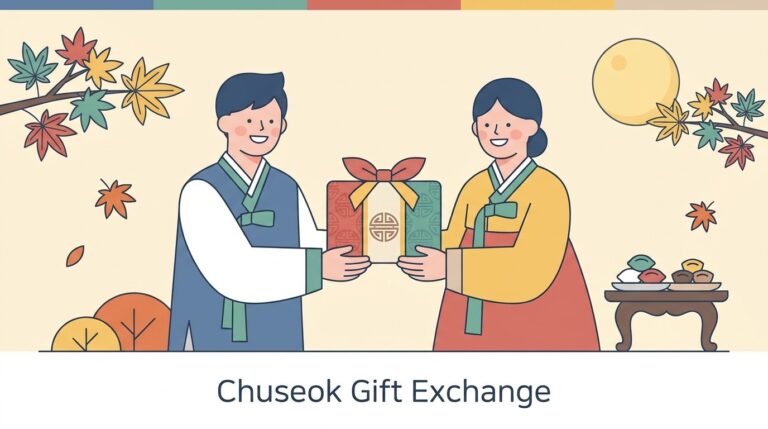
Master the Art of Korean Holiday Gift Exchanges Like a Native
안녕하세요! This is your Daily Hangul editor. Imagine this: Chuseok or Seollal is right around the corner, and your Korean colleague or mother-in-law hands you a gorgeously wrapped gift box filled with premium Hanwoo beef or decorated SPAM cans. You freeze. Do you just say “감사합니다” (Gamsahabnida) and grab it with one hand? Or if you are giving a gift set to your manager, how do you express warmth without sounding overly formal or stiff? Exchanging holiday gift sets (명절 선물 세트) is a delicate cultural art form in Korea where modesty, respect, and deep affection interweave. Today, based on real feedback from our B2-level learners who wished they knew how to navigate these festive social nuances, we’ll master the exact phrasing and cultural etiquette needed to exchange gifts effortlessly.
Phase 2: Core Expressions Deep Dive
1. 별거 아니지만 받아 주세요 (Byeolge anijiman bada juseyo)
- Pronunciation: [Byeol-geo a-ni-ji-man ba-da ju-se-yo] (Sounds like: “Byol-guh ah-nee-jee-mahn bah-dah joo-seh-yo”)
- Meaning: Literal: “It is nothing special, but please accept it.” / Nuance: “I picked this out for you with warmth, though I remain humble about it.”
- K-Culture Moment: Commonly heard in office hallways or home entryways when handing over a fruit or ginseng set to senior co-workers or neighbors.
- Editor’s Insight: Koreans value extreme modesty when giving gifts. Calling your gift “별거 아니다” (nothing special) lowers yourself to honor the recipient.
- Situation Spectrum: Casual ⚠️ | Semi-formal ✅ | Formal ✅
- 🤔 Think About It: Why does Korean culture value downplaying the physical value of a gift when handing it over?
2. 약소하지만 정성껏 준비했습니다 (Yaksohajiman jeongseongkkeot junbihaessseumnida)
- Pronunciation: [Yak-so-ha-ji-man jeong-seong-kkeot jun-bi-haet-seum-ni-da] (Sounds like: “Yahk-so-hah-jee-mahn jung-sung-kkut joon-bee-haet-seum-nee-dah”)
- Meaning: Literal: “It is modest, but I prepared it with all my heart.” / Nuance: A polished, elegant way to express deep respect during formal exchanges.
- K-Culture Moment: Standard phrase used in corporate environments or when visiting in-laws for the first time during Major Holidays.
- Editor’s Insight: “정성” (jeongseong) implies genuine effort and sincere intention. It shifts focus from monetary value to emotional devotion.
- Situation Spectrum: Casual 🚫 | Semi-formal ⚠️ | Formal ✅
- 🤔 Think About It: How does focusing on sincerity over monetary price alter the dynamic between gift giver and recipient?
3. 풍성한 한가위 보내세요 (Pungseonghan hangawi bonaeseyo)
- Pronunciation: [Pung-seong-han han-ga-wi bo-nae-se-yo] (Sounds like: “Poong-sung-hahn hahn-gah-wee boh-nae-seh-yo”)
- Meaning: Literal: “Have a bountiful Harvest Festival (Chuseok).” / Nuance: “Wishing you abundance, joy, and healthy family warmth this season.”
- K-Culture Moment: Written on holiday cards accompanying gift sets or spoken when saying goodbye before the holiday break.
- Editor’s Insight: “한가위” is the native Korean name for Chuseok. Using it instead of just “추석” adds a touch of traditional warmth.
- Situation Spectrum: Casual ✅ | Semi-formal ✅ | Formal ✅
- 🤔 Think About It: Notice how Korean holiday greetings emphasize shared abundance (“풍성함”) rather than individual happiness.
Phase 3: Textbook Korean vs. Real Native Korean
Situation 1: Giving a gift set to a team manager
- 📖 Textbook Korean: 이 선물 세트를 드립니다. 즐거운 명절 되십시오. (I give you this gift set. Have a pleasant holiday.)
- 🗣️ Real Native Korean: 팀장님, 작은 성의로 준비했어요. 풍성한 한가위 보내세요! (Team Leader, I prepared a small token of appreciation. Have a wonderful Chuseok!)
- 💡 Why the difference?: Textbook expressions sound like automatic system messages. Adding “작은 성의” (a small token of heart) bridges professional respect with personal affection.
Situation 2: Receiving a gift set unexpectedly
- 📖 Textbook Korean: 감사합니다. 잘 받겠습니다. (Thank you. I will receive it well.)
- 🗣️ Real Native Korean: 어머, 이런 걸 뭘 준비하셨어요! 신경 써 주셔서 정말 감사합니다. (Oh my, you didn’t have to prepare something like this! Thank you so much for your thoughtful care.)
- 💡 Why the difference?: Native speakers express pleasant surprise and acknowledge the effort (“신경 써 주시다”) rather than just accepting the physical item.
Phase 4: K-Culture Deep Dive & Non-Verbal Etiquette
4-1. Nunchi & Body Language
- Two-Hand Rule: Always present and receive gift sets using both hands. Support your right elbow or forearm lightly with your left hand if handing over a heavy box.
- The Gentle Refusal Dance: When offered a gift, native speakers often make a brief gesture of slight hesitation (“아이구, 뭘 이런 걸 다…”) before receiving it with gratitude.
4-2. Culture Code: The SPAM & Hanwoo Phenomenon
In Korean holiday culture, gift sets are big business! You will see massive displays of luxury canned ham (SPAM), cold-pressed sesame oil, premium tuna, and high-end Hanwoo beef. SPAM isn’t seen as cheap food; elegant, ribbon-wrapped SPAM sets symbolize practicality and shared household abundance.
Phase 5: Real-Life Roleplay Scenario
Setting: Office lobby right before the holiday weekend. You run into your senior manager, Manager Kim (김 부장님).
- Manager Kim: OOO 씨, 퇴근하기 전에 이것 좀 받아요. 명절 선물 세트예요.
(OOO, please take this before heading home. It’s a holiday gift set.)
🎭 Hands you a heavy, neatly wrapped boxed set with both hands. - You: 어머, 부장님! / 이런 걸 뭘 준비하셨어요! / 정말 감사합니다.
(Eomeo, bujangnim! / Ireon geol mwoeul junbihasyeoss-eoyo! / Jeongmal gamsahabnida.)
(Oh my, Manager Kim! You really didn’t have to prepare something like this! Thank you so much.)
🎭 Slightly bow your head while reaching out with both hands. - Manager Kim: 별거 아니에요. 한 해 동안 고생 많았어요. 가족들과 맛있게 드세요.
(It’s nothing special. You’ve worked hard all year. Enjoy it with your family.)
🎭 Smiles warmly and nods. - You: 부장님 덕분에 / 올해 정말 많이 배웠습니다. / 약소하지만 저도 작은 성의를 준비했어요.
(Bujangnim deokbune / olhae jeongmal mani baewosseumnida. / Yaksohajiman jeodo jageun seonguileul junbihaesseoyo.)
(Thanks to you, Manager, I learned so much this year. It’s modest, but I also prepared a small token of gratitude.)
🎭 Gently hand over your prepared gift set using two hands. - Manager Kim: 어휴, OOO 씨도 참! 뭘 이런 걸 다 챙겼어요?
(Oh my, OOO! Why did you go out of your way to prepare this?)
🎭 Pretends to refuse gently for 2 seconds before accepting. - You: 부담 없이 편하게 받아 주세요. / 풍성한 한가위 보내시길 바랍니다!
(Budam eobsi pyeonhanege bada juseyo. / Pungseonghan hangawi bonaesigil baramnida!)
(Please accept it comfortably without burden. Wishing you a wonderful and bountiful Chuseok!)
🎭 Bow politely at 30 degrees. - Manager Kim: 고마워요! OOO 씨도 맛있는 거 많이 먹고 쉬다 와요.
(Thank you! You too eat lots of delicious food and get some good rest.) - You: 네, 부장님! 연휴 잘 보내시고 다음 주에 뵙겠습니다!
(Ne, bujangnim! Yeonhyu jal bonaesigo daeum jue boepgesseumnida!)
(Yes, Manager! Have a great holiday break and see you next week!)
🔀 Interactive Decision Point
When Manager Kim hesitates to accept your gift at Turn 5, what do you say?
* Option A: “안 받으시면 서운합니다! 꼭 받아 주세요.” (If you don’t take it, I’ll be sad! Please take it.)
* Option B: “부담 없이 편하게 받아 주세요. 작은 마음입니다.” (Please accept it comfortably without burden. It’s just a small token.)
* Option C: “그러면 그냥 제가 도로 가져갈까요?” (Then should I just take it back?) / Feedback: 🛑 Risk! Too blunt and awkward.
- Option A Feedback: ⚠️ Semi-acceptable among very close peers, but slightly too emotional for formal boss relations.
- Option B Feedback: ✅ Best Choice! Reassures the recipient while maintaining polite humility.
Phase 6: 10-Second Emotional Shadowing Drill
[😊 Warm and Humble]
별거 아니지만 / 가족분들과 함께 / 맛있게 드세요.
(Byeolge anijiman / gajokbeunduelgwa hamkke / mas-issge deuseyo.)-
[🥺 Deep Gratitude & Respect]
신경 써 주셔서 / 정말 감사합니다 / 풍성한 명절 보내세요.
(Singyeong sseo juseosyeo / jeongmal gamsahabnida / pungseonghan myeongjeol bonaeseyo.)
Phase 7: K-Culture Mini Dictionary
- 명절 선물 세트 (Myeongjeol Seonmul Sete) | Holiday Gift Set
- Custom bundled gift boxes (SPAM, oil, fruits, meat) produced specifically for Chuseok and Seollal seasonal exchanges.
- 정 (Jeong) | Deep Affective Connection
- The unique Korean emotional bond built over time through mutual caring, giving, and sharing.
- 덤 (Deom) | Bonus / Extra Throw-in
- Extra freebies given by merchants during festive gift purchases, reflecting warm generosity.
- 눈치 (Nunchi) | Social Tact / Reading the Room
- Understanding unspoken gift-giving hierarchy, timing, and appropriate value levels.
Phase 8: Traveler & Expat Survival Kit
Survival Expressions TOP 3
- 포장해 주세요. (Pojang-hae juseyo.) – Please gift-wrap this. [Pro Tip: Department stores offer free official holiday wrapping!]
- 배송도 되나요? (Baesong-do doenayo?) – Do you offer delivery service? [Pro Tip: Send gift sets direct via retail delivery before holiday cutoff dates.]
- 추천해 주세요. (Chucheon-hae juseyo.) – Please recommend one. [Pro Tip: Ask clerks for popular gift sets within your budget.]
Editor’s Travel Note
Planning to send gift packages within Korea during holiday season? Make sure to use the Naver Map App Download Page to locate nearby post offices or major marts like E-Mart and Lotte Mart early, as nationwide courier cutoffs usually close 3 to 5 days before the holiday starts!
Phase 9: One Step Deeper
In Korean culture, giving a gift set is rarely a mere transactional swap of material items. The act of calling your gift “약소하다” (humble) while handing over a high-quality product is an act of elevating the recipient’s dignity. By prioritizing emotional sincerity (“정성”) over ego, gift exchanges strengthen social bonds and maintain communal harmony.
💬 Your Turn: Have you ever given or received a holiday gift set in Korea? What item surprised you the most? Share your stories in the comments below!
Phase 10: FAQ & Common Mistakes
Q: Should I open the gift set immediately in front of the person who gave it to me?
A: Usually, no! In traditional Korean etiquette, it is polite to accept the gift with two hands, express warm thanks, and set it aside to open privately later, unless the giver explicitly asks you to open it right away.
Q: Is giving SPAM considered rude to corporate clients or seniors?
A: Not at all! Premium SPAM sets packaged elegantly are considered practical, popular, and deeply appreciated across all generations during Korean holidays.
Q: How much should I spend on a holiday gift set for co-workers?
A: Typically between 30,000 KRW to 50,000 KRW is standard and comfortable. Going too expensive might burden the recipient due to social expectations of reciprocity.
🚨 Common Mistakes TOP 3
- One-handed handoff: Handing heavy gift boxes with one hand looks dismissive. Always use two hands.
- Excessive boastfulness: Saying “이거 아주 비싼 거예요” (This is very expensive) makes the interaction awkward. Use “작은 성의입니다” instead.
- Forgetting holiday greetings: Just handing the box without saying “즐거운 명절 보내세요” misses the crucial emotional connection.
Phase 11: Action Mission
- 🥉 Bronze Mission: Practice saying “별거 아니지만 받아 주세요” out loud 3 times using two-handed gestures.
- 🥈 Silver Mission: Post a photo of your favorite Korean food/gift on social media with the caption “풍성한 한가위 보내세요!”.
- 🥇 Gold Mission: Use “신경 써 주셔서 감사합니다” when receiving help or a small treat from a Korean friend or colleague this week.
🎮 K-Culture Mission: Watch a scene from a Korean workplace drama (like Misaeng) around holiday episodes and spot how characters hand over gift boxes!
Phase 12: Interactive Quiz Challenge
Quiz 1. Situation Judgment
What is the most natural native response when receiving a holiday gift set from a senior colleague?
* A) 필요 없는데 왜 사셨어요? (I don’t need it, why did you buy it?)
* B) 어머, 뭘 이런 걸 다 챙기셨어요! 정말 감사합니다.
* C) 다음에는 더 비싼 걸로 주세요. (Next time please give me a more expensive one.)
🔍 Click to view Answer & Explanation
Correct Answer: B
Explanation: Option B expresses warm surprise, appreciation for their thoughtfulness, and sincere gratitude without being overly formal.
Quiz 2. Fill in the Blank
Complete the standard Chuseok holiday greeting: “_______ 한가위 보내세요!”
* A) 매운 (Maeun)
* B) 풍성한 (Pungseonghan)
* C) 차가운 (Chagaeun)
🔍 Click to view Answer & Explanation
Correct Answer: B (풍성한)
Explanation: “풍성한” means bountiful/abundant, which is the signature adjective used for Harvest holiday greetings.
Quiz 3. True / False Culture Quiz
In Korea, handing over a gift set with two hands is required only when giving gifts to elderly family members, not co-workers. (True / False)
🔍 Click to view Answer & Explanation
Correct Answer: False
Explanation: Two-handed giving and receiving is standard polite etiquette across all social interactions in Korea, including workplace exchanges.







