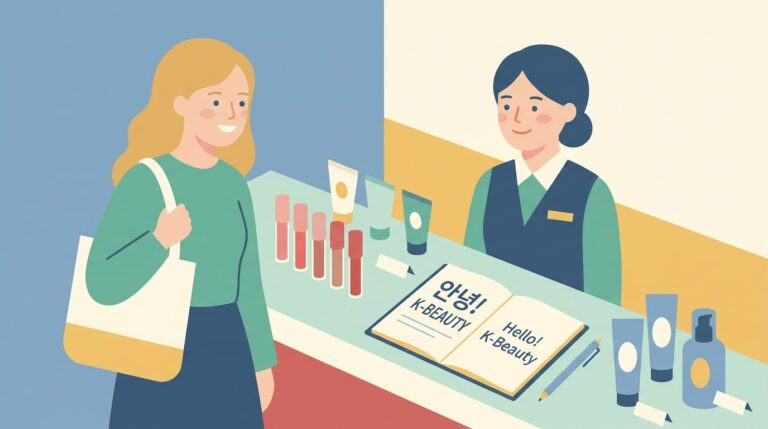
How to Try K-Beauty Testers in Korea Like a Local!
Phase 1: Welcome to the World of K-Beauty!
안녕하세요! 매일한글 에디터입니다. (Hello! I am your lead editor from Daily Hangul.) Imagine this: You step into a brightly lit, bustling K-beauty store in Myeongdong or Seongsu. The shelves are filled with colorful lip tints, glowing cushion foundations, and trendy skincare products. You spot a beautiful lip shade you’ve seen in your favorite K-Drama, but you hesitate. Can I just open this? Where is the tester? Should I ask the staff first? What if I accidentally ruin a fresh item?
If you have ever stood frozen in front of a cosmetic shelf in Seoul, holding a lip tint with nervous hands, you are definitely not alone! Trying out testers is one of the most exciting parts of K-beauty shopping, but language barriers often make learners feel timid. Knowing just a few simple, polite Korean phrases transforms your shopping experience from awkward to empowering. Today, based on real feedback from hundreds of foreign learners, we will learn how to test makeup products confidently, interact politely with store staff, and enjoy K-beauty culture like a true Seoulite!
Phase 2: 3 Essential Phrases for Testing Cosmetics
1. 이거 테스트해 봐도 돼요? (I-geo te-seu-teu-hae bwa-do dwae-yo?)
- Pronunciation: [ee-geo teh-sue-teu-hae bwa-doh dwae-yo?] (Think of ‘te-seu-teu’ like saying ‘test’ with three quick beats!)
- Meaning: Direct Translation: “Even if I test this, is it okay?” | Actual Nuance: “Can I try this tester?”
- K-Culture Moment: Seen in almost every K-beauty shopping vlog when a vlog host holds up a viral lip balm near their face and turns to the store clerk.
- Editor’s Insight: ‘이거’ (this) + ‘테스트해 보다’ (to try testing) + ‘-해도 돼요?’ (is it okay to…?). This is the single most useful magic phrase in Korean shops!
- Situation Spectrum: Casual: 🚫 | Semi-formal: ✅ | Formal: ⚠️ (A bit too stiff if you use formal ‘-십니까?’)
- 🤔 Think About It: In your home country, do you usually ask before touching testers, or do you just use them freely? How does asking permission reflect Korean courtesy?
2. 손등에 발라 봐도 돼요? (Son-deung-e bal-la bwa-do dwae-yo?)
- Pronunciation: [sohn-deung-eh bahl-lah bwa-doh dwae-yo?]
- Meaning: Direct Translation: “Can I try applying it on the back of my hand?” | Actual Nuance: “May I test this on my hand?”
- K-Culture Moment: In K-dramas, female leads often test three shades of lipstick on the back of their hand to compare swatches under shop lights.
- Editor’s Insight: ‘손등’ (son-deung) means ‘back of the hand’. Koreans prefer testing swatches on the back of the hand rather than directly on the face for hygiene reasons.
- Situation Spectrum: Casual: 🚫 | Semi-formal: ✅ | Formal: ⚠️
- 🤔 Think About It: Why might swatching on the hand be considered standard etiquette in public Korean beauty stores?
3. 화장솜 좀 주시겠어요? (Hwa-jang-som jom ju-si-get-eo-yo?)
- Pronunciation: [hwa-jang-som johm joo-see-get-oh-yo?]
- Meaning: Direct Translation: “Could you please give me a cotton pad?” | Actual Nuance: “Could I get a cotton pad, please?”
- K-Culture Moment: Asking staff for cotton pads or makeup remover tissues after swatching multiple dark lipstick shades.
- Editor’s Insight: ‘화장솜’ (hwa-jang-som) is a cotton pad. Adding ‘좀’ (jom – a little bit/please) softens your request, making you sound extremely polite and natural!
- Situation Spectrum: Casual: 🚫 | Semi-formal: ✅ | Formal: ✅
- 🤔 Think About It: Notice how ‘좀’ softening words exist in Korean! Does your language have a similar word to make requests sound gentle?
Phase 3: Textbook Korean vs. Real Korean
Situation 1: Asking if you can try a sample product
- 📖 Textbook Korean: 이것을 사용해 보아도 되겠습니까? (I-geot-eul sa-yong-hae bo-a-do doe-get-seum-ni-ka?)
- 🗣️ Real Korean: 이거 테스트해 봐도 돼요? (I-geo te-seu-teu-hae bwa-do dwae-yo?)
- 💡 Why the difference? The textbook version sounds like an official speech at a corporate presentation. Real shoppers use the friendly, natural semi-formal endings with the common loanword ‘테스트’ (test).
Situation 2: Wiping off cosmetics from your hand
- 📖 Textbook Korean: 휴지를 저에게 주십시오. (Hyu-ji-reul jeo-e-ge ju-sip-si-o.)
- 🗣️ Real Korean: 닦는 것 좀 주시겠어요? / 화장솜 좀 주시겠어요? (Dang-neun geot jom ju-si-get-eo-yo? / Hwa-jang-som jom ju-si-get-eo-yo?)
- 💡 Why the difference? Imperative forms like ‘주십시오’ sound overly blunt. Adding ‘좀’ (please/softener) and ‘-시겠어요?’ creates a warm, courteous interaction.
Phase 4: K-Culture Deep Dive & Non-Verbal Manners
4-1. Nunchi (눈치) & Gestures in K-Beauty Shops
When shopping in Korea, eye contact accompanied by a slight head nod (목인사) instantly builds rapport with store clerks. When pointing at a product on a shelf, point gently with your whole open hand or index finger softly. Never open a sealed box from the shelf! Look for the bottle labeled ‘테스터’ (Tester). After swatching, use the tissues or cotton pads provided at the testing station to wipe off the product before walking away.
4-2. The Olive Young Culture & Swatch Craze
In modern Korea, visiting stores like Olive Young (올리브영) is a social event. Friends visit together, test trendy tint swatches on their hands, take photos under bright store lights, and discuss skin tones (Personal Color – 퍼스널 컬러). Knowing how to use testers smoothly lets you fully enjoy this vibrant beauty environment!
Phase 5: Real-Life Roleplay Scenario
Setting: A trendy K-beauty shop in Hongdae. Staff member Min-ji approaches you with a friendly smile.
- Turn 1 (Staff): 안녕하세요! 찾으시는 상품 있으세요? (An-nyeong-ha-se-yo! Cha-jeu-si-neun sang-pum is-seu-se-yo?) – [🎭 Smiling warmly, clasping hands]
- Translation: Hello! Are you looking for any specific item?
- Turn 2 (You): 저… 이거 테스트해 봐도 돼요? (Jeo… i-geo te-seu-teu-hae bwa-do dwae-yo?) – [🎭 Pointing gently to a lip tint labeled ‘테스터’]
- Translation: Um… can I try testing this?
- Turn 3 (Staff): 네, 그럼요! 손등에 발라 보세요. (Ne, geu-reom-yo! Son-deung-e bal-la bo-se-yo.) – [🎭 Handing you the tester bottle gently]
- Translation: Yes, of course! Feel free to try it on the back of your hand.
- Turn 4 (You): 손등에 발라 볼게요. 색이 예쁘네요! (Son-deung-e bal-la bool-ge-yo. Saek-i ye-ppeu-ne-yo!) – [🎭 Swatching on hand and smiling]
- Translation: I’ll try it on my hand. The color is so pretty!
- Turn 5 (Staff): 잘 어울리세요! 거울 필요하세요? (Jal eo-ul-ri-se-yo! Geoul pil-yo-ha-se-yo?) – [🎭 Offering a small acrylic hand mirror]
- Translation: It suits you well! Do you need a mirror?
- Turn 6 (You): 네, 감사합니다! 혹시 화장솜 좀 주시겠어요? (Ne, gam-sa-ham-ni-da! Hok-si hwa-jang-som jom ju-si-get-eo-yo?) – [🎭 Nodding politely]
- Translation: Yes, thank you! By any chance, could I get a cotton pad?
- Turn 7 (Staff): 여기 리무버랑 화장솜 있어요. (Yeo-gi ri-mu-beo-rang hwa-jang-som is-seo-yo.) – [🎭 Pointing to the cleaning station]
- Translation: Here is makeup remover and cotton pads.
- Turn 8 (You): 와, 감사합니다! 이거 하나 주세요. (Wa, gam-sa-ham-ni-da! I-geo ha-na ju-se-yo.) – [🎭 Holding up the new sealed product]
- Translation: Wow, thank you! Please give me one of these.
🔀 Interactive Branching Choice
What would you do if you tested a lipstick and didn’t like the color?
* Option A: Silently put it back and walk away without saying anything.
* Option B: Say “아, 이거 조금 어두워요. 다른 색 보여주세요!” (Ah, this is a bit dark. Please show me another color!)
* Option C: Shout “이거 별로예요!” (This is bad!)
- Feedback:
- Option A (Risk): Not rude, but misses a chance to get helpful recommendations!
- Option B (BEST): Highly polite and expressive! The staff will happily recommend better colors for your skin tone.
- Option C (BAD): Too harsh and blunt in Korean culture.
Phase 6: 10-Second Emotion Shadowing Drill
Practice reading these out loud with appropriate feeling and rhythm! (/ indicates a short pause)
[😊 Curiously & Politely]저… / 이거 / 테스트해 봐도 돼요? (Jeo… / i-geo / te-seu-teu-hae bwa-do dwae-yo?)[✨ Delighted & Admiring]와! / 색이 / 진짜 예쁘네요! (Wa! / saek-i / jin-jja ye-ppeu-ne-yo!)[🥺 Seeking help gently]혹시… / 화장솜 좀 / 주시겠어요? (Hok-si… / hwa-jang-som jom / ju-si-get-eo-yo?)
Phase 7: K-Culture Mini Dictionary
- 올영 (Ol-yeong): Short for Olive Young. Young Koreans always say “오늘 올영 갈래?” (Wanna go to Ol-yeong today?).
- 테스터 (Te-seu-teo): Tester. Look for the yellow or red sticker on bottles.
- 화장솜 (Hwa-jang-som): Cotton pad used for applying toner or wiping swatches.
- 꿀조합 (Kkul-jo-hap): “Honey combination” – referring to two makeup/skincare products that go perfectly together.
Phase 8: Traveler’s Survival Kit
Top 3 Survival Phrases
- 이거 얼마예요? (I-geo eol-ma-ye-yo?) – How much is this?
- 새 상품 있어요? (Sae sang-pum is-seo-yo?) – Do you have a new/unopened one?
- 면세 돼요? (Myeon-se dwae-yo?) – Is tax-free shopping available?
Editor’s Travel Note
Before shopping in famous areas like Myeongdong or Seongsu, make sure to install and use 네이버 지도 앱 (Naver Map App download guide) to easily check store hours and tax-refund locations nearby.
Phase 9: One Step Deeper (Thinking Corner)
Korean beauty culture emphasizes respectful community sharing. Because hundreds of people use tester items every day, shoppers take extra care to keep tester caps clean and avoid touching nozzles directly to skin. This shared consideration reflects Korea’s ‘Jeong’ (정) and collective etiquette. When you clean your hand swatch neatly, you are participating in this pleasant culture!
💬 Your Turn: What cosmetic product are you most excited to test when you visit Korea? Leave a comment below in Korean!
Phase 10: FAQ & Common Mistakes
Q: Can I apply testers directly on my lips or face in Korean stores?
A: It is allowed, but staff highly recommend using a disposable applicator or swatching on the back of your hand for personal hygiene.
Q: Is it okay to take photos of products inside Olive Young?
A: Yes! Photography and checking online reviews while in store are very common in Korea.
Q: What should I do if a tester is empty?
A: You can simply hand it to staff and politely say, “테스터 다 썼어요” (The tester is empty).
🚨 Common Mistakes TOP 3
- ❌ Mistake: Opening a brand new box on the shelf to test it.
✅ Correct Action: Only use products clearly marked with a ‘테스터’ sticker. - ❌ Mistake: Saying “이거 줘” (Give me this) without polite endings.
✅ Correct Action: Always add ‘-요’ or say “이거 주세요” (I-geo ju-se-yo). - ❌ Mistake: Leaving dirty tissue swatches on cosmetic display counters.
✅ Correct Action: Dispose of trash in the small trash cans placed near testing stations.
Phase 11: Action Mission
- 🥉 Bronze Mission: Practice saying “이거 테스트해 봐도 돼요?” out loud 3 times in front of your mirror.
- 🥈 Silver Mission: Post a picture of your favorite lip tint on social media with the caption: “이거 테스트해 봐도 돼요?”
- 🥇 Gold Mission: Visit a local K-beauty branch or Asian cosmetics store and successfully ask for a tester in Korean!
🎮 K-Culture Mission: Watch a K-beauty routine video on YouTube and spot how many times the creator swatches cosmetics on their hand!
Phase 12: Interactive Quiz Challenge
Quiz 1: Situation Check
You want to ask the clerk if you can try a foundation on your hand. What do you say?
* A) 이거 드세요.
* B) 손등에 발라 봐도 돼요?
* C) 손 씻으세요.
Click to view Answer & Explanation
Answer: B! ‘손등’ means back of hand, and ‘발라 보다’ means to try applying.
Quiz 2: Fill in the Blank
“혹시 ______ 좀 주시겠어요?” (Could I get a cotton pad, please?)
* Choice: 화장솜 / 신발 / 휴대폰
Click to view Answer & Explanation
Answer: 화장솜 (Cotton pad). ‘신발’ means shoes and ‘휴대폰’ means smartphone!
Quiz 3: True or False Culture Quiz
In Korea, it is polite to open unopened package boxes on the shelf if there is no tester sticker.
Click to view Answer & Explanation
Answer: False! Never open sealed packages. Ask staff for help if there is no visible tester!