

Phase 1: Empathy (Storytelling Opening)
안녕하세요! I’m your Daily Hangul editor and your 10-year local Korean culture navigator.
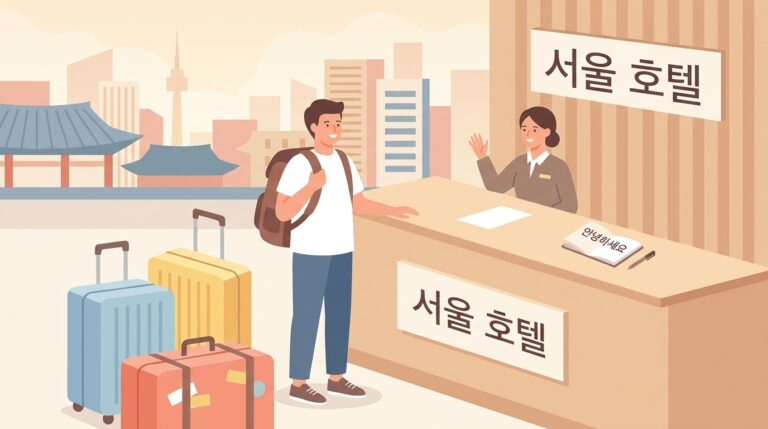
Picture this: You’ve just landed at Incheon Airport, taken the express train to Hongdae or Myeongdong, and arrived at your hotel at 11:00 AM. You are full of excitement, ready to dive into delicious street food or explore cute cafes! But there is one big problem: check-in isn’t until 3:00 PM, and you are dragging two heavy suitcases through crowded alleyways.
Your feet are aching, and you approach the hotel front desk. Your heart beats faster as you wonder: “How do I ask them to hold my luggage in Korean without sounding rude or getting confused?”
Don’t worry! Every traveler experiences this exact moment of hesitation. Based on feedback from hundreds of beginner learners, mastering just a few warm, natural phrases will turn this stressful moment into a smooth, delightful interaction. Let’s make sure you start your K-adventure light and stress-free!
Phase 2: Top 3 Core Expressions
1. 짐 좀 맡길 수 있을까요? (Jim jom matgil su isseul-kka-yo?)
- Pronunciation: [Jim jom mat-gil soo ee-sseul-kka-yo?]
(Sounds like: “Jim” as in the English name + “jom” like ‘jolt’ without the ‘lt’ + “mat-gil”)- Meaning: Literal: Can I leave my luggage a little? / Nuance: “Could I please leave my bags here for a bit?”
- K-Culture Moment: Seen in almost every travel K-Drama scene where the main character checks into a cozy Seoul boutique hotel before heading out to meet friends.
- Editor’s Insight: The tiny word ‘좀’ (jom) means “a little,” but in Korean requests, it acts as a magical politeness filter. It makes your request sound humble and considerate!
- Situation Spectrum: Casual ⚠️ | Semi-formal ✅ | Formal ✅
- 🤔 Think About It: In English, we say “Could you hold my bags?” In Korean, adding ‘좀’ softens the burden on the listener. How does your native language soften requests?
2. 체크인 전인데 짐을 보관해 주세요. (Chekeu-in jeon-inde jim-eul bogwan-hae juseyo.)
- Pronunciation: [Che-keu-in jeon-in-de jim-eul bo-gwan-hae joo-se-yo]
(Sounds like: “Check-in” + “jun-in-day” + “jim-ul” + “bo-gwan-hae-joo-say-yo”)- Meaning: Literal: It is before check-in, so please store my luggage.
- K-Culture Moment: Perfect when the desk staff looks busy and you need to state your situation clearly and quickly.
- Editor’s Insight: ‘전인데’ (-jeon-inde) provides the background context (“It’s before check-in…”) so the listener instantly understands why you are asking.
- Situation Spectrum: Casual 🚫 | Semi-formal ✅ | Formal ✅
- 🤔 Think About It: Koreans appreciate efficient context setting. Giving a quick reason first helps staff assist you faster!
3. 몇 시까지 맡길 수 있나요? (Myeot si-kkaji matgil su innayo?)
- Pronunciation: [Myeot see-kka-ji mat-gil soo in-na-yo?]
(Sounds like: “Myeot” + “see-kka-jee” + “mat-gil-soo-in-na-yo”)- Meaning: Literal: Until what time can I leave it?
- K-Culture Moment: Asking the receptionist before running off to enjoy late-night K-BBQ in Gangnam.
- Editor’s Insight: ‘까지’ (-kkaji) means “until.” This shows you are a respectful guest who cares about hotel operations and scheduling.
- Situation Spectrum: Casual ⚠️ | Semi-formal ✅ | Formal ✅
- 🤔 Think About It: How important is time punctuality in hotel hospitality in your home country?
Phase 3: Textbook Korean vs. Real Korean
Situation 1: Asking to leave bags
- 📖 Textbook Korean: 짐을 여기에 두어도 됩니까? (Jim-eul yeogi-e dueodo doebnikka?)
- 🗣️ Real Korean: 짐 좀 맡겨도 될까요? (Jim jom matgyeodo doel-kkayo?)
- 💡 Why is it different? The textbook expression sounds rigid like an official manual. Native speakers use ‘맡겨도 될까요?’ which feels much warmer and more natural for everyday hotel service.
Situation 2: Promising to pick up luggage later
- 📖 Textbook Korean: 나중에 짐을 찾겠습니다. (Najung-e jim-eul chat-gesseumnida.)
- 🗣️ Real Korean: 나중에 짐 찾으러 올게요! (Najung-e jim chajeureo olgeyo!)
- 💡 Why is it different? ‘올게요’ (-olgeyo) expresses a personal, friendly promise to return, making the interaction feel polite yet warm.
Phase 4: K-Culture Deep Dive & Non-Verbal Manners
4-1. Nunchi & Gestures (눈치와 제스처)
- Two-Hand Manners (두 손): When handing over your passport, booking confirmation, or receiving your luggage tag (번호표), always use both hands or support your right elbow with your left hand. This non-verbal gesture instantly shows deep respect.
- Soft Head Tilt: Accompany your request with a slight 15-degree head nod and a warm smile. It instantly creates Nunchi (cultural tact) harmony between you and the clerk.
4-2. Cultural Context: Korean Hospitality & Safety
South Korea is famous for its extreme safety and hospitality culture (정 / Jeong). Hotel luggage storage systems are meticulous. Staff will issue a numbered tag (번호표 or 짐 태그) and store your bags in a locked room or monitored area behind the desk. You can leave valuable items inside locked suitcases without anxiety!
Phase 5: Real-Life Roleplay Scenario
Setting: Front desk at a stylish boutique hotel in Hongdae, Seoul.
NPC Character: Minwoo (민우), a polite hotel receptionist.
- Minwoo: 안녕하세요! 무엇을 도와드릴까요? (Annyeonghaseyo! Mueos-eul dowadeoril-kkayo? / Hello! How may I help you?)
- You: 🎭 (Smiling, handing over passport with two hands) 안녕하세요! 체크인 전인데 짐 좀 맡길 수 있을까요? (Annyeonghaseyo! Chekeu-in jeon-inde jim jom matgil su isseul-kka-yo? / Hello! It’s before check-in, could I leave my luggage?)
- Minwoo: 네, 당연하죠! 성함이 어떻게 되시나요? (Ne, dang-yeonhajyo! Seongham-i eotteohke doesinayo? / Yes, of course! What is your name?)
- You: [Your Name]입니다. ( [Your Name] imnida. / I am [Your Name].)
- Minwoo: 확인되었습니다. 짐은 모두 몇 개인가요? (Hagindeoeosseumnida. Jim-eun modu myeot gae-ingayo? / Confirmed. How many pieces of luggage do you have?)
- You: 🎭 (Pointing to two suitcases) 두 개예요! (Du gae-yeo! / Two pieces!)
- Minwoo: 알겠습니다. 여기 번호표 받으세요. (Algesseumnida. Yeogi beonhopyo badeuseyo. / Understood. Please take this claim tag.)
- You: 🎭 (Receiving tag with two hands) 감사합니다! 몇 시까지 오면 될까요? (Gamsahamnida! Myeot si-kkaji omyeon doel-kkayo? / Thank you! Until what time should I return?)
🔀 Interactive Choice Point
How would you respond if Minwoo asks: “짐에 귀중품이 있으신가요?” (Are there valuables in your bags?)
- Choice A: “없어요! 다 옷이에요.” (Eobsoyo! Da os-ieyo. – No! It’s all clothes.)
- Choice B: “네! 귀중품 있어요. 보관해 주세요!” (Ne! Gwijungpum issoyo. Bogwan-hae juseyo! – Yes, I have valuables. Keep them safe!)
- Choice C: “아니요, 없습니다. 감사합니다!” (Aniyo, eobseumnida. Gamsahamnida! – No, there aren’t any. Thank you!)
Feedback:
* Best (Choice C): ✅ Polite, concise, and standard formal response in Korean service situations!
* Risk (Choice A): ⚠️ Grammatically correct, but missing polite endings for a hotel setting.
* Bad (Choice B): 🚫 Hotel storage usually asks guests to take valuables (laptops, cash, passports) with them. Storing high valuables in bags is usually discouraged!
Phase 6: 10-Second Emotion Shadowing Drill
- Practice speaking out loud with these emotional markers and timing pauses (
/)!
[😊 Polite & Warm]안녕하세요! / 짐 좀 맡길 수 있을까요?
(Annyeonghaseyo! / Jim jom matgil su isseul-kka-yo?)[🤔 Curious & Gentle]혹시 / 몇 시까지 / 맡길 수 있나요?
(Hoksi / myeot si-kkaji / matgil su innayo?)[😄 Happy & Grateful]감사합니다! / 나중에 짐 찾으러 올게요!
(Gamsahamnida! / Najung-e jim chajeureo olgeyo!)
Phase 7: K-Culture Mini Dictionary
- 짐 (Jim) | Luggage / Bags | Refers to any bags, suitcases, or backpacks you carry while traveling.
- 보관 (Bogwan) | Storage / Custody | Official term used in service facilities like hotels, train stations, and coat checks.
- 번호표 (Beonhopyo) | Claim Tag / Numbered Ticket | The essential paper or plastic slip given to you to redeem your luggage.
- 체크인 (Chekeu-in) | Check-in | Phonetic English loanword widely understood at every Korean hotel and hostel.
Phase 8: Traveler’s Survival Kit
Top 3 Emergency Phrases
- 짐 태그 주세요. (Jim tae-geu ju-se-yo.) — Please give me a luggage tag.
- 짐 두 개예요. (Jim du gae-yeo.) — I have two bags.
- 몇 시에 올까요? (Myeot si-e ol-kka-yo?) — What time should I come back?
Editor’s Travel Note
Before wandering around Korea, download the Naver Map App Download (네이버 지도). Google Maps does not provide walk navigation in South Korea, so Naver Map is essential for finding local luggage lockers (물품보관함) at subway stations if your hotel is too far!
Phase 9: “One Step Deeper” (Thoughtful Reflection)
In Korean society, hotel service revolves around anticipating guest convenience. Offering to store luggage before check-in or after check-out is an embodiment of Jeong (정)—a cultural warmth that seeks to lighten another person’s load. When you ask politely using Korean phrases, you aren’t just exchanging information; you are connecting with local hospitality culture.
💬 Your Turn: Have you ever needed to store your luggage in a foreign country? How did you handle it? Share your story in the comments below!
Phase 10: FAQ & Common Mistakes
Q: Can I leave my luggage after checking out as well?
A: Yes! You can say: “체크아웃 했는데 짐 좀 맡겨도 될까요?” (Chekeu-aut haessneunde jim jom matgyeodo doel-kkayo? – I checked out, but could I leave my luggage?)
Q: Is there usually a fee for hotel luggage storage in Korea?
A: Almost all hotels, hostels, and guesthouses in Korea offer free luggage storage for checked-in guests on arrival/departure dates.
Q: What if I lose my luggage tag (번호표)?
A: Show your passport and room reservation on your phone, then say: “번호표를 잃어버렸어요.” (Beonhopyo-reul ireobeoryeosseoyo. – I lost my luggage tag.)
🚨 Common Mistakes Warning Board
- ❌ Mistake 1: Pointing at your bags and saying “Take this!” (이거 받으세요!).
- Correct Action: Say politely: “짐 좀 맡아주세요.” (Jim jom mata-juseyo.)
- ❌ Mistake 2: Handing your reservation confirmation with only one hand.
- Correct Action: Use both hands (두 손) to maintain respectful etiquette.
- ❌ Mistake 3: Leaving passport/cash inside luggage given to storage.
- Correct Action: Always keep valuables in a small sling bag or daypack.
Phase 11: Action Mission & Engagement
- 🥉 Bronze Mission: Read the 3 core expressions aloud 3 times in front of a mirror.
- 🥈 Silver Mission: Record yourself practicing the Phase 6 Emotion Shadowing Drill and listen back!
- 🥇 Gold Mission: Use “짐 좀 맡길 수 있을까요?” during your next trip to Korea at your hotel or luggage service counter!
🎮 K-Culture Mission: Watch a hotel scene in a K-Drama like King the Land or Hotel Del Luna and listen for words like ‘체크인’ or ‘짐’!
Phase 12: Interactive Quiz Challenge
Question 1 (Fill in the blank):
Fill in the missing word: “체크인 전인데 짐 ___ 맡길 수 있을까요?” (Hint: The magic politeness word!)
* A) 아주
* B) 좀
* C) 많이
Click for Answer & Explanation
Answer: B) 좀
Explanation: ‘좀’ softens requests and makes your sentence sound warm and polite to hotel staff.
Question 2 (True or False):
In Korea, it is polite to receive your luggage tag using just one hand. (T/F)
Click for Answer & Explanation
Answer: False
Explanation: In Korean culture, receiving or giving items with both hands (두 손) is essential polite etiquette.







