

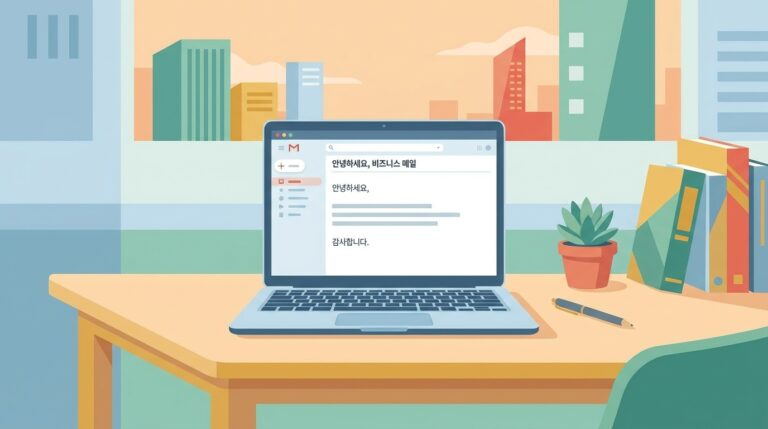
Phase 1: Empathy & Storytelling Opening
Hello! I’m your Daily Hangul editor.
Imagine this scenario: You have spent weeks refining a project proposal for your company’s Korean partner in Seoul. You sent the email two days ago, but the silence from their end is deafening. The deadline is looming this Thursday, and you urgently need their feedback to move forward. You open your inbox, type a quick draft asking “When will you reply?”, but stop yourself. Is that too aggressive? Will it break workplace harmony (Inhwa)?
In Korean corporate culture, writing a business email—especially when expressing gratitude while gently nudging for a delayed reply—is an art form. Send something too direct, and you risk sounding impatient or disrespectful. Send something too vague, and your email gets buried in their inbox.
Based on feedback from hundreds of intermediate (B2) Korean learners navigating real corporate environments in Korea, mastering these subtle linguistic nuances is the single biggest booster for your professional credibility. Today, we will transform your business emails from rigid textbook sentences into polished, authentic Korean that gets results politely and effectively.
Phase 2: Deep Dive into 3 Core Business Expressions
1. 바쁜 와중에 확인해 주셔서 감사합니다 (Babpeun wajunge hwak-inhae jusyeoseo gamsahabnida)
- Pronunciation: Bah-ppeun wah-jung-eh hwahk-in-hae joo-syeo-seo gahm-sah-hahb-ni-dah (Sounds like ‘bah-ppun wah-joong’ with a crisp ‘k’ sound)
- Meaning: Literal: “Thank you for checking this in the middle of your busy schedule.” / Nuance: Deep professional gratitude that acknowledges the recipient’s heavy workload.
- K-Culture Moment: A classic scene in workplace K-dramas like Misaeng where a junior consultant emails a senior director after receiving late-night document feedback.
- Editor’s Insight: Opening your response with “바쁜 와중에” shows empathy toward their busy schedule, immediately lowering any defensiveness.
- Situation Spectrum: Casual 🚫 / Semi-formal ⚠️ / Formal ✅
- 🤔 Think About It: Why does Korean workplace etiquette place such high value on acknowledging the other person’s effort before asking for something?
2. 편하신 시간에 확인 부탁드립니다 (Pyeonhasin sigane hwak-in beutakdeureimnida)
- Pronunciation: Pyeon-hah-seen see-gahn-eh hwahk-in boo-tahk-deu-reem-nee-dah
- Meaning: Direct: “Please check this at your convenience.” / Nuance: A courteous, non-pressuring call to action that sets a deadline expectation politely.
- K-Culture Moment: Sent by project managers along with a digital coffee voucher when requesting contract reviews from external vendors.
- Editor’s Insight: This phrase strikes the ideal balance for B2 speakers: highly polite yet clear in its intent.
- Situation Spectrum: Casual 🚫 / Semi-formal ✅ / Formal ✅
- 🤔 Think About It: How does giving the recipient control over their time (“편하신 시간에”) prevent office friction?
3. 혹시 회신 일정에 대해 여쭤보아도 될까요? (Hoksi hoesin iljeonge daehae yeojjwoboado doelkayo?)
- Pronunciation: Hohk-see hwae-seen eel-jeong-eh dae-hae yeo-jjwo-boh-ah-doh doel-kkah-yo?
- Meaning: Direct: “By any chance, may I inquire about the reply schedule?” / Nuance: The ultimate soft nudge for checking on a delayed response.
- K-Culture Moment: Used in follow-up emails when a pending decision is holding up an entire cross-departmental initiative.
- Editor’s Insight: Starting with “혹시” (by any chance) acts as a linguistic shock absorber, making your inquiry sound gentle rather than accusatory.
- Situation Spectrum: Casual 🚫 / Semi-formal ✅ / Formal ✅
- 🤔 Think About It: In your native language, what words function like “혹시” to cushion direct questions?
Phase 3: Textbook Korean vs. Real Business Korean
Scenario 1: Requesting a quick reply
- 📖 Textbook Korean: 빠른 답장을 바랍니다. (Ppareun dapjang-eul baramnida. / Please reply quickly.)
- 🗣️ Real Business Korean: 바쁘시겠지만 확인 후 회신 부탁드리겠습니다. (Babpeuseigetjiman hwak-in hu hoesin beutakdeurigetseumnida. / I know you are busy, but I would appreciate a reply after your review.)
- 💡 Why the difference? “빠른 답장을 바랍니다” sounds like a command from a superior to a subordinate. Real business Korean uses humble, soft conditional phrasing to build rapport.
Scenario 2: Following up on an unread email
- 📖 Textbook Korean: 왜 답장이 없습니까? (Wae dapjang-i eopseumnida? / Why is there no reply?)
- 🗣️ Real Business Korean: 혹시 메일이 누락되었을까 봐 다시 연락드립니다. (Hoksi meir-i nurakdeoeosseulkka bwa dasi yeonrakdeurimnida. / Reaching out again in case the previous email was missed.)
- 💡 Why the difference? Directly asking why someone hasn’t replied causes loss of face (Chaemyung). Framing the issue as a potential email delivery error preserves mutual respect.
Phase 4: K-Culture Deep Dive & Non-Verbal Manners
4-1. Nunchi & Email Timing Etiquette
In Korean corporate life, Nunchi (tact/situational awareness) extends to digital communications. Never send a follow-up email right at 9:00 AM (when workers are organizing their day) or 5:50 PM (when workers are preparing to leave). The golden window for follow-up emails is 10:30 AM to 11:30 AM, right after morning meetings wrap up.
4-2. Cultural Code: The Warm Opener
Korean business emails rarely jump straight into requests. A warm opening note referencing seasonal weather or general well-being shows professional maturity:
* “환절기에 건강 유의하시기 바랍니다.” (Please take care of your health during this seasonal change.)
Phase 5: Interactive Role-Play Scenario
Setting: Following up on a critical budget proposal with Director Min (민 부장님).
NPC Character: Director Min (A thorough, busy senior director at a partner firm).
- User: [😊 Respectful bow gesture] 안녕하세요, 민 부장님! 지난번 보내드린 제안서는 잘 전달되었는지 확인차 메일 드립니다. (Annyeonghaseyo, Min Bujangnim! Jinanbeon bonaedeorin jeanseonun jal jeondaldeoenneunji hwak-incha meil deurimnida. – Hello, Director Min! I am emailing to check if the proposal sent last time was received properly.)
- Director Min: [🧐 Reviewing inbox] 아, 네! 메일은 잘 받았습니다. 요즘 업무가 밀려서 아직 자세히 못 봤네요. (Ah, ne! Meireun jal badatseumnida. Yojeum eommuga millyeoseo ajik jasehi mot bwatneeyo. – Ah, yes! I got the email. Work has been backed up recently, so I haven’t reviewed it closely yet.)
- User: [💡 Empathic nodding] 바쁘신 와중에 확인해 주셔서 감사합니다. (Babpeun wajunge hwak-inhae jusyeoseo gamsahabnida. – Thank you for checking despite your busy schedule.)
- Director Min: [☕ Taking a sip of coffee] 언제까지 확정이 필요한 상황인가요? (Eonjekkaji hwakjeong-i pil-yohan sanghwang-ingayo? – By when do you need a final decision?)
- User: [🗓️ Pointing gently at the calendar] 이번 주 목요일까지 회신해 주시면 다음 단계 진행에 큰 도움이 됩니다. (Ibeon ju mogyo-ilkkaji hoesin-hae jusimyeon da-eum dangye jinhaeng-e keun do-eum-i doembnida. – If you could reply by this Thursday, it would greatly help us proceed to the next step.)
- Director Min: [👍 Nodding approvingly] 알겠습니다. 검토 후 목요일 오전까지 답장드리겠습니다. (Algetseumnida. Geomto hu mogyo-il ojeonkkaji dapjangdeurigetseumnida. – Got it. I will review it and reply by Thursday morning.)
- User: [🙏 Warm closing] 감사합니다! 편하신 시간에 확인 부탁드립니다. (Gamsahabnida! Pyeonhasin sigane hwak-in beutakdeureimnida. – Thank you! Please review at your convenience.)
- Director Min: [😊 Smiling] 네, 수고하세요! (Ne, sugohaseyo! – Yes, keep up the good work!)
🔀 Interactive Decision Point
Scenario: Thursday afternoon arrives, but Director Min has not replied yet. How do you respond?
- Option A: Send an instant message saying: “왜 아직 답장이 없으신가요? 급합니다.” (Why is there no reply yet? It is urgent.)
- Option B: Send a polite email: “혹시 업무로 바쁘실 듯하여 다시 연락드립니다. 편하실 때 회신 부탁드립니다.” (Reaching out again as you must be busy with work. Please reply when convenient.)
- Option C: Call his personal mobile phone at 10:00 PM.
Feedback:
* Option A: 🚫 Risk / Bad: Extremely blunt and demanding; destroys professional rapport.
* Option B: ✅ Best: Polite, respectful of his schedule, and gently prompts action.
* Option C: 🚫 Risk: Severe breach of personal-work boundaries in Korean business culture.
Phase 6: 10-Second Emotional Shadowing Drill
Practice reading these with proper stress and emotion markers:
- [😊 Warm Gratitude]
바쁜 와중에 / 확인해 주셔서 / 정말 감사합니다.
(Babpeun wajunge / hwak-inhae jusyeoseo / jeongmal gamsahabnida.) -
[🥺 Gentle Nudge]
혹시 / 회신 일정에 대해 / 여쭤보아도 될까요?
(Hoksi / hoesin iljeonge daehae / yeojjwoboado doelkayo?)
Phase 7: K-Culture Mini Dictionary
- 회신 (Hoesin) | Translation: Reply / Official Response | Used in formal business settings instead of the everyday word ‘답장’.
- 누락 (Nurak) | Translation: Omission / Oversight | A handy professional term to suggest an email got lost rather than ignored.
- 검토 (Geomto) | Translation: Review / Examination | Standard vocabulary for asking someone to inspect documents.
- 재촉 (Jaechok) | Translation: Nudging / Urging | The act of prompting someone for a response (best avoided in direct self-description).
Phase 8: Traveler & Business Survival Kit
Top 3 Survival Phrases for Business Meetings
- 확인 부탁드립니다. (Hwak-in beutakdeureimnida / Please check this.)
- 언제쯤 가능할까요? (Eonjejjeum ganeunghalkayo? / Around when might this be possible?)
- 감기 조심하세요. (Gamgi josimhaseyo / Take care not to catch a cold – ideal sign-off phrase.)
Editor’s Travel Note
When traveling in Korea for business, download the Naver Map App to navigate meeting locations smoothly. For subway schedules, rely on KakaoMetro to ensure you always arrive 10 minutes early for appointments.
Phase 9: A Deeper Reflection
Korean workplace communication relies heavily on indirect framing to preserve workplace harmony (Inhwa). When you ask “Did my email get lost?” instead of “Why didn’t you reply?”, you give the other party a graceful exit while still achieving your business goal. Respecting the recipient’s dignity (Chaemyung) is the true key to long-term corporate success in Korea.
💬 Your Turn: How do business follow-ups in your home country balance urgency with politeness? Share your experiences in the comments below!
Phase 10: FAQ & Mistake Prevention
Q: How long should I wait before sending a follow-up business email in Korea?
A: Waiting 2 to 3 business days is standard practice before sending a gentle follow-up email.
Q: Can I use terms like “ASAP” or “빠르게” in corporate Korean emails?
A: Direct demands like “빠르게 부탁드립니다” sound overly bossy. Always express deadlines with specific dates: “목요일까지 회신해 주시면 감사하겠습니다.”
Q: Are emojis acceptable in Korean business emails?
A: Limit emojis in formal business emails. Instead, rely on polite sentence endings (~습니다, ~시겠습니다) and courteous punctuation (!).
🚨 Common Mistakes Board
- ❌ Mistake 1: Using “빠른 답장 바랍니다” to senior partners. → Correct Action: Use “바쁘시겠지만 회신 부탁드리겠습니다.”
- ❌ Mistake 2: Omitting greeting lines and jumping straight to demands. → Correct Action: Include a brief weather or health greeting first.
- ❌ Mistake 3: Failing to specify a deadline while asking for a fast reply. → Correct Action: Politely propose a concrete target date.
Phase 11: Action Mission & Engagement
- 🥉 Bronze: Read the 3 core expressions out loud 5 times using the Shadowing Drill.
- 🥈 Silver: Draft a 3-sentence follow-up business email in Korean and post it in the comments.
- 🥇 Gold: Use “편하신 시간에 확인 부탁드립니다” in your next real email to a Korean partner or tutor.
🎮 K-Culture Mission: Watch an episode of a office drama like Misaeng or Business Proposal and spot how junior staff speak to project managers!
Phase 12: Interactive Quiz Challenge
Q1. Which phrase is most appropriate for gently asking for a reply at the recipient’s convenience?
A) 빠르게 답장해 주세요.
B) 편하신 시간에 확인 부탁드립니다.
C) 왜 답장이 없나요?
Click to view Answer & Explanation
Correct Answer: B) 편하신 시간에 확인 부탁드립니다.
Explanation: Option B shows respect for the recipient’s schedule while maintaining a clear, professional request.
Q2. True or False: Saying “혹시 메일이 누락되었을까 봐 다시 연락드립니다” is considered rude in Korean offices.
Click to view Answer & Explanation
Correct Answer: False.
Explanation: It is actually the preferred polite method because it attributes the delay to technical oversight rather than personal neglect.







