

Feeling Blue and Doing Nothing? Expressing Melancholy in Korean Like a Native!
Phase 1: 공감 (Empathy & Connection)
안녕하세요! 매일한글 에디터입니다! (Hello! I’m your Daily Hangul editor!)
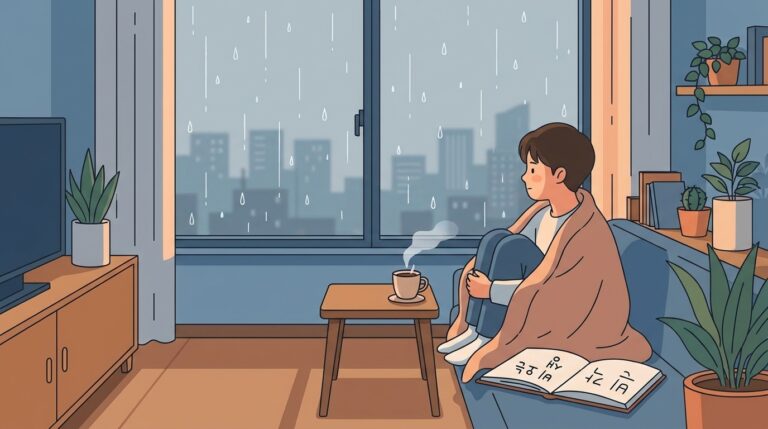
Picture this: It is a rainy Sunday afternoon in Seoul. You are wrapped up in your favorite cozy blanket, staring blankly out the window as raindrops slide down the glass. You turn on a classic K-drama episode where the main character slowly slumps onto their couch, turns off all the lights, and ignores three incoming phone calls from friends. They don’t want to eat, they don’t want to go outside, and when a friend asks what’s wrong, they sigh deeply and say, “하루 종일 우울해서 아무것도 하기 싫어…”
Have you ever felt so deeply unmotivated or down that even picking up your smartphone felt like lifting a 100kg barbell? We’ve all been there! Expressing sadness or emotional burnout is a crucial part of building authentic, deep relationships in Korea. While basic Korean textbooks teach you simple words like “슬퍼요” (I am sad), real Koreans use far more expressive, nuanced phrases to convey mental fatigue, feeling blue, and wanting to do absolutely nothing.
By the end of this guide, based on real feedback from over 500 B1-level learners, you will master how to convey your low-energy days naturally without sounding stiff. Let’s dive in together!
Phase 2: 핵심 표현 3선 심층 분석 (Deep Dive: 3 Key Expressions)
1. 우울하다 (U-ul-ha-da)
- Pronunciation: [U-ul-ha-da] (Think of saying “Ooh-ool-ha-da”—it almost sounds like a low, melancholic sigh in your throat!)
- Meaning: Direct translation: To be depressed/gloomy | Real nuance: Feeling blue, down in the dumps, or emotionally heavy.
- K-Culture Moment: You hear this constantly in indie Korean songs or chill K-R&B tracks whenever a protagonist drinks hot tea alone on a rainy evening.
- Editor’s Insight: Unlike the medical English term “depressed,” 우울하다 is widely used in casual everyday conversations in Korea to describe fleeting melancholic moods, gloomy weather vibes, or sudden low energy.
- Situation Spectrum:
- Casual: 우울해 (✅)
- Semi-formal: 우울해요 (✅)
- Formal: 우울합니다 (⚠️ – reserved for clinical contexts or formal speeches)
- 🤔 Think About It: In your native culture, do you openly tell friends when you feel gloomy, or do you prefer to keep it hidden until you feel better?
2. 아무것도 하기 싫다 (A-mu-got-do ha-gi sil-ta)
- Pronunciation: [A-mu-got-do ha-gi sil-ta] (Pronounce ‘sil-ta’ with a sharp breath release like “seel-tah”!)
- Meaning: Direct translation: I don’t want to do anything | Real nuance: I am totally burnt out and lack any motivation to move or think.
- K-Culture Moment: A character comes home after an exhausting 14-hour workday in a Seoul office, drops their bag on the floor, lies flat on the bed, and groans into a pillow.
- Editor’s Insight: Combined with 아무것도 (anything) and ~하기 싫다 (don’t want to do), this phrase is the ultimate expression for total mental and physical paralysis from low mood.
- Situation Spectrum:
- Casual: 아무것도 하기 싫어 (✅)
- Semi-formal: 아무것도 하기 싫어요 (✅)
- Formal: 아무것도 하고 싶지 않습니다 (🚫 – sounds unnaturally robotic in personal conversations)
- 🤔 Think About It: Notice how Korean attaches ~기도 싫다 directly to verbs. How does your language express total lack of motivation?
3. 무기력하다 (Mu-gi-ryeok-ha-da)
- Pronunciation: [Mu-gi-ryeok-ha-da] (The ‘ryeok’ sounds like “ryuk” in truck without the t!)
- Meaning: Direct translation: To be lethargic/helpless | Real nuance: Lacking all energy, feeling helpless or drained.
- K-Culture Moment: Used in health vlogs or healing K-dramas when characters discuss adult burnouts or seasonal affective changes.
- Editor’s Insight: Hanja roots: 無 (Mu = None) + 氣 (Gi = Energy/Spirit) + 力 (Ryeok = Power). Literally means “having zero spirit power.” Perfect for B1 learners who want to sound sophisticated!
- Situation Spectrum:
- Casual: 무기력해 (✅)
- Semi-formal: 무기력해요 (✅)
- Formal: 무기력합니다 (✅ – used when talking to doctors or counselors)
- 🤔 Think About It: Why do you think modern Korean culture has developed so many precise words to describe burnout and fatigue?
Phase 3: 교과서 한국어 vs 진짜 한국어 (Textbook vs. Real Native Korean)
Situation 1: Explaining why you are staying home all day
- 📖 교과서 한국어: 오늘 저는 슬픕니다. 그래서 집에서 아무것도 안 합니다. (Today I am sad. Therefore I do nothing at home.)
- 🗣️ 진짜 한국어: 오늘 좀 우울해서 하루 종일 멍때리고 있었어요. (I was feeling a bit down today, so I just spaced out all day.)
- 💡 왜 다를까? Natives rarely use flat adjectives like “슬픕니다” unless there is a specific sad event (like a tragic movie). For general melancholy, “우울하다” paired with expressive verbs like “멍때리다” (to space out) sounds 100 times more natural!
Situation 2: Turning down a friend’s invitation gently due to low mood
- 📖 교과서 한국어: 저는 기분이 나쁩니다. 약속을 취소합시다. (I feel bad. Let’s cancel the appointment.)
- 🗣️ 진짜 한국어: 미안해, 오늘 몸도 마음도 좀 쳐져서 다음에 보자. (Sorry, I’m feeling a bit down in spirit and body today, so let me catch you next time.)
- 💡 왜 다를까? Saying “기분이 나쁩니다” sounds like you are angry at the person! Using “몸도 마음도 쳐지다” (body and heart are drooping) softly blames your internal condition, preserving social harmony.
Phase 4: K-Culture 딥다이브 & 비언어적 매너 (K-Culture Deep Dive & Non-Verbal Manners)
4-1. Nunchi (눈치) & Expressive Gestures
When expressing low spirits in Korea, non-verbal cues are deeply tied to Nunchi (social awareness). You don’t shout your sadness; you lower your energy level to signal to others that you need space or quiet comfort.
* Posture: Slump your shoulders slightly (어깨를 늘어뜨리다) and avoid direct, bright eye contact.
* Sighing (한숨 쉬기): A soft, deep exhale with a slight nod is universally understood in Korea as a release of emotional burden, not necessarily rudeness.
4-2. K-Food Culture: Healing Foods for Gloomy Days
When Koreans say “하루 종일 우울해서 아무것도 하기 싫다,” their friends usually respond with one thing: Comfort Food Delivery!
* Tteokbokki (떡볶이): Spicy food releases endorphins! It is a running trope in K-dramas to order super spicy rice cakes when feeling depressed.
* Pajeon & Makgeolli (파전과 막걸리): On rainy, depressing days, the sound of frying savory pancakes mimics rain, making it the ultimate cozy rainy-day meal.
Phase 5: 실전 롤플레이 시나리오 (Interactive Roleplay Scenario)
Setting: You are at a cozy café in Hongdae. Your close Korean friend, Minjun (민준), notices you look exhausted and pale.
- Turn 1 (Minjun): 🎭 (Leans forward with a concerned expression) 어? 00아, 얼굴이 왜 그래? 무슨 일 있어?
(Eo? [Name]-a, eol-gul-i wae geu-rae? Mu-seun il is-seo? / Huh? [Name], why do you look like that? Did something happen?) - Turn 2 (You): 🎭 (Sighs softly and drops shoulders) 아니… 그냥 오늘 하루 종일 우울해서 아무것도 하기 싫네.
(A-ni… geu-nyang o-neul ha-ru jong-il u-ul-hae-seo a-mu-got-do ha-gi sil-ne. / No… I’m just feeling blue all day today and don’t want to do anything.) - Turn 3 (Minjun): 🎭 (Taps the table sympathetically) 아이구, 그랬구나. 요새 많이 피곤했어?
(A-i-gu, geu-raet-gu-na. Yo-sae ma-ni pi-gon-haet-seo? / Oh dear, I see. Have you been really tired lately?) - Turn 4 (You): 🎭 (Looks down at the coffee cup) 응, 정신적으로 좀 무기력하고 만사 귀찮아.
(Eung, jeong-sin-jeok-eu-ro jom mu-gi-ryeok-ha-go man-sa gwi-chan-ah. / Yeah, mentally I feel lethargic and everything is a hassle.) - Turn 5 (Minjun): 🎭 (Smiles warmly and pulls out his phone) 그러면 오늘은 맛있는 거 먹고 일찍 쉬자! 매운 거 먹을래?
(Geu-reo-myeon o-neul-eun mas-iss-neun geo meok-go il-jjik swi-ja! Mae-un geo meok-eul-lae? / Then let’s eat something delicious today and rest early! Want some spicy food?) - Turn 6 (You): 🎭 (Gives a tiny smile) 그럴까? 떡볶이 먹으면 기분이 좀 나아질지도 몰라.
(Geu-reol-kka? Tteok-bok-ki meok-eu-myeon gi-bun-i jom na-a-jil-ji-do mol-ra. / Should we? Eating tteokbokki might make me feel a bit better.) - Turn 7 (Minjun): 🎭 (Gives a thumbs up) 좋아! 내가 진짜 맛있는 떡볶이 집 알아. 가자!
(Jo-ha! Nae-ga jin-jja mas-iss-neun tteok-bok-ki jip a-ra. Ga-ja! / Great! I know a really delicious tteokbokki spot. Let’s go!) - Turn 8 (You): 🎭 (Nods gratefully) 고마워, 역시 너밖에 없다.
(Go-ma-wo, yeok-si neo-bak-ke eobs-da. / Thanks, truly you’re the best.)
🔀 Interactive Choice Point
How will you reply when Minjun asks if you want to go party tonight instead?
* Option A:
Frequently Asked Questions (FAQ)
Q: What does "우울하다 (U-ul-ha-da)" mean in Korean and how do you pronounce it?
A: In Korean, "우울하다 (U-ul-ha-da)" is pronounced [U-ul-ha-da] and means: Direct translation: To be depressed/gloomy | Real nuance: Feeling blue, down in the dumps, or emotionally heavy.
Q: What does "아무것도 하기 싫다 (A-mu-got-do ha-gi sil-ta)" mean in Korean and how do you pronounce it?
A: In Korean, "아무것도 하기 싫다 (A-mu-got-do ha-gi sil-ta)" is pronounced [A-mu-got-do ha-gi sil-ta] and means: Direct translation: I don't want to do anything | Real nuance: I am totally burnt out and lack any motivation to move or think.
Q: What does "무기력하다 (Mu-gi-ryeok-ha-da)" mean in Korean and how do you pronounce it?
A: In Korean, "무기력하다 (Mu-gi-ryeok-ha-da)" is pronounced [Mu-gi-ryeok-ha-da] and means: Direct translation: To be lethargic/helpless | Real nuance: Lacking all energy, feeling helpless or drained.







