

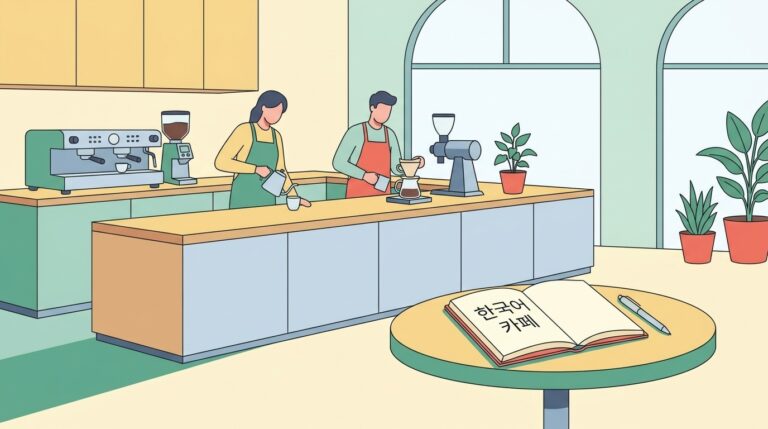
Designing a Korean Cafe Masterpiece: Nuances of Flow Lines and Interior Korean for Entrepreneurs
안녕하세요! 매일한글 에디터입니다. Welcome back to Daily Hangul! If you have ever dreamt of opening a trendy cafe in Seoul—from the neon-lit alleys of Seongsu-dong to the cozy corners of Yeonnam-dong—you probably know that brewing excellent coffee is only half the battle. The real magic happens when interior aesthetics meet seamless operational efficiency.
Picture this: You have rented a gorgeous ground-floor space in Gangnam. Your espresso machine is top-tier, and your interior designer presents a stunning minimalist layout. But during peak hours, your baristas collide with each other while reaching for milk, and customers queuing up for order pickup block the bathroom entrance! In Korea’s hyper-competitive cafe market, a flawed layout (동선) can destroy customer experience and lower seating turnover (회전율). Today, we are diving deep into C1-level business and spatial design Korean so you can discuss interior layouts, barista workflows, and spatial harmony like a seasoned Korean industry insider.
Phase 2: Core Expressions Deep Dive
1. 동선을 효율적으로 짜다
- Pronunciation: [dong-seon-eul hyo-yul-jeok-eu-ro jja-da] (Sounds like: dong-seun-ool hyo-yool-jug-eu-ro jjah-dah)
- Meaning: Literally “To weave the movement line efficiently.” In practice, it means designing an ergonomic and seamless operational workflow or traffic line for staff and customers.
- K-Culture Moment: Seen in K-business dramas or interior renovation YouTube series like Zero-Base Cafe, where consultants re-arrange espresso counter setups so baristas can tamp, pull shots, and steam milk without stepping on each other’s toes.
- Editor’s Insight: The word ‘동선’ (動線 – line of movement) is essential in urban planning, architecture, and service setup in Korea. ‘짜다’ means to weave or assemble. Saying ‘동선을 짜다’ elevates your Korean from conversational to professional executive level.
- Situation Spectrum: Casual ⚠️ | Semi-formal ✅ | Formal ✅
- 🤔 Think About It: How does your native language describe the spatial flow of human movement in a commercial establishment compared to the imagery of “weaving a line” (동선을 짜다)?
2. 공간의 개방감을 살리다
- Pronunciation: [gong-gan-ui gae-bang-gam-eul sal-li-da] (Sounds like: gong-gahn-eui geh-bahng-gahm-ool sahl-lee-dah)
- Meaning: To accentuate the sense of openness/spaciousness within a physical area.
- K-Culture Moment: Discussed frequently when transforming tight, high-rent Seoul retail spaces into seemingly expansive flagship cafes using glass partitions, high ceilings, and minimal clutter.
- Editor’s Insight: ‘개방감’ combines 개방 (openness) and 감 (feeling/sense). Korean spatial design heavily emphasizes creating optical openness to counter dense urban settings. Using ‘살리다’ (to bring alive / maximize) highlights design intentionality.
- Situation Spectrum: Casual ⚠️ | Semi-formal ✅ | Formal ✅
- 🤔 Think About It: In dense metropolitan cities like Seoul or Tokyo, why is psychological spatial openness often valued higher than sheer physical square footage?
3. 회전율과 체류 시간의 균형을 맞추다
- Pronunciation: [hoe-jeon-yul-gwa che-ryu si-gan-ui gyun-hyeong-eul mat-chu-da] (Sounds like: hweh-jeon-yool-gwah cheh-ryoo see-gahn-eui gyoon-hyeong-eul maht-choo-dah)
- Meaning: To strike a balance between customer turnover rate and duration of stay.
- K-Culture Moment: Highly relevant when deciding furniture ergonomics—mixing comfortable sofas for seating ambiance with higher bistro tables near windows to regulate how long ‘카공족’ (people who study in cafes) remain.
- Editor’s Insight: ‘회전율’ (table/seat turnover rate) and ‘체류 시간’ (dwell time) represent the core revenue dilemma of modern Korean cafes. Expressing this trade-off using ‘균형을 맞추다’ showcases strategic business insight.
- Situation Spectrum: Casual 🚫 | Semi-formal ✅ | Formal ✅
- 🤔 Think About It: How do business owners in your country manage long-stay laptop users without alienating their brand loyalty?
Phase 3: Textbook Korean vs. Real Native Korean
Situation 1: Evaluating a well-designed counter layout
- 📖 Textbook Korean: “바리스타의 이동 경로가 매우 편리하게 설계되었습니다.” (The barista’s movement path is designed very conveniently.)
- 🗣️ Real Native Korean: “작업 동선이 정말 깔끔하게 빠졌네요.” (The workflow line came out remarkably clean.)
- 💡 Why the difference? Native designers and entrepreneurs use the verb ‘빠지다’ (to come out / be extracted) when praising architectural blueprints or room layouts that feel natural and slick.
Situation 2: Expressing the aesthetic atmosphere of an interior
- 📖 Textbook Korean: “실내 인테리어가 매우 아름답고 유행에 맞습니다.” (The interior design is very beautiful and trendy.)
- 🗣️ Real Native Korean: “인스타 감성도 살리면서 개방감이 장난 아니에요.” (It captures the Instagram aesthetic perfectly while having an incredible sense of space.)
- 💡 Why the difference? Modern business Korean naturally integrates digital culture markers like ‘인스타 감성’ (Instagram aesthetic/vibe) with professional descriptive nouns like ‘개방감’.
Phase 4: K-Culture Deep Dive & Non-Verbal Manners
4-1. Nunchi (눈치) & Spatial Etiquette in Design
When designing a cafe layout in Korea, spatial Nunchi is critical. Customers subconsciously evaluate whether a seat offers enough personal privacy without feeling isolated. Notice how successful cafes position power outlets (콘센트) and low-profile partitions. When giving feedback to an interior contractor, maintaining a respectful tone through soft sentence endings like “~하면 어떨까 합니다” (I wonder if it would be better to…) avoids sounding overly aggressive while preserving professional authority.
4-2. Cultural Code: The ‘Takeout-to-Dine-In’ Dynamic
Korea boasts one of the highest coffee consumption rates per capita. During lunch rush hours (12:30 PM – 1:30 PM), up to 70% of cafe orders are take-out. Thus, prime cafe designs feature a dedicated ‘Pick-up Zone’ (픽업존) separated from seated dining traffic to avoid bottlenecks. Integrating a designated window kiosk flow line directly onto the sidewalk is a prime urban architecture strategy in areas like Yeouido and Gwanghwamun.
Phase 5: Real-life Roleplay Scenario
Setting: A modern cafe construction site in Seongsu-dong. You (the Founder) are discussing layout refinements with Mr. Park, your lead interior architect.
- Architect Park: 대표님, 주문 카운터와 바리스타 작업대 위치 수정안 나왔습니다. 한번 보시겠어요?
(Boss, I have the revised layout for the order counter and barista workstation. Would you like to take a look?) - You: 네, 박 소장님. 지난번 말씀드린 바리스타 동선 개선 건은 반영되었나요?
(Yes, Director Park. Was the barista flow improvement we discussed last time reflected?) - Architect Park: 🎭 Pointing at the blueprint with a stylus 네, 에스프레소 머신과 그라인더 위치를 수평으로 배치해서 작업 동선을 최적화했습니다.
(Yes, we placed the espresso machine and grinder horizontally to optimize the workflow.) - You: 깔끔하네요! 그런데 테이크아웃 손님 대기선이 매장 테이블 공간과 겹치지는 않을까요?
(Looks clean! But won’t the takeout waiting line overlap with the indoor seating area?) - Architect Park: 🎭 Nodding thoughtfully 아, 그 부분은 픽업존 전면에 나비형 동선을 확보해서 입출구를 분리했습니다.
(Ah, for that part, we secured a butterfly flow line in front of the pickup zone to separate entry and exit points.) - You: 좋습니다. 덕분에 손님 체류 시간과 매장 회전율을 모두 잡을 수 있겠네요.
(Great. Thanks to that, we can balance customer dwell time and table turnover rate.) - Architect Park: 맞습니다. 공간의 개방감도 훨씬 살렸으니 조명 세팅만 마치면 완벽할 겁니다.
(Exactly. We also heightened the sense of openness significantly, so once lighting setup is finished, it will be perfect.) - You: 정말 고생 많으셨습니다. 이대로 시공 진행해 주세요.
(Thank you for your hard work. Please proceed with construction according to this plan.)
🔀 Interactive Decision Point
Scenario: Architect Park asks if you want to add 4 more small tables by narrowing the aisle width between the entrance and the pickup counter.
- Option A: “회전율을 높여야 하니까 테이블을 최대한 많이 넣어주세요.”
- Option B: “동선이 꼬이면 매장이 산만해지니까 개방감을 위해 공간을 비워둡시다.”
- Option C: “그냥 소장님이 알아서 예쁘게 해 주세요.”
Feedback & Analysis:
* Best Choice (Option B): Excellent! Preserving flow efficiency and openness over overcrowding reflects top-tier C1 operational judgment in Korean retail culture.
* Risk Choice (Option A): While increasing seating sounds good, narrowing aisles disrupts peak-hour takeout flow line (동선), leading to long customer wait complaints.
* Bad Choice (Option C): Avoid passive language with contractor leads! In Korean business, clear owner direction ensures precision during finishing works.
Phase 6: 10-Second Emotion Shadowing Drill
Practice reading these lines aloud with the indicated pitch, pauses (/), and emotional nuance:
[😊 Confident & Professional]
작업 동선을 / 효율적으로 짜서 / 피크 타임 과부하를 / 줄였습니다.
(Jak-eop dong-seon-eul / hyo-yul-jeok-eu-ro jja-seo / pi-keu ta-im gwa-bu-ha-reul / jul-yeot-seum-ni-da.)-
[🤔 Analytical & Nuanced]
개방감을 살리면서도 / 손님의 체류 시간을 / 적절히 유도해야 합니다.
(Gae-bang-gam-eul sal-li-myeon-seo-do / son-nim-ui che-ryu si-gan-eul / jeok-jeol-hi yu-do-hae-ya ham-ni-da.) -
[👏 Satisfied & Decisive]
동선이 정말 깔끔하게 빠졌네요! / 이대로 시공 들어갑시다.
(Dong-seon-i jeong-mal kkal-kkeum-ha-ge ppa-jeot-nae-yo! / I-dae-ro si-gong deul-eo-gap-si-da.)
Phase 7: K-Culture Mini Dictionary
- 카공족 (Ka-gong-jok): People who study or work on laptops in cafes. Layout design must balance power outlet availability for this demographic without lowering turnover excessively.
- 동선 (Dong-seon): Traffic line / flow path of people (staff or customers) within a spatial layout.
- 개방감 (Gae-bang-gam): Psychological sense of visual openness created by high ceilings, clear glass, and spacious layout.
- 키오스크 동선 (Kiosk Dong-seon): The designated queuing path formed around automated ordering kiosks, vital for modern Korean self-serve cafe setups.
Phase 8: Entrepreneur Survival Kit
Top 3 On-Site Business Expressions
- “동선이 겹치지 않게 해주세요.” (Dong-seon-i gyeop-chi-ji anh-ge hae-ju-se-yo.) — Please ensure human flow paths don’t overlap.
- “콘센트 위치 좀 확인해 드릴게요.” (Kon-sen-teu wi-chi jom hwak-in-hae deu-ril-ge-yo.) — Let me double-check the power outlet locations for you.
- “마감재 느낌이 도면과 약간 다릅니다.” (Ma-gam-jae meuk-kim-i do-myeon-gwa yak-gan da-reum-ni-da.) — The texture of the finishing materials feels slightly different from the blueprint.
Editor’s Travel & Business Note
When scouting trendy cafe layout inspirations in Seoul, use the Naver Map App to bookmark iconic design spaces around Seongsu, Dosan Park, and Hongdae. Check real-time crowd congestion tags before visiting to analyze customer flow live during rush hours.
Phase 9: One Step Deeper (Spatial Humanities)
In Korean urbanization, cafes serve as extended living rooms and third spaces (제3의 공간). Because urban housing often features compact residential footprints, Koreans seek elevated aesthetic relief in cafe interiors. A cafe’s layout is not merely functional architecture; it is an emotional sanctuary where visual openness (개방감) directly influences psychological peace. Mastering language around interior design equips you to understand how modern Korean society blends commerce, spatial efficiency, and artistic sanctuary.
💬 Your Turn: What is the most critical factor when you choose a cafe: soft lighting, spacious seating flow, or plenty of laptop outlets? Share your thoughts in the comments below!
Phase 10: FAQ & Common Mistakes
Q: What is the difference between ‘이동 경로’ and ‘동선’?
A: ‘이동 경로’ is a general term meaning “route of travel” (used in navigation or geography). ‘동선’ specifically refers to architectural, interior, or ergonomic traffic paths designed intentionally for humans within a defined space.
Q: Is ‘회전율’ only used in business contexts?
A: Yes, ‘회전율’ (turnover rate) is primarily used in commercial settings like restaurants, cafes, retail stores, or finance. In everyday casual speech, people might say “손님이 금방 빠진다” (customers leave quickly) instead.
Q: Can I use ‘감성’ for business discussions?
A: Absolutely! In modern Korean commercial real estate and interior design, ‘감성’ (emotional branding/vibe) is a legitimate market strategy term when paired appropriately with business vocabulary.
🚨 Common Mistakes TOP 3
- Mistake: Using “길” (road/path) instead of “동선” when talking to interior architects.
- Correct Action: Use 동선 (e.g., “바리스타 동선이 길어요” -> “바리스타 동선이 비효율적이에요”).
- Mistake: Confusing “체류 시간” (dwell time) with “기다리는 시간” (wait time).
- Correct Action: 체류 시간 is time spent inside enjoying the space; 대기 시간 is time spent waiting in line.
- Mistake: Overusing casual slang like “인스타용” in formal contract meetings.
- Correct Action: Upgrade to “시각적 브랜드 콘셉트” or “개방감을 살린 디자인” during official budget reviews.
Phase 11: Action Missions
- 🥉 Bronze Mission: Read the 3 Core Expressions aloud 5 times using the pitch markers in Phase 6.
- 🥈 Silver Mission: Write a short 2-sentence description of your favorite local cafe using ‘동선’ and ‘개방감’ in the comments.
- 🥇 Gold Mission: Roleplay Phase 5 conversation out loud, recording your voice to check your business intonation.
🎮 K-Culture Mission: Watch a Korean interior renovation vlog on YouTube (search term: 카페 인테리어 브이로그) and spot at least two instances where they discuss counter placement or flow lines!
Phase 12: Interactive Quiz Challenge
Test your knowledge below!
1. Fill in the blank: 매장 안이 답답하지 않고 넓어 보이도록 공간의 ( )을/를 살렸습니다.
🔍 Click to view Answer & Explanation
- Answer: 개방감
- Explanation: ‘개방감’ means the sense of spatial openness, perfect for describing visually spacious interior design.
2. Situation Judgment: You want to tell your interior contractor that baristas keep bumping into each other while preparing drinks. Which sentence is most natural?
- A) 바리스타 길을 크게 만들어 주세요.
- B) 바리스타 작업 동선이 겹쳐서 수정이 필요합니다.
🔍 Click to view Answer & Explanation
- Answer: B
- Explanation: ‘작업 동선이 겹치다’ (work flow paths overlap) is the precise professional expression used in Korean interior design.
3. True or False: ‘회전율’ refers to how many times a cafe changes its drink menu per year.
🔍 Click to view Answer & Explanation
- Answer: False
- Explanation: ‘회전율’ refers to customer seat turnover rate within a operational business day.







