

The Warm and Savory Flavor of Jeolla Dialect: Master Authentic Korean Beyond Textbooks
Phase 1: Empathy & K-Culture Connection
안녕하세요! I’m your Daily Hangul editor. Have you ever been watching a hit K-drama like Reply 1994 or Hotel Del Luna, or perhaps tuned into a variety show set in the lush countryside of Jeollanam-do or Jeollabuk-do, and suddenly felt completely lost? The characters are talking rapidly, laughing warmly, and using words that look nothing like the standard Seoul dialect (PyoStandard-어) you’ve been diligently studying in your B2 textbooks.
You hear sounds like “Atta!”, “Geosigi…”, or “Omae!”, and you wonder if you missed a whole chapter of grammar. Don’t worry! That rich, melodic, and deeply emotional way of speaking is the Jeolla-do Dialect (Jeolla 사투리). It is renowned across South Korea for its rhythm, affectionate undertones, and warm hospitality (Jeong).
By understanding these dialect nuances, you won’t just understand movie characters better; you’ll unlock the authentic heartbeat of Southwestern Korea. This guide is built on real learning insights from fellow B2 Korean learners who wanted to bridge the gap between formal grammar and real-life human connection. Let’s dive into the savory world of Jeolla Korean!
Phase 2: Core Expressions Deep Dive
1. 거시기 (Geosigi)
- Pronunciation: [Guh-si-gi] (Sounds like saying “gosh-e-gi” softly)
- Meaning: Literal: “That thing / You-know-what” vs. Real Nuance: A versatile placeholder word used when you can’t remember a noun, verb, or adjective, or when you want to avoid saying something awkward directly.
- K-Culture Moment: In many movies set in Jeolla-do, friends converse using “Geosigi” three times in a single sentence, and yet they understand each other perfectly!
- Editor’s Insight: Think of it as the ultimate context-based word. It functions like “whaddya-call-it” or “you know what I mean.” Use it when searching for a word to keep the conversation flowing smoothly.
- Situation Spectrum: Casual ✅ | Semi-formal ⚠️ | Formal 🚫
- 🤔 Think About It: Why do you think Jeolla culture relies so heavily on context and shared intuition (Nunchi) when using placeholder words like Geosigi?
2. 오매! (Omae!)
- Pronunciation: [Oh-mae!] (Pitched high, like an exaggerated “Oh my!”)
- Meaning: Literal: Exclamation of surprise vs. Real Nuance: “Oh my goodness!” or “Good grief!” expressed with pure, unfiltered emotion.
- K-Culture Moment: An older grandmother (Halmeoni) at a traditional market seeing how much you’ve grown or how well you eat Korean food.
- Editor’s Insight: Unlike standard “Eomona!” (어머나), “Omae!” carries a deep, maternal warmth. You will often hear it elongated as “Omae-ya~” when someone is genuinely surprised or touched.
- Situation Spectrum: Casual ✅ | Semi-formal ⚠️ | Formal 🚫
- 🤔 Think About It: How does expressing surprise with regional warmth change your rapport with local speakers compared to standard textbook interjections?
3. 허벌나게 (Heobeollage)
- Pronunciation: [Heo-beol-na-ge] (Rhythmic, emphatic start on ‘Heo’)
- Meaning: Literal: Tremendously / Exceedingly vs. Real Nuance: “Super”, “Crazy fast/much”, or “Extremely” (similar to 엄청 or 너무 in standard Korean).
- K-Culture Moment: Describing a spread of Jeonju Bibimbap or local side dishes (Banchan) that overflows the entire dining table.
- Editor’s Insight: This word adds immense emphasis and enthusiasm to adjectives. Saying “Heobeollage mas-iss-eoyo!” at a local eatery will immediately bring a giant smile to the chef’s face.
- Situation Spectrum: Casual ✅ | Semi-formal ⚠️ | Formal 🚫
- 🤔 Think About It: Does your native language have regional slang that exaggerates quantities in a friendly, humorous way?
Phase 3: Textbook Korean vs. Real Korean
Situation 1: Expressing that food is extremely delicious
* 📖 Textbook Korean: 이 음식은 정말 맛있습니다. (I eomsig-eun jeongmal mas-issseumnida.)
* 🗣️ Real Jeolla Korean: 아따, 밥이 허벌나게 맛있당께요! (Atta, babi heobeollage mas-isdangkeyo!)
* 💡 Why the Difference?: Jeolla speakers often add ending suffixes like “-당께” (-dangke) or “-잉” (-ing) to create a melody that feels welcoming and expressive rather than stiff and distant.
Situation 2: Asking someone to do something quickly or gently encouraging them
* 📖 Textbook Korean: 어서 빨리 오세요. (Eoseo ppalli oseyeo.)
* 🗣️ Real Jeolla Korean: 솔찮이 퍼뜩 오씨오! (Solchan-i peotteuk ossio!)
* 💡 Why the Difference?: “Solchan-i” means “quite / more than expected”, and “Peotteuk” replaces “Ppalli” (fast). It reflects the lively tempo of regional market trade and communal life.
Phase 4: K-Culture Deep Dive & Non-Verbal Manners
4-1. Nunchi & Regional Gestures
When speaking with elders or restaurant hosts in Jeolla-do, non-verbal tone carries as much weight as words. Nodding rhythmically while saying “아~ 예예” (A~ ye-ye) with a slight smile shows high emotional intelligence (Nunchi). When hit with an “Omae!”, tilting your head slightly and placing a hand near your heart demonstrates that you share their warm surprise.
4-2. Cultural Code: The Art of Jeolla Hospitality (Namdo Han-jeongsak)
Jeolla-do is recognized as the culinary heartland of South Korea. Food isn’t just sustenance here; it is an expression of affection (Jeong). When dining in cities like Jeonju, Yeosu, or Mokpo, table spreads feature dozens of side dishes. Hearing the host say “거시기 만들어 봤으니까 많이 드시오” means “I prepared this with love, please enjoy every bite!”
Phase 5: Interactive Roleplay Scenario
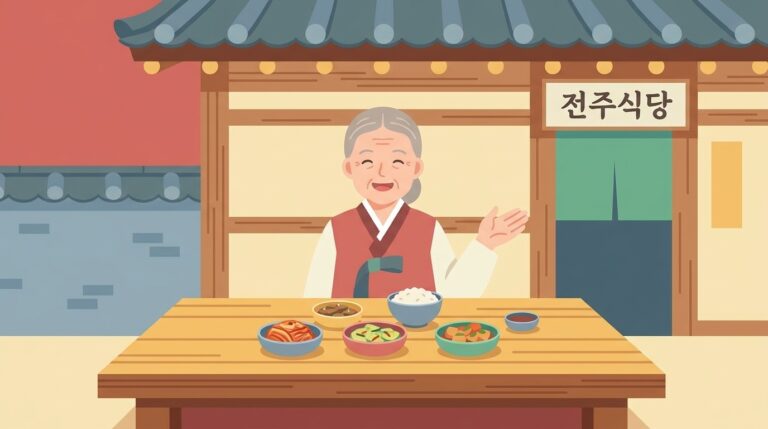
Scenario: You are visiting a cozy, historic soup restaurant in Jeonju. The friendly owner (Imo, auntie) notices you are an international traveler reading her menu carefully.
- Turn 1 (Imo): 어서 오씨오! 혼자 왔는가? 밥은 묵었어?
(Eoseo ossio! Honja wan-neunga? Babeun mugeosseo?)
🎭 Welcoming you with a big smile while wiping down a wooden table. - Turn 2 (Learner): 안녕하세요! 아직 안 먹었어요. 국밥 추천해 주실 수 있나요?
(Annyeonghaseyo! Ajik an meogeosseoyo. Gukbap chucheonhae jusil su unnayo?)
🎭 Politely bowing while looking at the menu board. - Turn 3 (Imo): 아따, 우리 집은 콩나물국밥이 허벌나게 시원하고 맛있당께!
(Atta, uri jibeun kongnamulgukbap-i heobeollage siwonhago mas-isdangkeyo!)
🎭 Patting her chest proudly with a confident wave of her hand. - Turn 4 (Learner): 오, 그래요? 그럼 그걸로 거시기… 하나 주시겠어요?
(O, geuraeyo? Geureom geogeollo geosigi… hana jusigesseoyo?)
🎭 Using ‘Geosigi’ shyly to point at the bean sprout soup item. - Turn 5 (Imo): 오매! 방금 거시기라고 했어? 한국말을 솔찮이 잘하네!
(Omae! Banggeum geosigirago heosseo? Hangungmareul solchan-i jalhane!)
🎭 Clapping her hands together in delight and laughing warmheartedly. - Turn 6 (Learner): 감사합니다! 사투리를 조금 배웠어요.
(Gamsahamnida! Saturireul jogeum baewosseoyo.)
🎭 Smiling brightly and taking a seat. - Turn 7 (Imo): 이따가 반찬 모자라면 말하더라고, 잉?
(Ittaga banchan mojaramyeon malhareagodeo, ing?)
🎭 Setting down three delicious side dishes with an extra egg garnish. - Turn 8 (Learner): 네! 맛있게 잘 먹겠습니다!
(Ne! Mas-itge jal meogessneunida!)
🎭 Holding utensils reverently with both hands.
🔀 Interactive Choice Point
The owner asks if you want your soup extra spicy: “매콤하게 해줄까, 어째?”
- Option A: “네, 허벌나게 매운 건 힘들지만 조금은 좋아요!” (Best Choice: Uses dialect naturally while expressing your preference accurately!)
- Option B: “아무거나 그냥 주세요.” (Bad Choice: A bit blunt and drops the warm conversational momentum.)
- Option C: “거시기… 너무 매우면 내 맴이 아파요!” (Risk Choice: Humorous and cute, but grammatically eccentric—might cause friendly laughter!)
Phase 6: 10-Second Emotion Shadowing Drill
Practice these lines out loud with the emotional tags and rhythm pauses (/):
[😊 Delighted & Energetic]
아따! / 밥이 / 허벌나게 / 맛있당께요!
(Atta! / Babi / heobeollage / mas-isdangkeyo!)-
[😲 Touched & Surprised]
오매~ / 징하게 / 반갑구만잉!
(Omae~ / jing-hage / ban-gapgumaning!) -
[Warm & Affectionate]
밥 / 많이 / 묵고 / 천천히 / 가더라고, / 잉?
(Bap / man-i / muk-go / cheon-cheon-hi / gadeorago, / ing?)
Phase 7: K-Culture Mini Dictionary
- 아따 (Atta) | Interjection | Used to introduce a thought, express mild surprise, or add dramatic flair. Equivalent to “Gosh!” or “Well now!”.
- 솔찮이 (Solchan-i) | Adverb | Means “quite a bit” or “significantly more than expected”. (e.g., “손님이 솔찮이 많네” = “There are quite a few customers!”).
- 징하게 (Jing-hage) | Adverb | Derived from severe/intense, used affectionately to mean “immensely” or “deeply” (e.g., “징하게 보고 싶었다” = “I missed you immensely”).
- ~잉 (~ing) | Sentence Ending | Softening sound added to the end of sentences, equivalent to a gentle “okay?” or “you know?”.
Phase 8: Traveler’s Survival Kit
Survival Expressions TOP 3
- 이거 허벌나게 맛있어요! (Igeo heobeollage mas-isseoyo!) – This is super delicious!
Pro Tip: Say this to food stall owners in Jeonju Hanok Village for instant smiles. - 조금만 거시기 해주세요~ (Jogeumman geosigi haejuseyo~) – Please tweak/adjust it a little for me~
Pro Tip: Pair this with pointing at ice or spice levels! - 싸게 싸게 주세요! (Ssage ssage juseyo!) – Please give me a good deal / fast service!
Pro Tip: Commonly used playfully in traditional markets.
Editor’s Travel Note
When traveling around Jeollanam-do, download and use the Kakao Map Navigation App for real-time bus schedules and local restaurant reviews written by native residents. Public transport drivers in this region are famously friendly—don’t hesitate to greet them with a polite “안녕하세요!” as you board.
Phase 9: One Step Deeper (Reflective Essay)
Regional dialects in South Korea reflect centuries of geographic isolation, local agriculture, and tight-knit village bonds. The Jeolla dialect, with its melodic pitch variations and endearing sentence endings, preserves a unique warmth known as Heung (joyful energy) and Jeong (emotional connection). While standard Seoul Korean prioritizes clarity and formal distance, dialect words like Geosigi invite the listener to share mutual understanding without needing explicit speech. Dialects remind us that language is not merely a tool for code transmission, but a vessel for living culture.
💬 Your Turn: Does your native language have a regional dialect that sounds softer, warmer, or more expressive than the standard accent? Share your favorite regional words in the comments below!
Phase 10: FAQ & Common Mistakes
Q: Is it rude for a non-native speaker to use regional dialects like Jeolla-do 사투리?
A: Not at all, provided it is done with respect and affection! Koreans love seeing foreign learners appreciate regional culture. However, stick to using these expressions in casual settings, with friends, or at local shops rather than during formal business presentations.
Q: What is the main difference between Gyeongsang dialect and Jeolla dialect?
A: Gyeongsang dialect tends to have sharper, rising tones and shorter phrasing, sounding strong and direct. Jeolla dialect has a smoother, singing cadence with expressive sentence endings like “-당께” and “-잉”.
Q: How can I tell if someone is using “Geosigi” properly?
A: Context is everything! Listen to the speaker’s body language and facial expression. If they are smiling and gesturing toward a dish, Geosigi refers to the dish.
🚨 Common Mistakes Warning Board
- Mistake: Overusing dialect in formal corporate meetings.
- Correct Action: Keep dialect for social gatherings, travel, and casual dining.
- Mistake: Pronouncing “허벌나게” with a harsh tone.
- Correct Action: Say it smoothly with enthusiasm rather than aggressive force.
- Mistake: Confusing dialect endings with rude speech (Panmal).
- Correct Action: Attach polite endings when speaking to elders (e.g., “맛있당께요” instead of “맛있당께”).
Phase 11: Action Mission
- Bronze Mission: Record yourself pronouncing “아따, 허벌나게 맛있당께요!” three times with dramatic emotion.
- Silver Mission: Watch a scene from a Jeolla-based K-drama (like Reply 1994) and spot at least two dialect sentence endings (-잉, -당께).
- Gold Mission: Next time you visit an authentic Korean restaurant, use “허벌나게 맛있어요!” to compliment the meal.
🎮 K-Culture Mission: Find a K-Pop idol born in Jeolla-do (such as BTS’s J-Hope or MAMAMOO’s Wheein) speaking in their natural dialect on a variety show clip and write down one phrase you recognized!
Phase 12: Interactive Quiz Challenge
Q1. What is the primary function of the Jeolla word “거시기” (Geosigi)?
A) A strict formal greeting
B) A versatile context-based placeholder word
C) A type of spicy soup
Click here for Answer & Explanation
Correct Answer: B
Explanation: Geosigi is used when you can’t immediately recall a word or want to refer to something contextually without naming it directly!
Q2. True or False: Adding “-잉” (-ing) to the end of a sentence in Jeolla dialect adds a soft, friendly nuance.
Click here for Answer & Explanation
Correct Answer: True
Explanation: -잉 softens the sentence tone, acting like an affectionate “okay?” or “right?”.







