

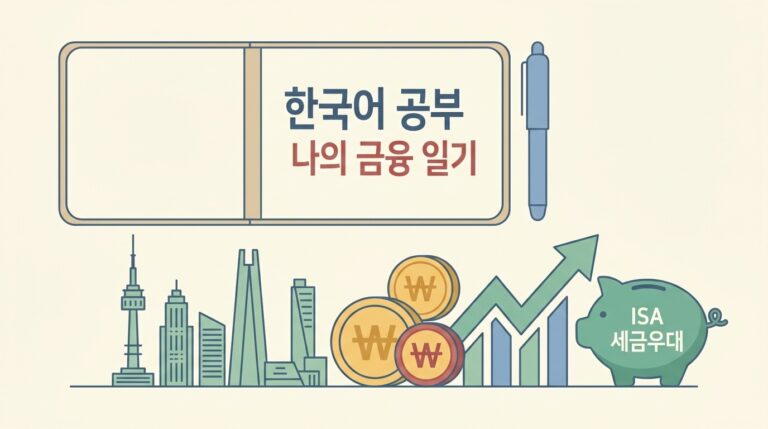
Mastering Korean Tax-Saving Wealth Secrets: Navigating the ISA Account Like a Local Financial Guru
안녕하세요! 매일한글 에디터입니다. Welcome back to another high-level edition of Daily Hangul! As an advanced speaker navigating life, work, or long-term investments in South Korea, you’ve likely realized that mastering the Korean language isn’t just about ordering coffee or chatting about the latest K-drama. When you reach the C2 tier, true linguistic fluency intersects with institutional fluency. Today, we are stepping into the sophisticated realm of Korean personal finance—specifically, the ISA (개인 종합 자산 관리 계좌 – Individual Savings Account) and its game-changing tax-saving benefits (절세 혜택).
Imagine sitting across from a seasoned wealth manager at a premier bank in Yeouido or Gangnam. The air is crisp, the coffee is freshly brewed, and the advisor leans in to say: “고객님, 비과세 한도를 최대한 활용하셔서 손익통산 혜택을 챙기셔야 합니다.” Do you follow every subtle nuance of that recommendation? In South Korea’s hyper-competitive financial ecosystem, saving on taxes isn’t just a strategy; it’s practically a cultural sport known as Jeteukeu (재테크 – wealth generation tech). This guide is built upon real-life financial consultations and feedback from advanced expatriates who transitioned from passive savers to savvy investor-level speakers. By the end of this deep dive, you will possess the precise vocabulary, non-verbal finesse, and socio-cultural insights required to negotiate tax-saving strategies with native fluency.
Phase 2: Core Expressions Deep Dive
1. 비과세 한도 (Bi-gwa-se Han-do)
- Pronunciation: [Bi-gwa-se Han-do] (Sounds like “bee-gwa-seh hahn-doh”—think of bee buzzing over gwaacamole)
- Meaning: Literal: Non-taxation limit | Real Nuisance: The tax-free threshold or umbrella under which your capital gains and interest earnings incur zero tax.
- K-Culture Moment: Seen in business K-dramas like Reborn Rich or financial vlogs on YouTube where smart investors boast about maximizing their annual tax-exempt cap before the fiscal year ends.
- Editor’s Insight: 비과세 (tax-exempt) combined with 한도 (limit) is the holy grail of Korean financial management. In ISA accounts, this cap typically ranges from 2 million to 4 million KRW depending on your income bracket (일반형 vs. 서민형).
- Situation Spectrum: Casual 🚫 | Semi-formal ⚠️ | Formal ✅
- 🤔 Think About It: How does your home country’s tax system incentivize personal savings compared to Korea’s institutionalized tax-free account caps?
2. 손익통산 (Son-ik Tong-san)
- Pronunciation: [Son-ik Tong-san] (Sounds like “sohn-eek tohng-sahn”)
- Meaning: Literal: Netting profits and losses | Real Nuisance: Profit-loss netting (offsetting capital gains against losses to pay tax only on the net profit).
- K-Culture Moment: Frequently discussed on YouTube finance channels like Shuka World when evaluating whether to aggregate stock losses with dividend gains inside an ISA.
- Editor’s Insight: 손 (Loss) + 익 (Profit) + 통산 (Summing up). Without 손익통산, you might pay tax on every winning trade even if your overall portfolio is in the red. Native financial planners emphasize this compound word constantly.
- Situation Spectrum: Casual 🚫 | Semi-formal ⚠️ | Formal ✅
- 🤔 Think About It: Why is the legal framework surrounding portfolio netting so vital for individual confidence in financial markets?
3. 분리과세 (Bul-ri Gwa-se)
- Pronunciation: [Bul-ri Gwa-se] (Sounds like “bool-ri gwa-seh”)
- Meaning: Literal: Separately taxed | Real Nuisance: Separate taxation at a flat, lower rate rather than combining earnings into global aggregate income tax.
- K-Culture Moment: A staple term in wealth management consultation scenes where high-net-worth characters try to avoid jumping into higher income tax brackets.
- Editor’s Insight: Returns exceeding the tax-free limit (비과세 한도) in an ISA account are subjected to a reduced flat tax rate (usually 9.9%) via 분리과세, protecting high earners from top-tier progressive income tax rates.
- Situation Spectrum: Casual 🚫 | Semi-formal ⚠️ | Formal ✅
- 🤔 Think About It: How does tax categorization reflect a society’s approach to wealth accumulation and redistribution?
Phase 3: Textbook Korean vs. Real Korean
Situation 1: Asking about tax benefits on account earnings
- 📖 Textbook Korean: 이 계좌는 세금을 얼마나 줄여줍니까? (How much tax does this account reduce?)
- 🗣️ Real Korean: 이 ISA 계좌로 비과세랑 분리과세 혜택을 얼마나 볼 수 있나요? (How much can I leverage tax-exempt and separate taxation benefits with this ISA account?)
- 💡 Why it differs: Native C2 speakers specify the exact mechanism (비과세, 분리과세) and use the active verb 혜택을 보다 (to gain/benefit) instead of the generic 줄이다.
Situation 2: Discussing portfolio losses and gains netting
- 📖 Textbook Korean: 손실과 이익을 함께 계산해 주세요. (Please calculate losses and profits together.)
- 🗣️ Real Korean: 이익이랑 손실 손익통산 처리되는 거죠? (The profits and losses are net-offsetted, right?)
- 💡 Why it differs: Using financial terminology like 손익통산 처리 shows executive-level comprehension and signals to the bank representative that you require precise financial handling.
Phase 4: K-Culture Deep Dive & Non-verbal Manners
4-1. Nunchi (눈치) & Financial Consultation Etiquette
When visiting a private banking (PB) center in Korea, body language conveys sophistication:
* Two-Handed Document Exchange: Always receive account disclosures and sign tablet screens using both hands or with your right hand supported at the elbow by your left hand.
* Attentive Nodding (조용한 경청): Maintain composed eye contact. When the advisor explains complex tax clauses, offer subtle nods accompanied by “아, 손익통산 부분 말씀이시군요” (Ah, you mean the profit-loss netting part).
4-2. Cultural Code: The Rise of ‘Smart Jeteukeu’ Culture
In South Korea, personal financial management is no longer taboo—it is a major conversational topic across all age groups. From young office workers (MZ세대) discussing dividend yields over lunch to popular finance podcasts, maximizing ISA accounts before tax deadlines represents economic self-care and diligence (갓생 culture).
Phase 5: Real-life Roleplay Scenario
Setting: Private Wealth Management Center, Yeouido, Seoul.
Characters: Manager Kim (Bank Advisor) & You (C2 Investor).
- Manager Kim: 고객님, 이번에 개설하시는 ISA 계좌는 일반형으로 진행해 드릴까요? (Client, shall we proceed with the standard type for the ISA account you are opening today?)
- You: 🎭 (Confidently adjusting documents on the desk) 네, 제 소득 요건상 일반형이 맞습니다. 비과세 한도가 200만 원까지죠? (Yes, considering my income bracket, the standard type is appropriate. The tax-exempt limit is up to 2 million KRW, correct?)
- Manager Kim: 맞습니다. 200만 원 초과분은 9.9% 저율로 분리과세 적용됩니다. (Correct. Any amount exceeding 2 million KRW is subject to separate taxation at a low rate of 9.9%.)
- You: 🎭 (Leaning forward slightly) 그렇군요. 만약 계좌 내 상품에서 손실이 나면 손익통산은 자동으로 산정되나요? (I see. If a loss occurs in products within the account, is the profit-loss netting calculated automatically?)
- Manager Kim: 네, 만기 해지 시 이익과 손실을 통산하여 순이익에 대해서만 과세합니다. (Yes, upon maturity liquidation, profits and losses are netted, and taxes apply only to net profits.)
- You: 🎭 (Nodding approvingly) 아주 유용하네요. 의무 가입 기간 3년을 채워야 이 혜택이 유지되는 거죠? (That is very useful. The mandatory holding period of 3 years must be satisfied to maintain these benefits, right?)
- Manager Kim: 정확하십니다. 3년 후 만기 연장이나 현금화 시점을 선택하시면 됩니다. (Precisely. You may choose to extend the maturity or cash out after 3 years.)
- You: 🎭 (Signing the digital document) 좋습니다. 그럼 오늘 ETF 중심으로 포트폴리오를 구성해서 가입 진행해 주세요. (Great. Please proceed with the enrollment today, structuring the portfolio primarily with ETFs.)
🔀 Interactive Branch Point
What would you say if the advisor asks if you’d like to transfer your existing individual stocks into the ISA?
* Option A: 그냥 아무거나 세금 안 나오는 걸로 다 넣어 주세요. (Just put anything that doesn’t trigger taxes in there.)
* Option B: ISA 계좌 내에서 운용 가능한 상품 종류와 손익통산 적용 범위부터 확인하고 싶습니다. (I would like to check the types of manageable products and the scope of profit-loss netting within the ISA account first.)
* Option C: 주식은 관심 없고 제일 안전한 예금만 100% 넣어 주세요. (I have no interest in stocks; please put 100% in the safest savings deposit.)
Feedback:
* Best Choice (Option B): Demonstrates high financial acumen, asserting your decision-making authority as a C2 speaker.
* Bad Choice (Option A): Sounds imprecise and uneducated regarding tax policy boundaries.
* Risk Choice (Option C): Safe, but underutilizes the tax-reduction capabilities of an ISA account.
Phase 6: 10-Second Emotional Shadowing Drill
Practice these lines focusing on natural cadence, appropriate pauses (/), and precise emotional delivery:
[😊 Confident & Professional]- 비과세 한도 200만 원을 / 알차게 활용해서 / 절세 효과를 극대화하고 싶습니다.
- (Bi-gwa-se han-do i-baek-man-won-eul / al-cha-ge hwal-yong-hae-seo / jeol-se hyo-gwa-reul geuk-dae-hwa-ha-go sip-seum-ni-da.)
[🤔 Analytical & Inquiring]- 손실이 발생했을 때 / 손익통산이 어떻게 적용되는지 / 구체적으로 설명해 주시겠어요?
- (Son-sil-i bal-syaeng-haess-eul ttae / son-ik-tong-san-i eot-teo-ke jeok-yong-doe-neun-ji / gu-che-jeok-eu-ro seol-myeong-hae ju-si-gess-eo-yo?)
Phase 7: K-Culture Mini Dictionary
- 절세 (Jeol-se) | Tax Saving | The strategic and legal optimization of one’s tax burden through financial instruments.
- 의무 가입 기간 (Ui-mu Ga-ip Gi-gan) | Mandatory Holding Period | The required timeframe (e.g., 3 years for ISA) an investor must maintain an account to secure full tax benefits.
- 서민형 ISA (Seo-min-hyeong ISA) | Low-Income / Special Tier ISA | A specialized ISA option offering expanded tax-exempt limits (up to 4 million KRW) for qualifying income brackets.
- 만기 해지 (Man-gi Hae-ji) | Liquidation at Maturity | Closing an account upon reaching the end of its contractual period to realize profits under preferential tax treatment.
Phase 8: Traveler’s & Expat Survival Kit
Top 3 Financial Survival Expressions
- 비과세 혜택 적용되나요? (Is the tax-exempt benefit applied?)
- 의무 가입 기간이 얼마나 되나요? (How long is the mandatory holding period?)
- 손익통산 내역 서류 출력해 주세요. (Please print out the profit-loss netting breakdown document.)
Editor’s Travel & Financial Note
When managing your finances in Korea, downloading banking apps is essential. Make sure to complete 네이버 인증서 발급가이드 (Naver Certificate Issuance Guide) or obtain a Financial Certificate (금융인증서) beforehand. These digital verification tools streamline ISA application processes on native mobile apps without necessitating in-person branch visits.
Phase 9: One Step Deeper (Socio-Cultural Insight)
In South Korea, personal tax management reflects more than individual thrift—it mirrors a society deeply attuned to policy compliance and economic efficiency. The government utilizes instruments like ISA accounts to encourage long-term retail investment in domestic capital markets. Understanding these institutional nuances transforms you from an outsider residing in Korea to an active economic participant who understands the national pulse.
💬 Your Turn: Have you opened a tax-saving account in Korea yet? What financial vocabulary do you find most challenging during bank consultations? Share your experiences in the comments below!
Phase 10: FAQ & Common Mistakes
Q: Can non-Korean citizens open an ISA account in South Korea?
A: Yes, foreign residents who qualify as tax residents in South Korea (typically possessing an Alien Registration Card and documented domestic taxable income) are eligible to open an ISA account.
Q: What happens if I close my ISA account before the 3-year mandatory period?
A: Early termination results in the loss of tax-free (비과세) and reduced separate tax (분리과세) privileges, subjecting your total earnings to standard income taxation (15.4%).
Q: Is there an annual contribution limit for an ISA?
A: Yes, the annual contribution limit is generally 20 million KRW per year, accumulating up to a total ceiling of 100 million KRW over 5 years.
🚨 Common Mistakes Warning Board
- Mistake: Confusing standard income tax deductions (소득공제) with ISA tax exemptions (비과세).
- Correct Action: Remember that ISA provides exemption on capital earnings, not a direct deduction on base salary tax calculations.
- Mistake: Assuming losses from regular brokerage accounts can be netted with ISA gains.
- Correct Action: Profit-loss netting (손익통산) applies strictly within the assets held inside the same ISA account.
- Mistake: Withdrawing principal early without consulting bank policies.
- Correct Action: You can withdraw up to your principal amount without penalty, but profit withdrawals trigger account termination.
Phase 11: Action Missions
- Bronze Mission: Read the Phase 6 shadowing drill aloud 3 times with accurate stress pauses (
/). - Silver Mission: Write a 2-sentence summary of ISA tax benefits in Korean and share it in our comment section.
- Gold Mission: Visit your primary Korean banking mobile app, search for ‘ISA’, and review the legal disclosures in native Korean.
🎮 K-Culture Mission: Watch a modern business Korean drama or YouTube financial seminar and spot the term 비과세 or 손익통산 being used in conversation!
Phase 12: Interactive Quiz Challenge
Question 1: Fill in the blank
ISA 계좌의 가장 큰 장점은 이익과 손실을 합산하여 순이익에 대해서만 과세하는 ( ________ ) 제도입니다.
🔍 Click to reveal Answer & Explanation
Answer: 손익통산 (Son-ik Tong-san)
Explanation: Profit-loss netting (손익통산) allows investors to offset portfolio gains with losses, ensuring taxes apply solely to aggregate net gains.
Question 2: True or False
All earnings inside an ISA account are completely tax-free regardless of the total profit amount.
🔍 Click to reveal Answer & Explanation
Answer: False
Explanation: Profits are tax-free up to the 비과세 한도 (2 million or 4 million KRW). Profits exceeding this limit are subject to separate taxation (분리과세) at a reduced rate of 9.9%.







