

Phase 1: Empathy (Story-driven Opening)
안녕하세요! (Hello!) I’m your chief editor at Daily Hangul, your 10-year local culture navigator.
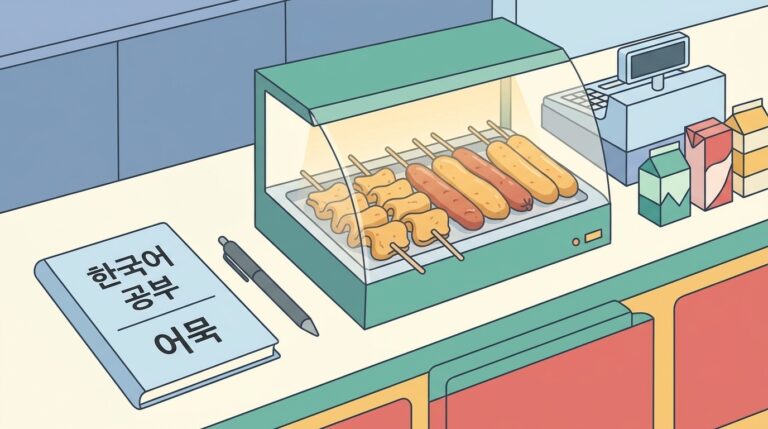
Imagine this: It is 11:00 PM in Seoul. You’ve been exploring Hongdae or walking along the Han River all evening. Your stomach starts rumbling, so you step into a cozy, brightly lit Korean convenience store (편의점). As you walk past the aisles, a warm, savory aroma catches your attention. Inside a clear glass display warmer near the register, row after row of golden-brown fish cake skewers—known as 핫바 (Hotbar)—are waiting for you. Cheese-stuffed, spicy pepper, wrapped in bacon… they all look delicious!
However, panic strikes. Do you just hand it to the clerk? Do you need to microwave it yourself? What if they ask you a question in fast Korean, and you freeze?
Don’t worry! Every foreign visitor faces this exact moment of hesitation. Ordering a simple hotbar is actually your ultimate doorway to mastering real-life Korean. Based on feedback from hundreds of beginner learners, mastering just three simple phrases will boost your confidence instantly. Let’s make sure you get your delicious late-night snack smoothly without any stress!
Phase 2: Core Expressions Deep Dive
1. 이거 데워 주세요. (Igeo deowo juseyo.)
- Pronunciation: [ee-geo deh-wo joo-seh-yo] (Sounds like “Ego, day-war, do-say-yo!”)
- Meaning: “Please heat this up for me.”
- K-Culture Moment: Seen in almost every K-Drama slice-of-life scene where characters buy warm snacks late at night.
- Editor’s Insight: While many convenience stores expect you to use the self-service microwave, clerks will gladly heat it up for you if you ask politely using this phrase!
- Situation Spectrum: Casual ⚠️ | Semi-formal ✅ | Formal ✅
- 🤔 Think About It: In English, we often say “Can you microwave this?” In Korean, focusing on the result “Make it warm (데워)” with “주세요 (please give/do)” sounds much more natural.
2. 핫바 하나 주세요. (Hatba hana juseyo.)
- Pronunciation: [haat-baa ha-na joo-seh-yo] (Rhymes with “Hot bar, Ha-na, do-say-yo”)
- Meaning: “One hotbar skewer, please.”
- K-Culture Moment: When ordering directly from the heated display counter next to the cash register.
- Editor’s Insight: “하나 (Hana)” means “one”. You can point directly to your favorite hotbar while saying this line.
- Situation Spectrum: Casual ⚠️ | Semi-formal ✅ | Formal ✅
- 🤔 Think About It: Notice how Korean places the item first (“핫바”), quantity second (“하나”), and verb last (“주세요”).
3. 이거 매워요? (Igeo maewoyo?)
- Pronunciation: [ee-geo mae-wo-yo?] (Sounds like “Ego, may-war-yo?”)
- Meaning: “Is this spicy?”
- K-Culture Moment: Asking the clerk before accidentally biting into a fiery Cheongyang pepper hotbar!
- Editor’s Insight: Many hotbars contain hidden green peppers or spicy seasonings. Asking this saves your tastebuds.
- Situation Spectrum: Casual ⚠️ | Semi-formal ✅ | Formal ✅
- 🤔 Think About It: Adding “요 (yo)” at the end instantly converts an informal word into a polite, respectful question suitable for any store employee.
Phase 3: Textbook Korean vs. Real Korean
Situation 1: Asking to heat up your snack
- 📖 Textbook: 이것을 전자레인지에 데워 주시겠습니까? (Igeoseul jeonjareinjie deowo jusigessneumnika?)
- 🗣️ Real Korean: 이거 데워 주세요~ (Igeo deowo juseyo~)
- 💡 Why the difference? Textbook phrasing is overly formal and stiff for a quick convenience store transaction. Real Koreans keep it short and friendly with “이거 데워 주세요”.
Situation 2: Asking about spice levels
- 📖 Textbook: 이것은 매운 맛입니까? (Igeoseun maeun masimnika?)
- 🗣️ Real Korean: 이거 많이 매워요? (Igeo mani maewoyo?)
- 💡 Why the difference? Locals use “많이 (mani – very/a lot)” to check if the spice level is intense or mild.
Phase 4: K-Culture Deep Dive & Non-verbal Manners
4-1. Nunchi (눈치) & Gestures
- The Two-Handed Hold: When handing your hotbar or credit card to the clerk, hold it with both hands or support your right wrist with your left hand. This subtle gesture shows polite respect.
- The Microwave Point: If you are unsure whether to heat it yourself, look around the register. If you see a row of microwaves nearby, point gently toward them and ask, “여기서 데워요?” (Do I heat it here?).
4-2. Culture Code: Convenience Store Gastronomy
In Korea, convenience stores (CU, GS25, Seven-Eleven) are not just quick stops—they are social culinary hubs! Hotbars are compressed fish cakes skewer snacks loaded with mozzarella cheese, sausage, or seafood paste. A classic local combo is placing a cheesy hotbar directly into a cup of spicy Shin Ramyun or Buldak Bokkeum Myeon!
Phase 5: Real Roleplay Scenario
Setting: Late night at a GS25 in Myeongdong.
Characters: You (Hungry Traveler) & Clerk (Friendly Convenience Store Worker).
- Turn 1 (You): 안녕하세요! (An-nyeong-ha-se-yo!) 🎭 [Smile and approach counter] – Hello!
- Turn 2 (Clerk): 안녕하세요! 찾으시는 것 있으세요? (An-nyeong-ha-se-yo! Cha-jeu-si-neun geot is-seu-se-yo?) 🎭 [Friendly nod] – Hello! Looking for anything?
- Turn 3 (You): 저기… 핫바 하나 주세요. (Jeo-gi… hat-ba ha-na ju-se-yo.) 🎭 [Point to cheese hotbar] – Excuse me… One hotbar, please.
- Turn 4 (Clerk): 치즈 핫바 맞으세요? (Chi-jeuh hat-ba ma-jeu-se-yo?) 🎭 [Picks up tongs] – The cheese hotbar, right?
- Turn 5 (You): 네! 이거 많이 매워요? (Ne! I-geo ma-ni mae-wo-yo?) 🎭 [Curious eye expression] – Yes! Is this very spicy?
- Turn 6 (Clerk): 아니요, 안 매워요! 데워 드릴까요? (A-ni-yo, an mae-wo-yo! De-wo deu-ril-kka-yo?) 🎭 [Shakes head gently] – No, it’s not spicy! Shall I heat it up for you?
- Turn 7 (You): 네, 이거 데워 주세요. 감사합니다! (Ne, i-geo de-wo ju-se-yo. Gam-sa-ham-ni-da!) 🎭 [Hands card with two hands] – Yes, please heat it up. Thank you!
- Turn 8 (Clerk): 따뜻하게 해드렸습니다. 맛있게 드세요! (Tta-tteut-ha-ge hae-dyeo-ryeot-seum-ni-da. Mas-it-ge deu-se-yo!) 🎭 [Bows slightly] – Here it is nice and warm. Enjoy your meal!
🔀 Interactive Choice Point
The clerk asks: “전자레인지 30초 데워드릴까요?” (Shall I microwave it for 30 seconds?)
- Option A: “네, 데워 주세요!” (Ne, deowo juseyo!)
- 👉 Feedback (BEST): Perfect! You confirmed politely, and you’ll get a piping hot snack.
- Option B: “아니요, 괜찮아요.” (Aniyo, gwaenchana-yo.)
- 👉 Feedback (RISK): You declined heating, so you’ll be eating a cold fish cake bar on a cold winter night!
- Option C: “몰라요.” (Mollayo.)
- 👉 Feedback (BAD): Saying “I don’t know” bluntly can sound rude to service staff.
Phase 6: 10-Second Emotion Shadowing Drill
[😊 Politeness & Excitement]
이거 / 데워 / 주세요!
(I-geo / de-wo / ju-se-yo!)-
[🤔 Curious & Cautious]
이거 / 많이 / 매워요?
(I-geo / ma-ni / mae-wo-yo?) -
[😋 Hungry & Eager]
핫바 / 하나 / 주세요!
(Hat-ba / ha-na / ju-se-yo!)
Phase 7: K-Culture Mini Dictionary
- 핫바 (Hatba): Steamed and fried fish cake skewer sold hot at convenience stores.
- 전자레인지 (Jeonjareinji): Microwave oven. Essential term for heat-and-eat convenience foods.
- 2+1 (I-plus-won): Korean promo deal meaning “Buy 2, Get 1 Free”. Extremely common for hotbars!
- 어묵 (Eomuk): Korean traditional fish cake paste, the main ingredient of hotbars.
Phase 8: Traveler’s Survival Kit
Top 3 Survival Phrases
- 봉투 필요하세요? (Bongtu pil-yo-ha-se-yo?) – Do you need a plastic bag?
- 영수증 버려주세요. (Yeongsujeung beoryeojuseyo.) – Please throw away my receipt.
- 계산해 주세요. (Gyesanhae juseyo.) – Please check me out / calculate total.
Editor’s Travel Note
Always keep a local map app ready on your phone when looking for late-night food spots. We recommend you Download Naver Map App for real-time convenience store locations. Most stores accept international contactless credit cards and T-Money transit cards!
Phase 9: One Step Deeper
In Korea, even quick interactions at a late-night convenience store reflect societal values of mutual respect and efficiency. Using respectful endings like “-요 (-yo)” shows warmth toward service workers who keep the city safe and well-fed at all hours.
💬 Your Turn: What is your favorite midnight snack when traveling abroad? Have you ever tried a Korean hotbar before? Share your story in the comments below!
Phase 10: FAQ & Common Mistakes
Q: How long should I heat my hotbar in the microwave?
A: Usually 20 to 30 seconds is perfect. Be careful not to heat it too long or the cheese inside will explode!
Q: Do I need to tear open the packaging before microwaving?
A: Yes! Always notch or slightly open the top corner of the hotbar plastic wrapper so steam can escape safely.
Q: Can I pay with my T-Money transport card for hotbars?
A: Absolutely! All major convenience stores in Korea accept T-Money cards for payment.
🚨 Common Mistakes Warning
- ❌ Mistake 1: Handing money or card with one finger/hand carelessly.
- 👉 Correct Action: Use both hands when exchanging payments.
- ❌ Mistake 2: Putting unopened plastic hotbar packaging directly into the microwave.
- 👉 Correct Action: Tear open the top corner slightly first.
- ❌ Mistake 3: Saying “너 데워” (Informal mode).
- 👉 Correct Action: Always add polite suffix: “데워 주세요“.
Phase 11: Action Mission
- 🥉 Bronze: Practice saying “이거 데워 주세요” out loud 3 times in front of a mirror.
- 🥈 Silver: Snap a picture of your favorite snack and post it on social media with the hashtag #DailyHangulSnack.
- 🥇 Gold: Visit a Korean mart or store, order a hotbar in Korean, and successfully get it heated up!
🎮 K-Culture Mission: Watch a modern K-drama episode and spot a scene taking place inside a convenience store. Did they eat a hotbar or ramen?
Phase 12: Interactive Quiz Challenge
Question 1: How do you politely ask a store clerk to heat up your hotbar?
- A) 이거 드세요.
- B) 이거 데워 주세요.
- C) 이거 버려 주세요.
🔍 Click to view Answer & Explanation
Answer: B) 이거 데워 주세요. (Please heat this up for me.)
Explanation: Option A means “Please eat this,” and Option C means “Please throw this away.”
Question 2: Fill in the blank: “핫바 ___ 주세요” (One hotbar, please.)
- A) 하나 (Hana)
- B) 둘 (Dul)
- C) 셋 (Set)
🔍 Click to view Answer & Explanation
Answer: A) 하나 (Hana)
Explanation: “하나” means 1 in native Korean numbers.
Question 3 (True/False): It is considered rude to hand your credit card to the convenience store clerk using both hands.
🔍 Click to view Answer & Explanation
Answer: False!
Explanation: Using both hands is a sign of respect and good manners in Korean culture.







