

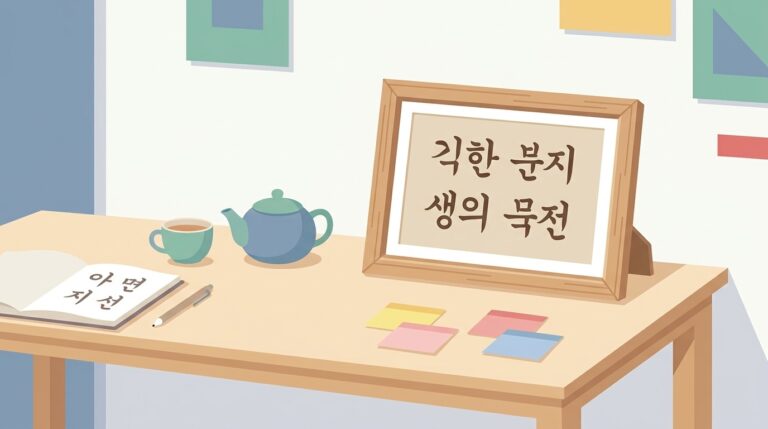
Find Your Ultimate Korean Life Motto: 3 Four-Character Idioms to Inspire Your Journey
Phase 1: 공감 (Empathetic Opening)
안녕하세요! 매일한글 에디터입니다.
Have you ever been asked in a Korean interview, or even during a relaxed catch-up with Korean friends, “좌우명이 뭐예요?” (What is your life motto?). Many Korean learners freeze at this moment! You might know simple Korean sentences, but expressing your core values, your personal philosophy, or your grit in polished Korean feels like a whole different mountain to climb.
Picture this: You are sitting in a cozy café in Ikseon-dong, Seoul. Your Korean friend shows you a sleek customized phone case and asks what inspiring Korean phrase they should engrave on it. You want to suggest something timeless and elegant—not just textbook prose like “Work hard and don’t give up.” This is where 사자성어 (Four-Character Idioms) come into play!
In Korean culture, four-character idioms (derived from Hanja) carry centuries of wisdom, emotional depth, and instant sophistication. When you use a well-chosen 사자성어 as your motto, native speakers won’t just understand you—they will deeply respect your commitment to learning the soul of the language. Today, based on feedback from hundreds of intermediate (B2) learners, we have curated three incredible life mottos that will transform how you express your inner drive. Let’s dive in!
Phase 2: 핵심 표현 3선 심층 분석 (3 Core Expressions)
1. 대기만성 (大器晚成)
- Pronunciation: Dae-gi-man-seong (Sounds like: Dae-gee-mahn-sung)
- Meaning: Literally “A great vessel takes a long time to complete.” Nuance: Great talents mature late; true success requires time, patience, and persistent effort.
- K-Culture Moment: Frequently mentioned by late-blooming K-Drama actors or K-Pop idols who endured years of grueling trainee life before achieving legendary success.
- Editor’s Insight: Use this when you feel frustrated with slow progress. It reassures the listener that you are not slow, but rather building something truly great.
- Situation Spectrum: Casual ✅ / Semi-formal ✅ / Formal ✅
- 🤔 Think About It: Does your native culture favor fast success or slow, steady mastery?
2. 초심불망 (初心不忘)
- Pronunciation: Cho-sim-bul-mang (Sounds like: Cho-seem-bool-mahng)
- Meaning: Literally “Do not forget your initial intention.” Nuance: Always remain humble and retain the original passion you had when starting out.
- K-Culture Moment: Veterans on Korean variety shows often remind younger artists to keep their “초심” when fame starts to take over.
- Editor’s Insight: While you can say “초심을 잃지 말자” in everyday speech, using the idiom “초심불망” in speeches or written bios adds a refined, poetic flair.
- Situation Spectrum: Casual ✅ / Semi-formal ✅ / Formal ✅
- 🤔 Think About It: Why do you think staying true to one’s beginner mindset is considered the ultimate ethical virtue in Korean professional life?
3. 우공이산 (愚公移山)
- Pronunciation: U-gong-i-san (Sounds like: Oo-gong-ee-sahn)
- Meaning: Literally “The foolish old man moves the mountain.” Nuance: No task is impossible if you work persistently step by step.
- K-Culture Moment: Used in sports commentary or career dramas when an underdog team achieves a miracle against unbelievable odds.
- Editor’s Insight: It highlights resilience (끈기). It shows that what others mock as “foolish slow effort” is actually the secret to legendary feats.
- Situation Spectrum: Casual ⚠️ / Semi-formal ✅ / Formal ✅
- 🤔 Think About It: How do you balance strategic efficiency with sheer grit in your own journey?
Phase 3: 교과서 한국어 vs 진짜 한국어 (Textbook vs. Real Korean)
Situation 1: Expressing determination through tough times
- 📖 교과서 한국어: 포기하지 않고 열심히 노력하면 성공할 것입니다. (If you work hard without giving up, you will succeed.)
- 🗣️ 진짜 한국어: 중요한 건 꺾이지 않는 마음! (중꺾마!) / 존버는 승리한다!
- 💡 왜 다를까?: While the textbook sentence is grammatically flawless, modern Koreans use trendy catchphrases like 중꺾마 (An unyielding heart is what matters) or casual slang like 존버 (extreme perseverance) in informal settings to express authentic grit.
Situation 2: Encouraging someone who feels lagging behind
- 📖 교과서 한국어: 천천히 하셔도 됩니다. 언젠가는 다 될 것입니다. (You may take it slowly. Someday it will all be done.)
- 🗣️ 진짜 한국어: 대기만성이잖아요. 서두르지 말고 페이스 유지해요.
- 💡 왜 다를까?: Native Koreans love using 사자성어 like 대기만성 because it conveys warm encouragement with high cultural literacy rather than generic comforting words.
Phase 4: K-Culture 딥다이브 & 비언어적 매너 (Culture & Manners)
4-1. 눈치 (Nunchi) & Gestures
When sharing your life motto with Korean colleagues or friends:
* Eye Contact & Posture: Stand or sit upright, maintain warm eye contact, and give a gentle single head nod. This demonstrates emotional stability and sincerity.
* Fist Clench (파이팅 Gesture): If appropriate in informal settings, holding a lightly clenched fist near your chest while stating your motto adds enthusiasm!
4-2. Cultural Code: The Calligraphy & Desk Post-It Spirit
In Korea, mottos aren’t just thoughts—they are visible art! Walk into a Korean office or home, and you will often see customized wooden calligraphy frames (서예 액자) hanging on the wall. Among younger generations, sticky notes with idioms are slapped onto dual-monitor screens. K-Pop artists frequently state their 사자성어 motto in debut profile forms. Having a ready 사자성어 shows you are thoughtful, goal-oriented, and culturally grounded.
Phase 5: 실전 롤플레이 시나리오 (Practical Roleplay)
Scenario: You are sitting at a cozy studio in Seongsu-dong with your Korean friend Minjun (민준), who is customizing a leather diary cover.
- 민준: 이번에 다이어리 커버에 문구를 각인하려고 하는데, 좋은 좌우명 없을까?
- (Minjun: I’m planning to engrave a sentence on my diary cover. Do you have any good life motto suggestions?)
- 나: 사자성어로 해보는 건 어때? 훨씬 멋지잖아!
- (🎭 Gesture: Smiling enthusiastically and gesturing toward the sample fonts)
- (Me: How about using a four-character idiom? It looks way cooler!)
- 민준: 오, 사자성어? 좋은 생각이다! 넌 어떤 사자성어 좋아해?
- (Minjun: Oh, a four-character idiom? Great idea! What idiom do you like?)
- 나: 나는 ‘대기만성’이라는 말을 항상 마음에 품고 살아.
- (🎭 Gesture: Placing a hand over the heart firmly)
- (Me: I always keep the phrase ‘Daegimanseong’ in my heart.)
- 민준: 대기만성! 둔재가 노력을 통해서 대성한다는 뜻이지? 너다운 선택이다.
- (Minjun: Daegimanseong! Meaning great talents take time to mature, right? That choice is so like you.)
- 나: 맞아. 서두르지 않고 매일 조금씩 쌓아가면 결국 이뤄낸다고 믿거든.
- (Me: Exactly. I believe if I don’t rush and build little by little every day, I will eventually achieve it.)
- 민준: 너랑 얘기하니까 나도 동기부여가 된다! 나는 ‘초심불망’으로 새겨야겠어.
- (Minjun: Talking to you really motivates me! I should engrave ‘Chosim-bulmang’ then.)
- 나: 탁월한 선택이야! 우리 둘 다 처음 그 마음대로 끝까지 가보자!
- (🎭 Gesture: Raising a fist for a light high-five or fist bump)
- (Me: Excellent choice! Let me and you keep that original mindset and go all the way!)
🔀 Interactive Choice Point
How would you respond if Minjun asks: “너는 공부하다가 힘들 때 어떻게 마인드컨트롤 해?” (How do you control your mindset when studying gets hard?)
- Choice A: “그냥 다 포기하고 맛있는 거 먹으러 가요!” (I just give up everything and go eat delicious food!)
- 🚫 Bad: Kills the motivational mood and misses the opportunity to practice idioms.
- Choice B: “‘우공이산’을 떠올려요. 하루에 단어 5개라도 꾸준히 외우면 산을 옮길 수 있으니까요.” (I remind myself of ‘Ugong-isan’. Because even if I memorize 5 words a day steadily, I can move mountains.)
- ✅ Best: Perfect B2-level grammar, elegant use of idiom context, inspiring tone!
- Choice C: “한국어 공부 너무 어려워서 그냥 번역기 앱만 쓸까 생각 중이에요.” (Korean study is so hard I’m just thinking of using a translator app.)
- ⚠️ Risk: A bit dismissive of your own learning journey, though honest.
Phase 6: 10초 감정 섀도잉 드릴 (10-Second Emotion Shadowing)
Practice pronouncing these with emotional conviction. The / marks natural pauses!
[😊 확신에 찬 목소리로]서두르지 않아도 괜찮아 / 대기만성이잖아!- (Seo-du-reu-ji a-na-do gwaen-chan-a / dae-gi-man-seong-i-ja-na!)
[🔥 결의에 찬 목소리로]어떤 어려움이 있어도 / 초심불망! / 처음 마음을 잊지 않을 거야.- (Eot-teon eo-ryeo-um-i is-seo-do / cho-sim-bul-mang! / Cheo-eum ma-eum-eul it-ji an-eul geo-ya.)
[💪 당당하고 유쾌하게]작은 노력이 모이면 / 우공이산처럼 / 큰 일을 해낼 수 있어!- (Ja-geun no-ryeok-i mo-i-myeon / u-gong-i-san-cheo-reom / keun il-eul hae-nael su is-seo!)
Phase 7: K-Culture 미니 사전 (4 Key Keywords)
- 좌우명 (Jwa-u-myeong) | Life Motto
- Literally “words placed on one’s right side.” Used in job applications, personal intros, and social bios.
- 사자성어 (Sa-ja-seong-eo) | Four-Character Idiom
- Idioms derived from classical stories. Essential tool for intermediate-to-advanced Korean expressive power.
- 존버 (Jon-beo) | Extreme Perseverance (Slang)
- A vulgar yet wildly popular modern slang meaning holding on through tough situations with relentless tenacity.
- 마인드컨트롤 (Mind Control) | Emotional Regulation / Mental Toughness
- Korean Konglish referring to keeping one’s composure and stay mentally strong under stress.
Phase 8: 여행자를 위한 생존 키트 (Travel Survival Kit)
Survival Expressions TOP 3
- “제 좌우명은 대기만성이에요.” (My life motto is Daegimanseong.)
- “좌우명이 어떻게 되세요?” (What is your life motto?)
- “초심을 잃지 않으려고 노력해요.” (I try hard not to lose my initial mindset.)
Editor’s Travel Note
When traveling in Seoul, visit traditional calligraphy cafés in Insadong to watch artists write these idioms live. To navigate effortlessly through local transit and find hidden tea houses, complete your Naver Map app download guide before landing in Korea—it works far better than Google Maps locally!
Phase 9: 한 발 더 깊이 (Cultural Insights)
In Korean culture, resilience is deeply rooted in the concept of 은근과 끈기 (subtle patience and unyielding grit). Historically, Korean society has faced countless hardships, shaping a collective mindset that honors those who quietly endure and triumph over long periods rather than those who seek quick, fleeting gains. Expressing your life motto through a classical 사자성어 shows that you understand this historic value of endurance. It bridges your personal narrative with the collective spirit of Korea.
💬 Your Turn: What is your personal life motto in your native language, and which Korean idiom best matches it? Leave your thoughts in the comments below!
Phase 10: FAQ & 오해 방지 (FAQ Schema & Common Mistakes)
Q: Is using 사자성어 in daily conversation considered too old-fashioned?
A: Not at all! While overusing obscure Hanja idioms can sound overly academic, using famous life-motto idioms like 대기만성 or 초심불망 makes you sound articulate, polite, and sophisticated.
Q: Can I put a 사자성어 on my Korean resume (이력서)?
A: Yes! In fact, HR managers in Korea love seeing candidates articulate their work ethic through well-chosen mottos during personal statement sections.
Q: What is the difference between 속담 (Proverb) and 사자성어 (Idiom)?
A: 속담 is usually a complete sentence rooted in everyday folk wisdom (e.g., “가랑비에 옷 젖는 줄 모른다”), whereas 사자성어 is strictly a four-character combination rooted in classical literature.
🚨 Common Mistakes Warning Board
- Mistake: Using casual slang like “존버” in formal interviews.
- Correct Action: Use “우공이산의 마음가짐으로…” instead in official contexts.
- Mistake: Mispronouncing Hanyu/Romanized letters naturally.
- Correct Action: Break down each character evenly: Dae / Gi / Man / Seong.
- Mistake: Mixing up similar sounding words like 초심 (first heart) and 소심 (timid).
- Correct Action: Ensure you say Cho-sim clearly!
Phase 11: 액션 미션 & 참여 유도 (Action Missions)
- 🥉 Bronze Mission: Read the 3 core expressions aloud 3 times using Phase 6’s emotional shadowing guide.
- 🥈 Silver Mission: Write down your favorite Korean motto on a sticky note and stick it on your study desk.
- 🥇 Gold Mission: Comment below using the sentence pattern: “제 좌우명은 [사자성어]이에요. 왜냐하면…”
- 🎮 K-Culture Mission: Watch a Korean interview video of your favorite actor or idol and catch if they mention their “좌우명”!
Phase 12: 인터랙티브 퀴즈 챌린지 (Interactive Quiz)
Q1. 상황 판단 퀴즈: A friend is feeling depressed because their Korean skill is improving slowly. Which expression is most encouraging?
1. 초심불망
2. 대기만성
3. 이열치열
🔍 정답 및 해설 보기
정답: 2번 (대기만성)
해설: 대기만성 means great vessels take time to complete. It is the perfect phrase to comfort someone making slow but steady progress!
Q2. 빈칸 채우기: 처음 가졌던 마음에 변함이 없다는 뜻의 사자성어는 ‘초심___’입니다.
1. 불망
2. 유수
3. 만성
🔍 정답 및 해설 보기
정답: 1번 (불망)
해설: ‘초심불망(初心不忘)’은 처음에 가졌던 원래의 순수한 마음을 잊지 않는다는 뜻입니다.
Q3. O/X 문화 퀴즈: 한국에서는 취업 면접이나 자기소개서에서 사자성어를 좌우명으로 사용하는 것을 긍정적으로 평가한다. (O / X)
🔍 정답 및 해설 보기
정답: O
해설: 적절한 사자성어 사용은 깊이 있는 소양과 신중한 태도를 보여주어 매우 좋은 인상을 줍니다!







