

Phase 1: Empathy (스토리 몰입형 오프닝)
안녕하세요! 매일한글 에디터입니다.
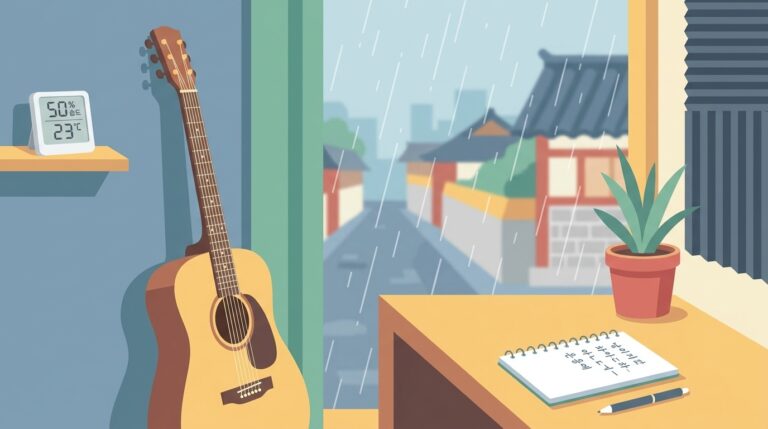
Imagine this: You have just brought your prized acoustic guitar or wooden traditional instrument to Seoul. You spent months practicing, looking forward to jamming at a cozy studio in Hongdae or sharing acoustic covers online. But suddenly, as Seoul’s notorious mid-summer Jangma (monsoon season) rolls in with humidity spiking past 85%, your instrument begins to sound eerily dull. The action feels uncomfortable, the wood feels swollen, or worse, dry winter air causes the fret edges to pop out.
Many music enthusiasts and advanced Korean learners hit a wall when trying to communicate these nuanced physical changes in an instrument. You enter Nakwon Music Mall (낙원상가), surrounded by seasoned luthiers who have repaired guitars for forty years, but dictionary terms like “습도” (humidity) barely scratch the surface of explaining that your instrument’s top board has swollen or that the sound has become muffled.
In this guide, curated from real feedback from foreign musicians navigating Korea’s dramatic four-season climate, we will unlock C1-level native expressions for instrument maintenance and humidity control. Master these phrases, and you won’t just protect your beloved instrument—you will earn instant respect from local luthiers and fellow musicians!
Phase 2: 핵심 표현 3선 심층 분석
1. 습기를 머금다
- Pronunciation: [Seup-gi-reul meo-geum-da] (Pronounced like seup-gee-reul muh-geum-dah, echoing the soft sound of a sponge soaking up water)
- Meaning: Literal: To hold/contain moisture. | Nuance: Used when organic materials (wood, leather, paper) absorb humidity deeply, causing structural swelling or tonal dampening.
- K-Culture Moment: Indie acoustic artists on YouTube frequently mention this when their guitars act up during the Korean summer: “기타가 습기를 머금어서 소리가 먹먹해졌어요.”
- Editor’s Insight: While “습기를 흡수하다” (absorb moisture) sounds like a technical science textbook, “머금다” evokes a poetic yet precise imagery of wood physically holding onto humidity like mouth-watering moisture.
- Situation Spectrum: Casual ✅ | Semi-formal ✅ | Formal ✅
- 🤔 Think About It: How does your native language poetically describe wood altering under weather conditions compared to Korean’s emotive verbs?
2. 제습제를 비치하다
- Pronunciation: [Je-seup-je-reul bi-chi-ha-da] (Pronounced jeh-seup-jeh-reul bee-chee-hah-dah)
- Meaning: Literal: To set up/place dehumidifying agents. | Nuance: A proactive, sophisticated way to state that you have arranged silica gels or desiccant packs inside an instrument case or room.
- K-Culture Moment: Professional classical musicians sharing room-setup tours online will advise: “케이스 안에 반드시 제습제를 비치해 두세요.”
- Editor’s Insight: Everyday speakers use “넣다” (put in), but C1 speakers and shop technicians use “비치하다” (furnish/place systematically) to indicate intentional, long-term care.
- Situation Spectrum: Casual ⚠️ | Semi-formal ✅ | Formal ✅
- 🤔 Think About It: In Korean culture, taking preventive care of belongings reflects high self-discipline (정성). How does formal vocabulary elevate your perceived expertise?
3. 소리가 먹먹해지다
- Pronunciation: [So-ri-ga meong-meong-hae-ji-da] (Pronounced so-ree-gah meong-meong-hae-jee-dah)
- Meaning: Literal: For the sound to become clogged/stuffy. | Nuance: Auditory descriptive imagery describing sound losing its crisp clarity due to excess humidity in wood or acoustics.
- K-Culture Moment: Sound engineers and band members discussing studio acoustics: “오늘 습해서 그런지 기타 소리가 좀 먹먹하네요.”
- Editor’s Insight: “먹먹하다” originally describes ears popping on an airplane or an overwhelming silent emotion, but applied to music, it perfectly mirrors the damp, muffled resonance of swollen tone-wood.
- Situation Spectrum: Casual ✅ | Semi-formal ✅ | Formal ⚠️
- 🤔 Think About It: Korean heavily relies on sensory mimetic words (의태어/의성어). What sensory words exist in your language for dull acoustics?
Phase 3: 교과서 한국어 vs 진짜 한국어
Situation 1: Explaining summer humidity damage to a guitar technician
- 📖 교과서 한국어: 습도가 너무 높아 기타 목재가 변형되었습니다. (The humidity is too high, so the guitar wood became deformed.)
- 🗣️ 진짜 한국어: 장마철이라 기타가 습기를 많이 머금어서 넥이 휜 것 같아요. (It’s monsoon season, so the guitar seems to have soaked up moisture and warped the neck.)
- 💡 왜 다를까?: Real speakers connect the season (장마철) and specific physical reaction (머금다, 넥이 휘다) rather than using dry dictionary words like 변형.
Situation 2: Asking for moisture control products at Nakwon Mall
- 📖 교과서 한국어: 습도 조절을 위한 상품을 주세요. (Please give me a product for humidity control.)
- 🗣️ 진짜 한국어: 케이스 안에 넣어둘 습도 조절 패크나 제습제 있을까요? (Do you have humidity control packs or desiccants I can keep inside the case?)
- 💡 왜 다를까?: Native speakers name the exact storage context (케이스 안에 넣어둘) and precise product names (제습제, 습도 조절 팩) to get tailored recommendations.
Phase 4: K-Culture 딥다이브 & 비언어적 매너
4-1. 눈치(Nunchi) & Gestures in Nakwon Music Market
When visiting traditional repair centers in Jongno, Seoul, politeness combined with technical knowledge yields the best service:
* Two-Handed Handling: When handing your instrument over to a luthier, support the neck with your right hand and body with your left, bowing slightly.
* Sightline & Listening Nunchi: As the master plucks the strings to check resonance, remain quiet and nod slowly. Demonstrating that you can hear the “먹먹함” (muffled sound) builds immediate rapport.
4-2. Cultural Code: The Four Seasons & Indie Music Scene
Korea’s extreme humidity fluctuation—from under 20% in freezing dry winters to over 90% in July monsoons—makes instrument care a hot topic among Hongdae indie bands and traditional Gugak (국악) musicians alike. Caring for a wooden instrument is seen as an extension of one’s personal identity as an artist. Passing season-change care tips is a standard conversation starter among music lovers in Korea.
Phase 5: 실전 롤플레이 시나리오
Setting: A historic guitar repair workshop inside Nakwon Instrument Mall (낙원상가).
Characters: You (C1 Korean Learner / Guitarist) & Master Kim (60s, Veteran Luthier).
- You: 안녕하세요, 사장님! 여름철이라 그런지 기타 소리가 너무 먹먹해져서 가져왔어요.
(An-nyeong-ha-se-yo, sa-jang-nim! Yeo-reum-cheol-i-ra geu-ron-ji gi-ta so-ri-ga neo-mu meong-meong-hae-jyeo-seo ga-jeo-waat-seo-yo.)
“Hello, Master! It might be because of summer, but my guitar sound has become so muffled, so I brought it in.”
🎭 Hands instrument carefully with both hands -
Master Kim: 어디 봅시다… 에구, 상판이 좀 부풀어 올랐네. 케이스 관리는 어떻게 하셨어요?
(Eo-di bop-si-da… e-gu, sang-pan-i jom bu-pul-eo ol-rat-ne. Ke-i-seu gwan-ri-neun eo-tteoh-ge ha-syeot-seo-yo?)
“Let’s see… Oh dear, the soundboard has swollen a bit. How have you been managing it in its case?”
🎭 Taps the guitar soundboard gently -
You: 룸 디후미디파이어만 돌리고 케이스 안에 제습제는 따로 비치해 두지 못했어요.
(Rum di-hu-mi-di-pa-i-eo-man dol-ri-go ke-i-seu an-e je-seup-je-neun tta-ro bi-chi-hae du-ji mot-hae-sso-yo.)
“I only ran a room dehumidifier and couldn’t separately place dehumidifiers inside the case.”
🎭 Scratches head apologetically -
Master Kim: 장마철에는 방 습도만 맞춰서 안 돼요. 나무가 습기를 머금으면 줄 높이도 올라가거든.
(Jang-ma-cheol-e-neun bang seup-do-man mat-chwo-seo an ddae-yo. Na-mu-ga seup-gi-reul meo-geum-eu-myeon jul nop-i-do ol-ra-ga-geod-eun.)
“During monsoon season, room humidity control isn’t enough. When wood absorbs moisture, string action goes up too.”
🎭 Measures string height with a ruler -
You: 아, 어쩐지 요즘 지판 누를 때 손가락이 많이 아프더라고요. 넥 조절도 필요한가요?
(A, eo-jjeon-ji yo-jeum ji-pan nu-reul ttae son-ga-rag-i ma-ni a-peu-deo-ra-go-yo. Nek jo-jeol-do pil-yo-han-ga-yo?)
“Ah, no wonder my fingers hurt so much pressing the fretboard lately. Does the neck need adjustment too?”
🎭 Demonstrates pressing frets -
Master Kim: 셋업 다시 잡고, 하드케이스용 댐핏이랑 제습지 챙겨줄 테니까 당분간 관리 잘 해봐요.
(Set-eop da-si jap-go, ha-deu-ke-i-seu-yong daem-pit-i-rang je-seup-ji chaeng-gyeo-jul te-ni-kka dang-bun-gan gwan-ri jal hae-bwa-yo.)
“I’ll set it up again and get you dampits and case desiccants, so take good care of it for a while.”
🎭 Begins loosening string tension -
You: 정말 감사합니다! 적정 습도는 45%에서 55% 사이로 유지하면 될까요?
(Jeong-mal gam-sa-ham-ni-da! Jeok-jeong seup-do-neun sa-sip-o-pro-e-seo o-sip-o-pro sa-i-ro yu-ji-ha-myeon doel-kka-yo?)
“Thank you so much! Should I keep the target humidity between 45% and 55%?”
🎭 Takes note on smartphone -
Master Kim: 그렇지! 아주 잘 아네. 그렇게만 해주면 소리 금방 되돌아올 거야.
(Geu-reot-ji! A-ju jal a-ne. Geu-reh-ge-man hae-ju-myeon so-ri geum-bang doe-dol-a-ol geo-ya.)
“Exactly! You know your stuff. Do that, and the tone will come right back.”
🎭 Gives a warm, approving smile
🔀 Interactive Branching Decision
The luthier asks if you want to leave the guitar for 3 days or take a temporary quick fix.
* Option A: “시간 걸려도 좋으니 정석대로 완전하게 셋업 잡아주세요.” (Take all the time needed, please set it up properly.)
* Feedback (Best): Shows deep respect for craftsmanship. The luthier will take extra care.
* Option B: “오늘 당장 공연이 있어서 줄 높이만 대충 낮춰주세요.” (I have a gig today, just quickly lower the string height.)
* Feedback (Risk): Emergency solution. Lowering height on wet wood might cause buzzing when it dries out later.
* Option C: “그냥 제가 집에서 드라이기로 말려볼게요.” (I’ll just dry it with a hair dryer at home.)
* Feedback (Bad): High risk! Rapid heating cracks tone-wood severely. The luthier will be horrified.
Phase 6: 10초 감정 섀도잉 드릴
[🥺 Worried & Asking for Help]
장마철이라 그런지 / 기타가 습기를 많이 머금어서 / 소리가 너무 먹먹해요.
(Jang-ma-cheol-i-ra geu-ron-ji / gi-ta-ga seup-gi-reul ma-ni meo-geum-eo-seo / so-ri-ga neo-mu meong-meong-hae-yo.)-
[😊 Relieved & Polite]
제습제를 비치해 두고 / 적정 습도를 유지하니까 / 소리가 다시 살아났어요!
(Je-seup-je-reul bi-chi-hae du-go / jeok-jeong seup-do-reul yu-ji-ha-ni-kka / so-ri-ga da-si sa-ra-nat-seo-yo!)
Phase 7: K-Culture 미니 사전
- 장마철 (Jangma-cheol) | Korean Monsoon Season
- Essential context: Early July to late July period with prolonged heavy rain and extreme humidity over 80-90%.
- 낙원상가 (Nakwon Sangga) | Nakwon Musical Instrument Mall
- Iconic multi-story music complex in Jongno, Seoul, housing hundreds of specialized instrument shops and luthiers.
- 하드케이스 (Hard Case) | Hard Shell Instrument Case
- Vital during seasonal transitions in Korea to isolate wooden instruments from rapid ambient humidity fluctuations.
- 통기타 (Tong-guitar) | Acoustic Guitar
- Refers specifically to hollow-body steel-string acoustic guitars, wildly popular across Korean cafe live music scenes.
Phase 8: 여행자를 위한 생존 키트
Top 3 Survival Phrases for Musicians in Korea
- “습도 조절용 제습제 있을까요?” (Do you have humidity control desiccants?)
- “넥이 좀 휜 것 같은데 셋업 봐주실 수 있나요?” (The neck seems slightly warped, could you take a look at the setup?)
- “겨울철 건조해서 크랙(균열) 안 가게 관리하는 팁이 있나요?” (Are there tips to prevent cracking due to winter dryness?)
Editor’s Travel Note
When searching for authentic luthiers or repair shops in Seoul, open your browser and utilize 네이버 지도 앱 다운로드 to search for “악기 수리점” (instrument repair shop) or “통기타 셋업” (acoustic guitar setup). Stores inside Nakwon Mall typically take cash or local bank transfers, though credit cards are widely accepted.
Phase 9: 한 발 더 깊이 (생각 질문)
In Korean culture, caring for personal items like musical instruments is viewed through the lens of 정성 (devoted care and heart). Instruments are not viewed merely as tools, but as living wooden sound-boxes that breathe the same air and experience the same harsh four seasons as their owners. Taking time to adjust humidity reflects a musician’s maturity and sensitivity to their environment.
💬 Your Turn: How does the climate in your home country affect instrument maintenance, and what unique care routines do you practice?
Phase 10: FAQ & 오해 방지 (FAQ Schema)
Q: Can I just use standard household silica gels inside my guitar case?
A: Standard shoe-box silica gels pull moisture indefinitely and can over-dry wood in winter. Native musicians recommend bidirectional humidity packs (like Boveda or Humidipak) which maintain a stable 45-55% range.
Q: What is the difference between ‘먹먹하다’ and ‘답답하다’ when describing tone?
A: While both mean stuffy, ‘먹먹하다’ is specifically auditory or sensory (muffled resonance), whereas ‘답답하다’ describes emotional frustration or air tightness in a room.
Q: Is winter or summer more dangerous for instruments in Korea?
A: Both present opposite threats! Summer humidity causes wood swelling and high action, but dry winter radiator heat causes wood shrinkage and devastating cracks (크랙).
🚨 Common Mistakes TOP 3
- Mistake: Using “물기” (liquid water drops) instead of “습기” (atmospheric moisture/humidity).
- Correct Action: Always say “기타가 습기를 머금었다” when talking about ambient moisture damage.
- Mistake: Telling a technician “기타가 부러졌어요” (My guitar broke) when it is just warped.
- Correct Action: Say “넥이 휜 것 같아요” (The neck seems warped) or “상판이 부풀었어요” (The top board swollen).
- Mistake: Asking for “습도 약” (humidity medicine).
- Correct Action: Ask for 제습제 (dehumidifier/desiccant) or 습도 조절 팩 (humidity control pack).
Phase 11: 액션 미션 & 참여 유도
- 🥉 Bronze Mission: Practice saying “습기를 머금어서 소리가 먹먹해요” out loud 3 times using the shadowing drill audio pace.
- 🥈 Silver Mission: Check your instrument room humidity today and post your Korean journal entry: “오늘 우리 집 습도는 __% 입니다. 제습제를 비치했어요.”
- 🥇 Gold Mission: Visit a local Korean instrument shop or online community and ask a question about setup using C1 terms like 셋업, 넥 조절, or 습도 관리.
🎮 K-Culture Mission: Watch a YouTube vlogging clip of a Korean indie musician doing a studio setup tour (작업실 브이로그) and spot when they mention seasonal room humidity!
Phase 12: 인터랙티브 퀴즈 챌린지
Q1. Situation Judgment: You enter Nakwon Mall in July monsoon season. Which sentence correctly describes a humid tone?
A) 기타 소리가 너무 따뜻해요.
B) 기타가 습기를 머금어서 소리가 먹먹해요.
C) 습도가 건조해서 소리가 딱딱해요.
🔍 정답 및 해설 보기 (Click to expand)
Correct Answer: B) 기타가 습기를 머금어서 소리가 먹먹해요.
Explanation: ‘습기를 머금다’ (absorb moisture) and ‘소리가 먹먹하다’ (dull/muffled sound) perfectly describe humidity overload during summer.
Q2. Fill in the Blank: “케이스 안에 ____를 비치해 두면 습도 관리에 도움이 됩니다.”
A) 제습제
B) 드라이기
C) 세제
🔍 정답 및 해설 보기 (Click to expand)
Correct Answer: A) 제습제 (Desiccant / Dehumidifying agent)
Explanation: ‘제습제’ is the precise term for moisture-absorbing packs used inside instrument cases.
Q3. True or False: In Korea, ‘장마철’ refers to the dry freezing winter period when wood cracks.
🔍 정답 및 해설 보기 (Click to expand)
Correct Answer: False!
Explanation: ‘장마철’ is the summer rainy monsoon season (July). The dry winter period is usually referred to as ‘겨울철 건조기’.







