

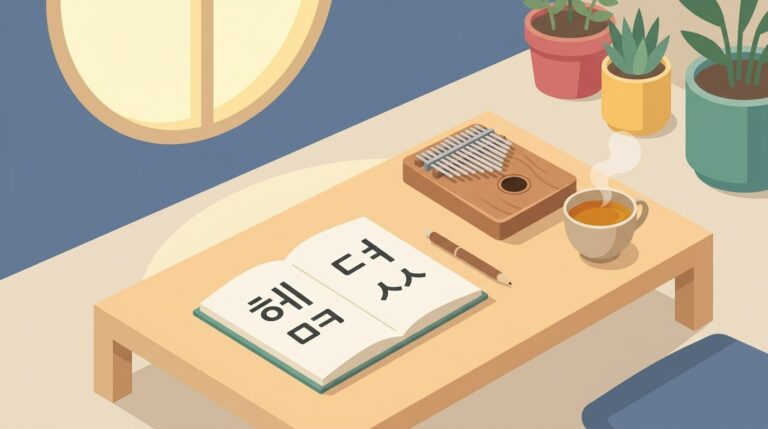
Phase 1: Empathy & Storytelling Opening
안녕하세요! 매일한글 에디터입니다. (Hello! This is your Daily Hangul editor.) Have you ever felt completely drained after a long, frantic day, searching for a quiet moment to reset your mind? In modern Korea’s fast-paced society, finding an oasis of calm has evolved from a luxury into an absolute survival skill. Enter the world of acoustic hobbies—specifically, the ethereal sound of the kalimba (손가락 피아노).
Imagine stepping into a sunlit studio in Yeonnam-dong. The gentle, metallic plucks of a kalimba vibrate through the air, instantly slowing down your racing pulse. However, expressing these deep, nuanced emotions in high-level Korean can be tricky. You might know basic words for “happy” or “quiet,” but at a C1 level, you want to articulate complex states of emotional restoration, tone color, and inner peace.
Based on real feedback from advanced learners who struggled to move past basic textbook descriptions, this guide is crafted to elevate your emotional vocabulary. By mastering these expressions, you will not only speak like a native speaker who understands the subtle art of healing (힐링), but you will also connect deeply with Korean acoustic music enthusiasts and hobbyists.
Phase 2: Deep Dive into 3 Core C1 Expressions
1. 마음을 다스리다 (Mae-um-eul da-seuseu-ri-da)
- Pronunciation: [Mae-um-eul da-seuri-da] (Sounds like clearing your throat softly: mah-eum-eul tah-seh-ree-dah)
- Meaning: Literal: To govern/rule one’s heart or mind. Actual Nuance: To regain composure, practice emotional regulation, or soothe inner turmoil through a focused activity.
- K-Culture Moment: Commonly heard in cozy vlog voiceovers or slow-tempo K-Dramas when a character sits down with a cup of tea or plays an instrument after a stressful event.
- Editor’s Insight: At the C1 level, replace simple phrases like “스트레스를 풀다” (to release stress) with “마음을 다스리다” when discussing mindful hobbies. It reflects introspection and self-care.
- Situation Spectrum: Casual ⚠️ | Semi-formal ✅ | Formal ✅
- 🤔 Think About It: Why does Korean use active verbs like “govern” (다스리다) for emotions, implying that self-care is a deliberate practice rather than a passive state?
2. 여운이 남다 (Yeo-un-i nam-da)
- Pronunciation: [Yeo-un-i nam-da] (Smooth flow: yoh-oon-ee nahm-dah)
- Meaning: Literal: An lingering after-tone remains. Actual Nuance: A deep emotional resonance, reverberation, or lasting impression left by music, a movie, or an experience.
- K-Culture Moment: Used by music critics or fans on K-Pop acoustic cover channels when a song’s final chord fades, leaving the listener in quiet awe.
- Editor’s Insight: While beginners describe music simply as “좋다” (good), C1 speakers use “여운이 남다” to convey how the sound lingers in both the room and the heart.
- Situation Spectrum: Casual ✅ | Semi-formal ✅ | Formal ✅
- 🤔 Think About It: How does the concept of lingering sound (yeoun) connect to traditional Korean aesthetics of empty space (yeobaek)?
3. 영롱하다 (Yeong-rong-ha-da)
- Pronunciation: [Yeong-rong-ha-da] (Resonant sound: young-rohng-hah-dah)
- Meaning: Literal: To be crystal clear and brilliant. Actual Nuance: Describing sound or light that is exquisitely clear, silvery, bell-like, and ethereal.
- K-Culture Moment: Frequently used in Korean instrument unboxing videos and acoustic performances to describe the bright, crystal-like timbre of a high-end kalimba or music box.
- Editor’s Insight: Use this adjective when praising tone quality. It carries an aesthetic elegance that elevates your descriptive power.
- Situation Spectrum: Casual ✅ | Semi-formal ✅ | Formal ✅
- 🤔 Think About It: Is there a single word in your native language that captures both auditory clarity and visual luminescence like “영롱하다”?
Phase 3: Textbook Korean vs. Real-World Korean
Scenario 1: Describing Emotional Calm
- 📖 Textbook Korean: 칼림바를 연주하면 기분이 좋아지고 편안해집니다. (When I play the kalimba, I feel good and comfortable.)
- 🗣️ Real-World C1 Korean: 칼림바 선율을 듣고 있으면 엉켰던 마음이 차분하게 다스려지는 느낌이에요. (Listening to the kalimba melody feels like my tangled thoughts are calmly being restored.)
- 💡 Why the Difference?: Textbook Korean relies on basic emotional adjectives (좋다, 편안하다). Advanced native speakers use rich metaphorical imagery like “tangled mind” (엉킨 마음) and refined verbs like “다스려지다”.
Scenario 2: Complimenting Instrument Sound
- 📖 Textbook Korean: 이 악기 소리가 매우 맑고 아름답습니다. (This instrument sound is very clear and beautiful.)
- 🗣️ Real-World C1 Korean: 맑으면서도 맑은 여운이 길게 남아서 소리가 정말 영롱하네요. (It’s clear, yet leaves such a long resonance—the tone is truly ethereal.)
- 💡 Why the Difference?: Native adults avoid repetitive descriptors like “매우 맑다”. Instead, they combine sound quality (영롱하다) with lingering resonance (여운).
Phase 4: K-Culture Deep Dive & Non-verbal Manners
4-1. Nunchi & Non-Verbal Etiquette in Acoustic Spaces
When attending a cozy hobby workshop or an acoustic gathering (소모임) in Korea, body language speaks louder than words:
* The Gentle Nod (소소한 끄덕임): When someone finishes a kalimba piece, avoid loud shouting. Offer a gentle, warm head nod with soft eye contact and quiet clapping.
* The Mindful Breath (숨고르기): Wait two or three seconds after the last note fades before speaking. Interrupting the lingering resonance (여운) shows a lack of nunchi (tact/awareness).
4-2. Cultural Code: The Search for So-hwak-haeng (소확행)
In modern Korea, the pursuit of So-hwak-haeng (소소하지만 확실한 행복 — small but certain happiness) has reshaped how urbanites spend their leisure time. Acoustic hobbies like playing the kalimba, journaling, and drip-coffee brewing represent a counter-culture to the high-pressure work environment. Sharing a video of kalimba practice with tags like #칼림바힐링 or #취미생활 is a key way young Koreans signal their commitment to emotional balance.
Phase 5: Real-World Roleplay Scenario
Setting: A cozy acoustic craft workshop in Hongdae. You are discussing kalimba techniques with Min-jun, a gentle studio host.
- Min-jun: 어서 오세요! 오늘 칼림바 원데이 클래스는 좀 어떠셨나요?
(Eoseo oseoyo! Oneul kalimba wonday keullaeseuneun jom eotteosyeossnayo?)
“Welcome! How did you find today’s kalimba one-day class?” - You: 생각했던 것보다 소리가 훨씬 영롱해서 연주하는 내내 놀랐어요.
(Saenggakhaessdeon geotboda soriga hwolssin yeongronghaeseo yeonjuhaneun naenae nollasseoyo.)
“The sound was far more ethereal than I expected, so I was amazed throughout the practice.” - Min-jun: 🎭 (미소를 지으며) 맞아요. 금속 튀김 소리가 은은해서 마음을 다스리는 데 제격이죠.
(Masayo. Geumsok twigim soriga euneunhaeseo maeumeul daseurineun de jegyeogijo.)
“🎭 (Smiling) Exactly. The subtle metallic pluck is perfect for calming the mind.” - You: 네, 일상의 스트레스가 싹 사라지고 마음이 한결 가벼워졌어요.
(Ne, ilsangeui seuteureseuga ssak sarajigo maeumi hangyeol gabyeowojyeoss-eoyo.)
“Yes, my daily stress completely vanished, and my heart feels much lighter.” - Min-jun: 마지막 곡을 연주하실 때 끝음 처리가 아주 인상적이었어요.
(Majimak gogeul yeonjuhasil ttae kkeuteum cheoriga aju insangjeogieoss-eoyo.)
“When you played the last song, your handling of the final note was very impressive.” - You: 잔잔한 여운을 길게 남기고 싶어서 살살 튕겨 봤거든요.
(Janjanan yeouneul gilge namgigo sip-eoseo salsal twinggyeo bwasseogeodeunyo.)
“I delicately plucked it because I wanted to leave a long, peaceful resonance.” - Min-jun: 🎭 (고개를 끄덕이며) 감각이 훌륭하시네요! 앞으로도 자주 힐링하러 오세요.
(Gogaereul kkeudeogimyeo: Gamgagi hullyunghasineyo! Aprepurodo jaju hillinghareo oseoyo.)
“🎭 (Nodding warmly) You have great artistic intuition! Please drop by often for healing.” - You: 감사합니다. 집에서도 꾸준히 연습해 볼게요!
(Gamsahamnida. Jibeseodo kkujunhi yeonseubhae beolgeo-yo!)
“Thank you. I’ll make sure to practice consistently at home too!”
🔀 Interactive Choice Point
When Min-jun compliments your play in Turn 5, how do you respond?
* Choice A: “감사합니다! 제가 원래 음악적 감각이 좀 있어요.” (Thank you! I naturally have good musical sense.)
* Choice B: “잔잔한 여운을 길게 남기고 싶어서 살살 튕겨 봤거든요.” (I delicately plucked it because I wanted to leave a long, peaceful resonance.)
* Choice C: “아니에요, 무슨 말씀이세요. 저 진짜 못해요.” (No, what are you talking about. I’m really terrible.)
Feedback:
* Best Choice (Choice B): Perfect! It expresses your artistic intent using C1 vocabulary (여운을 남기다) while remaining humble and polite.
* Bad Choice (Choice A): Sounds overly boastful in Korean social culture, breaking the serene mood of a healing workshop.
* Risk Choice (Choice C): Excessive self-deprecation can make the instructor feel uncomfortable after giving a genuine compliment.
Phase 6: 10-Second Emotion Shadowing Drill
Practice these lines with realistic emotional inflection and pause points (/):
[😊 Peacefully and gently]
바쁜 일상 속에서 / 칼림바를 연주하면 / 마음이 차분하게 / 다스려져요.
(Bappun ilsang sok-eseo / kalimbareul yeonjuhamyeon / maeumi chabunhage / daseuryeojyeoyo.)-
[✨ In quiet awe]
마지막 음이 울리고 나서 / 한참 동안 / 깊은 여운이 / 남았어요.
(Majimak eumi ulligo naseo / hancham dong-an / gipeun yeouni / nam-asseoyo.) -
[😍 Admiration for tone]
맑고 영롱한 소리 덕분에 / 듣기만 해도 / 절로 힐링이 되는 것 같아요.
(Malg-go yeongronghan sori deokbune / deutgiman haedo / jeollo hilling-i doeneun geot gat-ayo.)
Phase 7: K-Culture Mini Dictionary
- 영롱하다 (Yeong-rong-ha-da) | Ethereal/Crystal-clear | Used to praise clear sound timbres, gems, or dew drops. Expresses sophisticated aesthetic appreciation.
- 소확행 (So-hwak-haeng) | Small but Certain Happiness | A hugely popular lifestyle buzzword referring to finding joy in simple hobbies like kalimba playing.
- 멍때리다 (Meong-tteori-da) | To Spacing Out / Zone Out | Often combined as “소리멍” (zoning out while listening to soothing sounds) during musical relaxation.
- 취향 저격 (Chwi-hyang Jeo-gyeok) | Hitting One’s Taste Perfectly | Used when an instrument’s sound or design perfectly aligns with your aesthetic preferences.
Phase 8: Traveler’s Survival Kit
TOP 3 Survival Phrases for Hobby Workshops
- 조용한 분위기의 클래스인가요? (Joyonghan bunwigieui keullaeseuingayo?) — “Is this class quiet and relaxing?”
- Pro Tip: Essential when booking workshop tickets online to ensure a restful atmosphere.
- 소리가 울리는 울림통이 있는 모델인가요? (Soriga ullineun ullimtong-i inneun modeleingayo?) — “Is this a model with a soundbox for echo?”
- 초보자도 금방 곡을 완성할 수 있나요? (Choboja-do geumbang gogeul wanseonghal su innayo?) — “Can beginners finish playing a full song quickly?”
Editor’s Travel Note
Looking for serene local experiences in Seoul? Use the Naver Map App to search for “원데이 클래스” (One-day Class) or “음악 공방” (Music Workshop) in quiet districts like Mangwon-dong or Seochon. For booking indie acoustic workshops, browse through the Frip Activity Booking App to find unique kalimba and ukulele healing sessions.
Phase 9: A Step Deeper (Korean Mindset Essay)
In western wellness culture, mindfulness often focuses on clearing the mind entirely. In Korean culture, however, emotional restoration is deeply intertwined with jeong (정) and acoustic resonance (여운). Koreans believe that sound is not merely heard by the ears, but settles into the heart (마음에 담다). Playing an instrument like the kalimba is viewed as an inner dialogue—a process of smoothing out the rough edges of everyday stress (마음을 다스리다).
💬 Your Turn: What hobby or musical instrument do you use to regulate your mind when life gets overwhelming? Share your thoughts in Korean in the comments below!
Phase 10: FAQ & Common Mistakes
Q: Can I use “힐링” in formal writing in Korean?
A: While “힐링” (healing) is universally understood and widely used in media, in highly formal or academic contexts, replace it with standard terms like “정서적 안정” (emotional stability) or “마음의 평온” (peace of mind).







