

안녕하세요! I’m your Daily Hangul editor!
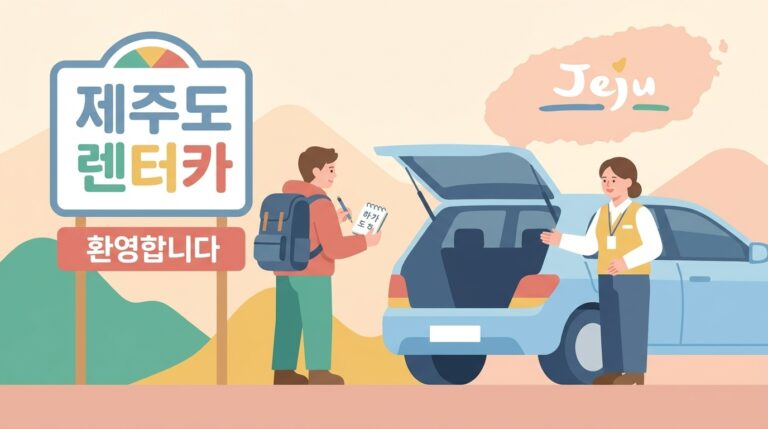
Imagine this: You’ve just touched down at Jeju International Airport, greeted by the warm island breeze and palm trees. You head over to the rental car depot, excited to start your dream road trip along the scenic coast. But as you walk up to your sleek rented SUV with two massive suitcases in hand, you suddenly hit a wall. Where is the trunk release button inside? Or how do you politely ask the rental staff nearby, “Could you please open the trunk for me?”
Staring at the back of a car while holding heavy luggage can feel awkward! Many learners know the word for luggage, but panic when trying to combine verbs and polite requests under pressure. Don’t worry—this is one of the most common pain points for travelers in Korea. Based on feedback from hundreds of our learners at Daily Hangul, mastering just three simple phrases will instantly boost your confidence at any car rental desk or taxi stand. Let’s make sure your journey starts smoothly!
Phase 2: Core Expressions Deep Dive
1. 트렁크 좀 열어주세요. (Teureongkeu jom yeoreojuseyo.)
- Pronunciation: [Teu-reong-keu jom yeo-reo-ju-se-yo] (Sounds like “Trunk jom yoh-roh-joo-say-yo”)
- Meaning: “Please open the trunk.”
- K-Culture Moment: You’ll hear this exact line whenever characters in K-dramas pick up a rental car for a spontaneous trip to East Sea or Jeju Island.
- Editor’s Insight: The magic word here is 좀 (jom). While it literally means “a little,” in polite requests it acts as a soft cushion, making you sound friendly and natural rather than demanding!
- Situation Spectrum: Casual ⚠️ | Semi-formal ✅ | Formal ✅
- 🤔 Think About It: How does adding a single softening word change a command into a polite request in your native language?
2. 트렁크 어디서 열어요? (Teureongkeu eodiseo yeoreoyo?)
- Pronunciation: [Teu-reong-keu eo-di-seo yeo-reo-yo?]
- Meaning: “Where do I open the trunk from?”
- K-Culture Moment: Useful when you are sitting in the driver’s seat of a new Korean car model (like a Hyundai or Kia) and can’t locate the trunk lever.
- Editor’s Insight: 어디서 (eodiseo) means “where at.” Using this phrasing shows initiative—you are asking how to do it yourself!
- Situation Spectrum: Casual ⚠️ | Semi-formal ✅ | Formal ✅
- 🤔 Think About It: Is it common in your culture to ask staff for technical guidance right away, or do you prefer searching on your phone first?
3. 짐 좀 실어주실 수 있나요? (Jim jom sireojusil su innayo?)
- Pronunciation: [Jim jom shi-reo-ju-sil soo in-na-yo?]
- Meaning: “Could you help me load the luggage?”
- K-Culture Moment: Seen in romantic drama scenes where the lead helpful offers assistance with heavy bags before hopping into a car.
- Editor’s Insight: 짐 (jim) means luggage/bags, and 싣다 (sitda) means to load. Combining them with -ㄹ 수 있나요? creates a super courteous, top-tier polite request.
- Situation Spectrum: Casual 🚫 | Semi-formal ✅ | Formal ✅
- 🤔 Think About It: How do expectations around helping with personal luggage differ between your home country and East Asian hospitality culture?
Phase 3: Textbook Korean vs. Real Korean
Situation 1: Asking staff to open the trunk
- 📖 Textbook Korean: 트렁크를 개방해 주시겠습니까? (Teureongkeureul gaebanghae jusigessneumnika? – Too formal and rigid, sounds like a public announcement!)
- 🗣️ Real Korean: 트렁크 좀 열어주세요! (Teureongkeu jom yeoreojuseyo! – Natural, polite, and instantly understood.)
- 💡 Why the difference? Spoken Korean prefers short, active verbs like 열다 (yeolda – to open) over heavy Sino-Korean vocabulary like 개방 (gaebang – opening/unsealing) in everyday customer interactions.
Situation 2: Storing your bags
- 📖 Textbook Korean: 수하물을 적재함에 넣겠습니다. (Suhamureul jeokjaehame neohgesseumnida. – Sounds like a cargo freight manual.)
- 🗣️ Real Korean: 짐 트렁크에 넣을게요! (Jim teureongkeue neoeulgeyo! – Friendly and natural.)
- 💡 Why the difference? Koreans use simple everyday loanwords like 트렁크 (trunk) and 짐 (bags) rather than formal vocabulary like 수하물 (baggage) during road trips.
Phase 4: K-Culture Deep Dive & Non-verbal Manners
4-1. Nunchi & Gestures
When asking rental car staff to open the trunk, a slight nod of the head (15-degree bow) combined with pointing lightly towards the rear of the vehicle using an open palm (never a single finger!) communicates respect instantly. If you are inside the vehicle trying to find the release button, pointing to your dashboard with a puzzled yet polite smile communicates your need without causing any stress.
4-2. Cultural Code: The Korean Road Trip Phenomenon
Car rentals in Korea—especially on Jeju Island or along the Gangwon-do coast—are synonymous with freedom, cafe-hopping, and coastal drives. Korean rental staff are incredibly fast and efficient. Because rental handovers happen quickly, communicating clearly about trunk access right at the start ensures a seamless departure!
Phase 5: Interactive Roleplay Scenario
Setting: Jeju Car Rental Center counter.
Characters: You (Traveler) & Min-soo (Friendly Car Rental Staff NPC)
- Min-soo: 안녕하세요! 예약하신 차량 준비되었습니다. 🎭 (Hands over the car keys with a bright smile)
(Annyeonghaseyo! Yeyakhasin charyang junbidoeotseumnida. – Hello! Your reserved car is ready.) - You: 감사합니다. 저… 트렁크 좀 열어주세요. 🎭 (Points politely toward the back of the white sedan)
(Gamsahamnida. Jeo… teureongkeu jom yeoreojuseyo. – Thank you. Um… please open the trunk.) - Min-soo: 아, 네! 잠시만요. 버튼 눌러드릴게요. 🎭 (Presses key fob button)
(A, ne! Jamsimanyo. Beoteun nulleodeurilegeyo. – Ah, yes! Just a moment. I’ll press the button for you.) - You: 짐이 좀 많아서요. 🎭 (Gently points to two big bags)
(Jimi jom manaseoyo. – I have quite a bit of luggage.) - Min-soo: 제가 짐 좀 실어드릴까요? 🎭 (Reaches out to assist with the handle)
(Jega jim jom sireodeureilkayo? – Shall I help you load the bags?) - You: 정말 감사합니다! 운전석 트렁크 버튼은 어디서 열어요? 🎭 (Looks curious while looking inside)
(Jeongmal gamsahamnida! Unjeonseok teureongkeu beoteuneun eodiseo yeoreoyo? – Thank you so much! Where do I open the trunk button from the driver’s seat?) - Min-soo: 핸들 왼쪽 아래에 있어요! 여기 보세요. 🎭 (Points clearly to the dashboard switch)
(Haendeul oenjjok araee isseoyo! Yeogi boseyo. – It’s below the left side of the steering wheel! Look here.) - You: 아, 여기 있군요! 친절하게 알려주셔서 감사합니다! 🎭 (Nods warmly with a smile)
(A, yeogi itgunyo! Chinjeolhage allyeojusyeoseo gamsahamnida! – Ah, here it is! Thank you for explaining so kindly!)
🔀 Interactive Choice Point
What would you say if the trunk won’t close after loading your luggage?
* Choice A: 트렁크가 안 닫혀요. 도와주세요! (Teureongkeuga an dachyeoyo. Dowajuseyo!)
* Choice B: 야! 이거 고장났어요! (Ya! Igeo gojangnasseoyo!)
* Choice C: 그냥 운전할게요. (Geunyang unjeonhalgeyo.)
Feedback:
* Choice A (BEST): Perfect! Clear, polite, and prompts the staff to assist immediately without placing blame.
* Choice B (BAD): Avoid this! “야 (Ya!)” is rude informal language, and assuming it’s broken right away can cause unnecessary conflict.
* Choice C (RISK): Dangerous! Driving with an unlatched trunk can cause luggage to fall out on the highway.
Phase 6: 10-Second Emotion Shadowing Drill
Practice reading these lines aloud with the indicated pause (/) and emotional tone:
[😊 Polite and Friendly]
저기요 / 트렁크 좀 / 열어주세요!
(Jeogiyo / teureongkeu jom / yeoreojuseyo!)-
[🤔 Curious and Seeking Help]
트렁크 버튼이 / 어디에 / 있어요?
(Teureongkeu beoteuni / eodie / isseoyo?) -
[🙏 Grateful and Happy]
짐 실어주셔서 / 정말 / 감사합니다!
(Jim sireojusyeoseo / jeongmal / gamsahamnida!)
Phase 7: K-Culture Mini Dictionary
- 트렁크 (Teureongkeu) | Trunk / Boot
Used everywhere in Korea for vehicle storage spaces. - 렌터카 (Renteokea) | Rental Car
Refers both to rental vehicles and car rental service companies. - 네비게이션 (Nebigeisyeon) | GPS / Navigation System
Essential equipment in Korean rental cars; often shortened to ‘네비 (Nebi)’. - 짐 (Jim) | Luggage / Bags / Belongings
Covers suitcases, backpacks, and grocery bags.
Phase 8: Traveler’s Survival Kit
Top 3 Survival Phrases
- 트렁크 열어주세요. (Please open the trunk.)
- 짐이 많아요. (I have a lot of luggage.)
- 어떻게 열어요? (How do I open it?)
Editor’s Travel Note
Before hitting the road in Korea, make sure to navigate like a local! KakaoMap and Naver Map work significantly better than Google Maps for driving turn-by-turn directions. Be sure to perform a quick check on your mobile device by setting up navigation before leaving the car rental center.
Phase 9: One Step Deeper
In Korean culture, asking for assistance with small everyday tasks is framed around mutual politeness. Adding simple softeners like ‘좀 (jom)’ or ending sentences in ‘-주세요 (-juseyo)’ acknowledges the other person’s effort and transforms a practical service interaction into a pleasant warm exchange.
💬 Your Turn: Have you ever rented a car in another country and struggled with a simple button or lever? Share your story in the comments below!
Phase 10: FAQ & Common Mistakes
Q: Can I use the English word “Trunk” directly in Korea?
A: Yes! Koreans use the loanword 트렁크 (Teureongkeu) exclusively. You do not need to memorize complex native Korean translations for car boot/trunk.
Q: What if I accidentally use informal language (Panmal) when asking for help?
A: Car rental staff will still understand you, but using formal polite endings like -세요 (-seyo) or -요 (-yo) ensures respectful customer service.
Q: How do I say “Where is the gas tank lever?”
A: You can say “주유구 버튼 어디 있어요? (Juyugu beoteun eodi isseoyo?)”.
🚨 Common Mistakes
- Mistake 1: Saying “트렁크 오픈하세요!” (Sounds unnaturally blunt like a direct order).
Correct Action: Say “트렁크 좀 열어주세요.” - Mistake 2: Forgetting to say “좀 (jom)” when making requests.
Correct Action: Include “좀” to soften your tone instantly. - Mistake 3: Pointing with one finger at the car staff or trunk.
Correct Action: Use an open hand gesture for polite non-verbal body language.
Phase 11: Action Mission & Engagement
- 🥉 Bronze: Repeat “트렁크 좀 열어주세요” 3 times out loud today!
- 🥈 Silver: Record your voice saying the shadowing drill and listen back to match the cadence.
- 🥇 Gold: Use this phrase confidently on your next Korean road trip or taxi ride!
🎮 K-Culture Mission: Watch a travel vlog set in Jeju Island on YouTube and comment below if you catch anyone opening a rental car trunk!
Phase 12: Interactive Quiz Challenge
1. Multiple Choice: How do you politely ask rental car staff to open the trunk?
– A) 트렁크 닫으세요.
– B) 트렁크 좀 열어주세요.
– C) 짐을 버리세요.
2. Fill in the Blank: “트렁크 _____ 열어요?” (Where do I open the trunk?)
– A) 어디서
– B) 언제
– C) 누구
3. True or False: In Korea, saying “트렁크 (Teureongkeu)” is widely understood by everyone.
– [ ] True
– [ ] False
Click for Answers!
- B) 트렁크 좀 열어주세요. (Teureongkeu jom yeoreojuseyo – Please open the trunk.)
- A) 어디서 (eodiseo – where at)
- True! (트렁크 is the standard everyday term used throughout Korea.)







