

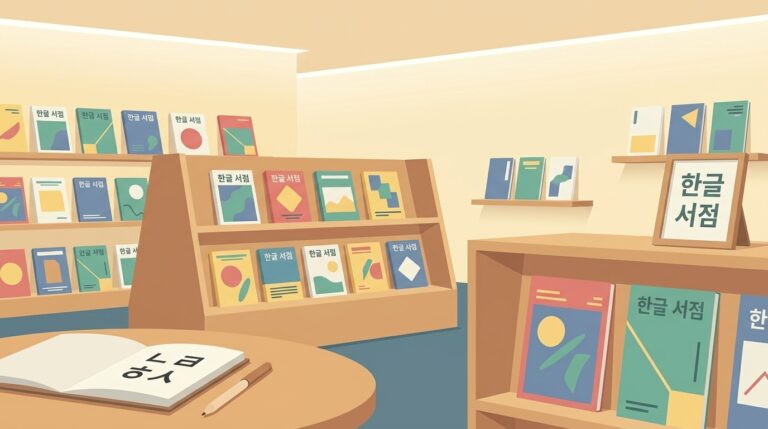
Lost in a Korean Bookstore? How to Find Your Favorite K-Magazines Like a Local
안녕하세요! Welcome back to Daily Hangul! I’m your editor and friendly Korean bestie. Have you ever stepped into a massive Korean bookstore like Kyobo or YP Books in Seoul, dreaming of picking up a glossy K-pop or fashion magazine featuring your favorite star, only to get overwhelmed by thousands of shelves? You wander around, staring at endless rows of books, too shy to ask where the magazine section is! Don’t worry—you are definitely not alone. Many of our learners share this exact pain point. Today, we’re going to transform you from a lost tourist into a confident K-culture shopper with simple A2-level Korean phrases for navigating the magazine section!
Phase 2: 3 Essential Expressions for the Magazine Section
1. 잡지 코너가 어디예요? (Japji koneoga eodiyeyo?)
- Pronunciation: [Jap-jee koh-neo-gah uh-dee-yay-yoh?] (Sounds like “job-G” + “corner-ga” + “uh-d-yay-yo”)
- Meaning: “Where is the magazine corner?”
- K-Culture Moment: Imagine walking into a giant subterranean bookstore in Gangnam. You want to buy the latest Vogue Korea featuring a BTS member, but you only see study guides around you. You ask a friendly staff member with this line!
- Editor’s Insight: ‘잡지’ (japji) means magazine, and ‘코너’ (koneo) comes from the English word ‘corner’. Putting them together makes it super easy to remember!
- Situation Spectrum:
- Casual: 🚫 (Too blunt for staff)
- Semi-formal (Polite): ✅ 잡지 코너가 어디예요?
- Formal: ✅ 잡지 코너가 어디에 있습니까?
- 🤔 Think About It: In Korean, we often add ‘-가/이’ to mark the topic you are looking for. How does asking directions in Korean compare to your native language?
2. 이번 달 잡지 있어요? (Ibeon dal japji issoyeo?)
- Pronunciation: [Ee-beon dahl jap-jee ees-suh-yoh?]
- Meaning: “Do you have this month’s magazine?”
- K-Culture Moment: Monthly cover reveals are huge events in Korea! You enter the bookstore on the 20th of the month right when the new issues drop.
- Editor’s Insight: ‘이번 달’ means “this month”. Korean uses simple present tense ‘있어요?’ (Do you have / Is there?) to ask about availability.
- Situation Spectrum:
- Casual: ⚠️ (Only with close friends)
- Semi-formal (Polite): ✅ 이번 달 잡지 있어요?
- Formal: ✅ 이번 달 잡지가 있습니까?
- 🤔 Think About It: Notice how Korean doesn’t require complex grammar like “Do you currently carry the latest issue?” Just say “This month magazine have?”
3. 부록도 들어있나요? (Burokdo deureoissnayo?)
- Pronunciation: [Boo-rohk-doh deu-ruh-ees-nah-yoh?]
- Meaning: “Does it include the free gift/supplement?”
- K-Culture Moment: Korean magazines are famous for incredible free gifts (부록) like luxury cosmetics, tote bags, or full-sized skincare products that often cost more than the magazine itself!
- Editor’s Insight: ‘부록’ means supplement or bonus gift. The particle ‘-도’ means “also/too”. Asking this ensures you get your free goodies at checkout!
- Situation Spectrum:
- Casual: 🚫
- Semi-formal (Polite): ✅ 부록도 들어있나요?
- Formal: ✅ 부록도 포함되어 있습니까?
- 🤔 Think About It: Why do you think freebies with magazines are so popular in Korean shopping culture?
Phase 3: Textbook Korean vs. Real Native Korean
Situation 1: Asking where the magazines are
- 📖 Textbook Korean: 실례지만, 잡지 매장이 어디에 위치해 있습니까? (Excuse me, where is the magazine store located?)
- 🗣️ Real Native Korean: 저기요, 잡지 코너 어디로 가야 해요? (Excuse me, which way should I go for the magazine corner?)
- 💡 Why is it different? Native speakers rarely say ‘위치해 있습니까?’ in casual conversations. Asking ‘어디로 가야 해요?’ (Where should I go?) sounds much warmer and natural.
Situation 2: Asking if a magazine is sold out
- 📖 Textbook Korean: 이 잡지는 품절되었습니까? (Is this magazine sold out?)
- 🗣️ Real Native Korean: 이거 다 나갔어요? (Is this all gone?)
- 💡 Why is it different? While ‘품절’ (sold out) is common on online shopping sites, spoken Korean often uses ‘다 나갔어요’ (literally: everything went out) to express sold-out items.
Phase 4: K-Culture Deep Dive & Non-Verbal Manners
4-1. 눈치 (Nunchi) & Bookstore Etiquette
- Mind your voice: Large bookstores like Kyobo are quiet spaces. Speak in a gentle, lower volume when asking staff.
- Browsing etiquette: You are allowed to flip through unlocked magazines, but if a magazine is sealed in plastic wrap (비닐 포장), do not tear it open! It means it contains special inserts or freebies.
4-2. The Magic of 잡지 부록 (Magazine Freebies)
In Korea, purchasing magazines is almost like buying a lucky box! Every month around the 15th-20th, fashion magazines announce their ‘부록’ (free gifts). Korean fans closely monitor online updates to grab issues offering high-end beauty products or limited edition idol posters.
Phase 5: Real Roleplay Scenario
Setting: Kyobo Bookstore in Gwanghwamun, Seoul. You are standing near the customer service desk.
NPC Character: Min-soo (Friendly Bookstore Staff)
- Min-soo: 🎭 (Smiling warmly) 안녕하세요! 찾으시는 책 있으세요? (Hello! Are you looking for a specific book?)
- You: 안녕하세요! 저… 잡지 코너가 어디예요? (Hello! Um… where is the magazine corner?)
- Min-soo: 🎭 (Points toward the back left) 아, 잡지는 저쪽 J 구역으로 가시면 돼요. (Ah, for magazines, you can go to Area J over there.)
- You: 🎭 (Nodding politely) 감사합니다. 혹시 K-POP 잡지도 거기에 있나요? (Thank you. Is the K-POP magazine also there?)
- Min-soo: 네, 맞아요! 패션 잡지랑 K-POP 잡지가 같이 있어요. (Yes, that’s right! Fashion and K-POP magazines are together.)
- You: 이번 달 잡지에 부록도 들어있나요? (Does this month’s magazine include the free gift?)
- Min-soo: 🎭 (Hands you a supplement package) 네! 계산하실 때 여기서 부록 같이 드려요. (Yes! We give you the free gift here when you check out.)
- You: 와, 대박! 정말 감사합니다! (Wow, awesome! Thank you so much!)
🔀 Interactive Choice Point
What would you say if the magazine you want isn’t on the shelf?
* Option A: 이거 혹시 재고 더 있어요? (Do you happen to have more stock of this?)
* Option B: 왜 없어요? 당장 가져오세요. (Why don’t you have it? Bring it immediately.)
* Option C: 없어? 그럼 잘 있어. (Not here? Bye then.)
Feedback:
* Option A (BEST): 🌟 Perfect! Asking polite questions about stock (‘재고’) is very polite and helpful.
* Option B (RISK): 🚨 Too rude! Demanding items aggressively breaks polite conversation etiquette in Korea.
* Option C (BAD): ❌ Informal language (반말) used with a stranger/staff is rude.
Phase 6: 10-Second Emotion Shadowing Drill
Practice these lines out loud with feeling!
[😊 Exciting & Polite]잡지 코너가 / 어디예요? (Japji koneoga / eodiyeyo?)[🥺 Curious & Hopeful]이번 달 잡지 / 있어요? (Ibeon dal japji / issoyeo?)[🎉 Surprised & Happy]와! / 부록도 / 들어있어요! (Wa! / Burokdo / deureoissosyo!)
Phase 7: K-Culture Mini Dictionary
- 잡지 (Japji): Magazine.
- 부록 (Burok): Supplement gift included with magazines or books.
- 신간 (Singan): Newly published books or issues.
- 화보 (Hwabo): Pictorial / Photo spread featured inside a magazine.
Phase 8: Traveler’s Survival Kit
Top 3 Survival Expressions
- 계산대 어디예요? (Gyesandae eodiyeyo?) – Where is the checkout counter?
- 포장해 주세요. (Pojanghae juseyo.) – Please wrap/pack it for me.
- 카드로 할게요. (Kadeuro halgeyo.) – I’ll pay by card.
Editor’s Travel Note
When navigating large Korean bookstores or finding nearby branches, use the Naver Map App Download instead of Google Maps for precise indoor walking directions in Seoul!
Phase 9: One Step Deeper
In Korean culture, bookstores are not just commercial places; they are community sanctuaries. The famous phrase “사람은 책을 만들고 책은 사람을 만든다” (Humans make books, and books make humans) adorns the entrance of Kyobo Bookstore. Asking staff politely reflects this mutual respect in shared cultural spaces.
💬 Your Turn: Which Korean star would you love to see on the cover of a magazine? Let us know in the comments below!
Phase 10: FAQ & Common Mistakes
Q: Can I buy older issues of magazines at standard bookstores?
A: Usually, major bookstores only display current and previous month issues. Older issues are best found at second-hand stores like Aladin (알라딘).
Q: Can I open sealed magazines to check the cover poster?
A: No, if a magazine is sealed in plastic, do not unwrap it before purchasing.
Q: How do I know what freebie comes with the magazine?
A: Look for a display sample near the magazine rack or check the small sticker on the cover showing ‘이달의 부록’ (Gift of the month).
🚨 Common Mistakes TOP 3
- Saying ‘어디’ without polite endings: Always say ‘어디예요?’ instead of just ‘어디?’.
- Opening wrapped books: Tearing plastic wraps will require you to pay for damaged goods.
- Using informal speech (반말) with staff: Remember to use polite ‘-요’ forms!
Phase 11: Action Mission & Challenge
- Bronze Mission: Practice saying “잡지 코너가 어디예요?” out loud 3 times.
- Silver Mission: Write down your favorite Korean magazine name in Hangul in your study notebook.
- Gold Mission: Visit a local Korean supermarket or bookstore in your city and ask for magazines in Korean!
- 🎮 K-Culture Mission: Watch a K-drama scene set in a bookstore and spot if the characters use ‘-요’ or ‘-습니다’!
Phase 12: Interactive Quiz Challenge
Q1. Situation Quiz
You want to ask if the new monthly issue is available. What do you say?
– A) 이번 달 잡지 있어요?
– B) 잡지 먹었어요?
Click here to see the answer!
Answer: A
Explanation: ‘있어요?’ means ‘Do you have?’. Option B asks ‘Did you eat the magazine?’ which makes no sense!
Q2. Fill-in-the-blank
잡지 _____ 어디예요? (Where is the magazine corner?)
– A) 코너
– B) 사과
Click here to see the answer!
Answer: A
Explanation: ‘코너’ (koneo) means corner. ‘사과’ means apple!
Q3. True or False
Korean magazines never include free gifts (부록).
Click here to see the answer!
Answer: False
Explanation: Korean magazines are famous for offering amazing ‘부록’ (free gifts) every month!







