

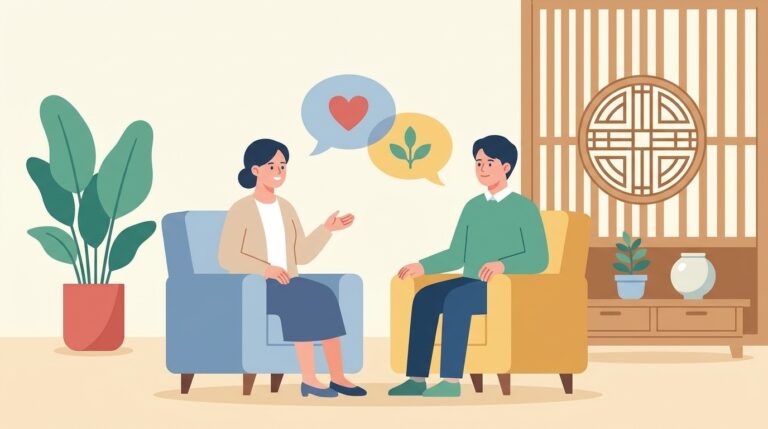
Navigating Mental Healthcare in Korea: Nuanced Korean Phrases for Emotional Well-being and Therapy
Phase 1: Empathy & Storytelling Opening
안녕하세요! 매일한글 에디터입니다.
Imagine this: You’ve been working at a bustling tech firm in Seoul for over a year. On the outside, your life looks like a dazzling montage from a sleek K-Drama—chasing deadlines, sipping iced Americanos in Gangnam, and hanging out at trendy Hongdae pop-up stores. But beneath the surface, an overwhelming exhaustion sets in. Your sleep is fragmented, the weight on your chest grows heavier each day, and you realize you aren’t just tired; you are emotionally burned out.
When you finally decide to seek professional help in Korea, a new hurdle appears: how do you express complex, vulnerable psychological states in Korean? Traditional dictionaries often offer rigid, clinical terms that feel too cold for a therapy room or too formal for a heart-to-heart with a trusted friend. Navigating mental health care in a foreign country can be deeply intimidating, especially when societal perceptions around therapy differ from your home country.
That is why we created this C1-level guide. Grounded in real feedback from long-term expats and native Korean speakers, this lesson equips you with modern, emotionally resonant, and culturally sensitive expressions. By mastering these nuanced phrases, you will gain the confidence to articulate your inner emotional landscape, seek professional psychiatric or counseling help, and foster genuine connections in Korea without feeling lost in translation.
Phase 2: Deep-Dive into 3 Core Expressions
1. 마음이 번아웃되다 (Maeum-i beon-a-ut-doeda)
- Pronunciation: [mae-um-i beon-a-ut-doe-da] (Sounds like “may-oom-ee burn-out-dwe-da”)
- Meaning: Literal: “For one’s mind/heart to become burned out.” | Nuance: Experiencing severe emotional, physical, and mental exhaustion, especially from prolonged stress or work overload.
- K-Culture Moment: Frequently used in modern workplace Korean dramas (like Work Later, Drink Now or Daily Dose of Sunshine) when characters reach a emotional breaking point after tireless hustling.
- Editor’s Insight: While ‘스트레스 받다’ (to be stressed) covers general annoyance, ‘마음이 번아웃되다’ signals a deeper, systemic depletion of your emotional reserves. Using ‘마음’ (mind/heart) adds a personal, compassionate touch.
- Situation Spectrum:
- Casual: ⚠️ (Use ‘번아웃 왔어’ instead)
- Semi-formal: ✅ (마음이 번아웃된 것 같아요)
- Formal: ✅ (심리적으로 번아웃 상태입니다)
- 🤔 Think About It: How does your native language distinguish between everyday fatigue and profound emotional burnout? In Korean, attaching ‘마음’ shifts the focus from physical lethargy to psychological care.
2. 정신건강의학과에 상담을 받으러 가다 (Jeongsin-geongang-uihak-gwa-e sangdam-eul badeureo gada)
- Pronunciation: [jeong-sin-geon-gang-ui-hak-gwa-e sang-dam-eul ba-deu-reo ga-da] (Pronounced like “jung-shin gun-gang wee-hak-gwa”)
- Meaning: Literal: “To go to the Department of Mental Health and Medicine for a consultation.” | Nuance: Visiting a psychiatric clinic or mental health professional in a proactive, healthcare-focused manner.
- K-Culture Moment: In past decades, visiting ‘정신과’ carried a heavy social stigma. Modern Korean society explicitly renamed the medical field to ‘정신건강의학과’ (Mental Health Medicine) to refashion therapy as routine self-care.
- Editor’s Insight: Using the full updated clinical name ‘정신건강의학과’ demonstrates cultural refined knowledge and avoids outdated, stigmatized abbreviations like ‘정신병원’ (asylum/psychiatric hospital).
- Situation Spectrum:
- Casual: ⚠️ (Sounds too formal for casual chit-chat; use ‘상담받으러 가’ instead)
- Semi-formal: ✅
- Formal: ✅
- 🤔 Think About It: Does naming medical departments differently change public perception in your home culture? How does clinical terminology influence your willingness to seek help?
3. 마음을 털어놓다 (Maeum-eul teoreo-noda)
- Pronunciation: [mae-um-eul teor-eo-no-ta] (Sounds like “may-oom-eul tur-eo-no-ta”)
- Meaning: Literal: “To shake out and lay down one’s heart/mind.” | Nuance: To unburden oneself by candidly opening up about bottled-up feelings or trauma.
- K-Culture Moment: Seen in intimate late-night drinking scenes or cozy cafe conversations where two close friends transition from superficial bantering to vulnerable soul-sharing.
- Editor’s Insight: The verb ‘털다’ means to dust off or shake out. Thus, ‘마음을 털어놓다’ evokes a vivid visual of shaking out dusty, hidden emotional baggage into the light.
- Situation Spectrum:
- Casual: ✅ (솔직하게 마음을 털어놔 봐)
- Semi-formal: ✅ (누군가에게 마음을 털어놓고 싶었어요)
- Formal: ✅ (환자가 마음을 털어놓을 수 있는 환경이 중요합니다)
- 🤔 Think About It: Why is unburdening oneself seen as an active act of cleaning or dusting off in Korean metaphors?
Phase 3: Textbook Korean vs. Real Korean
Situation 1: Expressing Severe Emotional Distress
- 📖 Textbook Korean: 저는 요즘 매우 우울하고 슬픕니다. (I am very depressed and sad these days.)
- 🗣️ Real Korean: 요즘 마음이 너무 가라앉고 아무것도 할 의욕이 안 나요. (Lately my heart feels so sunken, and I have zero motivation to do anything.)
- 💡 Why the difference? Textbook phrases sound like clinical diagnostic statements. Advanced native speakers describe depression through vivid sensory metaphors like ‘가라앉다’ (to sink) and lack of daily vitality.
Situation 2: Asking for a Friend’s Mental State Gently
- 📖 Textbook Korean: 당신의 정신 건강 상태는 어떻습니까? (How is your mental health condition?)
- 🗣️ Real Korean: 요즘 요동치는 감정 때문에 힘들진 않아? 멘탈 괜찮아? (Are you having a tough time with emotional swings lately? Is your mental state holding up alright?)
- 💡 Why the difference? Directly asking about ‘정신 건강’ in casual conversations feels invasive. Natives check in using loanwords like ‘멘탈’ (mental) or soft descriptive phrases about emotional waves.
Phase 4: K-Culture Deep Dive & Non-Verbal Manners
4-1. Nunchi (눈치) & Non-Verbal Manners in Therapy Settings
When entering a mental health clinic in Korea, subtle non-verbal cues dictate the social atmosphere:
* Lowered Tone & Soft Eye Contact: Unlike loud medical clinics, psychiatric reception areas maintain hushed environments. Speaking in a quiet, subdued tone shows respect for others’ privacy.
* Respecting Anonymity: Avoid staring at other patients sitting in the waiting area. Maintaining discreet eye contact (avoiding intense eye locks) is considered polite Nunchi.
* Body Posture: When discussing emotional struggles with a therapist, sitting upright with hands gently clasped in your lap demonstrates sincere willingness to participate in care.
4-2. Cultural Code Analysis: The Shift in Mental Health Discourse
Korea’s high-pressure academic and workplace environments traditionally emphasized endurance (인내 – innae). However, modern media—such as the acclaimed drama Daily Dose of Sunshine (정신병동에도 아침이 와요)—has spearheaded a massive cultural pivot. Today, young adults view therapy not as weakness, but as ‘마음 스케일링’ (mind scaling), treating psychological check-ups like regular dental cleanings.
Phase 5: Real-World Roleplay Scenario
Setting: A quiet intake room at a modern psychiatric clinic in Seoul. Doctor Min (NPC) is conducting an initial assessment with foreign resident Alex.
Dialogue
- 민 의사: 어서 오세요, 알렉스 님. 오늘 어떤 일로 상담을 신청하게 되셨나요?
(Eoseo oseoyo, Alex-nim. Oneul eotteon illo sangdam-eul sincheong-hage doenayo?)
“Welcome, Alex. What brings you in for a consultation today?”
🎭 [Soft eye contact with a welcoming smile] -
알렉스: 안녕하세요, 선생님. 요즘 일도 너무 많고… 마음이 완전히 번아웃된 것 같아요.
(Annyeonghaseyo, seonsaengnim. Yojeum ildo neomu manko… maeum-i wanjeonhi beon-a-ut-doen geot gat-ayo.)
“Hello, doctor. I’ve had so much work lately… I feel like my mind is completely burned out.”
🎭 [Sighs softly while wringing hands lightly] -
민 의사: 그러셨군요. 언제부터 그런 감정이 깊어지셨는지 말씀해 주실 수 있나요?
(Geureosyeotgunyo. Eonjebuteo geureon gamjeong-i gipeojisyeotneunji malssamhae jusil su 있nayou?)
“I see. Could you tell me when those feelings started to deepen?”
🎭 [Nods sympathetically, pen ready over clipboard] -
알렉스: 한 세 달 전부터요. 밤에 잠도 잘 못 자고, 아침에 눈을 뜨면 마음이 돌덩이처럼 무거워요.
(Han se dal jeonbuteoyo. Bame jamdo jal mot jago, achime nuneul tteumyeon maeum-i doldeong-i-cheoreom mugeowo-yo.)
“About three months ago. I can’t sleep well at night, and when I open my eyes in the morning, my heart feels heavy as a stone.”
🎭 [Looks down briefly, speaking calmly] -
민 의사: 잠을 못 이루고 마음이 무거우시면 일상생활도 많이 지치셨겠어요. 혹시 주변에 이런 마음을 털어놓을 분이 계신가요?
(Jameul mot irugo maeum-i mugeowousimyeon ilsangsaenghwaldo mani jichisyeotgesseoyo. Hoksi jubyeone ireon maeumeul teoreo-no-eul buni gyesingayo?)
“It must be exhausting to go through daily life with sleeplessness and a heavy heart. Is there anyone nearby you can unburden your heart to?”
🎭 [Leans forward with warm concern] -
알렉스: 타국에 있다 보니 가족들 걱정시킬까 봐 혼자 속으로만 삼켜왔어요.
(Taguge itda boni gajokdeul geokjeongsikilkka bwa honja sogureoman samkyeowasseoyo.)
“Since I live abroad, I worried about stressing my family, so I just swallowed it all down inside.”
🎭 [Voice quavers slightly] -
민 의사: 혼자 참아내느라 고생 많으셨습니다. 이제는 저와 함께 차근차근 해결 방법을 찾아봐요.
(Honja chamanaeneura gosaeng maneusyeosseumnida. Ijeneun jeowa hamkke chageunchageun haegyeol bangbeobeul chajabwayo.)
“You’ve suffered a lot trying to endure it alone. Now, let’s find a solution together step by step.”
🎭 [Reassuring smile with an encouraging gesture] -
알렉스: 네, 선생님. 그렇게 말씀해 주시니 마음이 한결 가벼워지네요.
(Ne, seonsaengnim. Geureokke malssamhae jusini maeum-i hanggyeol gabyeowojineyo.)
“Thank you, Doctor. Hearing you say that makes my heart feel considerably lighter.”
🎭 [Takes a deep, relieved breath]
🔀 Interactive Choice Point
How should Alex respond when the doctor asks about medication treatment?
- Option A: “약물 치료는 무조건 싫어요. 제 의지로 극복할게요.”
- Option B: “약물 치료와 상담 치료의 장단점을 자세히 설명해주실 수 있나요?”
- Option C: “선생님이 알아서 다 처방해 주세요.”
Feedback & Analysis:
* Best Choice (Option B): Excellent! Demonstrates proactive, highly educated engagement (C1 style). Asking for comparison in a polite formal register shows therapeutic readiness.
* Risk Choice (Option A): Refusing abruptly using ‘무조건’ (unconditionally) sounds overly defensive and dismissive of clinical expertise.
* Bad Choice (Option C): Submitting completely without asking questions prevents you from actively participating in your customized recovery plan.
Phase 6: 10-Second Emotion Shadowing Drill
Practice these high-frequency emotional sentences by matching tone markers and pauses (/):
[🥺 지치고 쓸쓸하게]
요즘은 / 아무것도 하고 싶지 않고 / 마음이 텅 빈 것 같아요.
(Yojeumeun / amugotdo hago sipji anko / maeum-i teong bin geot gat-ayo.)
Pause after each phrase to express deep emotional emptiness.-
[😌 안도하며 따뜻하게]
선생님과 이야기하고 나니 / 꽉 막혔던 마음이 / 조금은 뚫리는 기분이에요.
(Seonsaengnim-gwa iyagihago nani / kkwak mak-hyeot-deon maeum-i / jogeumeun ttul-lingi-bun-ieyo.)
Emphasize ‘조금은 뚫리는’ to convey relief. -
[💪 의지를 담아 차분하게]
제 속도에 맞춰서 / 천천히 / 마음을 회복해 보고 싶어요.
(Je sokdoe matchwoseo / cheoncheonhi / maeumeul hoebokhae bogo sip-eoyo.)
Speak ‘천천히’ slowly and deliberately to show inner resolve.
Phase 7: K-Culture Mini Dictionary
- 속상하다 (Soksanghada) | To feel upset/distressed | Expresses deep internal soreness when things don’t go as planned or when emotional wounds burn internally.
- 우울증 (Uul-jeung) | Depression (Clinical) | The formal medical condition. Used in healthcare contexts rather than trivial sad feelings.
- 멘탈 케어 (Mental Care) | Mental Health Management | Modern Konglish widely used among younger Koreans to denote proactive self-care habits (meditation, gym, journaling).
- 마음의 병 (Maeum-ui Byeong) | Sickness of the Soul/Mind | A culturally sensitive metaphor for psychological distress, softening the medical stigma of clinical illness.
Phase 8: Traveler’s & Expat’s Survival Kit
Survival Expressions TOP 3
- 외국어 상담이 가능한가요? (Oegugeo sangdam-i ganeung-hangayo?)
Is foreign language consultation available?- Pro Tip: Ask this at the reception desk before filling out intake sheets.
- 처방전에 약 복용법을 적어주세요. (Cheobangjeone yak bogyongbeobeul jeogeojuseyo.)
Please write down medication usage instructions on the prescription. - 실손보험 청구 서류를 발급받고 싶어요. (Silson-boheom cheonggu seoryureul balgeup-batgo sip-eoyo.)
I’d like to get documents issued for my private health insurance claim.
Editor’s Travel Note
When looking for mental health services in South Korea, use official mapping platforms. Navigate using the Naver Map App search query “정신건강의학과” rather than general hospital keywords. For non-Korean speakers, contact the Global Seoul Center Hotline for verified English-speaking medical translation services.
Phase 9: “One Step Deeper” (Insights into Korean Society)
In traditional Korean society, emotional suppression (화병 / Hwabyeong) was often viewed as a tragic badge of endurance. However, modern urban Korea is undergoing a revolution in personal wellness. Younger generations actively dismantle the myth of perpetual grit, redefining strength as the courage to say, “I need help.” Seeking therapy in contemporary Seoul is increasingly viewed as an essential act of self-respect and emotional maturity.
💬 Your Turn: Have you ever felt hesitant to express emotional burnout due to cultural expectations? How do people in your home country discuss mental wellness? Share your thoughts in the comments below!
Phase 10: FAQ & Common Mistakes
Q: Can foreigners access Korean National Health Insurance (NHIS) for mental health care?
A: Yes! If you hold NHIS coverage (mandatory for residents staying over 6 months), consultations and prescriptions at psychiatric clinics are covered, making visits remarkably affordable (often 15,000–30,000 KRW per visit).
Q: Will seeking therapy affect my visa status or job background check in Korea?
A: No. Medical records in South Korea are protected under strict medical privacy laws. Employers and immigration authorities cannot access your psychiatric history without your explicit legal consent.
Q: How do I know if I should go to a ‘심리상담센터’ (Counseling Center) or ‘정신건강의학과’ (Psychiatric Clinic)?
A: Visit a ‘정신건강의학과’ if you require medical diagnosis or medication (covered by insurance). Opt for a ‘심리상담센터’ for talk therapy without medication (usually paid out-of-pocket).
🚨 Common Mistakes TOP 3
- Mistake: Using “정신병이 있어요” (I have a mental disease/madness).
- Correct Action: Say “우울감이 심해요” (My feelings of depression are severe) or “마음이 많이 힘들어요” (My heart is having a hard time).
- Mistake: Confusing clinical psychology with general stress.
- Correct Action: Don’t overuse heavy terms like ‘조현병’ or ‘정신병’ casually; stick to ‘스트레스’, ‘번아웃’, or ‘우울감’.
- Mistake: Referring to your therapist as “의사 씨” (Doctor Mr.).
- Correct Action: Address your therapist or medical doctor always as “선생님” or “원장님”.
Phase 11: Action Missions
- 🥉 Bronze Level: Practice saying “마음이 번아웃된 것 같아요” out loud 3 times using proper emotion shadowing.
- 🥈 Silver Level: Write down 3 personal stressors in Korean using the metaphor “마음이 돌덩이처럼 무겁다”.
- 🥇 Gold Level: Search Naver Map to locate 2 English-friendly mental health clinics near your neighborhood in Korea and save their contact details.
🎮 K-Culture Mission: Watch an episode of Daily Dose of Sunshine on Netflix. Note down how characters gently check in on each other’s emotional well-being using the word ‘마음’.
Phase 12: Interactive Quiz Challenge
Question 1 (Situation Judgment)
Which phrase is the most natural and culturally appropriate way to tell a close Korean friend that you are seeing a therapist?
* A) 나 정신병원에 입원했어.
* B) 요즘 마음이 좀 힘들어서 상담받으러 다니고 있어.
* C) 나는 정신병자야.
Click to reveal Answer & Explanation
- Correct Answer: B
- Explanation: Option B uses the soft, emotionally clear phrase ‘상담받으러 다니고 있어’ (I’m attending counseling sessions). Option A implies involuntary psychiatric hospitalization, and Option C contains derogatory self-stigma.
Question 2 (Fill in the Blank)
fill in the blank: “요즘 일이 너무 많아서 마음이 완전히 _________.”
* A) 번아웃됐어요
* B) 행복해요
* C) 시원해요
Click to reveal Answer & Explanation
- Correct Answer: A) 번아웃됐어요
- Explanation: ‘번아웃됐다’ accurately describes burnout caused by overwhelming workloads.
Question 3 (True or False Cultural Quiz)
Statement: In modern Korea, visiting a ‘정신건강의학과’ automatically registers on public employment portals.
* True
* False
Click to reveal Answer & Explanation
- Correct Answer: False
- Explanation: Medical privacy in South Korea strictly protects patient records. Private companies cannot view your medical care history.







