

Phase 1: Empathy (Storytelling Opening)
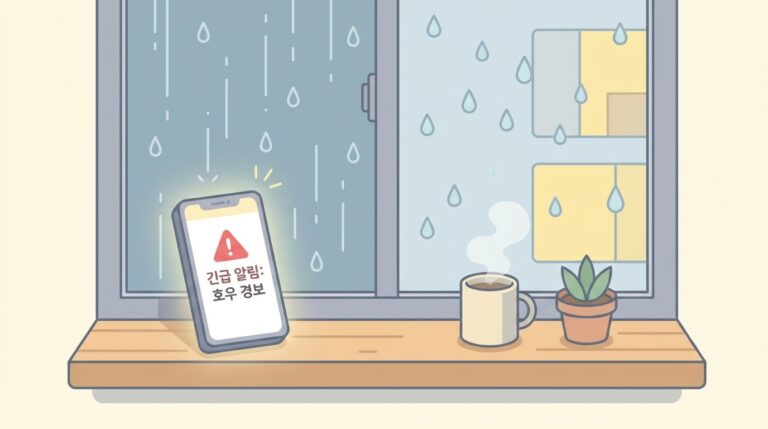
안녕하세요! 매일한글 에디터입니다. Have you ever been relaxing in your cozy room in Seoul when suddenly your smartphone blasts a loud siren emergency sound? You look down and see a bright banner with Korean characters everywhere! If you have ever experienced a typhoon advisory (태풍 주의보) in Korea, you know how alarming or confusing it can feel, especially when you are just starting your Korean learning journey.
Don’t worry at all! Korea has one of the world’s most efficient public safety systems. Learning just a few super simple expressions will help you stay completely calm, safe, and confident whenever severe weather strikes. Based on real feedback from international students and travelers living in Korea, we prepared this easy A1 beginner guide so you can handle rainy weather and emergency alerts like a local Korean friend!
Phase 2: Key Expressions Analysis
1. 비가 많이 와요 (Bi-ga man-i wa-yo)
- Pronunciation: Bi-ga man-i wa-yo (Sounds like: Bee-gah mahn-ee wah-yo)
- Meaning: Literal: “Rain comes a lot.” / Actual: “It is raining heavily!”
- K-Culture Moment: Seeing torrential rain fall outside convenience stores in K-Dramas while characters huddle under clear plastic umbrellas.
- Editor’s Insight: This is the most natural, basic expression to describe rainy weather at the A1 level. ‘비’ means rain, and ‘많이 와요’ means comes a lot.
- Situation Spectrum: Casual ✅ / Semi-formal ✅ / Formal ⚠️
- 🤔 Think About It: In your home country, do people talk about the weather to show friendly concern for one another?
2. 조심하세요 (Jo-sim-ha-se-yo)
- Pronunciation: Jo-sim-ha-se-yo (Sounds like: Joe-sheem-hah-seh-yoh)
- Meaning: Literal: “Do caution.” / Actual: “Please be careful!”
- K-Culture Moment: Friends sending warm text messages with cute umbrella emojis during storm warnings.
- Editor’s Insight: You will hear this expression constantly in everyday life—when stepping off buses, walking on wet ground, or leaving home during bad weather.
- Situation Spectrum: Casual ⚠️ / Semi-formal ✅ / Formal ✅
- 🤔 Think About It: How does warning others about danger reflect Korea’s warm community mindset?
3. 집에 계세요 (Jib-e gye-se-yo)
- Pronunciation: Jib-e gye-se-yo (Sounds like: Jeeb-eh gyeh-seh-yoh)
- Meaning: Literal: “Please stay at home.” / Actual: “Please stay indoors!”
- K-Culture Moment: News anchors announcing safety precautions during disaster broadcasts.
- Editor’s Insight: ‘계세요’ is the polite honorific form of ‘있어요’ (to stay/be). It shows respect while gently advising someone to remain safely indoors.
- Situation Spectrum: Casual 🚫 / Semi-formal ✅ / Formal ✅
- 🤔 Think About It: Why is using honorifics important even when giving urgent safety advice?
Phase 3: Textbook Korean vs. Real Native Korean
Situation 1: Talking about an approaching storm
- 📖 Textbook Korean: 태풍이 접근하고 있습니다. (Tae-pung-i jeob-geun-ha-go iss-seub-ni-da.)
- 🗣️ Real Korean: 태풍 온대요! (Tae-pung on-dae-yo!)
- 💡 Why it’s different: Official reports use heavy verbs like ‘접근하다’ (approach), but native friends casually use reported speech (‘~대요’) to quickly pass on news they heard.
Situation 2: Telling someone not to go out
- 📖 Textbook Korean: 외출을 자제해 주십시오. (Wae-chul-eul ja-je-hae ju-sib-si-o.)
- 🗣️ Real Korean: 오늘 나가지 마세요. (O-neul na-ga-ji ma-se-yo.)
- 💡 Why it’s different: Announcements sound formal and rigid, whereas everyday people use friendly negative commands like ‘~지 마세요’ (please don’t).
Phase 4: K-Culture Deep Dive & Non-verbal Manners
4-1. Nunchi & Gesture
When a high-pitched siren emergency alert sounds in public places like subway trains or cafes, you will notice Koreans instantly perform a subtle ‘Nunchi’ check: everyone looks at their phones simultaneously, quietly reads the notification, nods calmly, and continues their routine or texts family members.
4-2. Culture Code: Disaster Emergency Text Alerts (재난문자)
In Korea, cellular broadcast notifications called 재난문자 (Jae-nan-mun-ja) are sent automatically to all mobile phones in affected areas. During typhoon season (summer to early autumn), receiving these alerts is completely normal. Koreans often react by stocking up on quick snacks from convenience stores and ordering warm comfort food like pajeon (scallion pancakes) to enjoy indoors!
Phase 5: Practical Roleplay Scenario
Setting: You are inside your apartment in Seoul during a Typhoon Advisory. Your Korean friend Minjun calls to check on you.
- Minjun: 🎭 [Looking out the window worriedly] 비가 많이 와요! (Bi-ga man-i wa-yo! / It’s raining heavily!)
- You: 🎭 [Checking smartphone text alert] 맞아, 태풍 주의보예요. (Maj-a, tae-pung ju-ui-bo-ye-yo. / Right, it’s a typhoon advisory.)
- Minjun: 🎭 [Speaking with warm concern] 오늘 나가지 마세요. (O-neul na-ga-ji ma-se-yo. / Don’t go out today.)
- You: 🎭 [Nodding reassuringly] 네, 집에 있을게요. (Ne, jib-e is-seul-ge-yo. / Yes, I will stay home.)
- Minjun: 🎭 [Gesturing to storm outside] 창문도 잘 닫으세요! (Chang-mun-do jal dad-eu-se-yo! / Please close your windows well too!)
- You: 🎭 [Checking window locks] 네, 조심할게요. (Ne, jo-sim-hal-ge-yo. / Yes, I’ll be careful.)
- Minjun: 🎭 [Smiling] 맛있는 음식 시켜 먹어요! (Mas-iss-neun eum-sik si-kyeo meog-eo-yo! / Let’s order delicious food!)
- You: 🎭 [Clapping hands happily] 좋아요! 조심하세요! (Jo-ha-yo! Jo-sim-ha-se-yo! / Sounds great! Be careful!)
🔀 Interactive Branching Choice
Minjun asks you: “바람이 세요! 창문 닫았어요?” (The wind is strong! Did you close the window?)
* Option A: “네, 닫았어요!” (Ne, dad-ass-eo-yo! / Yes, I closed it!)
* 👉 Best Choice! Clear, polite, and reassures your friend immediately.
* Option B: “아니요, 괜찮아요.” (A-ni-yo, gwaen-chan-ah-yo. / No, it’s okay.)
* 👉 Bad Choice! Strong typhoon winds can open or damage loose windows. Safety first!
* Option C: “몰라요.” (Mol-la-yo. / I don’t know.)
* 👉 Risk Choice! Sounds blunt and careless during an emergency.
Phase 6: 10-Second Emotional Shadowing Drill
- [🥺 worriedly] 비가 / 진짜 많이 와요! (Bi-ga / jin-jja man-i wa-yo!)
- [😊 warmly & gently] 오늘 나가지 마시고 / 집에 계세요! (O-neul na-ga-ji ma-si-go / jib-e gye-se-yo!)
- [🙏 earnestly] 모두 / 조심하세요! (Mo-du / jo-sim-ha-se-yo!)
Phase 7: K-Culture Mini Dictionary
- 재난문자 (Jae-nan-mun-ja) | Emergency Broadcast Alert | Cell phone safety notifications issued by the Korean emergency network.
- 태풍 (Tae-pung) | Typhoon | Tropical storms that periodically affect Korea between July and September.
- 안전 (An-jeon) | Safety | A high-frequency word visible on public signage, subways, and shelter maps.
- 우산 (U-san) | Umbrella | Essential everyday item readily available at every Korean convenience store.
Phase 8: Traveler’s Survival Kit
Survival Expressions TOP 3
- 태풍 주의보 (Tae-pung ju-ui-bo) – Typhoon Advisory (Pro Tip: Recognized easily on news banners and phone alerts)
- 바람이 많이 불어요 (Ba-ram-i man-i bul-eo-yo) – It’s very windy (Pro Tip: Useful when describing storm intensity)
- 괜찮아요? (Gwaen-chan-ah-yo?) – Are you okay? (Pro Tip: Universal phrase to express care for friends)
Editor’s Travel Note
For real-time disaster information translated into English, download the Emergency Ready Korea App Download provided by the Ministry of Interior and Safety. Always keep your smartphone charged and stay indoors away from windows during high wind warnings!
Phase 9: A Step Deeper (Culture Insight)
In Korea, warning someone about safety is one of the standard ways to show warm human connection, known as Jeong (정). When friends say “조심하세요” (Please be careful) or check if your windows are closed, it isn’t just safety advice—it is an active expression of warmth and community care.
💬 Your Turn: Have you ever received an emergency text alert while traveling or living in Korea? Share your story in the comments below!
Phase 10: FAQ & Common Mistakes
Q: What should I do when my phone makes a loud siren alert sound in Korea?
A: Remain calm! It is a public 재난문자 (Emergency Text Alert). Open a translation app or check for key target words like 태풍 (Typhoon) or 비 (Rain).
Q: Can I order food delivery during a typhoon advisory?
A: Delivery services often pause or limit delivery routes when rain or wind becomes dangerously severe to protect drivers. It is best to prepare indoor food ahead of time!
Q: What is the difference between 태풍 주의보 and 태풍 경보?
A: 태풍 주의보 is a Typhoon Advisory (cautionary warning stage), while 태풍 경보 is a severe Typhoon Warning (higher emergency alert level).
🚨 Common Mistakes TOP 3
- Mistake: Panicking or ignoring text alerts because they are written in Korean.
- Correct Action: Copy the text into translation tools or identify core keywords like 태풍 and 안전.
- Mistake: Going out to river parks or coastal boardwalks to take photos during heavy rain.
- Correct Action: Stay indoors and keep clear of low-lying areas or flooded paths.
- Mistake: Using casual non-polite speech (안녕) when warning older adults or strangers.
- Correct Action: Always use polite expressions like 조심하세요 (Jo-sim-ha-se-yo)!
Phase 11: Action Mission & Engagement
- 🥉 Bronze Mission: Practice saying “비가 많이 와요!” out loud 3 times.
- 🥈 Silver Mission: Share this safety guide with a friend who is traveling or living in Korea!
- 🥇 Gold Mission: Check your phone settings to confirm disaster alerts are enabled, and spot the word “태풍” on news weather broadcasts.
- 🎮 K-Culture Mission: Watch a scene from a rainy K-Drama episode and spot characters handing each other umbrellas while saying “조심하세요”!
Phase 12: Interactive Quiz Challenge
Q1. What is the correct Korean phrase to tell someone “Please be careful!” during bad weather?
1) 맛있게 드세요
2) 조심하세요
3) 처음 뵙겠습니다
Click to view Answer & Explanation
Answer: 2) 조심하세요 (Jo-sim-ha-se-yo)
Explanation: 조심하세요 means “Please be careful!”, making it the ideal phrase to express safety concern.
Q2. Fill in the blank: “태풍 때문에 비가 ____ 와요.” (Because of the typhoon, it rains a lot.)
1) 많이 (man-i)
2) 조금 (jo-geum)
3) 안 (an)
Click to view Answer & Explanation
Answer: 1) 많이 (man-i)
Explanation: ‘많이’ means “a lot” or “heavily”, so “비가 많이 와요” means “it rains a lot.”
Q3. True or False: In Korea, receiving emergency text alerts (재난문자) on your mobile phone means you should panic immediately.
Click to view Answer & Explanation
Answer: False!
Explanation: 재난문자 are routine public safety warnings sent to inform citizens early so everyone stays safe and prepared.







