

Phase 1: Empathy & Storytelling
안녕하세요! 매일한글 에디터입니다. (Hello! I am the chief editor at Daily Hangul.)
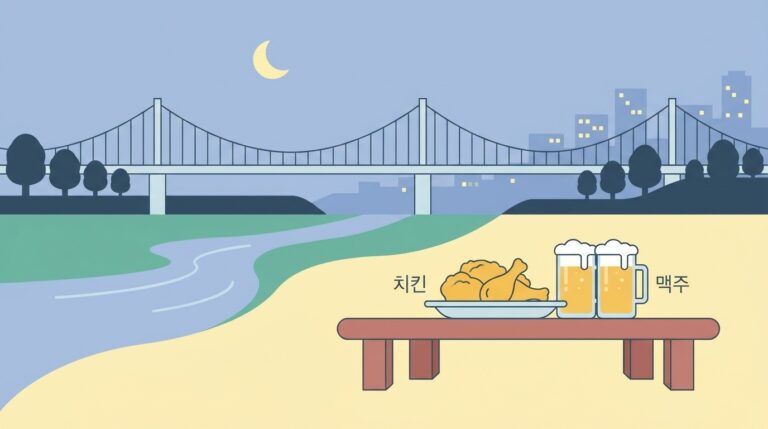
Imagine this: You are sitting by the bustling Han River in Seoul on a breezy Friday evening. The neon lights flicker across the water, and all around you, groups of friends are laughing, clinking cold glasses of beer, and enjoying crispy, fried Korean chicken. You want to join in on this iconic Korean pastime known as Chimaek (치맥)—a delicious combination of Chicken (치킨) and Beer (맥주). But as the server approaches or as you try to place an order on a busy delivery app, panic sets in! What if you order the wrong spice level? How do you ask for extra pickled radish without sounding rude?
As someone who has guided thousands of beginner learners through their first real-world Korean experiences, I know how intimidating ordering food in a noisy environment can be. A1 learners often freeze because textbook phrases sound too formal or complex. That is why this guide is crafted specifically from real student feedback! By learning just a few simple, high-impact phrases, you will transform from a nervous tourist into a confident local enjoying the best nightlife Seoul has to offer. Let’s dive into your ultimate Chimaek survival guide!
Phase 2: Top 3 Core Expressions Deep Dive
1. 맥주 두 잔 주세요 (Maek-ju du jan ju-se-yo)
- Pronunciation: [Maek-ju du jan ju-se-yo] (Sounds like: “Mac-zoo do jahn joo-say-yo”)
- Meaning: Direct: “Beer two glasses give please.” vs Real Nunchi: “Two beers, please!”
- K-Culture Moment: In any K-Drama street pub (Pocha), characters shout this right after sitting down to start the night.
- Editor’s Insight: ‘주세요’ (Ju-se-yo) is your magic wand in Korea. Add it to any noun to politely request it!
- Situation Spectrum:
- Casual: 맥주 두 잔 (⚠️ Only with close friends)
- Semi-formal: 맥주 두 잔 주세요 (✅ Perfect for restaurants/bars)
- Formal: 맥주 두 잔 부탁드립니다 (🚫 Too formal for a casual pub)
- 🤔 Think About It: Why does Korean count drinks using counter words like ‘잔’ (jan) instead of just numbers? How does your native language count beverages?
2. 반반으로 주세요 (Ban-ban-eu-ro ju-se-yo)
- Pronunciation: [Ban-ban-eu-ro ju-se-yo] (Sounds like: “Bahn-bahn-oo-roh joo-say-yo”)
- Meaning: Direct: “Half-half as give please.” vs Real Nunchi: “Half original fried, half sweet & spicy chicken, please!”
- K-Culture Moment: The ultimate dilemma in Korea is choosing between Fried (후라이드) and Sweet Spicy (양념). ‘반반’ solves it instantly!
- Editor’s Insight: ‘반’ (Ban) means half. Repeating it (‘반반’) creates a rhythmic, friendly slang term widely accepted at all chicken joints.
- Situation Spectrum:
- Casual: 반반이요 (✅ Great for fast ordering)
- Semi-formal: 반반으로 주세요 (✅ Most polite & common)
- Formal: 반반으로 주문하겠습니다 (🚫 Unnecessarily stiff)
- 🤔 Think About It: In Korean culture, compromise and harmony are valued highly—even in choosing chicken flavors! Do you have a similar half-and-half concept in your food culture?
3. 치킨무 더 주세요 (Chi-kin-mu deo ju-se-yo)
- Pronunciation: [Chi-kin-mu deo ju-se-yo] (Sounds like: “Chee-keen-moo duh joo-say-yo”)
- Meaning: Direct: “Chicken radish more give please.” vs Real Nunchi: “Could we get more pickled radish, please?”
- K-Culture Moment: Crunchy white pickled radish is essential to cut through the greasy deliciousness of fried chicken!
- Editor’s Insight: ‘더’ (deo) simply means “more”. Put it right before ‘주세요’ to ask for free refills on side dishes.
- Situation Spectrum:
- Casual: 무 더줘 (⚠️ Friend level only)
- Semi-formal: 치킨무 더 주세요 (✅ Polite and clear)
- Formal: 치킨무를 더 부탁드립니다 (🚫 Sounds like a legal petition)
- 🤔 Think About It: Free side dish refills are standard in Korea. How does this compare to dining out in your home country?
Phase 3: Textbook Korean vs Real Native Korean
Situation 1: Ordering Food
- 📖 Textbook Korean: 무엇을 주문하시겠습니까? / 맥주를 주문하고 싶습니다.
- 🗣️ Real Native Korean: 맥주 500 두 잔 주세요! (Maek-ju o-baek du jan ju-se-yo!)
- 💡 Why the difference?: Natives order draft beer by volume (500cc is standard) and keep orders short and fast due to high pub noise.
Situation 2: Calling the Server
- 📖 Textbook Korean: 저기요, 실례합니다. (Excuse me, pardon me.)
- 🗣️ Real Native Korean: 저기요~! (Jeo-gi-yo~!) or simply pressing the table bell!
- 💡 Why the difference?: Service in Korea is rapid. Calling out a crisp ‘저기요’ or pushing the call button gets immediate attention without awkward pleasantries.
Phase 4: K-Culture Deep Dive & Non-Verbal Manners
4-1. Nunchi & Gestures
- Pouring Drinks: When receiving a drink from someone older or superior, hold your glass with both hands (or place one hand under your elbow). Turn your head slightly away when taking a sip!
- Calling Servers: Raise your hand slightly while making gentle eye contact and saying “저기요!”
4-2. Cultural Code: The Chimaek Phenomenon
In Korean culture, Chimaek is not just food; it is a social bonding ritual. After a stressful workday, colleagues and friends gather at chicken pubs to wash away fatigue. Whether watching a soccer match or hanging out near Han River park, ordering chicken via delivery apps (배달) is a rite of passage for living like a local.
Phase 5: Real-World Roleplay Scenario
Setting: A bustling Korean Pub (호프집) in Hongdae. You are sitting at a table with NPC Staff (지은/Ji-eun).
- Turn 1 (Staff): 어서 오세요! 몇 분이세요? (Welcome! How many people?)
- Turn 2 (You): 두 명이요! (Two people!)
- Turn 3 (Staff): 편한 자리에 앉으세요. 메뉴판 여기 있습니다. (Please sit anywhere. Here is the menu.)
- Turn 4 (You): 🎭 [Politely raises hand] 저기요! 주문할게요. (Excuse me! We are ready to order.)
- Turn 5 (Staff): 네, 어떤 걸로 드릴까요? (Yes, what would you like?)
- Turn 6 (You): 🎭 [Points at menu] 반반으로 주세요. 그리고 맥주 두 잔 주세요! (Half-and-half please. And two beers!)
- Turn 7 (Staff): 네! 생맥주 두 잔하고 반반치킨 맞으시죠? (Yes! Two draft beers and half-and-half chicken, right?)
- Turn 8 (You): 네, 맞아요! 감사해요. (Yes, correct! Thank you.)
🔀 Interactive Branching Point
The staff brings the chicken, but forgot your pickled radish! What do you do?
- Option A: 🎭 [Politely shout across table] “저기요, 치킨무 더 주세요!”
- Option B: Wait silently for 20 minutes hoping they notice.
- Option C: Stand up and shout “이봐요! 무 없어요!” (Hey! No radish!)
Feedback:
- Option A (Best): ✅ Perfect! Courteous, direct, and completely natural.
- Option B (Bad): ❌ You will miss out on delicious radish. Servers expect you to call them when needed.
- Option C (Risk): 🚨 Very rude! ‘이봐요’ sounds aggressive and inappropriate in dining settings.
Phase 6: 10-Second Emotion Shadowing Drill
[😊 Excitement & Bright]- 맥주 / 두 잔 / 주세요! (Maek-ju / du jan / ju-se-yo!)
[😋 Hungry & Decisive]- 후라이드 반 / 양념 반으로 / 주세요! (Hu-ra-i-deu ban / yang-nyeom ban-eu-ro / ju-se-yo!)
[🥺 Politeness & Eagerness]- 저기요 / 치킨무 / 더 주세요~! (Jeo-gi-yo / chi-kin-mu / deo ju-se-yo~!)
Phase 7: K-Culture Mini Dictionary
- 치맥 (Chimaek): Portmanteau of 치킨 (Chicken) + 맥주 (Beer). Korea’s iconic late-night dining combination.
- 생맥주 (Saeng-maek-ju): Draft beer. Usually ordered in 500cc glasses (“500 두 잔!”).
- 치킨무 (Chi-kin-mu): Pickled daikon radish cubes served chilled with fried chicken.
- 호프집 (Hof-jip): Traditional Korean-style pub or beer hall.
Phase 8: Traveler’s Survival Kit
Top 3 Emergency Phrases
- 물은 셀프인가요? [Mul-eun sel-peu-in-ga-yo?] – Is water self-service?
- 포장해 주세요. [Po-jang-hae ju-se-yo.] – Please wrap this up / To-go, please.
- 계산서 주세요. [Gye-san-seo ju-se-yo.] – Bill, please.
Editor’s Travel Note
When ordering chicken to your hotel or Han River, download the Naver Map App for location navigation to easily copy-paste your delivery address. Payment by credit card at the door or table is standard across Korea!
Phase 9: A Step Deeper (Reflection Essay)
In Western cultures, eating out is often centered around individual meals. In Korea, dining—especially late-night Chimaek—is an inherently communal act. Ordering shared plates like ‘반반치킨’ reflects the Korean concept of Jeong (정), an unspoken bond of warm affection and sharing. When you share food and pour drinks for one another, you aren’t just eating; you are building a friendship.
💬 Your Turn: What is your favorite late-night comfort food in your home country? Share in the comments below in Korean or English!
Phase 10: FAQ & Common Mistakes
Q: Can I ask for extra side dishes for free in Korea?
A: Yes! Side dishes like pickled radish, dipping sauces, and fried cracker snacks are almost always refilled for free upon request.
Q: How do I get the server’s attention if there is no bell?
A: Simply raise your hand slightly and say “저기요!” (Jeo-gi-yo) in a clear, friendly voice.
Q: Is tipping required at Korean pubs?
A: No! Tipping is not part of Korean culture. Good service is included in the menu prices.
🚨 Common Mistakes TOP 3
- Mistake: Tipping money on the table.
- Correct Action: Do not leave tips; it may confuse staff into chasing you down to return forgotten money.
- Mistake: Pouring your own drink first while older companions wait.
- Correct Action: Pour drinks for others first before accepting a pour for yourself.
- Mistake: Using ‘당신’ (Dang-sin) to call the waiter.
- Correct Action: Say ‘저기요’ or ‘사장님’ instead!
Phase 11: Action Mission
- Bronze Mission: Practice saying “맥주 두 잔 주세요” out loud 3 times in front of a mirror.
- Silver Mission: Record your voice practicing the 10-second emotion shadowing drill and share it on Instagram or TikTok using #DailyHangulChimaek.
- Gold Mission: Visit a Korean fried chicken pub or restaurant and order using only Korean phrases!
🎮 K-Culture Mission: Watch an episode of a K-Drama (like Crash Landing on You) and spot the exact scene where characters eat Chimaek!
Phase 12: Interactive Quiz Challenge
Question 1 (Multiple Choice)
How do you say “Half-and-half, please” in Korean?
* A) 반반으로 주세요
* B) 맥주 주세요
* C) 물 주세요
Click here for Answer & Explanation
Answer: A) 반반으로 주세요!
Explanation: ‘반’ means half. ‘반반으로 주세요’ asks for half original and half sweet & spicy chicken.
Question 2 (Fill in the blank)
“Excuse me!” when calling a server: 저__요!
Click here for Answer & Explanation
Answer: 기 (Jeo-gi-yo / 저기요!)
Explanation: ‘저기요’ literally means “Over there,” but functions as “Excuse me!”
Question 3 (True or False)
You should tip 15% at a pub in Seoul.
Click here for Answer & Explanation
Answer: False!
Explanation: Korea is a non-tipping culture. Tipping is not expected or required anywhere.







