

Phase 1: Empathy
안녕하세요! This is your Daily Hangul editor, your favorite Korean culture navigator! Have you ever landed your dream job or internship at a Korean company, only to freeze when introducing yourself to your teammates? Picture this: You want to call your senior colleague Sarah, but calling her ‘Sarah-ssi’ feels too cold, ‘Sarah Unnie/Noona’ feels too casual for the office, and ‘Sarah Team Jang’ sounds totally wrong! Navigating titles in a Korean workplace can feel like playing a high-stakes puzzle game. One wrong title, and the atmosphere goes completely ice-cold. Don’t worry! Hundreds of our B1 learners have walked into Korean offices feeling terrified of these hierarchy titles. Today, we’ll demystify Korean workplace titles so you can address everyone smoothly, build great relationships with your coworkers, and sound like a seasoned professional from day one!
Phase 2: Core Expressions
1. [성함] [직급]님 ([Name] [Title]-nim)
- Pronunciation: [Seong-ham Title-nim] (Sounds like: Song-ham + Title + Neem)
- Meaning: “Mr./Ms. [Name] [Job Title]” (Literal: Esteemed Name Title)
- K-Culture Moment: In workplace K-Dramas like Misaeng or Business Proposal, you’ll hear employees address superiors like “Kim Deari-nim” (Assistant Manager Kim) or “Lee Bujiang-nim” (Department Head Lee) with a polite bow.
- Editor’s Insight: Always attach -님 (-nim) to job titles when speaking directly to or about superiors in the office. Omitting -nim when talking to a superior is a major social faux pas!
- Situation Spectrum:
- Casual: 🚫
- Semi-formal: ✅
- Formal: ✅
- 🤔 Think About It: Why do you think Korean company culture relies on job titles instead of first names? How does this reflect the value of respect and hierarchy in the workplace?
2. [이름] 대리님 ([Name] Daeri-nim)
- Pronunciation: [Name Dae-ri-nim] (Sounds like: Name + Die-ree-neem)
- Meaning: “Assistant Manager [Name]”
- K-Culture Moment: When the mid-level manager comes over to offer helpful advice on a corporate project, juniors warmly call out, “Minwoo Daeri-nim!”
- Editor’s Insight: ‘Daeri’ (Deputy/Assistant Manager) is often the first managerial rank you’ll closely work with. It’s the sweet spot title for someone who guides you directly.
- Situation Spectrum:
- Casual: ⚠️ (Only outside work if very close)
- Semi-formal: ✅
- Formal: ✅
- 🤔 Think About It: How does addressing someone by their specific title change your professional dynamic compared to calling them “Mr. Smith”?
3. [이름] 씨 ([Name]-ssi)
- Pronunciation: [Name-ssi] (Sounds like: Name + See with a sharp ‘s’)
- Meaning: “Mr./Ms. [Name]”
- K-Culture Moment: Heard in office hallways when peers of similar rank or managers speak to team members who don’t hold a management title yet.
- Editor’s Insight: Caution! Never use [Name]-ssi toward someone higher in rank or age. It is strictly used for peers, equals, or juniors. Calling your boss “Minjun-ssi” will cause instant awkward silence!
- Situation Spectrum:
- Casual: ⚠️
- Semi-formal: ✅
- Formal: 🚫 (Use full title in formal meetings)
- 🤔 Think About It: Is there a similar title in your native language that only works laterally or downward?
Phase 3: Textbook vs. Real Korean
Situation 1: Addressing a Senior Team Leader
- 📖 Textbook Korean: 김민수 과장, 이것 좀 봐주세요. (Kim Minsu Gwajang, igeot jom bwajuseyo. – Minsu Kim Manager, look at this.)
- 🗣️ Real Korean: 과장님, 잠시 이 문서 확인해 주실 수 있으신가요? (Gwajangnim, jamsi i munseo hwaginhae jusil su isseusingayo? – Manager-nim, could you please take a quick look at this document?)
- 💡 Why is it different?: Dropping the honorific -nim after a title sounds robotic and disrespectful in real life. Also, native speakers often drop the person’s last name once context is clear.
Situation 2: Asking a Peer Coworker for Help
- 📖 Textbook Korean: 지민 씨, 나를 도와주세요. (Jimin-ssi, nareul dowajuseyo. – Jimin-ssi, help me.)
- 🗣️ Real Korean: 지민 씨, 혹시 지금 잠깐 시간 괜찮으세요? (Jimin-ssi, hoksi jigeum jamkkan sigan gwaenchanheuseyo? – Jimin-ssi, by any chance do you have a quick moment?)
- 💡 Why is it different?: Direct commands sound demanding. Real Korean workplace interaction relies heavily on soft qualifiers like hoksi (by any chance) and jamkkan (a moment).
Phase 4: K-Culture Deep Dive & Manner
4-1. Nunchi & Gestures
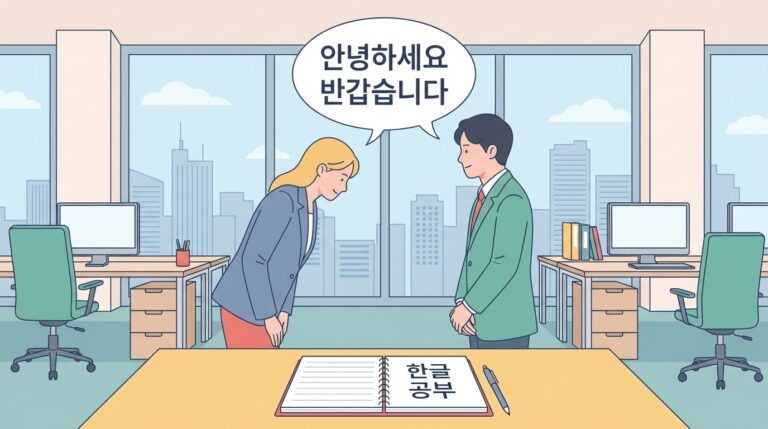
When addressing a senior colleague in Korea, use two hands when handing over documents or business cards. Maintain a gentle 15-degree head tilt (a subtle bow) when saying their title. Avoid direct, intense eye contact while speaking to high executives; soft, polite eye contact with occasional nods demonstrates Nunchi (cultural tact).
4-2. Cultural Code
In Korean corporate dramas like Misaeng or Agency, corporate rank defines communication flow. Understanding job titles like Sawon (Staff), Daeri (Assistant Manager), Gwajang (Manager), and Cha-jang (Senior Manager) isn’t just vocabulary—it’s understanding how respect and responsibility are structured in Korean working society.
Phase 5: Real-Life Roleplay Scenario
Setting: Coffee break corner at a tech startup in Seoul.
NPC: Assistant Manager Park (박대리님) – Friendly, supportive senior team member.
- Turn 1 (You): 박대리님, 커피 드시는 중이세요? (Park Daeri-nim, keopi deusineun jung-iseyo? / 🎭 Smiling warmly while walking over / Park Daeri-nim, are you having coffee?)
- Turn 2 (Park): 아, 네! 씨, 오늘 작성한 보고서 잘 봤어요. (A, ne! [Name]-ssi, oneul jakseonghan bogoseo jal bwasseoyo. / 🎭 Nodding approvingly / Ah, yes! [Name]-ssi, I saw the report you wrote today.)
- Turn 3 (You): 정말요? 감사합니다! 혹시 수정할 부분이 있을까요? (Jeongmalyo? Gamsahabnida! Hoksi sujeonghal bubuni isseulkkal-yo? / 🎭 Clasping hands together eagerly / Really? Thank you! Is there any part I should revise?)
- Turn 4 (Park): 과장님께 드리기 전에 몇 가지만 다듬으면 완벽할 것 같아요. (Gwajangnimkke deurigi jeone myeot gajiman dadeumeumeon wanbyeokhal geot gat-ayo. / 🎭 Taking a sip of coffee / Before giving it to Manager-nim, tweaking a few things will make it perfect.)
- Turn 5 (You): 아, 과장님 피드백도 반영해야 하는군요! (A, Gwajangnim pideubaekdo banyeonghaeya haneungun-yo! / 🎭 Nodding thoughtfully / Ah, so I need to reflect Manager-nim’s feedback too!)
- Turn 6 (Park): 네, 그럼 제가 퇴근 전에 같이 봐드릴까요? (Ne, georeom jega toe-geun jeone gachi bwadeureilkkal-yo? / 🎭 Offering a warm smile / Yes, shall I look over it with you before leaving work?)
- Turn 7 (You): 와, 대리님! 바쁘신데 도와주셔서 진짜 감사해요. (Wa, Daeri-nim! Bappeusinde dowajusyeoseo jinja gamsahaeyo. / 🎭 Bowing slightly with hands together / Wow, Daeri-nim! Thank you so much for helping despite being busy.)
- Turn 8 (Park): 별말씀을요! 우리 팀워크잖아요. (Byeolmalsseumeul-yo! Uri tim-weokeu-jan-ayo. / 🎭 Patting your shoulder lightly / Don’t mention it! That’s what teamwork is for.)
🔀 Interactive Choice Point
How do you ask Manager Kim (Gwajangnim) for a quick review next?
* Choice A: 김민수 씨, 이것 좀 검토해 주세요! (Kim Minsu-ssi, i-geot jom geomtohae juseyo!)
* Choice B: 과장님, 시간 되실 때 이 보고서 봐주실 수 있으신가요? (Gwajangnim, sigan Doesil ttae i bogoseo bwajusil su isseusingayo?)
* Choice C: 민수 형, 이거 봐줘! (Minsu hyeong, igeo bwajwo!)
Feedback:
* Choice A (Risk): ❌ Calling a superior “[Name]-ssi” is rude and inappropriate in a workplace setting.
* Choice B (Best): ✅ Perfect! You used the correct title “Gwajangnim” with polite workplace grammar.
* Choice C (Bad): 🚫 Never use family terms like “Hyeong/Oppa” in official office settings unless explicitly invited to after work hours!
Phase 6: 10-Second Emotional Shadowing Drill
[😊 Expressing Gratitude]- 대리님 / 도와주셔서 / 진짜 감사해요!
- (Daeri-nim / dowajusyeoseo / jinja gamsahaeyo!)
[🥺 Polite Hesitation]- 과장님, / 혹시 / 잠깐 시간 괜찮으세요?
- (Gwajangnim, / hoksi / jamkkan sigan gwaenchanheuseyo?)
Phase 7: K-Culture Mini Dictionary
- 직급 (Jik-geup) | Job Rank / Title | The official hierarchical rank assigned to employees within a company structure.
- 존칭 (Jon-ching) | Honorific Title | Terms of respect added to names or titles (e.g., -님 / -nim) to honor the listener.
- 선배 (Seon-bae) | Senior | A person with more experience in an organization or field.
- 팀장님 (Tim-jang-nim) | Team Leader | The head of a specific team, universally addressed with high respect in corporate offices.
Phase 8: Traveler & Professional Survival Kit
Survival Top 3
- 안녕하세요, [직급]님! (Annyeonghaseyo, [Title]-nim! – Hello, [Title]-nim!)
- 수고하셨습니다! (Sugohasyeossseumnida! – Great work today! / Used when finishing work)
- 먼저 퇴근해보겠습니다. (Meonjeo toe-geun-hae-bo-gesseumnida. – I will head off first.)
Editor’s Travel & Work Note
Need to find your way to corporate meetings or business hubs in Seoul? Always download the Naver Map App Download for real-time subway and transit navigation across business districts like Gangnam and Yeouido.
Phase 9: A Step Deeper
In Korean culture, titles reflect mutual respect and corporate harmony rather than rigid distance. Calling someone by their exact job title shows that you recognize their hard work and authority within the community effort. It fosters professional clarity while building workplace camaraderie.
💬 Your Turn: What job title system does your country use at work? Share your thoughts in the comments below!
Phase 10: FAQ & Common Mistakes
Q: Can I call my boss “Oppa” or
Frequently Asked Questions (FAQ)
Q: What does "[성함] [직급]님 ([Name] [Title]-nim)" mean in Korean and how do you pronounce it?
A: In Korean, "[성함] [직급]님 ([Name] [Title]-nim)" is pronounced [Seong-ham Title-nim] and means: "Mr./Ms. [Name] [Job Title]" (Literal: Esteemed Name Title)
Q: What does "[이름] 대리님 ([Name] Daeri-nim)" mean in Korean and how do you pronounce it?
A: In Korean, "[이름] 대리님 ([Name] Daeri-nim)" is pronounced [Name Dae-ri-nim] and means: "Assistant Manager [Name]"
Q: What does "[이름] 씨 ([Name]-ssi)" mean in Korean and how do you pronounce it?
A: In Korean, "[이름] 씨 ([Name]-ssi)" is pronounced [Name-ssi] and means: "Mr./Ms. [Name]"







