

Master Work-Life Balance at Korean Company Dinners (Hoesik) Like a Local! 🍻
Phase 1: Empathy (Story-Driven Opening)
안녕하세요! I’m your Daily Hangul editor, your trusted Korean buddy! Imagine this: You’ve just finished a long week at your Seoul office. Your team manager happily shouts, “오늘 회식 가자!” (Let’s go for a company dinner today!). You arrive at a bustling Korean barbecue restaurant, the aroma of grilled pork belly filling the air. Suddenly, your senior manager pours a fresh glass of Soju and slides it toward you, saying, “자, 한잔 받아!”. You don’t drink alcohol, or maybe you just want to go home and relax. Panic sets in. Should you drink it to be polite? Will saying ‘no’ ruin your workplace relationships?
Take a deep breath! You’re not alone. Korea’s traditional forced drinking culture (Sool-gang-kwon) is rapidly changing thanks to the modern focus on Work-Life Balance (워라밸 – Worabel). Today, we’re sharing practical, real-world strategies tested by international professionals in Korea to help you decline drinks respectfully while staying a beloved team player!
Phase 2: Top 3 Core Expressions Deep Dive
1. 오늘은 마음만 받겠습니다 (Onuel-eun ma-eum-man bat-get-seum-ni-da)
- Pronunciation: [Oh-neul-eun ma-eum-man bat-get-seum-ni-da] (Sounds like: “Ma-eum” as in mind)
- Meaning: “I will just take your warm intention today.” (Polite way to decline a drink/offer).
- K-Culture Moment: A classic scene in modern office K-dramas where a smart junior employee politely dodges a second round of shots from an enthusiastic manager.
- Editor’s Insight: It highlights Ma-eum (heart/thought). You are accepting their kindness while gently rejecting the physical glass.
- Situation Spectrum: Casual 🚫 / Semi-formal ✅ / Formal ✅
- 🤔 Think About It: How do people in your country reject an unwanted offer at work without sounding rude?
2. 제가 내일 중요한 일정이 있어서요 (Je-ga nae-il jung-yo-han il-jeong-i it-seo-seo-yo)
- Pronunciation: [Je-ga nae-il joong-yoh-han il-jung-ee eet-suh-suh-yoh]
- Meaning: “I have an important schedule tomorrow, so…”
- K-Culture Moment: Used frequently at 10 PM when someone tries to drag you into a 2nd round (Cha) of drinking.
- Editor’s Insight: Ending sentences with ~서요 (~seo-yo) creates a soft, apologetic nuance rather than a harsh refusal.
- Situation Spectrum: Casual ⚠️ / Semi-formal ✅ / Formal ✅
- 🤔 Think About It: Is giving a soft reason better than giving a direct ‘No’ in your culture?
3. 사이다로 건배해도 될까요? (Sa-i-da-ro geon-bae-hae-do doel-kka-yo?)
- Pronunciation: [Sa-ee-da-roh gun-bae-hae-doh dwel-kka-yoh?]
- Meaning: “Can I toast with Chilsung Cider (sprite/soda) instead?”
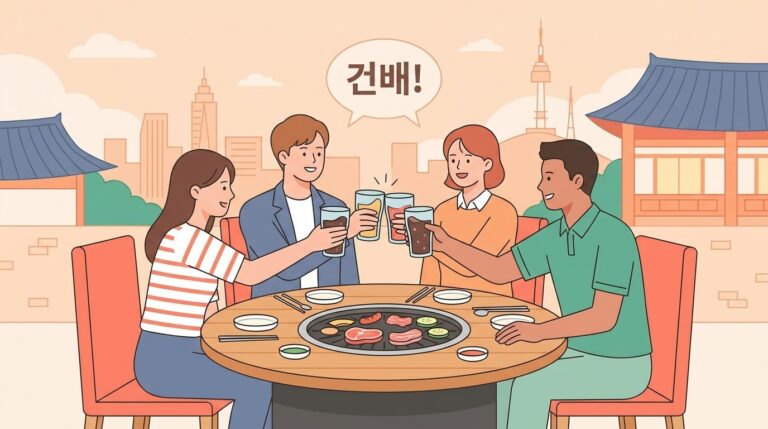
- K-Culture Moment: Gathering around the grill, raising glasses, but substituting alcoholic drinks with soft drinks.
- Editor’s Insight: Showing eagerness to participate in the toast (Geon-bae) proves you value team unity even without drinking!
- Situation Spectrum: Casual ✅ / Semi-formal ✅ / Formal ✅
- 🤔 Think About It: Why is participating in the collective ritual (toast) often more important than what’s actually in your glass?
Phase 3: Textbook Korean vs. Real-World Korean
- Declining a drink
- 📖 Textbook: 저는 술을 못 마십니다. (Jeo-neun sul-eul mot ma-sip-ni-da. / I cannot drink alcohol.)
- 🗣️ Real-World: 저 오늘 술을 잘 못해서 사이다 마실게요! (Jeo o-neul sul-eul jal mot-hae-seo sa-i-da ma-sil-ge-yo! / I’m not feeling up for alcohol today, so I’ll drink soda!)
- 💡 Why is it different?: Adding 오늘 (today) implies you’re not rejecting the group, just adjusting for today, which keeps the atmosphere light!
- Leaving early
- 📖 Textbook: 저는 먼저 집에 가겠습니다. (Jeo-neun meon-jeo ji-be ga-get-seum-ni-da. / I will go home first.)
- 🗣️ Real-World: 먼저 일어나 보겠습니다! 오늘 정말 즐거웠습니다. (Meon-jeo i-reo-na bo-get-seum-ni-da! O-neul jeong-mal jeul-geo-wot-seum-ni-da. / I’ll get going first! I had a great time today.)
- 💡 Why is it different?: Saying 일어나다 (to stand up) is a polite, indirect metaphor for leaving, sounding much softer.
Phase 4: K-Culture Deep Dive & Non-Verbal Manners
4-1. Nunchi (눈치) & Gestures
When turning down a drink in Korea, always use two hands (두 손). Cross your hands lightly over your glass or cover the top of your glass with one hand while bowing your head slightly. Smile softly to maintain a warm atmosphere!
4-2. Cultural Code: The ‘Worabel’ Revolution
Traditionally, Hoesik was mandatory extensions of work. However, the rise of modern corporate culture, legal work-hour caps, and the popularity of the trendy term 워라밸 (Work-Life Balance) have completely transformed this scene! Nowadays, lunch Hoesiks, bowling night team-buildings, or alcohol-free cultural gatherings are becoming the new normal.
Phase 5: Interactive Role-Play Scenario
Setting: A loud Korean BBQ restaurant. Manager Kim (김 부장) is pouring shots for everyone.
- Manager Kim: OOO씨, 오늘 한주 동안 고생 많았어! 자, 한잔 받아!
(OOO-ssi, o-neul han-ju dong-an go-saeng ma-na-sseo! Ja, han-jan ba-da!)
(OOO, great work this week! Here, take a shot!)
🎭 Gestures: Manager holds a bottle of Soju with two hands, smiling broadly. -
You: 부장님, 오늘 마음만 받으면 안 될까요? 제가 약을 먹고 있어서요.
(Bu-jang-nim, o-neul ma-eum-man ba-deu-myeon an doel-kka-yo? Je-ga ya-geul meok-go it-seo-seo-yo.)
(Manager Kim, could I just take your warm intent today? I’m taking medicine.)
🎭 Gestures: Lightly cup hands near your chest, tilting head apologetically. -
Manager Kim: 아, 그래? 약 먹을 땐 술 마시면 안 되지. 아쉽네!
(A, geu-rae? Yak meok-eul ttaen sul ma-si-myeon an doe-ji. A-swip-ne!)
(Ah, really? You shouldn’t drink while taking medicine. That’s a pity!) -
You: 대신 사이다로 건배하겠습니다! 부장님, 건배!
(Dae-sin sa-i-da-ro geon-bae-ha-get-seum-ni-da! Bu-jang-nim, geon-bae!)
(Instead, I will toast with soda! Cheers, Manager!)
🎭 Gestures: Raise your glass filled with soda using two hands and clink lower than his glass.
🔀 Interactive Choice:
Manager Kim says: “2차로 노래방 가자!” (Let’s go to Karaoke for round 2!)
* Option A: “저는 집에 가고 싶습니다.” (I want to go home.)
* Option B: “2차요? 죄송하지만 내일 중요한 일정이 있어서 먼저 일어나 보겠습니다!”
* Option C: “노래방 싫어합니다.”
Feedback:
* Option A (Bad): Too direct! It sounds cold.
* Option B (Best): Perfect balance of respect, reason, and polite farewell.
* Option C (Risk): Very risky. It hurts team morale.
Phase 6: 10-Second Emotion Shadowing Drill
[😊 Warmly & Apologetically]오늘 / 마음만 / 받겠습니다! (O-neul / ma-eum-man / bat-get-seum-ni-da!)[🥺 Polite & Soft]제가 내일 / 중요한 일정이 / 있어서요… (Je-ga nae-il / jung-yo-han il-jeong-i / it-seo-seo-yo…)[🎉 Enthusiastic & Bright]사이다로 / 건배해도 / 될까요? (Sa-i-da-ro / geon-bae-hae-do / doel-kka-yo?)
Phase 7: K-Culture Mini Dictionary
- 워라밸 (Wo-ra-bael) | Work-Life Balance | Short for Work-Life Balance. Used everywhere in modern employment contexts.
- 회식 (Hoe-sik) | Company Dinner | Official social gathering among coworkers, usually over food and drinks.
- 2차 (I-cha) | Second Round | Moving to another venue (like a pub or noraebang) after dinner.
- 건배 (Geon-bae) | Cheers / Toast | Literally translates to “empty glass”, used during toasts.
Phase 8: Traveler’s Survival Kit
Survival Expressions Top 3
- 저 술 못 마셔요. (Jeo sul mot ma-syeo-yo.) – I can’t drink alcohol.
- 물 좀 주세요. (Mul jom ju-se-yo.) – Please give me some water.
- 먼저 갈게요! (Meon-jeo gal-ge-yo!) – I’ll head out first!
Editor’s Travel Note
Need to catch the last subway home after a dinner? Make sure to download the Naver Map App Download to check real-time Korean public transit schedules!
Phase 9: A Step Deeper (Reflection)
In Korean corporate life, drinking was long viewed as a tool to break down social hierarchies and build genuine camaraderie (Jeong). However, modern Korean society is increasingly valuing personal boundaries and individual well-being over collective drinking rituals.
💬 Your Turn: How are company dinners managed in your country? Let us know in the comments below!
Phase 10: FAQ & Common Mistakes
Q: Is it rude to decline a drink from a senior manager in Korea?
A: Not anymore! As long as you use soft, polite phrasing and participate in toasts using soda or water, it is completely socially acceptable.
Q: Should I pour my own drink at a Hoesik?
A: Traditionally, pouring your own drink (Ja-jak) is avoided. It’s polite to pour for others and let them pour for you.
Q: What if they keep insisting I drink?
A: Simply state health reasons gently, such as taking medication or feeling unwell (몸이 좀 안 좋아서요).
🚨 Common Mistakes
- Mistake 1: Pouring drinks with only one hand for your boss.
- Correct Action: Hold the bottle with your right hand and support your right elbow/wrist with your left hand.
- Mistake 2: Turning your head back toward the boss while taking a shot.
- Correct Action: Turn your body slightly away from seniors when sipping.
Phase 11: Action Mission
- Bronze: Practice saying “오늘 마음만 받겠습니다” out loud 3 times in front of a mirror.
- Silver: Share this article on social media and tag your Korean-learning study buddy!
- Gold: Try ordering a non-alcoholic drink using “사이다로 주실 수 있나요?” at a local Korean venue.
🎮 K-Culture Mission: Watch a episode of an office K-drama (like Misaeng or Business Proposal) and spot a scene where coworkers say “건배!”
Phase 12: Interactive Quiz Challenge
- What is the modern Korean abbreviation for Work-Life Balance?
a) 회식
b) 워라밸
c) 건배 -
True or False: Holding your glass with one hand when receiving a drink from an elder is good etiquette in Korea.
🔍 Click here for Answers & Explanations!
- Answer: b) 워라밸 (Short for Work-Life Balance).
- Answer: False (You should always use two hands to show respect!).







