

Phase 1: Empathy (Opening Story)
안녕하세요! This is your trusted Lead Editor at Daily Hangul, your 10-year local culture navigator. Welcome back!
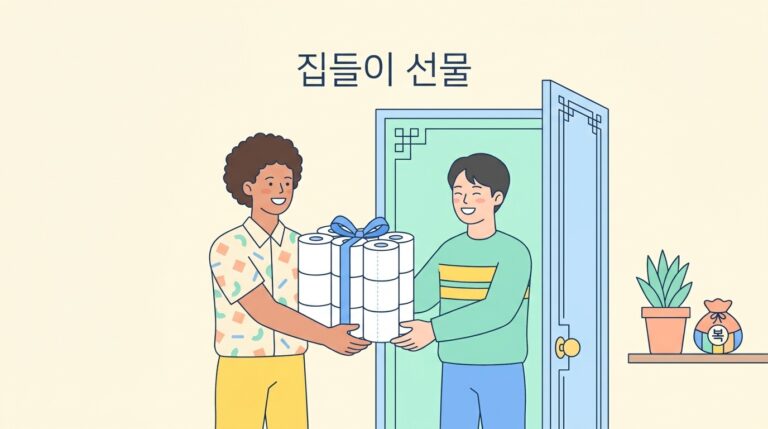
Imagine this: You finally got invited to a friend’s new apartment in Seoul for a 집들이 (Housewarming Party). You want to be a great guest, so you walk into a local supermarket, ready to buy a gift. But wait… you see people carrying massive rolls of toilet paper and giant bottles of laundry detergent!
You start overthinking: “Wait, toilet paper? Detergent? Am I secretly insulting their hygiene if I bring this?!”
Don’t panic! In Korea, giving toilet paper and detergent is actually the ultimate wish for success and good fortune. Toilet paper symbolizes things unraveling smoothly (휴지가 잘 풀리다), and detergent bubbles mean wealth rising! Hundreds of our A2 learners used to feel confused by this exact situation. But after reading this guide, you will confidently walk into any Housewarming party, hand over these practical gifts, and drop the perfect polite Korean phrases like a true insider.
Phase 2: Core Expressions Deep Dive
1. 휴지 좀 사 왔어요. (Huji jom sa wassoyo.)
- Pronunciation: [Hoo-ji jom sa wah-sso-yo] (Think of ‘Hoo’ like blowing out a candle!)
- Meaning: “I bought some toilet paper.” (Literal: Toilet paper a little bought came)
- K-Culture Moment: Seen in almost every modern Korean slice-of-life drama when a friend casually visits a newly rented studio apartment (원룸).
- Editor’s Insight: Adding ‘좀’ (jom) doesn’t just mean ‘a little’—it softens your voice, making you sound humble and polite rather than boastful about bringing a gift.
- Situation Spectrum: Casual (⚠️) / Semi-formal (✅) / Formal (🚫)
- 🤔 Think About It: In your country, is it normal to bring practical household items to a party, or do people prefer wine and flowers?
2. 집들이 선물이에요. (Jipdeuri seonmul-ieyo.)
- Pronunciation: [Jeep-deu-ree seon-mool-ee-eh-yo] (Say ‘Jeep’ softly, followed by ‘dree’)
- Meaning: “This is a housewarming gift.”
- K-Culture Moment: Handing over a gift bag right at the front door (현관) while taking off your shoes.
- Editor’s Insight: ‘집들이’ (Jipdeuri) comes from ‘집’ (house) + ‘들이다’ (to enter/let in). Using this phrase shows you understand Korean host traditions!
- Situation Spectrum: Casual (✅) / Semi-formal (✅) / Formal (✅)
- 🤔 Think About It: Why do you think Korean culture values practical gifts that help a household save daily expenses?
3. 모든 일이 잘 풀리길 바랄게요! (Modeun iri jal pool-rigil baral-geyo!)
- Pronunciation: [Mo-deun ee-ree jal pool-ree-gheel bah-ral-gheh-yo]
- Meaning: “I hope everything unravels smoothly for you!”
- K-Culture Moment: Toasting with a glass of beer or sodas during the housewarming dinner.
- Editor’s Insight: This uses a play on words! Just as toilet paper unrolls easily (풀리다), your friend’s job, health, and business will unfold smoothly (잘 풀리다).
- Situation Spectrum: Casual (⚠️) / Semi-formal (✅) / Formal (✅)
- 🤔 Think About It: Does your language have puns that connect physical actions to luck or success?
Phase 3: Textbook Korean vs. Real Korean
Situation 1: Presenting the Detergent Gift
- 📖 Textbook: 세제를 받아 주세요. (Seje-reul bada juseyo. / Please accept the detergent.)
- 🗣️ Real Korean: 이거 세제예요! 거품처럼 부자 되세요! (Igeo seje-yeyo! Geopum-cheoreom buja doeseyo! / Here’s detergent! Become rich like these bubbles!)
- 💡 Why is it different? Nobody speaks like a robot at a home party. Korean locals love cheerful, punny wishes about getting rich!
Situation 2: Responding to Hospitality
- 📖 Textbook: 초대해 주셔서 감사합니다. (Chodaehae jusyeoseo gamsahamnida. / Thank you for inviting me.)
- 🗣️ Real Korean: 와, 집 진짜 좋네요! 초대해 줘서 고마워요. (Wa, jip jinjja jonneyo! Chodaehae jwoseo gomawoyo. / Wow, your home is so nice! Thanks for inviting me.)
- 💡 Why is it different? Complementing the home right away breaks the ice and instantly warms up the room.
Phase 4: K-Culture Deep Dive & Mannerisms
4-1. Nunchi (눈치) & Gestures
- Two-Handed Delivery: ALWAYS hand over the gift using both hands (or support your right forearm with your left hand). Doing it with one hand looks dismissive!
- Doorway Etiquette: Take off your shoes facing away from the living room, neatly lining them up. Never step on the floor while still wearing shoes!
4-2. Cultural Code: The Magic of Detergent & Paper
In the 1960s-70s post-war Korea, daily household supplies were precious. Toilet paper and detergent were premium commodities. Toilet paper (휴지) meant smooth sailing without hitches, while laundry detergent (세제) created rich bubbles (거품)—a metaphor for accumulating wealth fast. Today, it remains a beloved, practical tradition!
Phase 5: Roleplay Scenario
Setting: You are arriving at your Korean friend Minjun’s new apartment for his Housewarming.
Characters: You (Learner) & Minjun (민준 – Friendly host)
- Minjun: 어서 오세요! 와 줘서 고마워요! (Eoseo oseyo! Wa jwoseo gomawoyo!)
🎭 [Smiles warmly and opens the door wide] - You: 안녕하세요! 초대해 줘서 고마워요. (Annyeonghaseyo! Chodaehae jwoseo gomawoyo.)
🎭 [Bow slightly with a smile] - You: 이거 집들이 선물이에요. 휴지 좀 사 왔어요. (Igeo jipdeuri seonmul-ieyo. Huji jom sa wassoyo.)
🎭 [Hand over the big bundle of toilet paper using both hands] - Minjun: 와! 휴지 진짜 많이 필요했는데, 고마워요! (Wa! Huji jinjja mani pil-yohaenneunde, gomawoyo!)
🎭 [Receives gift joyfully with both hands] - You: 모든 일이 휴지처럼 잘 풀리길 바랄게요! (Modeun iri hujicheoreom jal pool-rigil baral-geyo!)
🎭 [Clap hands cheerfully] - Minjun: 감동이에요! 집 구경할래요? (Gamdong-ieyo! Jip gugyeonghallaeyo?)
🎭 [Gives a warm tour of the living room] - You: 와, 집이 진짜 넓고 깨끗하네요! (Wa, jibi jinjja neolpgo kkaekkeut-haneyo!)
🎭 [Look around appreciously] - Minjun: 고마워요! 편하게 앉으세요, 맛있는 거 먹어요! (Gomawoyo! Pyeonhageanjeuseyo, masinneun geo meogeoyo!)
🎭 [Points to the dining table]
🔀 Interactive Choice Point
Minjun asks: “음료수 뭐 마실래요? 맥주? 콜라?” (What would you like to drink? Beer? Coke?)
* Choice A: 아무거나 주세요! (Give me anything!) -> Best! Very flexible and friendly in Korean dining contexts.
* Choice B: 저는 물이 좋아요! (I like water!) -> Good! Clear and polite.
* Choice C: 손님한테 왜 물어봐요? (Why do you ask a guest?) -> Risk! Sounds aggressive and rude!
Phase 6: 10-Second Emotion Shadowing Drill
[😊 Joyful & Warm]이거 / 집들이 / 선물이에요! (Igeo / jipdeuri / seonmul-ieyo!)[🎉 Enthusiastic & Hopeful]모든 일이 / 잘 풀리길 / 바랄게요! (Modeun iri / jal pool-rigil / baral-geyo!)[😮 Impressed & Friendly]와, / 집이 진짜 / 좋네요! (Wa, / jibi jinjja / jonneyo!)
Phase 7: K-Culture Mini Dictionary
- 휴지 (Huji) | Toilet Paper / Tissues | Essential practical housewarming gift symbolizing smooth success.
- 세제 (Seje) | Detergent | Gift symbolizing wealth rising like soap bubbles.
- 집들이 (Jipdeuri) | Housewarming party | Gathering friends/family to celebrate moving into a new home.
- 거품 (Geopum) | Bubbles / Foam | Used metaphorically to mean rapid growth of money or success.
Phase 8: Traveler’s Survival Kit
Top 3 Survival Phrases
- 근처 마트가 어디예요? (Geuncheo mateuga eodiyeyo? / Where is a nearby supermarket?)
- 휴지 어디에 있어요? (Huji eodie issoyo? / Where is the toilet paper?)
- 포장해 주세요. (Pojang-hae juseyo. / Please wrap/bag this up for me.)
- Pro Tip: When buying heavy toilet paper or detergent bundles, use a navigation app like Naver Map App Download to find the closest convenience store or supermarket right around the corner!
Phase 9: A Step Deeper (Reflection)
Korean gift-giving isn’t about how expensive an item is; it’s deeply rooted in 정 (Jeong – affection and mutual support). Gifting practical everyday items like toilet paper shows thoughtfulness for the host’s daily living costs while sharing clever wordplay for good luck.
💬 Your Turn: Leave a comment below! What is the most surprising housewarming gift in your culture?
Phase 10: FAQ & Common Mistakes
Q: Can I bring wine or cake instead of toilet paper?
A: Yes! Modern Koreans, especially younger generations, also appreciate wine, candles, or dessert. However, toilet paper and detergent remain classic, fun defaults!
Q: Is it okay to bring a single small roll of paper?
A: It’s better to buy a multi-pack bundle (휴지 세트) from a supermarket. A single roll might look like you took it out from a public bathroom!
Q: Should I open my gift in front of the host?
A: In Korea, hosts usually set gifts aside to open after guests leave, so don’t feel offended if they don’t open it immediately!
🚨 Common Mistakes TOP 3
- ❌ Handing gifts with one hand: ALWAYS use two hands.
- ❌ Wearing shoes inside: Take off your footwear at the entrance threshold.
- ❌ Saying ‘비싸요’ (It’s expensive): Avoid mentioning prices; focus on good wishes!
Phase 11: Action Mission
- 🥉 Bronze: Say “집들이 선물이에요” 3 times out loud in front of a mirror.
- 🥈 Silver: Send a message to your language exchange partner wishing them “모든 일이 잘 풀리길 바랄게요!”
- 🥇 Gold: Visit a supermarket in Korea, spot the paper bundle section, and practice saying “휴지 어디 있어요?”
🎮 K-Culture Challenge: Watch a Korean reality show (like I Live Alone) and spot how guests enter a housewarming party!
Phase 12: Interactive Quiz Challenge
Q1. What does gifting toilet paper (휴지) symbolize at a Korean housewarming party?
A) Cleaning the house together
B) Things unrolling smoothly and successfully
C) Wishing for a quiet life
Click to reveal Answer & Explanation!
Answer: B
Toilet paper unrolls easily (잘 풀리다), which symbolizes all future work and life unraveling smoothly without problems!
Q2. Fill in the blank: “이거 _____ 선물이에요.” (This is a housewarming gift.)
A) 결혼
B) 생일
C) 집들이
Click to reveal Answer & Explanation!
Answer: C
‘집들이’ means housewarming! ‘결혼’ is wedding and ‘생일’ is birthday.







