

안녕하세요! 매일한글 에디터입니다.
Have you ever watched a K-drama like My Mister (나의 아저씨) or Our Blues (우리들의 블루스) and felt deeply moved by how an elder supports a younger person—not by lecturing them, but by listening quietly and taking responsibility? In Korea, where hierarchy and age have traditionally dictated social dynamics, the concept of what makes a true adult is undergoing a massive shift. Young generations in Korea increasingly distinguish between a pushy Kkondae (꼰대) and a respected elder (존경받는 어른).
If you are learning Korean at the intermediate level (B2), understanding this cultural nuance is essential. Expressing respect without sounding overly archaic, or discussing modern societal values like generation gaps (세대 차이), allows you to have meaningful, deep conversations with native speakers. Based on real feedback from our foreign learners living in Seoul, knowing how to express respect and maturity elevates your Korean from textbook-correct to culturally authentic.
Phase 2: Core Expressions Deep Dive
1. 나잇값을 하다
- Pronunciation: [Nait-ggeap-seul ha-da] (Sounds like “night-gaps-eul ha-da”)
- Meaning: Literally “To do one’s age’s worth” ➔ Act your age / Behave maturely.
- K-Culture Moment: Used frequently in family dramas when an older sibling or adult acts irresponsibly, and a elder relative sighs, “제발 나잇값 좀 해라!” (Please act your age!).
- Editor’s Insight: This phrase carries a mild reprimand or expectation. Saying someone doesn’t do their age’s worth (나잇값을 못하다) implies they lack emotional maturity despite being older.
- Situation Spectrum: Casual ⚠️ | Semi-formal ✅ | Formal 🚫
- 🤔 Think About It: In your culture, does age automatically grant respect, or is respect earned through actions?
2. 귀감이 되다
- Pronunciation: [Gwi-gam-i doe-da] (Sounds like “gwee-gam-ee dway-da”)
- Meaning: Literally “To become a turtle shell mirror” ➔ To set a fine example / To be a role model.
- K-Culture Moment: Heard in official speeches, news, or award shows honoring mentors who bridge the generation gap with wisdom.
- Editor’s Insight: This is an elegant B2-level expression. Instead of just saying “좋은 사람이다” (They are a good person), using “귀감이 되는 어른이다” shows high language proficiency.
- Situation Spectrum: Casual 🚫 | Semi-formal ✅ | Formal ✅
- 🤔 Think About It: What qualities make an older mentor a true role model in your hometown?
3. 솔선수범하다
- Pronunciation: [Sol-seon-su-beom-ha-da] (Sounds like “soul-seon-soo-beom-ha-da”)
- Meaning: Literally “To lead at the front and set an example with one’s own hands” ➔ To lead by example.
- K-Culture Moment: In corporate or community settings, respected seniors who pitch in during difficult cleanups or overtimes rather than just barking orders.
- Editor’s Insight: Korean youth deeply respect leaders who 솔선수범하다 rather than just talking. It is the ultimate antidote to being called a Kkondae.
- Situation Spectrum: Casual ⚠️ | Semi-formal ✅ | Formal ✅
- 🤔 Think About It: Is leading by example valued over verbal authority in your country’s workplaces?
Phase 3: Textbook Korean vs. Real Korean
Situation 1: Praising an elder’s wise behavior
- 📖 Textbook Korean: “그 어른은 매우 존경스럽습니다.” (That elder is very respectable.)
- 🗣️ Real Korean: “진짜 존경할 만한 어른이에요. 본받고 싶어요.” (They’re truly an elder worth respecting. I want to emulate them.)
- 💡 Why the difference? 존경스럽다 can sound like a dictionary reading. Adding ~할 만하다 (worth doing) and 본받다 (to emulate) feels much warmer and natural.
Situation 2: Expressing annoyance at an authoritative elder
- 📖 Textbook Korean: “저분은 나이가 많지만 예의가 없습니다.” (That person is old but rude.)
- 🗣️ Real Korean: “나이만 많다고 다 어른은 아니죠.” (Just being older doesn’t make someone a real adult.)
- 💡 Why the difference? Modern Koreans frequently use this proverb-like sentence to critique elders who demand respect solely based on age.
Phase 4: K-Culture Deep Dive & Non-Verbal Manners
4-1. Nunchi & Gestures: Listening as a Respected Elder
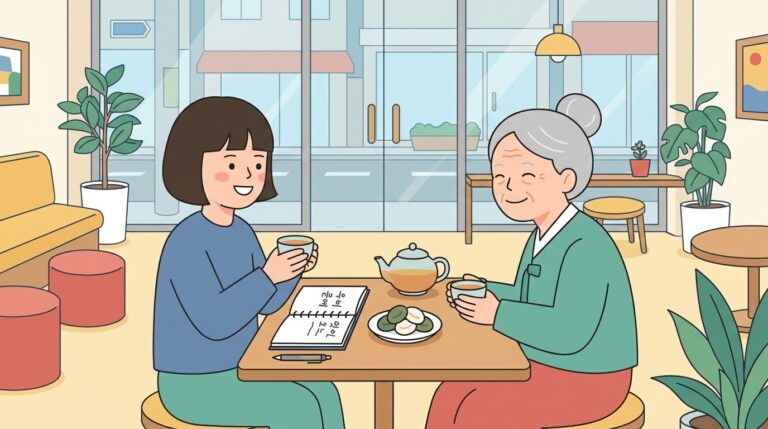
In traditional settings, younger people bow lower and use two hands to pour drinks. However, a modern respected adult shows respect downward (내리사랑): when listening to a younger person, they nod slowly, avoid interrupting, and maintain relaxed eye contact without crossing their arms.
4-2. Culture Code: The Death of “Kkondae-ism”
The term Kkondae (꼰대) originally meant an old person, but now describes anyone who forces their outdated views on others using seniority. Respected elders in modern K-Dramas show humility—they admit mistakes and treat younger colleagues as equal partners.
Phase 5: Real-Life Roleplay Scenario
Setting: A company dinner (회식). Min-soo (a senior manager in his 50s) and Sophia (an intermediate foreign employee).
- Min-soo: 소피아 씨, 요즘 젊은 직원들이랑 소통하기가 쉽지 않네요. (Sophia, it’s not easy communicating with younger employees these days.)
- Sophia: 🎭 (Listening attentively) 세대 차이 때문에 그러세요, 부장님? (Is it because of the generation gap, Manager?)
- Min-soo: 권위적으로 보이기 싫은데, 어떻게 해야 귀감이 되는 선배가 될까요? (I don’t want to look authoritative, but how can I become a senior who sets a good example?)
- Sophia: 🎭 (Warm smile) 조언보다 말을 먼저 들어주시면 다들 좋아할 거예요. (If you listen before giving advice, everyone will appreciate it.)
- Min-soo: 아, 제가 먼저 솔선수범하고 들어주어야겠군요. (Ah, I should lead by example and listen first.)
- Sophia: 맞아요. 부장님처럼 노력하시는 분이 진짜 멋진 어른이죠. (Exactly. Someone who makes an effort like you is a truly cool adult.)
- Min-soo: 허허, 고마워요. 소피아 씨 덕분에 생각이 넓어졌어요. (Haha, thank you. Thanks to you, my perspective broadened.)
- Sophia: 🎭 (Nodding gently) 천만에요. 저도 부장님께 항상 많이 배워요. (You’re welcome. I also learn a lot from you always.)
🔀 Interactive Choice Point
How should Sophia respond when Min-soo asks if he acts like a Kkondae?
* Option A: “네, 조금 꼰대 같으세요.” (Direct statement)
* 🚫 Risk: Too direct for business Korean etiquette; might cause awkwardness.
* Option B: “전혀요! 부장님은 솔선수범하시고 경청해 주시는 진정한 어른이세요.” (Complimenting core traits)
* ✅ Best: Polite, highly encouraging, and utilizes intermediate vocabulary naturally.
* Option C: “상관없어요. 신경 쓰지 마세요.” (Indifferent response)
* ⚠️ Bad: Sounds dismissive and disinterested in the senior’s reflection.
Phase 6: 10-Second Emotional Shadowing Drill
- [😊 Warm & Admiration]
나이만 많다고 어른이 아니라 / 솔선수범하는 모습이 / 진짜 멋있어요.
(Na-i-man man-ta-go eo-reun-i a-ni-ra / sol-seon-su-beom-ha-neun mo-seup-i / jin-jja meos-is-seo-yo.) -
[🥺 Empathetic & Gentle]
세대 차이를 줄이려고 / 노력하시는 모습에 / 정말 감동했어요.
(Se-dae cha-i-reul ju-ri-ryeo-go / no-ryeok-ha-si-neun mo-seup-e / jeong-mal gam-dong-haess-eo-yo.)
Phase 7: K-Culture Mini Dictionary
- 꼰대 (Kkondae): An condescending person (often older) who expects deference based solely on age/rank.
- 내리사랑 (Naeri-sarang): Love flowing downward—the traditional value of elders caring unconditionally for juniors.
- 격의 없다 (Gyeok-ui eopt-da): To be open, approachable, and free of unnecessary formality.
- 귀감 (Gwigam): A paragon, role model, or worthy example to follow.
Phase 8: Traveler’s Survival Kit
TOP 3 Expressions
- 도와주셔서 감사합니다. (Do-wa-ju-seo-seo gam-sa-ham-ni-da.) – Thank you for helping me.
- 배려해 주셔서 감동했어요. (Bae-ryeo-hae ju-seo-seo gam-dong-haess-eo-yo.) – I was touched by your thoughtfulness.
- 말씀 많이 들었습니다. (Mal-sseum man-i deul-eoss-seum-ni-da.) – I’ve heard a lot about you (said to respected elders).
- Editor’s Travel Note: When traveling around Korea, you can easily navigate public transit to visit cultural heritage sites using the 네이버 지도 앱 다운로드 guide for seamless routing.
Phase 9: One Step Deeper
In traditional Korea, age dictated social authority. Today, Korean society is redefining respect. Age alone no longer guarantees esteem; true respect is awarded to adults who demonstrate empathy, self-reflection, and open-mindedness across generational lines.
💬 Your Turn: Who is a adult in your life that you respect the most? Share your stories in the comments below in Korean!
Phase 10: FAQ & Common Mistakes
Q: Is calling someone a 꼰대 (Kkondae) directly to their face acceptable?
A: No! It is a strong slang insult. You should only use it when discussing general behaviors in private conversations with friends.
Q: How can I complement an older person on being open-minded?
A: Use expressions like “마음이 정말 열려 있으세요” (You are really open-minded) or “생각이 젊으세요” (Your mindset is young and fresh).
Q: Does using 존댓말 (honorifics) automatically make me polite?
A: Words matter, but non-verbal cues like tone of voice, nodding, and listening without interrupting are equally vital in Korean politeness.
🚨 Common Mistakes
- ❌ Mistake: Calling an older superior “너” or using 반말 to show friendliness.
- ✅ Correct Action: Maintain honorifics (~시/습니다) while using warm facial expressions.
- ❌ Mistake: Overusing dictionary words like “연장자” in casual conversation.
- ✅ Correct Action: Use natural terms like “어르신” (polite for elderly) or “선배님” (senior).
- ❌ Mistake: Assuming all older Koreans expect submissive obedience.
- ✅ Correct Action: Express your opinion politely using phrases like “제 생각에는~” (In my opinion…).
Phase 11: Action Mission
- 🥉 Bronze: Write 3 sentences using 솔선수범하다, 귀감이 되다, and 나잇값 in your study notebook.
- 🥈 Silver: Record yourself speaking Phase 6 shadowing sentences and review your tone.
- 🥇 Gold: Use one core expression during your next online Korean tutoring lesson or conversation exchange!
- 🎮 K-Culture Mission: Watch an episode of a slice-of-life K-drama and identify one scene where an elder acts as a role model.
Phase 12: Interactive Quiz Challenge
1. Fill-in-the-blank:
남에게 말로만 시키지 않고 스스로 먼저 행동하는 것을 ‘____하다’라고 합니다.
Click to reveal answer
정답: 솔선수범 (솔선수범하다는 자발적으로 먼저 행동함을 의미합니다.)
2. True or False:
Calling an older boss ‘나잇값을 하세요’ is a polite compliment.
Click to reveal answer
정답: False (‘나잇값을 하다’ is a reprimand meaning ‘act your age’. Never say it to a boss!)







