

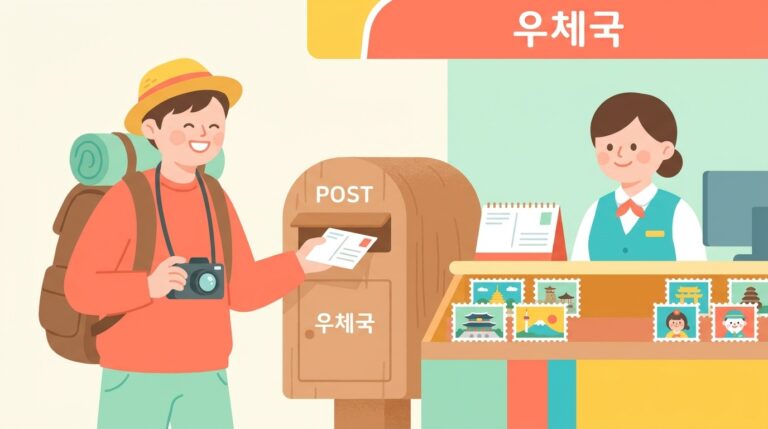
Phase 1: 공감 (Empathetic Opening)
안녕하세요! 매일한글 에디터입니다. 😊
Have you ever wanted to send a handwritten letter or a cute postcard to your favorite K-pop bias, a Korean friend, or your family back home while traveling in Korea? You step inside a bright, busy Korean post office (우체국), holding your precious postcard. But suddenly, your mind goes blank! What do you say to the staff? How do you ask for a stamp? Do you need to weigh it?
Don’t worry at all! Sending a letter in Korea is super easy once you know a few simple words. In fact, many of our A1 beginner students were nervous at first, but after learning these three basic lines, they successfully sent postcards all over the world! Today, I’ll be your friendly Korean bestie and local culture navigator. Let’s master sending a letter together step-by-step! ✉️
Phase 2: 핵심 표현 3선 심층 분석 (Top 3 Key Expressions)
1. 편지 보내고 싶어요. (Pyeon-ji bo-nae-go sip-eo-yo.)
- Pronunciation: [Pyeon-ji bo-nae-go sip-eo-yo] (Sounds like: Pyohn-jee boh-nae-goh ship-uh-yoh)
- Meaning: “I want to send a letter.”
- K-Culture Moment: In K-Dramaland, writing a heartwarming letter to a long-distance lover or dropping a fan letter into a company mailbox always starts with this intention!
- Editor’s Insight: This is your magic opener! Point to your letter, smile, and say this. The post office clerk will instantly understand what you need.
- Situation Spectrum: Casual (⚠️) / Semi-formal (✅ 편지 보내고 싶어요) / Formal (✅ 편지 보내고 싶습니다)
- 🤔 Think About It: In Korea, ending sentences with ~요 (-yo) shows politeness while keeping a friendly vibe. How do you express polite requests in your native language?
2. 우표 주세요. (U-pyo ju-se-yo.)
- Pronunciation: [U-pyo ju-se-yo] (Sounds like: Oo-pyoh joo-seh-yoh – ‘oo’ as in ‘cool’)
- Meaning: “Please give me a stamp.”
- K-Culture Moment: Buying limited-edition stamps featuring Korean heritage or cute characters at the postal counter!
- Editor’s Insight: ~주세요 (Ju-se-yo) means “Please give me.” You can attach this to any noun in Korea to buy or request something easily!
- Situation Spectrum: Casual (🚫) / Semi-formal (✅ 우표 주세요) / Formal (✅ 우표 부탁드립니다)
- 🤔 Think About It: Is “Please give me” considered polite in your culture, or do you need a longer phrase?
3. 얼마나 걸려요? (Eol-ma-na geol-ryeo-yo?)
- Pronunciation: [Eol-ma-na geol-ryeo-yo] (Sounds like: Uol-mah-nah guol-ryuh-yoh)
- Meaning: “How long does it take?”
- K-Culture Moment: Waiting for a special package or letter to arrive during a K-drama romantic scene!
- Editor’s Insight: Koreans love speed (Pali-pali culture!). This sentence is super useful for transportation, delivery, and waiting in lines.
- Situation Spectrum: Casual (⚠️ 얼마나 걸려?) / Semi-formal (✅ 얼마나 걸려요?) / Formal (✅ 얼마나 걸립니까?)
- 🤔 Think About It: Speed is a big part of modern Korean service culture. How fast is postal service in your country?
Phase 3: 교과서 한국어 vs 진짜 한국어 (Textbook vs. Real-Life)
Situation 1: Asking to send a letter
- 📖 Textbook Korean: 이 편지를 항공편으로 발송하고 싶습니다. (I wish to dispatch this letter via airmail.)
- 🗣️ Real-Life Korean: 이거 해외로 보내고 싶어요. (I want to send this overseas.)
- 💡 Why the difference? Real Koreans keep it simple! Just pointing to the item and saying “이거” (this) with “보내고 싶어요” is natural and crystal clear.
Situation 2: Asking for the price
- 📖 Textbook Korean: 요금이 얼마입니까? (How much is the fee?)
- 🗣️ Real-Life Korean: 얼마예요? (How much is it?)
- 💡 Why the difference? “얼마예요?” is the ultimate go-to phrase everywhere in Korea, from markets to post offices!
Phase 4: K-Culture 딥다이브 & 비언어적 매너 (Culture & Manners)
4-1. Nunchi & Gestures 🤲
When handing your letter or credit card to the post office clerk, always use two hands (or support your right forearm with your left hand). This small gesture shows high respect and instantly makes locals smile!
4-2. Cultural Code: Slow Postboxes (느린 우체통)
In famous tourist spots in Korea (like Namsan Tower or Jeju Island), you’ll find yellow or blue Slow Postboxes. Letters dropped here are delivered 6 months to 1 year later! It’s a popular romantic trend for lovers and travelers to write a letter to their future selves.
Phase 5: 실전 롤플레이 시나리오 (Interactive Roleplay)
Setting: A cozy post office in Seoul. You walk up to the counter where a friendly staff member (Min-soo) welcomes you.
- Turn 1 (Min-soo): 안녕하세요! 무엇을 도와드릴까요? (Hello! How can I help you?) 🎭 [Smiles brightly at the counter]
- Turn 2 (You): 안녕하세요! 편지 보내고 싶어요. (Hello! I want to send a letter.) 🎭 [Politely hands over the postcard with two hands]
- Turn 3 (Min-soo): 어디로 보내실 거예요? (Where are you sending it?) 🎭 [Looks at the address label]
- Turn 4 (You): 미국이요. (To the US.) 🎭 [Nods gently]
- Turn 5 (Min-soo): 네, 저울 위에 올려주세요. (Okay, please put it on the scale.) 🎭 [Points to the small scale]
- Turn 6 (You): 네, 여기요. 얼마나 걸려요? (Okay, here. How long does it take?) 🎭 [Places letter on the scale]
- Turn 7 (Min-soo): 일주일 정도 걸려요. 1,000원입니다. (It takes about a week. That’s 1,000 won.) 🎭 [Taps screen]
- Turn 8 (You): 카드로 할게요. 감사합니다! (I’ll pay by card. Thank you!) 🎭 [Hands over card with two hands]
🔀 Interactive Branching Choice
The clerk asks: “저울 위에 올려주세요” (Please put it on the scale), but you didn’t hear clearly! What do you do?
- Option A: Say “네? 다시 말씀해 주세요.” (Best! Politely asks to repeat.)
- Option B: Just stand there and smile silently. (Bad! Creates awkward silence.)
- Option C: Walk away thinking you are done. (Risk! Your letter won’t get sent!)
Phase 6: 10초 감정 섀도잉 드릴 (10-Sec Emotion Shadowing)
[😊 Friendly & Polite]편지 / 보내고 싶어요! (Pyeon-ji / bo-nae-go sip-eo-yo!)[🤔 Curious & Eager]얼마나 / 걸려요? (Eol-ma-na / geol-ryeo-yo?)[🙏 Grateful & Happy]우표 주세요 / 감사합니다! (U-pyo ju-se-yo / gam-sa-ham-ni-da!)
Phase 7: K-Culture 미니 사전 (Mini Dictionary)
- 우체국 (U-che-guk) | Post Office | Everyday place for mail and shipping.
- 편지 (Pyeon-ji) | Letter | Handwritten message full of heart.
- 우표 (U-pyo) | Stamp | Postage stamp placed on envelopes.
- 주소 (Ju-so) | Address | Destination details written on mail.
Phase 8: 여행자를 위한 생존 키트 (Traveler’s Survival Kit)
Survival Top 3
- 해외로 보내요. (Hae-wae-ro bo-nae-yo.) = Sending it overseas. (Pro Tip: Say your country name + 로/으로! e.g., 미국으로)
- 얼마예요? (Eol-ma-ye-yo?) = How much is it?
- 카드돼요? (Ka-deu-dwae-yo?) = Can I use a card?
Editor’s Travel Note 📍
Need to find the nearest post office in Korea? Google Maps isn’t fully functional in Korea! Be sure to use Naver Map App Download to search for “우체국” (Post Office) near your location!
Phase 9: “한 발 더 깊이” (Deep Cultural Insight)
In Korea, sending a handwritten letter carries a special emotional value called Jeong (정). Even in our high-tech digital age, Koreans treasure physical fan letters and holiday postcards. Taking the time to write by hand shows deep affection and sincerity.
💬 Your Turn: Who is the first person you want to send a Korean postcard to? Tell us in the comments below! 👇
Phase 10: FAQ & 오해 방지 (FAQ Schema & Common Mistakes)
Q: Can I pay with an international credit card at Korean post offices?
A: Yes! Most Korean post offices accept international Visa and Mastercard payments easily.
Q: Do I need to write the address in Korean?
A: No! You can write the destination country in Korean (e.g., 미국 for USA) at the bottom, but the rest of the address can be in English.
Q: Where do I place the stamp?
A: Top right corner of the envelope or postcard, just like anywhere else in the world!
🚨 Common Mistakes TOP 3
- ❌ Saying “표 주세요” (Ticket please) instead of “우표 주세요” (Stamp please).
- ❌ Forgetting to write the return address.
- ❌ Handing money/cards with one hand (Always use two hands!).
Phase 11: 액션 미션 & 참여 유도 (Action Mission)
- 🥉 Bronze: Say “편지 보내고 싶어요” out loud 3 times in front of a mirror!
- 🥈 Silver: Write a post-it note in Korean and snap a picture for your SNS!
- 🥇 Gold: Visit a real Korean post office (or slow postbox) and send a letter!
🎮 K-Culture Mission: Watch a K-drama today and spot a letter or post office scene!
Phase 12: 인터랙티브 퀴즈 챌린지 (Quiz Challenge)
Q1. How do you politely ask for a stamp in Korean?
🔍 Click to see Answer & Explanation
Answer: 우표 주세요 (U-pyo ju-se-yo)
Explanation: ‘우표’ means stamp and ‘주세요’ means please give me!
Q2. True or False: You should hand your card to the clerk using only one hand to be fast.
🔍 Click to see Answer & Explanation
Answer: False!
Explanation: Using two hands shows respect and polite Korean etiquette!







