

Master Korean Convenience Store Logistics: The Art of Half-Price Parcel Delivery (반값택배)
Phase 1: Empathy (Story-Driven Opening)
안녕하세요! 매일한글 에디터입니다! 💙 Have you ever found yourself standing in front of a Korean convenience store kiosk, holding a heavy parcel, completely paralyzed by a screen full of unfamiliar logisitical terms? You’re not alone! Many advanced learners who have mastered high-level business Korean or literary grammar still freeze when facing Korea’s hyper-efficient everyday infrastructure.
Imagine this: You sold a second-hand item on Karrot Market (당근마켓) or want to send a gift to a friend in Busan. You walk into GS25 or CU, but instead of standard domestic shipping, you hear people talking about ‘반값택배’ (Half-Price Parcel). It costs nearly 50% less, utilizes internal logistics networks, and takes over the entire nation’s daily life. Navigating this system requires sophisticated vocabulary, high-level cultural intuition, and precise execution. Today, we’re unlocking the nuances of Korean convenience store logistics—from terminal routing nuances to native socio-linguistic hacks—so you can maneuver through Korean daily life like an absolute local!
Phase 2: Deep Dive into 3 Essential Expressions
1. 반값택배로 보낼게요 (Bang-gap-taek-bae-ro bo-nae-kke-yo)
- Pronunciation: [Ban-gat-taek-bae-ro bo-nae-ggeyo] (Sounds like ‘bahn-GAHT-taek-bae-roh boh-nae-gaw-yoh’)
- Meaning: “I’d like to send this via Half-Price Delivery.”
- K-Culture Moment: Seen constantly in modern Korean slice-of-life dramas and second-hand trading vlogs when characters meet up or ship items via Karrot Market (당근마켓).
- Editor’s Insight: Standard parcel delivery (일반택배) delivers directly to a residential doorstep via door-to-door couriers. 반값택배 (GS25) or 알뜰택배 (CU) routes the package through the store’s internal distribution trucks to the recipient’s designated convenience store. It requires advanced situational awareness to specify which convenience store branch (점포명) the recipient will pick it up from.
- Situation Spectrum: Casual ✅ | Semi-formal ✅ | Formal 🚫
- 🤔 Think About It: How does a culture’s density and ubiquitous 24/7 retail infrastructure shape eco-friendly, ultra-low-cost micro-logistics compared to your home country?
2. 점포 재고 및 수령 지점을 확인해 주시겠어요? (Jeom-po jae-go mit su-ryeong ji-jeom-eul hwag-in-hae ju-si-geess-eo-yo?)
- Pronunciation: [Jeom-po jae-go meet soo-ryeong jee-jeom-eul hwag-in-hae joo-shee-get-aw-yoh]
- Meaning: “Could you please verify the store inventory and pick-up location?”
- K-Culture Moment: Used when dealing with customer service or clarifying ambiguous delivery destinations with a second-hand buyer.
- Editor’s Insight: Elevated native speech uses nominal compounds like 수령 지점 (pick-up location) and 점포 (retail branch). Mastery at the C2 level means seamlessly using Sino-Korean nouns (수령, 지점, 재고) rather than basic native phrasing like 받는 곳.
- Situation Spectrum: Casual 🚫 | Semi-formal ✅ | Formal ✅
- 🤔 Think About It: Why does Korean rely heavily on precise Sino-Korean vocabulary (한자어) in logistics to convey efficiency and clarity?
3. 운송장 번호를 공유해 드릴게요 (Un-song-jang beon-ho-reul gong-yu-hae deu-ril-ge-yo)
- Pronunciation: [Oon-song-jang beon-ho-reul gong-yoo-hae deu-reel-geh-yoh]
- Meaning: “I will share the tracking number with you.”
- K-Culture Moment: Standard etiquette text sent immediately after registering a package at the post box terminal in a convenience store.
- Editor’s Insight: 운송장 specifically refers to a shipping bill/waybill. Adding the honorific auxiliary verb ~해 드리다 shows polished interpersonal manners (정중한 배려).
- Situation Spectrum: Casual ⚠️ | Semi-formal ✅ | Formal ✅
- 🤔 Think About It: Notice how Korean transactional communication shifts honorific levels depending on whether you are serving or being served.
Phase 3: Textbook Korean vs. Real-World Native Korean
Situation 1: Asking if a package has arrived at the store
- 📖 Textbook: 택배가 편의점에 도착했습니까? (Has the parcel arrived at the convenience store?)
- 🗣️ Real Native: 혹시 반값택배 들어온 거 있나요? (By any chance, has the half-price parcel come in yet?)
- 💡 Why the difference? Native speakers rarely say 도착했습니까. They use 들어오다 (to come in/be stocked) when referring to logistics arriving at a retail store.
Situation 2: Asking the staff to process the printout label
- 📖 Textbook: 이 바코드를 스캔해 주세요. (Please scan this barcode.)
- 🗣️ Real Native: 송장 출력했는데, 바코드 찍고 결제 부탁드릴게요! (I printed the waybill, could you please scan the barcode and process the payment?)
- 💡 Why the difference? Natives use 찍다 (to stamp/scan) instead of 스캔하다 and proactively mention the step of printing (출력하다).
Phase 4: K-Culture Deep Dive & Non-Verbal Etiquette
4-1. Nunchi (눈치) & Micro-Gestures
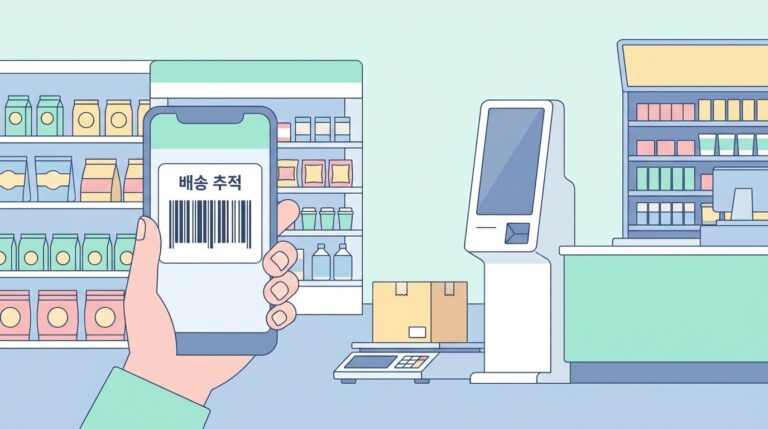
When using the convenience store parcel kiosk (무인택배기), pay attention to store flow. If a line forms behind you, quickly print your pre-registered coupon via the app using a QR code rather than typing your address manually on the screen. Hold the printed receipt (운송장) with both hands when handing it over to the clerk, pointing the barcode directly toward their scanner for maximum efficiency.
4-2. Cultural Code Analysis: The Karrot Market (당근마켓) Phenomenon
‘Half-Price Parcel’ (반값택배) exploded due to Korea’s hyper-local secondhand trade boom. Because meeting face-to-face (직거래) isn’t always convenient, Koreans turned convenience stores into decentralized neighborhood logistics hubs. It costs around 1,800 KRW to 2,600 KRW, operating 365 days a year without Sunday breaks because it uses retail supply chain logistics!
Phase 5: Real-World Roleplay Scenario
- Setting: A busy GS25 near Gangnam Station during evening rush hour.
- Characters: You (Advanced Learner), NPC Min-ho (Convenience Store Clerk)
-
Dialog:
- You: 저기요, 혹시 사전 접수한 반값택배 바코드 출력 어디서 하나요? (Excuse me, where do I print the barcode for a pre-registered half-price parcel?)
- Min-ho:
🎭 Points with a scanner at the terminal아, 저기 저울 달린 키오스크에서 휴대폰 번호 입력하시면 됩니다! (Ah, you can enter your phone number on that kiosk with the scale over there!) - You:
🎭 Weighing the box on the scale무게 재고 나니까 예약 내역이 떴네요. (The reservation popped up after weighing it.) - Min-ho: 네, 송장 출력 누르시고 왼쪽 부분은 상자에 붙이신 뒤 오른쪽 접수표 가져오세요. (Yes, press print waybill, stick the left portion onto the box, and bring the right receipt to me.)
- You:
🎭 Handing the receipt over with both hands여기 있습니다. 선불 결제 맞죠? (Here it is. It’s prepaid payment, right?) - Min-ho:
🎭 Scans the barcode smoothly네, 1,800원입니다. 포장은 규격 박스로 잘 하셨네요! (Yes, 1,800 KRW. You packaged it well in a standard box!) - You: 혹시 수령인한테 알림톡은 자동으로 가나요? (By any chance, does a notification message automatically go to the receiver?)
- Min-ho: 그럼요! 점포 도착하면 바로 알림 갑니다. 옆 수거함에 상자 넣어주세요! (Of course! As soon as it arrives at the store, they get notified. Place the box in the collection bin next to you!)
🔀 Interactive Branching Point
The clerk tells you your parcel is over 5kg, which exceeds the half-price parcel limit! How do you respond?
- Option A: “아 그럼 그냥 일반택배로 변경해서 접수해 주세요.” (Ah, then please change it to regular domestic courier service.)
- Option B: “왜 안 돼요? 그냥 좀 보내주세요!” (Why not? Just send it anyway!)
- Option C: “무게를 좀 줄여서 다시 올게요!” (I will reduce the weight and come back!)
Feedback:
* Option A (BEST): Smooth, pragmatic, and displays flawless C2 adaptability. Switching to 일반택배 immediately resolves the issue.
* Option B (RISK): Too blunt and violates store weight restriction compliance. Kiosks will auto-reject over-weight limits.
* Option C (GOOD): Reasonable if you want to save money, though requires repacking.
Phase 6: 10-Second Emotion Shadowing Drill
[😊 Polished & Confident]
앱으로 / 미리 / 사전 접수하고 / 왔는데요 / 바코드만 / 스캔하면 / 될까요?
(Aeb-eu-ro / mi-ri / sa-jeon jeob-su-ha-go / wat-neun-de-yo / ba-co-deu-man / seu-kaen-ha-myeon / doel-kka-yo?)-
[🤔 Courteous Query]
혹시 / 점포명을 / 잘못 입력했는데 / 현장에서 / 수정이 / 가능한가요?
(Hok-si / jeom-po-myeong-eul / jal-mot im-ryeok-haet-neun-de / hyeon-jang-e-seo / su-jeong-i / ga-neung-han-ga-yo?)
Phase 7: K-Culture Mini Dictionary
- 반값택배 (Ban-gat-taek-bae) | Half-Price Parcel | GS25’s proprietary logistics network using internal retail delivery trucks to offer ultra-cheap rates.
- 알뜰택배 (Al-tteul-taek-bae) | Thrifty Parcel | CU’s equivalent half-price store-to-store delivery system.
- 운송장 (Un-song-jang) | Waybill / Shipping Label | The physical sticker generated by the kiosk containing barcodes and tracking codes.
- 사전 접수 (Sa-jeon Jeob-su) | Pre-Registration | Filling out address and phone numbers beforehand on the mobile app (GS25 Post / CU Post) to save time at the physical store.
Phase 8: Traveler’s Survival Kit
Survival Expressions TOP 3
- 바코드 스캔 좀 부탁드릴게요. (Please scan this barcode.)
- 점포 보관 기간이 며칠인가요? (How many days will the store hold the package?)
- 택배 수거함이 어디에 있나요? (Where is the parcel drop-off bin?)
Editor’s Travel Note
Make sure to download GS25 나만의냉장고 및 GS Postbox 앱 or CU 포켓CU 앱. Pre-registering your shipment gives you discount coupons (할인쿠폰) worth 100~200 KRW every single time!
Phase 9: A Step Deeper (Reflection)
Korea’s delivery culture isn’t just about speed; it’s an evolving mirror of societal trust and space optimization. Convenience stores have transitioned from mere snack corners into neighborhood utility hubs providing banking, eco-friendly logistics, and second-hand commerce connectivity. By learning 반값택배, you aren’t just learning language—you are participating in Korea’s hyper-connected daily eco-system.
💬 Your Turn: Have you ever used a micro-logistics service in your home country? How does it compare to Korea’s convenience store system? Leave your thoughts in the comments below!
Phase 10: FAQ & Common Mistakes
Q: Can I ship perishable food items via 반값택배?
A: No. Perishables, liquids, precious metals, and items valued over 500,000 KRW are strictly prohibited due to potential transit delays.
Q: How long does half-price parcel delivery take?
A: Typically 2 to 4 days, including weekends and public holidays, since convenience store supply trucks run daily.
Q: What happens if the recipient doesn’t pick up the item?
A: If unclaimed after 4 days of arrival, the package is automatically returned to the sender’s home address, and return shipping fees apply!
🚨 Common Mistakes TOP 3
- Mistake: Writing the recipient’s home address for 반값택배.
- Correct Action: You must select and input the exact convenience store branch name (점포명).
- Mistake: Using paper bags or loose plastic wrapping.
- Correct Action: Items must be packed inside a sturdy cardboard box or thick padded envelope sealed with tape.
- Mistake: Exceeding 5kg or total dimensions (length+width+height) over 80cm.
- Correct Action: Ensure your box fits within the standard weight and size parameters before taking it to the store.
Phase 11: Action Mission
- Bronze: Open your phone and search for your nearest convenience store branch name in Korean (e.g., GS25 강남플래그십점).
- Silver: Download the GS Postbox or CU Post app and practice navigating the 사전 접수 (Pre-registration) menu.
- Gold: Visit a store, drop off a small box to a friend using 반값택배, and send them the tracking receipt screenshot!
🎮 K-Culture Mission: Watch a modern Korean lifestyle vlog on YouTube and comment below when you spot someone using a convenience store parcel machine!
Phase 12: Interactive Quiz Challenge
- Situation Quiz: Which of the following is correct regarding 반값택배?
- A) Deliveries are made to the recipient’s doorstep.
- B) Deliveries are picked up at a designated convenience store branch.
- C) Deliveries stop operating on Sundays.
- Fill in the blank: 택배 상자에 붙이는 바코드가 적힌 종이를 ( _____ )(이)라고 합니다.
- Hints: 운송장 / 상품권 / 영수증
- True / False: You can send packages weighing over 10kg using 반값택배.
- (True / False)
🔍 Click to view Quiz Answers & Explanations
- Answer: B (It is a store-to-store service picked up at the branch).
- Answer: 운송장 (Waybill / Shipping Label).
- Answer: False (The limit is strictly 5kg or less).







