

Phase 1: 공감 (Empathy Opening)
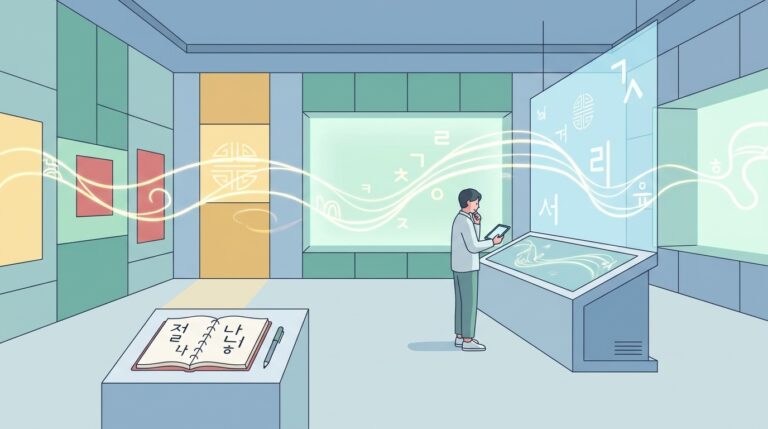
안녕하세요! Welcome back to Daily Hangul, your friendly neighborhood Korean culture navigator! Have you ever walked into a stunning contemporary gallery like the Leeum Museum or MMCA Seoul, stood before a massive interactive installation art or glowing media art piece, and felt a sudden wave of hesitation? You want to share your deep, nuanced thoughts about the artwork’s spatial presence or technological metaphor with a friend or a local docent, but the words get stuck in your throat. Textbook phrases like “이 미술품은 아름답습니다” (This artwork is beautiful) just don’t capture the immersive experience of C1-level artistic dialogue.
Don’t worry! Talking about contemporary installation art and media art in Korean doesn’t require an art history degree, but it does demand sophisticated nuances. Today, based on feedback from advanced learners who felt lost during Seoul Biennale visits, we’re diving deep into the vocabulary and expressions that will make you sound like a true Korean art insider!
Phase 2: 핵심 표현 3선 심층 분석 (Core Expressions)
1. 공간을 압도하다 (Gong-gan-eul ap-do-ha-da)
- Pronunciation: [Gong-gan-eul ap-do-ha-da] (Think of gong like a brass gong, and ap-do sounding like “up-door” with a crisp impact)
- Meaning: Literal: To overwhelm the space. / Nuance: To hold immense spatial presence; an installation that visually and emotionally dominates the gallery environment.
- K-Culture Moment: Seen frequently in art reviews of grand installation works at Leeum Museum of Art.
- Editor’s Insight: Use this when a large-scale installation work completely commands your attention the moment you enter the room.
- Situation Spectrum: Casual ✅ | Semi-formal ✅ | Formal ✅
- 🤔 Think About It: How does your native language describe an artwork’s physical presence compared to Korean’s dynamic verb ‘압도하다’ (overwhelm)?
2. 몰입감을 선사하다 (Mol-ip-gam-eul seon-sa-ha-da)
- Pronunciation: [Mol-ip-gam-eul seon-sa-ha-da] (Mol-ip rhymes with ‘mole-leap’, seon-sa like ‘sun-saw’)
- Meaning: Literal: To present a feeling of immersion. / Nuance: To provide a deeply engaging, immersive sensory experience (especially in media art).
- K-Culture Moment: Commonly used when describing digital projections or VR exhibitions like Arte Museum Jeju.
- Editor’s Insight: While ‘재미있다’ (is fun) is basic, ‘몰입감을 선사하다’ elevates your speech to a refined, analytical tone.
- Situation Spectrum: Casual ⚠️ | Semi-formal ✅ | Formal ✅
- 🤔 Think About It: In Korean, experiences are often framed as gifts (‘선사하다’ = to present/gift). What does this say about Korean hospitality in culture?
3. 여운이 남다 (Yeo-un-i nam-da)
- Pronunciation: [Yeo-un-i nam-da] (Yeo-un sounds like ‘yeo-soon’ without the ‘s’, nam-da like ‘nam-dah’)
- Meaning: Literal: A lingering impression remains. / Nuance: To leave a profound, haunting, or thoughtful aftertaste/afterglow long after viewing an exhibition.
- K-Culture Moment: Frequently used by cinema and art critics on Korean talk shows like Yoo Quiz on the Block.
- Editor’s Insight: Perfect for wrapping up your thoughts when an exhibition makes you think deeply even after leaving the venue.
- Situation Spectrum: Casual ✅ | Semi-formal ✅ | Formal ✅
- 🤔 Think About It: ‘여운’ originates from Eastern artistic philosophy regarding subtle echoes and empty spaces. How does this compare to Western aesthetic terms?
Phase 3: 교과서 한국어 vs 진짜 한국어 (Textbook vs. Real Native)
Situation 1: Expressing that a media art exhibition was very impressive.
- 📖 교과서 한국어: 이 미디어 아트는 정말 인상적이고 재미있었습니다. (This media art was really impressive and fun.)
- 🗣️ 진짜 한국어: 시각적인 자극을 넘어서 공간 전체가 주는 몰입감이 상당하네요. (Beyond visual stimulation, the immersion given by the entire space is quite remarkable.)
- 💡 왜 다를까?: C1 Korean moves beyond basic emotional adjectives toward descriptive nouns and nuanced evaluation verbs.
Situation 2: Commenting on an interactive installation.
- 📖 교과서 한국어: 사람이 움직이면 작품도 바뀌어서 신기해요. (It’s amazing because the art changes when people move.)
- 🗣️ 진짜 한국어: 관객의 참여로 완성되는 상호작용성이 돋보이는 작품이에요. (It’s a piece where the interactivity, completed by audience participation, truly stands out.)
- 💡 왜 다를까?: Native speakers discussing contemporary art prefer professional terms like ‘상호작용성’ (interactivity) and ‘돋보이다’ (stand out).
Phase 4: K-Culture 딥다이브 & 비언어적 매너 (Culture Deep-Dive)
4-1. Gallery Etiquette & Nunchi (눈치)
When discussing art in Korean galleries, maintain a low, respectful vocal tone (소곤소곤). When pointing at an installation element, avoid using a single finger; instead, use an open palm directed toward the artwork to show respect both to the docent and surrounding visitors.
4-2. Cultural Code: Media Art Boom in Korea
Korea has embraced digital media art at the intersection of tech and aesthetics. From digital light art exhibitions in Jeju to high-tech installations in Seoul’s Seongsu-dong, art is viewed as an interactive space rather than a static frame. Showing appreciation for technological integration (‘기술과 예술의 융합’) is key to joining local art conversations.
Phase 5: 실전 롤플레이 시나리오 (Roleplay Scenario)
Setting: A sleek contemporary art museum in Seoul. You are discussing an immersive projection gallery with Min-jun, a local gallery docent.
- Min-jun: 고객님, 이번 미디어 아트 전시는 어떻게 관람하셨나요? (How did you enjoy this media art exhibition?)
- Learner (You): 🎭 [감탄하는 표정으로] 빛과 소리가 공간을 완전히 압도하는 느낌이었어요. (It felt like light and sound completely overwhelmed the space.)
- Min-jun: 아, 공간감을 깊이 느끼셨군요! 기술적인 요소는 어떠셨나요? (Ah, you deeply felt the spatial sense! How did you find the technical elements?)
- Learner (You): 🎭 [진지하게 고개를 끄덕이며] 기술과 예술의 경계를 허물며 엄청난 몰입감을 선사하더군요. (It destroyed the boundaries between technology and art, offering incredible immersion.)
- Min-jun: 정확한 관전 포인트입니다. 특히 마지막 관객 반응형 설치 미술이 인기가 많습니다. (That’s a precise takeaway. The last interactive installation is especially popular.)
- Learner (You): 🎭 [미소를 지으며] 맞아요. 관객이 참여할 때 비로소 작품이 완성되는 점이 인상적이었어요. (Right. I was impressed that the artwork is truly completed when the audience participates.)
- Min-jun: 오늘 전시가 좋은 기억으로 남길 바랍니다. (I hope today’s exhibition remains a fond memory.)
- Learner (You): 🎭 [잔잔한 목소리로] 네, 전시장을 나선 후에도 긴 여운이 남을 것 같아요. (Yes, I think a long-lasting impression will remain even after leaving the gallery.)
🔀 Interactive Choice Point
Min-jun asks: “다음 주에 시작하는 현대 미술 파빌리온 전도 추천해 드릴까요?” (Shall I recommend the contemporary art pavilion exhibition starting next week?)
* Choice A: 네, 이번 전시에서 깊은 인상을 받아서 다음 전시도 너무 기대돼요! (Best Response – Enthusiastic & Natural)
* Choice B: 아니요, 바빠서 못 가요. (Bad Response – Too abrupt/blunt)
* Choice C: 글쎄요, 가격이 싸면 갈게요. (Risk Response – Focuses awkwardly on price in an art context)
Phase 6: 10초 감정 섀도잉 드릴 (Emotional Shadowing Drill)
[😲 Deeply Awed]빛과 소리가 / 공간을 완전히 / 압도하는 느낌이었어요. (Bit-gwa so-ri-ga / gong-gan-eul wan-jeon-hi / ap-do-ha-neun neuk-kim-i-eo-sseyo.)[✨ Mesmerized]기술과 예술의 / 경계를 허물며 / 엄청난 몰입감을 / 선사하더군요. (Gi-sul-gwa ye-sul-ui / gyeong-gye-reul heo-mul-myeo / eom-cheong-nan mol-ip-gam-eul / seon-sa-ha-deo-gun-yo.)[😌 Soft & Thoughtful]전시장을 나선 후에도 / 긴 여운이 / 남을 것 같아요. (Jeon-si-jang-eul na-seon hue-do / gin yeo-un-i / na-meul geot ga-ta-yo.)
Phase 7: K-Culture 미니 사전 (Mini Dictionary)
- 설치 미술 (Seol-chi Mi-sul) | Installation Art | Artworks arranged in a specific space to transform perception.
- 상호작용성 (Sang-ho-jak-yong-seong) | Interactivity | The quality of allowing two-way interaction between artwork and viewer.
- 공간감 (Gong-gan-gam) | Sense of Space | The impression or feeling created by dimensions and volume within an art venue.
- 시공간을 초월하다 (Si-gong-gan-eul Cho-wol-ha-da) | Transcend Time & Space | Expressing art that feels timeless or takes the viewer to another realm.
Phase 8: 여행자를 위한 생존 키트 (Traveler’s Survival Kit)
Top 3 Expressions
- 오디오 가이드 있나요? (Oh-di-oh ga-i-deu it-na-yo?) – Do you have an audio guide?
- 플래시 없이 촬영 가능한가요? (Peul-lae-si eob-si chwal-yeong gan-eung-han-ga-yo?) – Can I take photos without flash?
- 도슨트 투어 시간 알려주세요. (Do-seun-teu tu-eo si-gan al-ryeo-ju-se-yo.) – Please let me know the docent tour schedule.
Editor’s Travel Note
When visiting top galleries in Seoul (like Leeum, MMCA, or SeMA), use the 네이버 지도 앱 다운로드 to check current exhibition schedules and pre-book ticket reservations to avoid long queues.
Phase 9:
Frequently Asked Questions (FAQ)
Q: What does "공간을 압도하다 (Gong-gan-eul ap-do-ha-da)" mean in Korean and how do you pronounce it?
A: In Korean, "공간을 압도하다 (Gong-gan-eul ap-do-ha-da)" is pronounced [Gong-gan-eul ap-do-ha-da] and means: Literal: To overwhelm the space. / Nuance: To hold immense spatial presence; an installation that visually and emotionally dominates the gallery environment.
Q: What does "몰입감을 선사하다 (Mol-ip-gam-eul seon-sa-ha-da)" mean in Korean and how do you pronounce it?
A: In Korean, "몰입감을 선사하다 (Mol-ip-gam-eul seon-sa-ha-da)" is pronounced [Mol-ip-gam-eul seon-sa-ha-da] and means: Literal: To present a feeling of immersion. / Nuance: To provide a deeply engaging, immersive sensory experience (especially in media art).
Q: What does "여운이 남다 (Yeo-un-i nam-da)" mean in Korean and how do you pronounce it?
A: In Korean, "여운이 남다 (Yeo-un-i nam-da)" is pronounced [Yeo-un-i nam-da] and means: Literal: A lingering impression remains. / Nuance: To leave a profound, haunting, or thoughtful aftertaste/afterglow long after viewing an exhibition.







