

Phase 1: Empathy & Storytelling
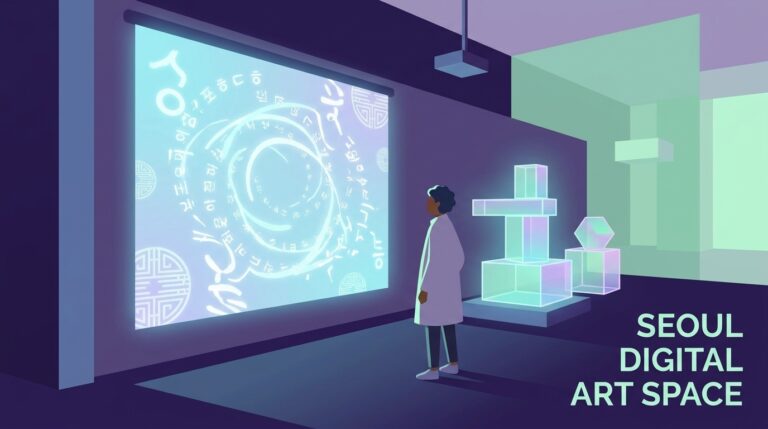
안녕하세요! Editor here from Daily Hangul! Imagine standing inside a dimly lit, high-ceiling gallery in Seoul’s trendy Seongsu-dong or Samcheong-dong. Around you, LED projections pulse with cosmic light, and immersive ambient sounds fill the air. You’re experiencing cutting-edge Korean installation and media art! But as your Korean friends animatedly debate the artistic philosophy behind the multi-sensory space, you suddenly feel stuck. How do you articulate complex thoughts like “the boundary between the digital world and reality feels blurred” or “this interactive installation really evokes a sense of nostalgia” without falling back on basic phrases like “이거 예뻐요” (This is pretty)?
Don’t worry—you are not alone. Transitioning from intermediate conversational Korean to C1-level artistic and critical critique is one of the most common hurdles our advanced learners face. Discussing abstract media art requires nuanced vocabulary, passive construction, and culturally grounded metaphors. Based on real feedback from advanced learners attending art fairs like Frieze Seoul and Kiaf, this guide will equip you with sophisticated, natural Korean expressions to effortlessly converse about contemporary art, media installations, and spatial aesthetics. Let’s elevate your Korean art dialogue together!
Phase 2: Key Expressions Deep Dive
1. 경계가 허물어지는 느낌이 들어요 (Gyeonggyega heomureojineun neokkimi deureoyo)
- Pronunciation: [Gyeong-gye-ga heo-mureo-ji-neun neo-kkim-i deu-reo-yo] (Think of ‘heo-mureo’ like the sound of a crumbling soft wave)
- Meaning: “It feels like the boundaries are being dissolved / blurred.”
- K-Culture Moment: Used frequently when discussing immersive media art (미디어 아트) where light projections eliminate physical room walls, blending the spectator with the artwork.
- Editor’s Insight: ‘허물어지다’ literally means to collapse or break down (like a wall). Using this verb instead of the plain ‘없어지다’ (disappear) showcases C1-level literary sophistication, expressing an organic blending of space or concepts.
- Situation Spectrum: Casual: ⚠️ | Semi-formal: ✅ | Formal: ✅
- 🤔 Think About It: How does your native language describe the blending of abstract concepts compared to Korean’s spatial metaphor of “walls collapsing”?
2. 공간감이 압도적이네요 (Gonggangami apdojeogineyo)
- Pronunciation: [Gong-gan-gam-i ap-do-jeok-i-ne-yo] (‘Ap-do’ rolls off the tongue with strong emphasis, mimicking overwhelming impact)
- Meaning: “The sense of spatial scale/volume is overwhelming.”
- K-Culture Moment: Commonly uttered at massive site-specific installation works (설치 미술) in museum spaces like MMCA (국립현대미술관) or DDP (동대문디자인플라자).
- Editor’s Insight: ‘공간감’ (sense of space) combined with ‘압도적이다’ (overwhelming) allows you to praise the architectural scale and atmosphere without resorting to generic adjectives like ‘크다’ (big) or ‘멋지다’ (cool).
- Situation Spectrum: Casual: ⚠️ | Semi-formal: ✅ | Formal: ✅
- 🤔 Think About It: Why do Koreans place so much importance on the suffix ‘-감’ (sense/feeling) in aesthetic appreciations like ‘공간감’, ‘몰입감’, and ‘계절감’?
3. 관객의 참여로 작품이 완성되네요 (Gwangaegi chamyeoro jakpumi wanseongdoeneyo)
- Pronunciation: [Gwan-gae-gi cha-myeo-ro jak-pu-mi wan-seong-doe-ne-yo]
- Meaning: “The artwork becomes complete through the audience’s participation.”
- K-Culture Moment: Said when interacting with sensor-driven or responsive digital media installations where human movement alters the visuals or sounds.
- Editor’s Insight: This sentence highlights the interactive nature (상호작용성) of contemporary art. Using the passive form ‘완성되다’ (to be completed) underscores the philosophical concept that art is an ongoing process dependent on human presence.
- Situation Spectrum: Casual: ⚠️ | Semi-formal: ✅ | Formal: ✅
- 🤔 Think About It: How does shifting the focus from the artist (‘작가가 완성하다’) to the audience (‘관객의 참여로 완성되다’) reflect modern audience-centered art appreciation?
Phase 3: Textbook Korean vs. Real Korean
Situation 1: Expressing deep immersion in a media art projection
- 📖 Textbook: 이 영상은 매우 재미있어서 집중이 잘 됩니다. (This video is very interesting so I can focus well.)
- 🗣️ Real Korean: 몰입감이 정말 대단해서 작품 속에 들어와 있는 것 같아요. (The sense of immersion is so intense, it feels like I’m standing inside the artwork itself.)
- 💡 Why the difference? Advanced native speakers use conceptual words like ‘몰입감’ (immersion) and metaphorical expressions like ‘작품 속에 들어와 있다’ to describe aesthetic engagement.
Situation 2: Expressing that an installation feels confusing yet intriguing
- 📖 Textbook: 이 설치 미술은 이해하기 어렵지만 좋습니다. (This installation art is difficult to understand but good.)
- 🗣️ Real Korean: 난해하긴 한데, 여운이 길게 남는 작품이네요. (It’s somewhat arcane/complex, but it leaves a long-lasting lingering impression.)
- 💡 Why the difference? C1 speakers replace basic ‘어렵다’ with ‘난해하다’ (complex/arcane) and ‘좋다’ with ‘여운이 남다’ (leaves an echo/lingering aftertaste), showing subtle analytical depth.
Phase 4: K-Culture Deep Dive & Non-verbal Manners
4-1. Nunchi & Gallery Etiquette (눈치와 전시 관람 매너)
When viewing media art and physical installations in Korea, maintaining Nunchi (cultural empathy and awareness) is key:
1. Silent Observation & Spatial Courtesy: Media art exhibits are often dark. Avoid using flash photography, and be mindful of your shadow blocking the projector lines for others.
2. Whispered Critique: When expressing awe, Koreans lower their tone and use soft nodding gestures. Saying “와, 공간감이…” while slightly stepping back signals deep appreciation.
4-2. Cultural Code: The Rise of Immersive Spaces in Korea
Korea has embraced digital media art faster than almost anywhere else, blending tech giants’ visual displays with artistic narrative (e.g., Arte Museum, Bunker des Lumières in Jeju, or Seongsu pop-up installations). Contemporary Korean art often explores themes of rapid urbanization, digital connection versus isolation, and blending traditional motifs (like Hanbok patterns or nature) with laser and AI technology.
Phase 5: Interactive Roleplay Scenario
Setting: An ultra-modern gallery night event at Seoul Arts Center. You are conversing with Curator Minji (민지 큐레이터) in front of a giant interactive mirror-light installation.
Characters:
* Minji (큐레이터 민지): An insightful, articulate gallery curator.
* You (학습자): A sophisticated art enthusiast visiting the exhibition.
Dialogue Script
- Minji: 🎭 (밝은 미소로 작품을 가리키며) 이번 설치 작품은 빛과 반사를 활용한 미디어 아트입니다. 어떠신가요?
(This installation work is media art utilizing light and reflection. What are your thoughts?) - You: 🎭 (작품을 조용히 감상한 후 고개를 끄덕이며) 와, 빛의 흐름 때문에 현실과 가상의 경계가 허물어지는 느낌이 들어요.
(Wa, bit-ui heureum ttaemune hyeon-sil-gwa ga-sang-ui gyeong-gye-ga heo-mu-reo-ji-neun neo-kkim-i deu-reo-yo.)
(Wow, because of the flow of light, it feels like the boundaries between reality and virtuality are dissolving.) - Minji: 🎭 (눈을 반짝이며) 정확하게 보셨네요! 작가도 공간의 경계를 허물고 싶어 했어요.
(You noticed precisely! The artist also wanted to dissolve spatial boundaries.) - You: 🎭 (천장을 올려다보며) 특히 넓은 공간을 가득 채운 공간감이 정말 압도적이네요.
(Teuk-hi neol-beun gong-gan-eul ga-deuk chae-un gong-gan-gam-i jeong-mal ap-do-jeok-i-ne-yo.)
(Especially the sense of space filling up this vast room is truly overwhelming.) - Minji: 🎭 (손을 센서 쪽으로 내밀며) 관객이 움직이면 조명의 색도 함께 변한답니다.
(When the audience moves, the colors of the lights change as well.) - You: 🎭 (천천히 손을 흔들어보며) 그렇군요! 결국 관객의 참여로 작품이 완되는 셈이네요.
(Geu-reot-gun-yo! Gyeol-guk gwan-gae-gi cha-myeo-ro jak-pu-mi wan-seong-doe-neun sem-i-ne-yo.)
(I see! So in the end, it means the artwork is completed through audience participation.) - Minji: 🎭 (감탄하며) C1 수준의 깊이 있는 감상평이시네요! 혹시 이 감정적인 느낌을 한 단어로 표현한다면요?
(That is such a deep C1-level review! If you were to express this emotional feeling in one word?) - You: [Choose your reaction below!]
🔀 Interactive Choice Point
- Choice A:
Frequently Asked Questions (FAQ)
Q: What does "경계가 허물어지는 느낌이 들어요 (Gyeonggyega heomureojineun neokkimi deureoyo)" mean in Korean and how do you pronounce it?
A: In Korean, "경계가 허물어지는 느낌이 들어요 (Gyeonggyega heomureojineun neokkimi deureoyo)" is pronounced [Gyeong-gye-ga heo-mureo-ji-neun neo-kkim-i deu-reo-yo] and means: "It feels like the boundaries are being dissolved / blurred."
Q: What does "공간감이 압도적이네요 (Gonggangami apdojeogineyo)" mean in Korean and how do you pronounce it?
A: In Korean, "공간감이 압도적이네요 (Gonggangami apdojeogineyo)" is pronounced [Gong-gan-gam-i ap-do-jeok-i-ne-yo] and means: "The sense of spatial scale/volume is overwhelming."
Q: What does "관객의 참여로 작품이 완성되네요 (Gwangaegi chamyeoro jakpumi wanseongdoeneyo)" mean in Korean and how do you pronounce it?
A: In Korean, "관객의 참여로 작품이 완성되네요 (Gwangaegi chamyeoro jakpumi wanseongdoeneyo)" is pronounced [Gwan-gae-gi cha-myeo-ro jak-pu-mi wan-seong-doe-ne-yo] and means: "The artwork becomes complete through the audience's participation."







