

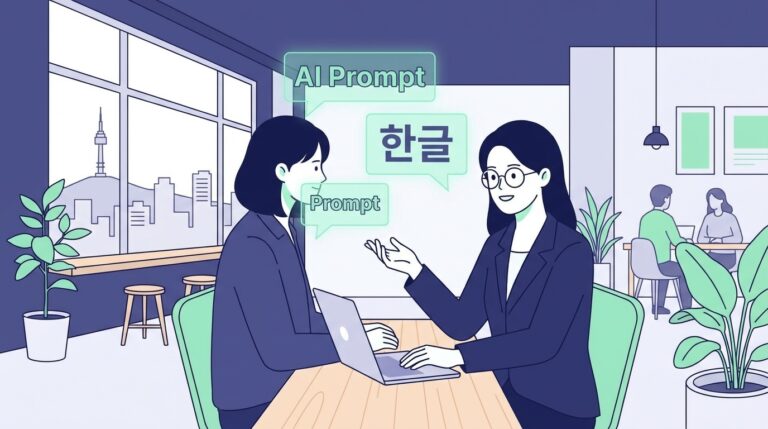
안녕하세요! 매일한글 에디터입니다. Have you ever typed a meticulously structured prompt into ChatGPT in Korean, only to receive a response that feels strangely stiff, overly formal, or completely misses the subtle socio-cultural context of Korean communication? As advanced (C2) learners, you already know the grammar rules, but prompt engineering in Korean demands something deeper: an understanding of linguistic nuances, tone modulation, and register appropriateness. Whether you are generating marketing copy for a Seoul startup, drafting executive emails, or tuning an LLM agent for native-level fluency, this guide will bridge the gap between basic translation and high-level Korean prompt engineering. Based on real-world testing and feedback from tech founders in Gangnam, we are breaking down how to command Generative AI in authentic, nuanced Korean.
1. 문맥을 고려해서 답변해 주세요 (Munmaeg-eul golaehaeseo dadbyeonhae juseyo)
- Pronunciation: [Mun-maeg-eul go-ryeo-hae-seo dap-byeon-hae ju-se-yo] (Sounds like moon-mag-ool go-ryo-hae-so dhab-byon-hae joo-say-yo)
- Meaning: Literal: “Please answer considering the context.” / Real Nuance: “Ensure the generated output reflects the subtle situational background and cultural tone, not just literal word matching.”
- K-Culture Moment: Commonly used in IT scrums or content strategy meetings when instructing an AI or copywriter to adjust tone for corporate vs. casual Gen-Z audiences.
- Editor’s Insight: In Korean, 문맥 (munmaeg) covers far more than textual context; it encapsulates implicit hierarchy, relationships, and unsaid expectations (눈치).
- Situation Spectrum: Casual ⚠️ | Semi-formal ✅ | Formal ✅
- 🤔 Think About It: How does setting contextual boundaries in Korean differ from English, where direct imperatives are more standard?
2. 페르소나를 설정하여 작성해 드립니다 (Pereusona-reul seoljeonghayeo jakseonghae deorimnida)
- Pronunciation: [Pe-reu-so-na-reul seol-jeong-ha-yeo jak-seong-hae deo-rim-ni-da]
- Meaning: Literal: “I will set a persona and write it for you.” / Real Nuance: “Adopting a specific identity/role to tailor the pragmatic tone of the text.”
- K-Culture Moment: Used when setting system prompts for chatbots representing brands—such as a friendly Seongsu-dong barista versus an authoritative tech executive.
- Editor’s Insight: When prompting AI in Korean, defining a persona (페르소나) instantly fixes issues regarding honorific levels (존댓말/반말).
- Situation Spectrum: Casual 🚫 | Semi-formal ✅ | Formal ✅
- 🤔 Think About It: Why is role-definition crucial in a language with multiple politeness levels?
3. 뉘앙스를 정교하게 다듬어 주세요 (Nwiangseu-reul jeonggyohage dadumeo juseyo)
- Pronunciation: [Nwi-ang-seu-reul jeong-gyo-ha-ge da-du-meo ju-se-yo]
- Meaning: Literal: “Please refine the nuance delicately.” / Real Nuance: “Fine-tune the tone to eliminate unnatural robotic phrasing and make it sound natively elegant.”
- K-Culture Moment: Essential when editing AI-generated scripts for K-dramas, webtoons, or corporate PR releases where small shifts in speech endings (~거든, ~잖아요) alter emotional impact.
- Editor’s Insight: High-level Korean relies heavily on sentence-ending particles. Prompting for 뉘앙스 다듬기 tells the AI to pay attention to these subtle pragmatic markers.
- Situation Spectrum: Casual ⚠️ | Semi-formal ✅ | Formal ✅
- 🤔 Think About It: Can AI truly replicate human emotional nuance without explicit human editing?
📖 교과서 한국어: AI에게 “이 글을 번역하고 더 가깝게 만드세요”라고 지시합니다. (Instructing AI: “Translate this text and make it closer.”)
🗣️ 진짜 한국어: “원어민이 자연스럽게 느끼도록 문맥과 어조를 다듬어 주세요.” (“Refine the context and tone so it feels natural to a native speaker.”)
💡 왜 다를까?: Textbook translations often use rigid imperative verbs like 번역하세요. C2 prompt engineers use idiomatic stylistic requests like 어조를 다듬다 (refine the tone) to guide language models toward native stylistic conventions.
📖 교과서 한국어: “챗GPT에게 캐릭터를 주십시오.” (“Give a character to ChatGPT.”)
🗣️ 진짜 한국어: “페르소나를 부여하여 페르소나에 맞는 말투를 구현해 주세요.” (“Assign a persona and implement a speech style that fits that persona.”)
💡 왜 다를까?: Professional tech communication in Korea employs precise terms like 페르소나 부여 (persona assignment) and 말투 구현 (speech pattern implementation) rather than basic verbs.
4-1. 눈치 (Nunchi) & Non-verbal Tech Manners
When prompt engineering in Korean, 눈치 translates into predicting how the recipient will interpret hierarchy and tone. In professional Korean AI workflows, outputs intended for superiors must default to 하십시오체 or polished 해요체, whereas outputs for peers adopt warm, collaborative phrasing. Always verify the pragmatics before deploying automated copy.
4-2. K-Tech Culture Code
Korea’s generative AI ecosystem moves at lightning speed. Platforms like Naver’s HyperCLOVA X emphasize localized linguistic nuances better than global models for culturally dense text. Understanding the interplay between global tools like ChatGPT and local platforms is essential for C2 mastery in the Korean tech sector.
Scenario: You are fine-tuning a prompt with your Korean lead engineer, Min-woo (민우), at a Gangnam tech startup.
- Turn 1 (Min-woo): 🎭 (노트북 화면을 가리키며) 에디터님, 챗GPT가 작성한 이 결과물 어때요? (Pointing at laptop screen: Editor, how does this output generated by ChatGPT look?)
- Turn 2 (You): 🎭 (고개를 갸웃거리며) 의미는 전달되는데, 문맥이 조금 어색하네요. (The meaning gets across, but the context is a bit awkward.)
- Turn 3 (Min-woo): 🎭 (진지하게) 맞아요. 너무 직역한 느낌이 들죠? 어떻게 수정할까요? (Right. It feels too literally translated, doesn’t it? How should we fix it?)
- Turn 4 (You): 🎭 (손가락으로 프롬프트를 짚으며) 프롬프트에 구체적인 페르소나를 부여해 보는 건 어떨까요? (How about assigning a specific persona in the prompt?)
- Turn 5 (Min-woo): 🎭 (호기심 어린 눈빛으로) 아, 페르소나요? 어떤 식으로 지시하면 좋을까요? (Ah, persona? How should we instruct it?)
- Turn 6 (You): 🎭 (자신감 있게) “30대 IT 기획자 페르소나를 설정하고 어조를 다듬어 줘”라고 해보세요. (Try saying “Set a persona of a 30s IT planner and refine the tone.”)
- Turn 7 (Min-woo): 🎭 (키보드를 치며) 와, 문장이 훨씬 매끄러워졌네요! 뉘앙스가 완전 사는데요? (Wow, the sentences became much smoother! The nuance really comes alive!)
- Turn 8 (You): 🎭 (미소를 지으며) 네, 한국어 프롬프트는 어조와 맥락 설정이 핵심이에요. (Yes, tone and context settings are key in Korean prompts.)
🔀 Interactive Choice:
How would you instruct ChatGPT to lower the formality for a marketing post?
* A: “반말을 사용해서 더 재미있게 써 봐.” (“Use informal speech and write it funnier.”)
* B: “20대 타깃에 맞게 친근한 어조와 해요체로 문맥을 다듬어 주세요.” (“Refine the context in a friendly tone and ‘haeyo-che’ suited for a 20s target audience.”)
* C: “존댓말을 모두 삭제하십시오.” (“Delete all honorifics.”)
Feedback:
* Choice A (Risk): Too casual/blunt. AI might generate disrespectful slang.
* Choice B (BEST): Perfect C2 level! Specifies target audience, desired tone, and exact grammatical register (해요체).
* Choice C (Bad): Removing honorifics mechanically often produces grammatically broken text.
Practice these high-level prompt commands out loud with intentional rhythm:
[😊 명확하고 프로페셔널하게]원어민이 읽었을 때 / 자연스럽도록 / 문맥을 다듬어 주세요.
(Won-eo-min-i ilg-eos-eul ttae / ja-yeon-sreu-do-rok / mun-maeg-eul da-du-meo ju-se-yo.)[🤔 신중하고 정교하게]문장의 뉘앙스를 고려하여 / 페르소나에 맞게 / 재작성해 주시겠어요?
(Mun-jang-ui nwi-ang-seu-reul go-ryeo-ha-yeo / pe-reu-so-na-e mat-ge / jae-jak-seong-hae ju-si-ges-eo-yo?)
- 프롬프트 엔지니어링 (Peu-rom-peu-teu En-ji-ni-eo-ring) | Prompt Engineering | The practice of structuring text input for Generative AI to obtain optimal responses.
- 맥락 (Maeg-nag) | Context | The surrounding circumstances or framework that give complete meaning to a statement.
- 페르소나 (Pe-reu-so-na) | Persona | An adopted role or character given to an AI model to dictate its stylistic voice.
- 어조 (Eo-jo) | Tone of voice | The emotional or stylistic quality of written language in Korean pragmatic structure.
- Top 1:
한국어 문맥에 맞게 재작성해 주세요.(Please rewrite this to fit Korean context.) - Top 2:
전문적인 비즈니스 어조로 변경해 주세요.(Please change this to a professional business tone.) - Top 3:
자연스러운 구어체 뉘앙스를 살려 주세요.(Please retain a natural spoken nuance.)
Editor’s Tech Note: When testing prompts live in Korea, explore localized platforms. Check out the 네이버 클로바X 서비스 활용하기 to test localized Korean conversational context against global models.
In Korean culture, communication is rarely purely objective; it is deeply relational. When you engineer prompts in Korean, you are not merely translating code—you are instructing the system how to navigate implicit social hierarchies, warmth, and respect (정 and 눈치). Mastering C2 prompt design means understanding how speech endings reflect respect for the human reader.
💬 Your Turn: What is your favorite Korean phrase to tune ChatGPT’s output? Share your go-to prompt engineering tips in the comments below!
Q: Why does ChatGPT sound so stiff when translated from English to Korean?
A: English-to-Korean direct translations ignore pragmatic speech levels (존댓말) and cultural particles. Explicitly specifying tone parameters like 자연스러운 해요체 fixes this issue.
Q: How do I make AI generate high-level C2 business Korean?
A: Use precise instructions such as 격식 있는 비즈니스 어조로, 보고서 형식에 맞춰 작성해 주세요 (Write in a formal business tone suited for a report format).
Q: Should I write prompts in English or Korean for better output?
A: For simple logic, English prompt framing works well; however, for stylistic nuance, phrasing the prompt directly in nuanced Korean yields significantly better native phrasing.
🚨 Common Mistakes & Correct Actions
- ❌ Mistake: Using generic demands like “make it better” (더 좋게 만들어줘).
- ✅ Correct Action: Use precise linguistic terminology: 문맥과 뉘앙스를 정교하게 다듬어 주세요.
- ❌ Mistake: Forgetting to specify formality levels.
- ✅ Correct Action: Define exact endings (e.g., ~하십시오체로 작성해 주세요).
- ❌ Mistake: Translating idioms literally.
- ✅ Correct Action: Ask AI to replace idioms with 원어민이 자주 쓰는 자연스러운 관용구 (natural native idioms).
- 🥉 Bronze: Write 3 custom system prompts in Korean specifying persona, context, and speech style.
- 🥈 Silver: Test your prompt on ChatGPT and share a screenshot of the before/after response on your social media tagging #DailyHangulAI.
- 🥇 Gold: Draft a complete corporate email or blog post in Korean using solely advanced prompt engineering techniques.
🎮 K-Culture Mission: Watch a scene from a modern workplace K-drama (like Start-Up) and extract 2 professional phrases to feed into your custom AI system prompt!
1. Fill in the blank: “원어민이 자연스럽게 느끼도록 문맥과 ____를 다듬어 주세요.”
(Hint: Tone of voice)
See Answer & Explanation
Answer: 어조 (Eo-jo)
Explanation: 어조 refers to the tone of voice, which is critical for making AI-generated text sound natural to native speakers.
2. True or False: Asking AI to write without specifying honorific levels usually results in perfect professional Korean.
See Answer & Explanation
Answer: False
Explanation: Without specifying honorifics (e.g., 해요체 or 하십시오체), AI often mixes casual and formal endings inconsistently.







