

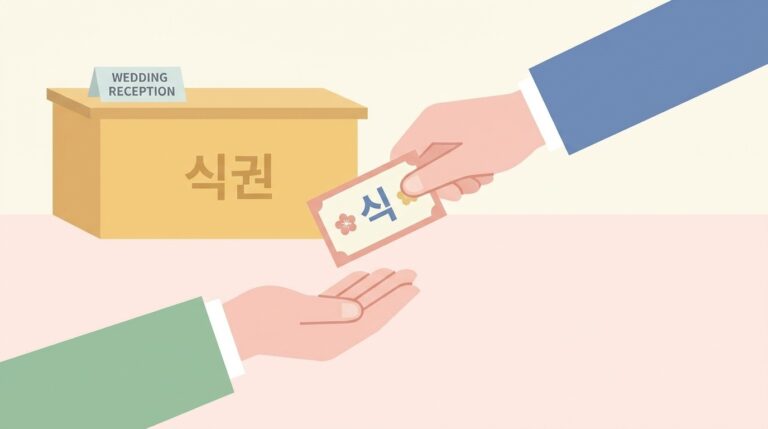
Phase 1: Welcome to Your First Korean Wedding!
안녕하세요! I’m the lead editor at Daily Hangul, your 10-year local culture navigator.
Imagine this: You walk into a stunning wedding hall in Gangnam, Seoul. Soft music plays, gorgeous flower arrangements surround you, and everyone is dressed impeccably. You approach the registration desk holding a crisp white envelope with your congratulations money (축의금, chuk-ui-geum). But suddenly, your heart starts racing! The desk manager hands you a small paper ticket and speaks quickly in Korean. You pause—is this the buffet meal ticket? What do you say back? How do you ask for another ticket if you brought a friend?
Don’t worry at all! Navigating a Korean wedding reception is one of the most exciting cultural experiences you can have. Based on feedback from hundreds of beginner learners who felt nervous at Korean social events, I’ve created this simple, foolproof guide. By the end of this lesson, you’ll comfortably hand over your envelope, ask for your meal ticket in natural Korean, and enjoy a delicious post-wedding buffet like a local!
Phase 2: 3 Essential Expressions for Getting Your Meal Ticket
1. 식권 주세요 (Sik-kwon ju-se-yo)
- Pronunciation: [Sik-kwon joo-seh-yo] (Sounds like “Seek-kwon” + “Juice-eh-yo”)
- Meaning: Direct translation: “Please give me a meal ticket.” / Real nuance: “May I have a meal ticket, please?”
- K-Culture Moment: In popular K-dramas, you often see guests exchanging envelopes at the desk right before asking for their buffet vouchers.
- Editor’s Insight: ‘식’ means meal and ‘권’ means ticket. Adding ‘주세요’ (please give) makes it polite and perfect for beginners!
- Situation Spectrum: Casual 🚫 | Semi-formal ✅ | Formal ✅
- 🤔 Think About It: In your home country, do guests receive physical vouchers for food at weddings, or is seating pre-assigned?
2. 식권 두 장 주세요 (Sik-kwon du jang ju-se-yo)
- Pronunciation: [Sik-kwon doo jahng joo-seh-yo]
- Meaning: Direct translation: “Please give me two meal tickets.” / Real nuance: “Two meal tickets, please!”
- K-Culture Moment: Used when you attend a wedding together with a partner or a friend.
- Editor’s Insight: ‘두’ (du) means two, and ‘장’ (jang) is the counting unit for paper items like tickets or cards.
- Situation Spectrum: Casual 🚫 | Semi-formal ✅ | Formal ✅
- 🤔 Think About It: Korean uses different counter words for paper, bottles, and people. Isn’t that fascinating?
3. 감사합니다 (Gam-sa-ham-ni-da)
- Pronunciation: [Gahm-sah-ham-nee-dah] (Pronounce ‘-ni-‘ like ‘nee’)
- Meaning: Direct translation: “Thank you.” / Real nuance: “Thank you very much.”
- K-Culture Moment: Said with a slight head bow when receiving your meal ticket and greeting the family hosts.
- Editor’s Insight: Always combine this with a warm smile and two hands receiving the ticket!
- Situation Spectrum: Casual ⚠️ | Semi-formal ✅ | Formal ✅
- 🤔 Think About It: Notice how bowing slightly adds respect without needing long, complex sentences!
Phase 3: Textbook Korean vs. Real Korean
Situation 1: Asking for a meal ticket
- 📖 Textbook: 식사권을 받을 수 있습니까? (Sik-sa-kwon-eul ba-deul su it-seum-ni-ka? – May I receive a meal voucher?)
- 🗣️ Real Korean: 식권 주세요~ (Sik-kwon ju-se-yo~ – Meal ticket, please!)
- 💡 Why is it different?: Real wedding desks are busy! Short, polite phrases like “식권 주세요” are clearer and sound much more natural.
Situation 2: Expressing thanks when getting the ticket
- 📖 Textbook: 진심으로 감사드립니다. (Jin-sim-eu-ro gam-sa-deu-rim-ni-da. – I offer my heartfelt thanks.)
- 🗣️ Real Korean: 감사합니다! (Gam-sa-ham-ni-da! – Thank you!)
- 💡 Why is it different?: At the front desk, speed and friendly politeness win over overly formal speeches.
Phase 4: K-Culture Deep Dive & Mannerisms
4-1. Nunchi & Two-Handed Gesture
When handing over your monetary gift envelope (축의금봉투) and receiving your meal ticket (식권):
1. Use two hands (or support your right elbow with your left hand) as a sign of respect.
2. Make gentle eye contact, give a subtle 15-degree bow, and say “감사합니다”.
4-2. Cultural Code: The Wedding Buffet Tradition
In Korea, wedding meals are famous for their lavish buffets (뷔페). The meal ticket serves as access control to the reception hall. Losing your ticket means you might have to ask the desk again, so keep it safe in your pocket or clutch until entering the dining hall!
Phase 5: Interactive Roleplay Scenario
Setting: The reception desk at a modern wedding venue in Seoul.
Characters: You (Guest) and Min-soo (The Groom’s friend handling tickets).
- Turn 1 (Min-soo): 안녕하세요! 축하하러 와주셔서 감사합니다. (Hello! Thank you for coming to congratulate us.)
- Turn 2 (You): 🎭 [Handing envelope with two hands] 축하드려요! 여기 축의금이에요. (Chuk-ha-deu-ryeo-yo! Yeo-gi chuk-ui-geum-i-e-yo. / Congratulations! Here is the gift envelope.)
- Turn 3 (Min-soo): 아, 감사합니다! 방명록도 작성해 주세요. (Ah, thank you! Please sign the guestbook too.)
- Turn 4 (You): 🎭 [Signing the guestbook gently] 네, 작성했어요. (Ne, jak-seong-haess-eo-yo. / Yes, I signed it.)
- Turn 5 (Min-soo): 감사합니다. 식사하고 가실 건가요? (Thank you! Will you stay for the meal?)
- Turn 6 (You): 🎭 [Smiling politely] 네! 식권 두 장 주세요. (Ne! Sik-kwon du jang ju-se-yo. / Yes! Two meal tickets, please.)
- Turn 7 (Min-soo): 🎭 [Handing over two tickets] 네, 여기 식권 두 장 있습니다. 맛있게 드세요! (Sure, here are two meal tickets. Enjoy your meal!)
- Turn 8 (You): 🎭 [Bowing slightly with two hands receiving tickets] 감사합니다! (Gam-sa-ham-ni-da! / Thank you!)
🔀 Interactive Choice Point
What would you do if Min-soo accidentally gave you only 1 ticket when you arrived with your friend?
* Option A: Say nothing, walk away, and try to share 1 ticket.
* Option B: Politeness boost: Say “저기요, 한 장 더 주세요!” (Excuse me, one more ticket please!)
* Option C: Grab a ticket off the counter yourself without asking.
Feedback:
* Option A (Risk): You won’t be able to enter the buffet together!
* Option B (BEST ⭐): Perfect! “한 장 더 주세요” (Han jang deo ju-se-yo) is polite, natural, and clear.
* Option C (Bad): This violates venue rules and creates confusion at the desk.
Phase 6: 10-Second Emotion Shadowing Drill
Practice these lines with rhythm and emotion!
[😊 Warm & Respectful]축하드려요 / 여기 축의금이에요!
(Chuk-ha-deu-ryeo-yo / yeo-gi chuk-ui-geum-i-e-yo!)[😄 Bright & Friendly]식권 / 두 장 주세요~
(Sik-kwon / du jang ju-se-yo~)[🙏 Polite & Grateful]감사합니다 / 잘 먹겠습니다!
(Gam-sa-ham-ni-da / jal meok-get-seum-ni-da!)
Phase 7: K-Culture Mini Dictionary
- 식권 (Sik-kwon) | Meal Voucher | A ticket handed out at weddings or events that grants entry to the dining hall.
- 축의금 (Chuk-ui-geum) | Congratulatory Money | Cash gift placed in a white envelope for weddings or celebrations.
- 방명록 (Bang-myeong-rok) | Guestbook | The registry book you sign at the reception desk upon arrival.
- 피로연 (Pi-ro-yeon) | Wedding Reception | The post-ceremony party where guests enjoy food and social interaction.
Phase 8: Traveler’s Survival Kit
TOP 3 Survival Phrases
- 식권 주세요 (Sik-kwon ju-se-yo) – Meal ticket, please.
- 화장실 어디예요? (Hwa-jang-sil eo-di-ye-yo?) – Where is the restroom?
- 축하해요! (Chuk-ha-hae-yo!) – Congratulations!
Editor’s Travel Note
When traveling to wedding venues across Korea, use reliable navigation tools. Check out the Naver Map app download guide to find wedding halls in Seoul seamlessly without getting lost on subway transfers!
Phase 9: One Step Deeper (Reflection)
In Korean culture, weddings are a communal feast built on mutual reciprocity. The exchange of money and meal tickets isn’t transactional—it’s a warm system of sharing joy and thanking guests for taking time out of their weekend to celebrate love.
💬 Your Turn: Have you ever attended a traditional or modern Korean wedding? What surprised you the most? Share your stories in the comments below!
Phase 10: FAQ & Common Mistakes
Q: Can I get extra meal tickets for family members?
A: Yes! Simply state the number of tickets you need using Korean numbers + 장 (e.g., “식권 세 장 주세요” for 3 tickets).
Q: What if I don’t want to eat at the buffet?
A: You can often exchange your meal ticket for a small thank-you gift (답례품, dap-rye-pum) like wine or tea at a separate counter!
Q: Do children need meal tickets?
A: Venues usually count children above 36 months or school age. Ask the desk politely: “아이 식권도 필요해요?” (A-i sik-kwon-do pil-yo-hae-yo?)
🚨 Common Mistakes TOP 3
- Mistake: Handing money directly without an envelope.
- Correct Action: Put cash inside a plain white envelope and write your name vertically on the back.
- Mistake: Using one hand to receive tickets.
- Correct Action: Receive tickets using both hands with a bow.
- Mistake: Saying informal words like “고마워” to reception staff.
- Correct Action: Stick to polite form “감사합니다”.
Phase 11: Action Missions
- 🥉 Bronze Mission: Speak “식권 주세요” out loud 3 times in front of your mirror.
- 🥈 Silver Mission: Record your voice saying “식권 두 장 주세요” and post it on your Instagram story tagging @DailyHangul.
- 🥇 Gold Mission: Use “주세요” (Ju-se-yo) successfully at a Korean restaurant or grocery store this week!
🎮 K-Culture Mission: Watch a scene from a Korean drama wedding (like Crash Landing on You or Business Proposal) and spot the reception desk with guestbooks and meal tickets!
Phase 12: Interactive Quiz Challenge
Quiz 1: How do you ask for two meal tickets?
Click to view Answer & Explanation
Answer: 식권 두 장 주세요 (Sik-kwon du jang ju-se-yo)
Explanation: ‘두’ means two and ‘장’ is the ticket counter word in Korean!
Quiz 2: True or False – You should hand your gift envelope using only one hand.
Click to view Answer & Explanation
Answer: False!
Explanation: Always hand over gift envelopes and receive meal tickets using two hands as a sign of respect.







