

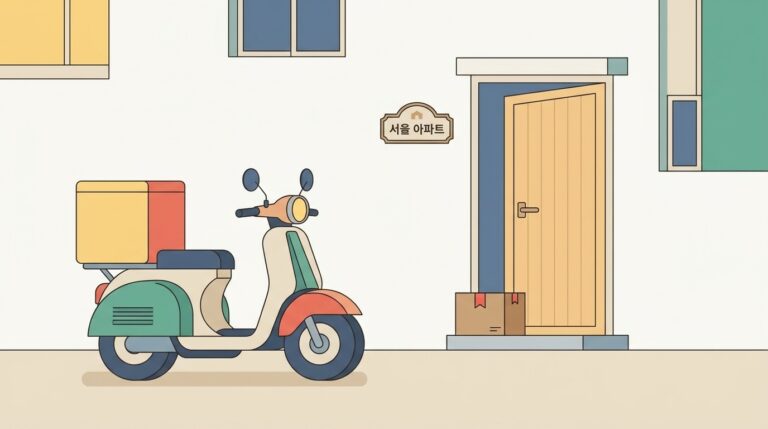
Master Contactless Delivery in Korea: Asking Riders to Leave Food at Your Door
Phase 1: Empathy (스토리 몰입형 오프닝)
안녕하세요! I’m your lead editor at Daily Hangul. Imagine this scenario: It is 11:00 PM in Seoul. You are relaxed in your cozy officetel wearing your comfortable pajamas, binge-watching your favorite K-drama. Your stomach rumbles, so you open a Korean delivery app like Baemin (배달의민족) or Coupang Eats to order crispy, golden fried chicken (치킨). Everything goes smoothly until you reach the checkout screen. The app prompts you for delivery instructions: “어디로 전달해 드릴까요?” (Where should we deliver this?).
You want the rider to leave the food right outside your door and text you without ringing the doorbell, avoiding any awkward late-night interaction or waking up your housemates. However, typing the wrong phrase might cause the driver to stand outside waiting for you to open the door! According to feedback from over 1,000 foreign residents in Korea, navigating delivery app memos is one of the top intermediate communication hurdles. Don’t worry! By mastering a few natural, polite B2-level phrases, you will be ordering late-night snacks like a seasoned Seoul resident.
Phase 2: Core Expressions (핵심 표현 3선 심층 분석)
1. 문 앞에 놓고 연락해 주세요 (Mun ap-e noko yeollak-hae juseyo)
- Pronunciation: [Mun ap-eh noh-ko yeol-lak-hae joo-seh-yo] (Sounds like: “Moon-up-eh no-ko yoll-lak-hay zoo-say-yo”)
- Meaning: Literal: Please put it in front of the door and contact me. / Nuance: “Please leave it at my door and send me a text/call.”
- K-Culture Moment: Commonly seen in slice-of-life K-dramas when introverted main characters avoid face-to-face contact with delivery staff.
- Editor’s Insight: Adding 연락해 주세요 ensures the rider notifies you immediately upon drop-off so your food stays warm.
- Situation Spectrum: Casual ⚠️ | Semi-formal ✅ | Formal ✅
- 🤔 Think About It: Why has high-density apartment living in Seoul made written drop-off memos the national standard for privacy?
2. 벨 누르지 말고 문자로 남겨 주세요 (Bel nureuji malgo munjaro namgyeo juseyo)
- Pronunciation: [Bel noo-reu-ji mal-go mun-ja-ro nam-gyeo joo-seh-yo] (Sounds like: “Bell noo-roo-ji mal-go moon-jah-ro nam-gyuh zoo-say-yo”)
- Meaning: Literal: Don’t press the bell, leave it as a text. / Nuance: “Please don’t ring the doorbell; just text me instead.”
- K-Culture Moment: A must-use phrase for households with sleeping babies or bark-prone pets featured heavily on Korean family YouTube vlogs.
- Editor’s Insight: The intermediate connector -지 말고 (“don’t do X, but do Y”) is extremely useful for redirecting actions politely.
- Situation Spectrum: Casual ⚠️ | Semi-formal ✅ | Formal ✅
- 🤔 Think About It: How does direct text photo proof balance speed and accountability in Korean delivery culture?
3. 경비실에 맡겨 주세요 (Gyeongbisil-e matgyeo juseyo)
- Pronunciation: [Gyeong-bi-sil-e mat-gyeo joo-seh-yo] (Sounds like: “Gyung-bee-seel-eh mat-gyuh zoo-say-yo”)
- Meaning: Literal: Entrust it to the security office, please. / Nuance: “Please leave it with the building security office.”
- K-Culture Moment: Frequently used when residents are away from home during high-value parcel deliveries.
- Editor’s Insight: 맡기다 means “to entrust/leave something under care.” Use this when your apartment door is inaccessible to guests.
- Situation Spectrum: Casual ⚠️ | Semi-formal ✅ | Formal ✅
- 🤔 Think About It: What role do security guards (경비아저씨) play in maintaining safety in Korean residential complexes?
Phase 3: Textbook vs Real Korean (교과서 한국어 vs 진짜 한국어)
Situation 1: Leaving instructions on a delivery app memo
- 📖 Textbook Korean: 배달원님, 물건을 문 앞에 두시고 전화해 주십시오. (Deliverer, please place the item in front of the door and call me.)
- 🗣️ Real Korean: 문 앞에 두시고 문자 주세요! (Please leave it at the door and text me!)
- 💡 Why the difference?: Real app memos prioritize efficiency. Using 주세요 strikes the perfect balance of politeness and speed without sounding stiff like -하십시오.
Situation 2: Asking not to make noise during late hours
- 📖 Textbook Korean: 소음을 내지 마시고 가주시기 바랍니다. (Please do not make noise and leave.)
- 🗣️ Real Korean: 벨X 노크X 문 앞 부탁드려요! (No bell, no knock, front door please!)
- 💡 Why the difference?: Because of character limits and quick scanning by delivery drivers, short symbolic expressions like 벨X (No bell) are widely understood in Korea.
Phase 4: K-Culture Deep Dive & Non-verbal Manners
4-1. Nunchi & Gestures (눈치와 제스처)
If you accidentally open the door right as the delivery driver arrives, don’t awkwardly freeze! Show your Nunchi (cultural etiquette) by giving a slight 15-degree head bow and saying a warm “감사합니다! 수고하세요!” (Gam-sa-ham-ni-da! Su-go-ha-se-yo!). Always use two hands if you happen to take the item directly from the rider.
4-2. Culture Code Analysis
Korea’s delivery phenomenon is powered by Palli-Palli (빨리빨리 – Fast Fast) culture combined with unmatched public safety. Because theft of packages left outside front doors is virtually non-existent in Korea, contactless delivery (비대면 수령) has become the default option on major platforms.
Phase 5: Real Roleplay Scenario (실전 롤플레이 시나리오)
Setting: You ordered late-night food. The delivery rider sends a messenger chat before reaching your floor.
- Rider Kim: 🎭 (Rider arriving in elevator) 손님, 5분 뒤 도착하는데 문 앞에 그냥 둘까요? (Son-nim, 5-bun dwi do-chak-ha-neun-de mun ap-e geu-nyang dul-kka-yo?) — Customer, I arrive in 5 minutes. Should I just leave it at the door?
- You: 🎭 (Typing quickly on phone) 네! 문 앞에 놓아주세요. (Ne! Mun ap-e no-a-ju-se-yo.) — Yes! Please place it in front of the door.
- Rider Kim: 🎭 (Checking delivery note) 벨 누르고 갈까요? (Bel nu-reu-go gal-kka-yo?) — Should I ring the doorbell before leaving?
- You: 🎭 (Replying politely) 아니요, 벨 누르지 말고 문자로 남겨 주세요. (A-ni-yo, bel nu-reu-ji mal-go mun-ja-ro nam-gyeo ju-se-yo.) — No, please don’t ring the bell, just leave a text message.
- Rider Kim: 🎭 (Arriving at door and taking photo) 네, 알겠습니다. 문 앞에 두고 사진 찍어 보낼게요. (Ne, al-get-seum-ni-da. Mun ap-e du-go sa-jin tji-geo bo-nael-ge-yo.) — Okay, understood. I’ll leave it at the door and send a photo.
- You: 🎭 (Grateful) 감사합니다! 안전운전 하세요! (Gam-sa-ham-ni-da! An-jeon-un-jeon ha-se-yo!) — Thank you! Drive safely!
- Rider Kim: 🎭 (Leaving modern apartments) 맛있게 드세요! (Ma-sit-ge deu-se-yo!) — Enjoy your meal!
- You: 🎭 (Opening door after rider departs) 잘 먹겠습니다! (Jal meok-get-seum-ni-da!) — I will eat well!
🔀 Interactive Branching Point
Scenario: What if the rider calls because your apartment main entrance keypad is locked?
* Choice A: “경비실 눌러주세요.” (Ask them to dial security office)
* Choice B: “비밀번호는 1234# 이에요. 문 앞에 놓고 문자 주세요!” (Give entrance PIN & request drop-off)
* Choice C: “지금 내려갈게요!” (Say you’ll go down to meet them)
- Feedback:
- Choice A (Bad): Rider loses time waiting for security to answer.
- Choice B (Best ✅): Efficient, clear, and maintains contactless request!
- Choice C (Risk ⚠️): Defeats the purpose of contactless delivery if you are unprepared.
Phase 6: 10-Second Emotion Shadowing Drill
[😊 Politeness & Clarity]
문 앞에 / 놓고 / 문자 / 주세요!
(Mun ap-e / no-ko / mun-ja / ju-se-yo!)-
[🤫 Quiet & Respectful Request]
벨은 / 누르지 / 마시고 / 문 앞에 / 부탁해요!
(Bel-eun / nu-reu-ji / ma-si-go / mun ap-e / bu-tak-hae-yo!)
Phase 7: K-Culture Mini Dictionary
- 요청사항 (Yo-cheong-sa-hang) | Delivery request/memos field in apps.
- 비대면 수령 (Bi-dae-myeon su-ryeong) | Contactless drop-off/receipt.
- 문앞 배송 (Mun-ap bae-song) | Front-door delivery service.
- 안전운전 (An-jeon-un-jeon) | Safe driving (commonly said to delivery riders as a polite goodbye).
Phase 8: Traveler’s Survival Kit
TOP 3 Survival Phrases
- 문 앞에 두고 가주세요. (Mun ap-e du-go ga-ju-se-yo.) — Please leave it at the door and go.
- 도착하면 문자 부탁드립니다. (Do-chak-ha-myeon mun-ja bu-tak-deu-rim-ni-da.) — Please text me when you arrive.
- 음식 문 앞에 놓아주세요. (Eum-sik mun ap-e no-a-ju-se-yo.) — Please place the food in front of the door.
Editor’s Travel Note
When ordering in Korea, download localized navigation or delivery software via the 배달의민족 앱 다운로드 page. Always keep your full room number written in the delivery detail form!
Phase 9: A Step Deeper (한 발 더 깊이)
Korea’s high level of personal safety allows unattended food drop-offs without fear of theft. However, respect for the rider’s fast-paced schedule is essential. Polite phrasing in your app memo bridges privacy with social courtesy, showcasing your deep understanding of modern Korean etiquette.
💬 Your Turn: Have you ever ordered food in Korea? What delivery memo would you write today? Tell us in the comments below!
Phase 10: FAQ & Common Mistakes
Q: Can I use informal Korean (반말) in delivery app memos?
A: No, delivery memos are read by working adults. Always use -주세요 or polite honorific forms.
Q: What should I do if the delivery rider rings the doorbell anyway?
A: Don’t panic! Simply say “감사합니다, 문 앞에 두세요!” through the intercom.
Q: Is tipping required for contactless delivery in Korea?
A: No, tipping is not part of Korean culture. Delivery fees are included in your payment.
🚨 Common Mistakes TOP 3
- Saying “나한테 줘” (Give it to me) ❌ ➔ Correct Action: Use “문 앞에 놓아주세요.” ✅
- Confusing 문 앞 (Front door) with 문 밖 (Outside main entrance gate) ❌ ➔ Correct Action: Specify your apartment unit number.
- Forgetting to check your phone for photos ❌ ➔ Correct Action: Check your messages right after ordering.
Phase 11: Action Mission & Engagement
- Bronze Mission: Practice saying “문 앞에 놓고 문자 주세요” out loud 3 times.
- Silver Mission: Share this guide on social media tag
@DailyHangulwith your favorite Korean food. - Gold Mission: Use this exact request memo on your next real delivery order in Korea!
🎮 K-Culture Mission: Watch a late-night vlog on YouTube and identify whenever a character says “택배 문 앞에 두세요”!
Phase 12: Interactive Quiz Challenge
Q1. How do you ask a driver NOT to ring the doorbell polite in Korean?
Click to view Answer & Explanation
Answer: 벨 누르지 말고 문자로 남겨 주세요!
Explanation: -지 말고 is used to ask someone not to do an action and suggest an alternative.
Q2. True or False: Tipping delivery riders cash in Korea is customary.
Click to view Answer & Explanation
Answer: False
Explanation: Korea has no tipping culture; all delivery charges are handled via the platform app payment.







