

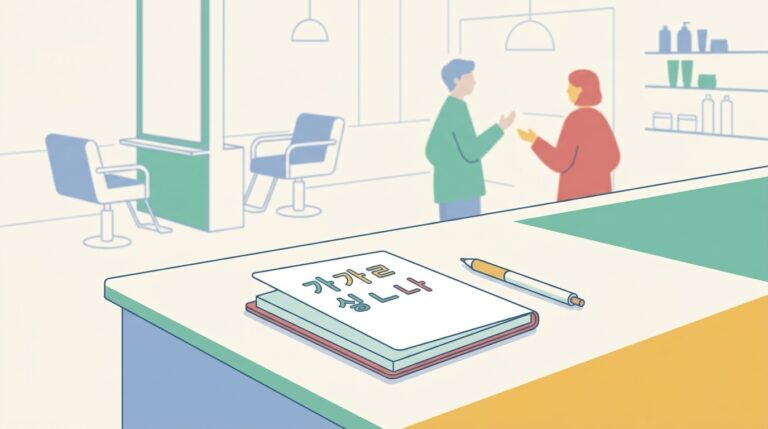
Master Your K-Beauty Hair Salon Visit: How to Express Damaged Hair in Korean
안녕하세요! 매일한글 에디터입니다. (Hello! This is your Daily Hangul Editor.) Have you ever sat in a sleek, aesthetic hair salon in Hongdae or Cheongdam, feeling super excited for a new K-pop inspired makeover, only to freeze when the stylist touches your bleached ends and asks you what you want?
You know your hair has been through a lot—bleaching, perming, daily heat styling—and you desperately want to say, “My hair is so damaged, can you save it without cutting it all off?” But instead, you just smile awkwardly and say, “A little bit cut, please…” and end up with a hair length you didn’t ask for!
Don’t worry, you’re not alone. Many intermediate learners know basic vocabulary like ‘머리’ (hair) and ‘자르다’ (to cut), but struggle with nuanced expressions about hair texture, damage, and treatment options. Today, based on real feedback from K-beauty enthusiasts and learners just like you, we are going to master exact, natural Korean expressions so you can confidently talk about hair damage, negotiate trims, and get that glass-hair clinic treatment at any Korean salon!
Phase 2: Top 3 Core Expressions Deep Dive
1. 머릿결이 많이 상해서 걱정이에요.
- Pronunciation: [Meoritgyeori mani sanghaeseo geokjeong-ieyo] (Sounds like: Muh-reet-gyeol-ee mah-nee sang-hae-suh guhk-jjung-ee-yah-yoh)
- Meaning: Literal: “Because my hair texture is damaged a lot, I’m worried.” / Real Nuance: “I’m really worried because my hair is so damaged.”
- K-Culture Moment: You hear this in every beauty vlog on YouTube! A vlogger sits in the chair, sighs softly while running fingers through their hair, and confides in their favorite stylist.
- Editor’s Insight: ‘머릿결’ specifically refers to hair texture or hair health (literally ‘hair grain/wave’), while ‘상하다’ means to go bad/get damaged. Saying ‘머릿결이 상했다’ sounds much more natural than saying ‘머리가 아파요’ or ‘머리가 나빠요’.
- Situation Spectrum:
- Casual: 머릿결 많이 상해서 걱정이야. (⚠️ Friends/Stylists you are close with)
- Semi-formal: 머릿결이 많이 상해서 걱정이에요. (✅ Standard for salon staff)
- Formal: 머릿결이 많이 상해서 걱정됩니다. (🚫 Too stiff for a hair salon)
- 🤔 Think About It: In English, we often say “My hair is fried/damaged.” In Korean, the word ‘상하다’ is also used for spoiled food (음식이 상했다). Why do you think Koreans use a word associated with decay/spoiling to describe hair health?
2. 머리가 많이 탄 것 같은데, 복구 펌 되나요?
- Pronunciation: [Meoriga mani tan geot gat-eunde, bokgu peom doenayo?]
- Meaning: Literal: “It seems my hair burned a lot, is recovery perm possible?”
- K-Culture Moment: A character in a K-drama enters a high-end salon after a DIY dyeing disaster at home, asking the hair master for a miracle.
- Editor’s Insight: Korean hair salons specialize in ‘복구’ (recovery/restoration) procedures like ‘복구 펌’ (restoration perm) or ‘복구 클리닉’ (restoration clinic). Using ‘탄 것 같다’ (looks burned/crispy) vividly describes hair that has lost all elasticity from excessive heat or chemical processing.
- Situation Spectrum:
- Casual: 머리 많이 탄 것 같은데 복구 펌 돼? (⚠️)
- Semi-formal: 머리가 많이 탄 것 같은데, 복구 펌 되나요? (✅ Recommended)
- Formal: 머리가 많이 탄 것 같은데 복구 펌이 가능합니까? (🚫 Too formal)
- 🤔 Think About It: Koreans tend to use cautious expressions like ‘-것 같다’ (it seems like) even when they know their hair is clearly fried. How does using soft, indirect language affect politeness in Korean culture?
3. 상한 부분만 살짝 다듬어 주세요.
- Pronunciation: [Sanghan bubunman saljjak dadumeo juseyo]
- Meaning: Literal: “Please slightly trim only the damaged parts.”
- K-Culture Moment: When a client wants to maintain their long hair length for a K-pop idol style, but the stylist insists on cutting off split ends.
- Editor’s Insight: The word ‘다듬다’ means to trim/tidy up. Combining it with ‘살짝’ (slightly/a little bit) acts as a safety shield so your stylist won’t chop off 5 inches when you only wanted 1 inch off!
- Situation Spectrum:
- Casual: 상한 데만 살짝 다듬어 줘. (⚠️)
- Semi-formal: 상한 부분만 살짝 다듬어 주세요. (✅ Perfect for your visit)
- Formal: 손상된 부위만 다듬어 주시기 바랍니다. (🚫 Sounds like a formal instruction manual)
- 🤔 Think About It: Notice how adding ‘살짝’ completely changes the tone from a command to a gentle request. What softeners do you use in your language when giving instructions to a service provider?
Phase 3: Textbook Korean vs. Real Korean
Situation 1: Describing bad hair condition
- 📖 Textbook Korean: “제 모발이 심각하게 손상되었습니다.” (My hair fibers have been severely damaged.)
- 🗣️ Real Korean: “제 머릿결 완결 개털 됐어요…” (My hair turned completely into dog hair… / My hair is so fried!)
- 💡 Why the difference? While ‘손상’ is a formal technical term used on product labels, Koreans casually compare extremely damaged, dry hair to coarse dog fur (‘개털’). Using this self-deprecating humor instantly breaks the ice with your hairdresser!
Situation 2: Asking for a hair treatment
- 📖 Textbook Korean: “모발 영양 처치를 받고 싶습니다.” (I would like to receive hair nutritional treatment.)
- 🗣️ Real Korean: “머리에 영양 좀 넣어야 할 것 같아요. 클리닉 추천해 주세요!” (I think my hair needs some nourishment. Please recommend a clinic treatment!)
- 💡 Why the difference? Salons in Korea refer to hair deep-conditioning treatments as ‘클리닉’ (clinic) or adding ‘영양’ (nutrition/nutrients). Phrases like ‘처치’ sound medical and unnatural in a hair salon setting.
Phase 4: K-Culture Deep Dive & Non-Verbal Manners
4-1. Nunchi (눈치) & Gestures
- Gently touching your ends: When expressing concern, hold the ends of your hair with both hands and look down at them with a slight pout. This visually reinforces ‘상한 부분’ (damaged part).
- The ‘Just a Pinch’ Gesture: When saying ‘살짝’ (a little bit), hold your index finger and thumb close together. Korean hair stylists appreciate this visual boundary because “a little bit” means different things to different people!
- Patience during consultation: Korean hairdressers take pride in detailed consultations. Listen attentively, nod gently, and say “아~ 네네” (Ah, yes yes) while they examine your hair strands.
4-2. Culture Code: Korean Hair Salon Culture
In Korea, hair stylists are exceptionally honest about hair health. If your hair is too damaged, a Korean stylist might politely refuse to perm or bleach it, saying “고객님, 이 머리는 펌 하면 다 녹아요” (Customer, if we perm this hair, it will completely melt!).
This isn’t rudeness—it’s K-Beauty professionalism. They prioritize long-term hair integrity over a quick sale. Instead, they will propose alternative options like ‘신데렐라 클리닉’ (Cinderella protein treatment) or ‘복구 매직’ (restoration straightening).
Phase 5: Real-Life Roleplay Scenario
Setting: A stylish K-Beauty Salon in Gangnam. Stylist Min-jun is conducting a pre-service consultation with Sarah, who wants a new style for her trip.
- Turn 1 (Stylist): 안녕하세요! 오늘 어떤 스타일 생각하고 오셨어요?
(An-nyeong-ha-se-yo! O-neul eot-deon seu-ta-il saeng-gak-ha-go o-syeot-seo-yo?)
Hello! What kind of style were you thinking of getting today?
🎭 Action: Smiles warmly while handing over a digital hairstyle lookbook catalog. -
Turn 2 (Sarah): 저 이런 레이어드 컷 하고 싶은데요… 머릿결이 많이 상해서 걱정이에요.
(Jeo i-reon le-i-eo-deu keot ha-go sip-eun-de-yo… meo-rit-gyeo-ri ma-ni sang-hae-seo geok-jeong-i-e-yo.)
I’d like to get a layered cut like this… but I’m really worried because my hair is so damaged.
🎭 Action: Touches split ends with a worried expression. -
Turn 3 (Stylist): 아, 끝쪽이 약간 손상되셨네요. 빗질할 때 많이 걸리시죠?
(A, kkeut-jjog-i yak-gan son-sang-doe-syeot-nae-yo. Bit-jil-hal ttae ma-ni geol-li-si-jyo?)
Ah, the ends are a bit damaged. Does your hairbrush catch a lot when you brush it?
🎭 Action: Gently brushes Sarah’s hair with a wide-tooth comb to check resistance. -
Turn 4 (Sarah): 네, 맞아요! 개털 됐어요… 기장은 유지하고 싶어요.
(Ne, ma-ja-yo! Gae-teol dwaet-seo-yo… Gi-jang-eun yu-ji-ha-go sip-e-yo.)
Yes, exactly! It turned into dog fur… But I want to keep my overall length.
🎭 Action: Laughs self-deprecatingly while pointing to shoulder length. -
Turn 5 (Stylist): 그럼 상한 부분만 살짝 다듬고, 수분 클리닉 같이 진행할까요?
(Geu-reom sang-han bu-bun-man sal-jjak da-deum-go, su-bun kkeul-li-nik ga-chi jin-haeng-hal-kka-yo?)
Then shall we trim just the damaged ends slightly and do a moisture clinic treatment together?
🎭 Action: Shows the difference in length using fingers. -
Turn 6 (Sarah): 좋아요! 자르면 기장이 많이 짧아지나요?
(Jo-a-yo! Ja-reu-myeon gi-jang-i ma-ni jjalb-a-ji-na-yo?)
Sounds good! If you cut it, will the length become much shorter?
🎭 Action: Eyes widen slightly with cute anxiety. -
Turn 7 (Stylist): 걱정 마세요! 1cm 정도만 손질할 거라서 티 거의 안 나요.
(Geok-jeong ma-se-yo! Il-sen-ti jeong-do-man son-jil-hal geo-ra-seo ti geo-ui an na-yo.)
Don’t worry! I’m only trimming about 1cm, so you won’t even notice a loss in length.
🎭 Action: Reassures with a trustworthy smile and an OK hand gesture. -
Turn 8 (Sarah): 아, 다행이다! 그럼 말씀해주신 대로 해주세요.
(A, da-haeng-i-da! Geu-reom mal-sseum-hae-ju-sin dae-ro hae-ju-se-yo.)
Phew, what a relief! Please do it just as you said.
🎭 Action: Relaxes shoulders and nods happily.
🔀 Interactive Branching Points
Situation: The stylist tells you that your hair is too damaged for a perm. What do you reply?
- Option A: “그래요? 그럼 상한 것만 다듬고 클리닉으로 할게요.”
- (Is that so? Then I’ll just trim the damaged parts and do a clinic treatment instead.)
- 👉 Feedback (Best): Fantastic choice! You accepted the professional’s advice gracefully and switched to hair care while maintaining safety.
- Option B: “아니요, 그냥 강제로 펌 해주세요!”
- (No, just force the perm anyway!)
- 👉 Feedback (Risk): Yikes! Using ‘강제로’ (by force) sounds overly harsh, and you risk completely frying your hair into melted straw!
- Option C: “그럼 머리 안 잘라요. 안녕히 계세요.”
- (Then I won’t cut my hair. Goodbye.)
- 👉 Feedback (Bad): Walking out abruptly without exploring care alternatives might leave your hair damaged without solving the problem.
Phase 6: 10-Second Emotion Shadowing Drill
Practice saying these lines with the exact tone and pauses indicated by /!
[🥺 Worry & Anxiety]
머릿결이 / 너무 상해서 / 걱정이에요… / 어떡하죠?
(Meoritgyeori / neomu sanghaeseo / geokjeong-ieyo… / eotteokhajo?)-
[🙏 Desperate Request]
길이는 / 유지해 주시고요, / 상한 부분만 / 살~짝! / 다듬어 주세요.
(Girineun / yujihae jusigoyo, / sanghan bubunman / sal~jjak! / dadumeo juseyo.) -
[😮 Relief & Satisfaction]
와, / 클리닉 받으니까 / 머릿결이 / 완전 비단이 됐어요!
(Wa, / kkeullinig badeunikka / meoritgyeori / wanjeon bidani dwaesseoyo!)
Phase 7: K-Culture Mini Dictionary
- 상하다 (Sang-ha-da) | To be damaged / spoiled
- Used for hair, skin, or food. In beauty context: “머리가 많이 상했어요” (My hair is very damaged).
- 다듬기 (Da-deum-gi) | Trimming / Tidying up
- Essential word when you don’t want a full haircut. “다듬기만 해주세요” (Just a trim, please).
- 클리닉 (Kkeul-li-nik) | Hair Treatment / Deep Conditioning
- Loanword from ‘Clinic’. Refers to deep keratin, moisture, or protein hair salon treatments.
- 기장 (Gi-jang) | Hair Length
- Hair salon-specific vocabulary. Asking “기장은 유지하고 싶어요” means “I want to keep my current length.”
Phase 8: Traveler’s Survival Kit
TOP 3 Survival Phrases
- 머릿결이 많이 상해서 펌은 어려울까요?
(Meoritgyeori mani sanghaeseo peomeun eoryeowulkkayo?)
Is a perm difficult because my hair is too damaged?- 👉 Pro Tip: Ask this beforehand to avoid disappointing results.
- 샴푸할 때 물 온도 괜찮으세요?
(Syampu-hal ttae mul ondo gwaenchanheuseyo?)
Is the water temperature okay during shampooing?- 👉 Pro Tip: The stylist will ask you this! Answer: “네, 딱 좋아요!” (Yes, it’s perfect!)
- 드라이할 때 굵은 컬로 말아주세요.
(Deurai-hal ttae gulgeun keollo mara-juseyo.)
Please style it with loose curls when blow-drying.
Editor’s Travel Note
Before heading out to famous Seoul salons in Sinsa-dong or Hongdae, make sure to use Naver Maps App Download or KakaoMap App Download to search for salons with “외국어 가능” (Foreigner-friendly/English available) tags. You can also book appointments easily through online reservation platforms!
Phase 9: “One Step Deeper” (Cultural Insights)
In Korean culture, hair is historically considered a reflection of bodily wellness and personal self-care (자기관리). Taking care of your hair texture through salon treatments isn’t seen as pampering or vanity; it’s considered standard grooming and respect for oneself. That is why Korean salons focus so heavily on scalp head spas and customized nutrient treatments rather than just cutting styles.
💬 Your Turn: Have you ever experienced hair salon culture shock in Korea or another country? What is the most important sentence you need at a hair salon? Let us know in the comments below!
Phase 10: FAQ & Common Mistakes
Q: What is the difference between ‘자르다’ and ‘다듬다’?
A: ‘자르다’ means to cut/chop hair (can imply a major length change), while ‘다듬다’ specifically means to trim, clean up, or tidy existing ends without drastically changing the overall style.
Q: How do I ask for a treatment without getting a haircut?
A: You can simply say: “오늘 컷 없이 클리닉만 받을게요.” (I’ll just get a clinic treatment today without a haircut.)
Q: Is tipping required at Korean hair salons?
A: No! Tipping is not part of Korean culture. The price listed on the menu or service board includes all service fees and taxes.
🚨 Common Mistakes TOP 3
- Mistake: Saying “머리가 아파요” when trying to say hair is damaged.
- ❌ Why: ‘머리가 아파요’ means “I have a headache!”
- ✅ Correct Action: Say “머릿결이 상했어요” (My hair texture is damaged).
- Mistake: Using “조금 자르다” instead of “다듬다”.
- ❌ Why: Stylists might still take off 2-3 inches.
- ✅ Correct Action: Say “상한 부분만 살짝 다듬어 주세요” (Please trim only damaged parts slightly).
- Mistake: Calling deep conditioning “트리트먼트” during booking.
- ❌ Why: Salons call quick rinse-offs ‘트리트먼트’, but professional leave-in service is called ‘클리닉’.
- ✅ Correct Action: Ask for a ‘클리닉’ or ‘영양’.
Phase 11: Action Mission & Engagement
Action Mission 3 Steps
- 🥉 Bronze: Say “상한 부분만 살짝 다듬어 주세요” 3 times out loud in front of a mirror!
- 🥈 Silver: Record your voice doing Phase 6 Emotion Shadowing and share it with your study group or Instagram story!
- 🥇 Gold: Use these expressions when booking or visiting a K-beauty hair salon in Korea!
🎮 K-Culture Mission
Watch a beauty vlog from your favorite Korean YouTuber (search: 미용실 브이로그 or 머릿결 복구) and drop a comment timestamp when you spot the stylist saying “상했다” or “클리닉”!
Phase 12: Interactive Quiz Challenge
Test your knowledge before your salon trip!
- Situation Judgment: You want to keep your long hair, but split ends are terrible. What should you say?
- A) 머리 완전히 숏컷해 주세요.
- B) 상한 부분만 살짝 다듬어 주세요.
- C) 머리 그냥 깎아 주세요.
- Fill-in-the-Blank:
“머릿결이 많이 ____해서 걱정이에요.” (My hair texture is so damaged that I’m worried.)- Hint: Verb for ‘damaged/spoiled’
- True / False: In Korea, it is customary to tip your hairdresser 15% after receiving a clinic treatment. (T / F)
🔍 Click here to check the Answers & Explanations!
- Answer: B – “상한 부분만 살짝 다듬어 주세요” asks to trim only damaged parts while maintaining length.
- Answer: 상해서 – From the verb ‘상하다’.
- Answer: False – Korea is a zero-tip culture! Pay only the exact amount quoted on the bill.







